NFT

NFTs are unique digital identifiers recorded on a blockchain that certify ownership and authenticity of a specific asset. Moving past the "PFP" craze, 2026 NFTs emphasize utility, representing everything from IP rights and digital fashion to RWA titles and event ticketing. This tag explores the technical standards of digital ownership, the growth of NFT marketplaces, and the integration of non-fungible tech into the broader Creator Economy and enterprise solutions.

13301 Articles
Created: 2026/02/02 18:52
Updated: 2026/02/02 18:52
Near Instant Transfers Now Possible on Ethereum Mainnet

Near Instant Transfers Now Possible on Ethereum Mainnet

The post Near Instant Transfers Now Possible on Ethereum Mainnet appeared on BitcoinEthereumNews.com. Ethereum transactions can now be preconfirmed in just a fraction of a second with new tech from an Ethereum infrastructure platform. Primev says its FAST RPC (Remote Procedure Call) allows transactions to be preconfirmed and set for inclusion in blocks in under 200ms — enabling everything from Ether (ETH) transfers and interacting with smart contracts to minting non-fungible tokens (NFTs) at “blazing speed.” Preconfirmation is an early signal from a block builder indicating a transaction will likely be included in the next block, while block inclusion refers to a transaction being added into a block. RPCs like FAST RPC connect crypto wallets to blockchain nodes, enabling users to send transactions and interact with decentralized applications onchain. From the user’s perspective, 200ms could theoretically rival high-speed layer 1 blockchains like Sui, where transactions are usually confirmed within 200ms. Primev’s founder, Murat Akdeniz, posted a live demonstration to X on Monday, showing a near-instant ETH transfer via Ethereum self-custody wallet MetaMask, which he said was preconfirmed in 377ms and included in the same block. Akdeniz said his team has been working for more than two years to “supercharge Ethereum” to these speeds. Ethereum L1 is painfully slow 😩 Can devs PLEASE fix this?!? For 2+ years, the @primev team has been grinding to supercharge Ethereum mainnet. Today: MILLISECOND preconfirmations… ON L1! 🚀watch me send ETH blazing fast in this 18s vid pic.twitter.com/Diao4VfHzT — Murat | lordofcoins.eth (@MuratLite) October 20, 2025 FAST RPC hasn’t been tested at scale The most widely used RPCs on Ethereum are Infura and Alchemy’s solution, which, while slower than Primev’s FAST RPC, have a much larger node distribution and have been battle-tested under much heavier network loads. More than 400,000 builders leverage the Consensys-built Infura to connect with Ethereum, while Alchemy facilitates more than $150 billion in transactions…

Author: BitcoinEthereumNews
Next Crypto to Explode Bitcoin Hyper ($HYPER) Solves Bitcoin Paradox

Next Crypto to Explode Bitcoin Hyper ($HYPER) Solves Bitcoin Paradox

Bitcoin, the $1.3T foundation of the digital economy, is trapped in a paradox: it is the most secure asset in the world, yet the least functional for modern dApps. That is, until now, thanks to Bitcoin Hyper ($HYPER).

Author: Brave Newcoin
TRUMP memecoin may be doing poorly, but MELANIA is an atrocity

TRUMP memecoin may be doing poorly, but MELANIA is an atrocity

The post TRUMP memecoin may be doing poorly, but MELANIA is an atrocity appeared on BitcoinEthereumNews.com. While it’s fair to say that Donald Trump’s memecoin $TRUMP — down 80% since its launch in January and currently sitting 86% below all-time highs — is doing poorly, it’s worth taking a quick look at the other Trump memecoin: Melania coin. Melania Trump, who launched her own memecoin less than a day after her husband, has seen her token lose an extraordinary 94% since launch and 97.8% off all-time highs. However, the first lady has seen little, if any, blowback for her obvious rug pulls, particularly compared to the criticisms levelled at the president. The Apollo-11 NFTs Melania first dipped her toe in the world of high tech grifting when she announced a now unavailable Apollo-11 NFT collection that didn’t receive approval from NASA. The launch, which was strange considering how little Melania was involved with the United States space program, came after her husband’s first stint as POTUS. NASA has repeatedly forced unauthorized creators and artists to take down images and products that utilize its branding, including Anicorn watches, which hired an artist to create two NFTs that sold for over $40,000 each. Those NFTs no longer appear to exist. The site on which Melania sold her illegal NFTs has pivoted to a more Trump-esque style of grift: gold plated trinkets being offered for way too much money. The Melania Coin scam In January of 2025 Melania decided to launch a memecoin. Read more: Hayden Davis still making millions from LIBRA, MELANIA memecoins According to the Financial Times, it’s possible that the Trumps earned up to $100 million from the sales and transaction fees associated with the token, though putting an exact figure on what the family has been able to extract from its fans is unclear. What is clear is that the memecoin has provided no value,…

Author: BitcoinEthereumNews
Solana Founder: The Visionary Behind Solana’s Rise

Solana Founder: The Visionary Behind Solana’s Rise

Anatoly Yakovenko is the founder and CEO of Solana, a blockchain platform known for its speed and efficiency. With a background in computer science and engineering, Yakovenko brought his experience together to create one of the fastest-growing blockchain systems in the world. He designed Solana’s proof-of-history technology, which helps it handle thousands of transactions per second.Yakovenko’s work has made Solana stand out in the crowded world of cryptocurrency. The platform has attracted a lot of attention for its ability to scale and its approach to solving real problems in blockchain technology.Anatoly Yakovenko: Solana FounderAnatoly Yakovenko, the driving force behind Solana, is well known for his technical expertise and entrepreneurial mindset. He combined a strong background in computer science with experience in major tech companies to create one of the fastest blockchain platforms.Early Life and BackgroundAnatoly Yakovenko was born in Ukraine before moving to the United States. He grew up in a family that valued education and hard work. His early interests were centered around mathematics, science, and computers.By the time he was a teenager, Anatoly was already experimenting with computer systems and programming. Moving to the US gave him access to better opportunities in technology. During these formative years, he developed a strong foundation in logical thinking and problem-solving.He began building his career as a software engineer, taking on small projects and collaborating with others online. These early experiences shaped his understanding of technology’s potential to solve real-world problems.Education and Academic JourneyAnatoly Yakovenko attended the University of Illinois at Urbana-Champaign, a well-known school for computer science. While there, he focused his studies on computer engineering and programming. This academic environment allowed him to learn from respected professors and peers.His coursework included important subjects like algorithms, distributed systems, and cryptography. These fields later played a role in his blockchain work. He also participated in research projects and coding competitions, which helped him think creatively and solve complex problems.This education gave him the tools to understand how computers communicate and process large amounts of data. After graduation, he applied these skills in the tech industry, further shaping his future projects and collaborations.Motivation for Entering BlockchainYakovenko’s work in the tech industry, especially at Qualcomm, exposed him to the limits of existing systems. He saw issues with scale, speed, and fairness in popular payment and data networks. These challenges motivated him to explore blockchain and decentralized technologies.He recognized the need for a system that could offer fast, cheap, and secure transactions. Anatoly saw proof-of-history (PoH) as a solution, letting blockchains process thousands of transactions quickly. His engineering knowledge gave him the confidence to experiment with new consensus methods.By founding Solana, he sought to build a blockchain that would solve the problems he encountered in earlier roles. His personal drive came from a desire to make technology more accessible for both developers and users.Professional Experience Before SolanaBefore founding Solana, Anatoly Yakovenko built a strong background in technology and engineering. He gained experience in voice over internet protocol, software systems, and large-scale computing at several important companies.Alescere and VoIP InnovationsEarly in his career, Yakovenko co-founded Alescere, a startup focused on Voice over Internet Protocol (VoIP) technology. This project aimed to improve communication over the internet by making phone calls cheaper and more reliable. He took on challenges related to network stability and audio quality, which were big concerns for VoIP in the early 2000s.Yakovenko’s work at Alescere helped him develop skills in real-time data processing. It also gave him a foundation in distributed systems, as VoIP requires computers in many places to work together smoothly. His early startup experience trained him in both technical problem-solving and business operations.Role at QualcommAnatoly Yakovenko spent over a decade at Qualcomm, a major player in mobile technology. At Qualcomm, he worked as a software engineer focused on high-performance networking, wireless technologies, and data compression.He was involved in building systems for 4K video processing and signal optimization. His work demanded strict efficiency and speed, dealing with large data streams common in today’s smartphones and mobile networks.Part of his role was to ensure reliable communication over mobile devices worldwide. This position also required a deep understanding of handling massive amounts of data, which became important in his later blockchain work.Work at Mesosphere and DropboxAfter Qualcomm, Yakovenko joined Mesosphere, where he focused on cloud infrastructure and large-scale distributed systems. His main tasks centered on designing platforms to manage computer resources automatically in data centers.He later worked at Dropbox, a cloud storage company serving millions. At Dropbox, Yakovenko’s role was to help build and maintain software that worked smoothly at large scale.This meant dealing with enormous numbers of user files and ensuring fast, secure access. Such experience in distributed cloud systems further expanded his skills, paving the way for Solana’s development.Founding of SolanaSolana began as an ambitious project to solve common problems in blockchain technology. The aim was to create a high-speed, scalable network with low transaction costs and increased efficiency.Conceptualization of SolanaAnatoly Yakovenko is widely credited as the main visionary behind Solana. He drew on his background as a software engineer, particularly in distributed systems, to identify scalability as a major concern for blockchains.Yakovenko introduced an innovative approach called Proof of History (PoH). This technique uses timestamps as a core part of its blockchain, allowing for faster processing and validation of transactions. The goal was to make a blockchain that could process thousands of transactions per second.His concept was designed to address the slow speeds and high fees seen in networks like Bitcoin and Ethereum. Yakovenko wrote the first whitepaper for Solana in late 2017 and began building a prototype soon after. The focus was on solving real problems and providing a technical foundation for decentralized applications.Co-Founders and TeamWhile Anatoly Yakovenko was the original creator, Raj Gokal joined as a co-founder and played a key role in shaping Solana’s direction. Together, they formed Solana Labs in San Francisco to lead the project’s development.Raj GokalThe founding team brought in experts from well-known tech companies such as Qualcomm, Apple, and Intel. Their combined experience helped build a robust and innovative blockchain. They also received support from a growing community and investors interested in blockchain scalability.Solana Labs later helped launch the Solana Foundation, a separate entity focused on growth and community development. This group supports ecosystem projects, organizes events, and provides grants to developers building on the Solana blockchain.Launch TimelineDevelopment on Solana started soon after the original whitepaper in late 2017. After building early prototypes and working through technical challenges, the team released Solana’s first testnet in 2018.By March OF 2020, the Solana mainnet was launched to the public. This marked the official start of the Solana blockchain, allowing developers to deploy decentralized applications and services.Solana Ecosystem and GrowthSolana has become a major network for applications involving both decentralized finance and digital collectibles. Its fast transaction speeds and low fees support a growing community of developers and users.DeFi and Financial MarketsDecentralized finance (DeFi) is a key part of Solana’s ecosystem. Many projects have launched on Solana, taking advantage of its efficient proof-of-stake system. Users can lend, borrow, and trade with little delay.The SOL token is used for paying transaction fees and is central to financial activities on the network. DeFi apps have brought more liquidity and helped Solana compete with other blockchains.Some protocols allow users to earn interest or provide liquidity. Solana’s DeFi platforms have grown rapidly, even as other blockchains face congestion or high costs. The network supports a range of financial products including exchanges and trading platforms.NFT Marketplaces and ProjectsSolana is home to an active market for NFTs (non-fungible tokens). NFT marketplaces like Magic Eden have become popular for buying and selling digital art, music, and collectibles.The platform’s fast, low-cost transactions make it appealing for creators and traders. This has led to many new NFT projects launching on Solana.Solana’s NFT community is known for original collections and frequent releases. Projects often use NFTs for gaming, memberships, and other digital experiences. The ecosystem keeps attracting both artists and collectors, which helps it stay dynamic.Challenges and SetbacksSolana and its founder Anatoly Yakovenko have faced technical and external challenges. Issues with network stability and changes in regulation have impacted the blockchain's growth and reputation.Network Outages and ReliabilitySolana became known for its fast and low-cost transactions. However, this speed sometimes caused problems. The blockchain’s high throughput led to network congestion, especially during periods of heavy use. In several cases, Solana experienced network outages where transactions would stop for hours.Key examples include:Multiple outages from 2021 to 2023, often linked to overloaded validators.Technical setbacks requiring software updates and team coordination.Challenges in handling outages while protecting user funds and trust.To address these reliability issues, Yakovenko and the Solana team developed new software like the Firedancer client. These efforts aimed to make the Solana blockchain more stable and ensure fewer disruptions for users and developers.Anatoly Yakovenko’s Net WorthAnatoly Yakovenko’s financial standing is closely linked to his role as a co-founder of Solana Labs and his early ownership of SOL tokens. As of 2025, estimates place his net worth between $500 million and $800 million. Much of this value comes from his early equity in Solana Labs and large personal holdings of the SOL token.When Solana’s value reached higher levels in previous years, his net worth briefly surpassed $1 billion, but fluctuated with the token’s price. His wealth is not only built on SOL holdings, but also on investments in different tech ventures and blockchain startups.Yakovenko is recognized as one of the more influential figures in crypto thanks in part to his technical background and business decisions. He is not publicly known for a flashy lifestyle, keeping much of his wealth out of the spotlight.Intellectual Property and PatentsYakovenko’s contributions to technology go beyond just finances — they include key intellectual property and engineering solutions. As a former engineer at Qualcomm, and later as Solana’s creator, he has led or contributed to projects that address blockchain scalability and speed.He holds several patents related to wireless technologies and data transmission from his engineering career, most from his time at Qualcomm. While specific patent details related to Solana's technology are not widely published, his technical papers and protocol designs are well-documented in open-source forums.Yakovenko’s focus has been on sharing solutions with the development community rather than restricting access through exclusive patents. Open-source principles guide much of his work with Solana, making the platform’s core innovations available to all. This has helped Solana attract more developers and engage the community in its growth.Frequently Asked QuestionsWho is the founder of Solana?Anatoly Yakovenko is the founder of Solana. He created the foundation for the project and played a large role in its launch and ongoing development.What is the nationality of Solana's founder?Anatoly Yakovenko is a Ukrainian immigrant. He later lived and worked in the United States.How did Anatoly Yakovenko contribute to Solana's development?Yakovenko designed Solana’s Proof of History, which is a key innovation that helps the blockchain process transactions quickly. He has led Solana Labs and directed much of the platform's technical progress from the start.What is the estimated net worth of Anatoly Yakovenko?Exact figures vary, but Anatoly Yakovenko's estimated net worth has been reported to be between $500 million and $800 million.Does Raj Gokal have a role in the creation of Solana?Raj Gokal is a co-founder of Solana and works alongside Anatoly Yakovenko. He has contributed to the growth of the Solana project, especially on the business and operations side.

Author: Coinstats
VyFinance Introduces cstAPEX to Bridge Cardano and EVM DeFi Ecosystems

VyFinance Introduces cstAPEX to Bridge Cardano and EVM DeFi Ecosystems

VyFinance has announced the launch of cstAPEX, a staked version of the APEX token built on Cardano, offering up to 10% APY.

Author: Blockchainreporter
Is Now the Best Time to Join Blazpay’s Crypto Presale as Bitcoin Holds Steady?

Is Now the Best Time to Join Blazpay’s Crypto Presale as Bitcoin Holds Steady?

As of October 20, 2025, Bitcoin trades around $107,000, rebounding from a brief dip below $105,000 earlier this month. Despite October being the worst in a decade for declines, Bitcoin shows signs of stabilization, fueled by institutional accumulation and market recovery. Analysts are cautiously optimistic, projecting end-of-quarter targets near $109,450 and early 2026 levels around […] The post Is Now the Best Time to Join Blazpay’s Crypto Presale as Bitcoin Holds Steady? appeared first on Live Bitcoin News.

Author: LiveBitcoinNews
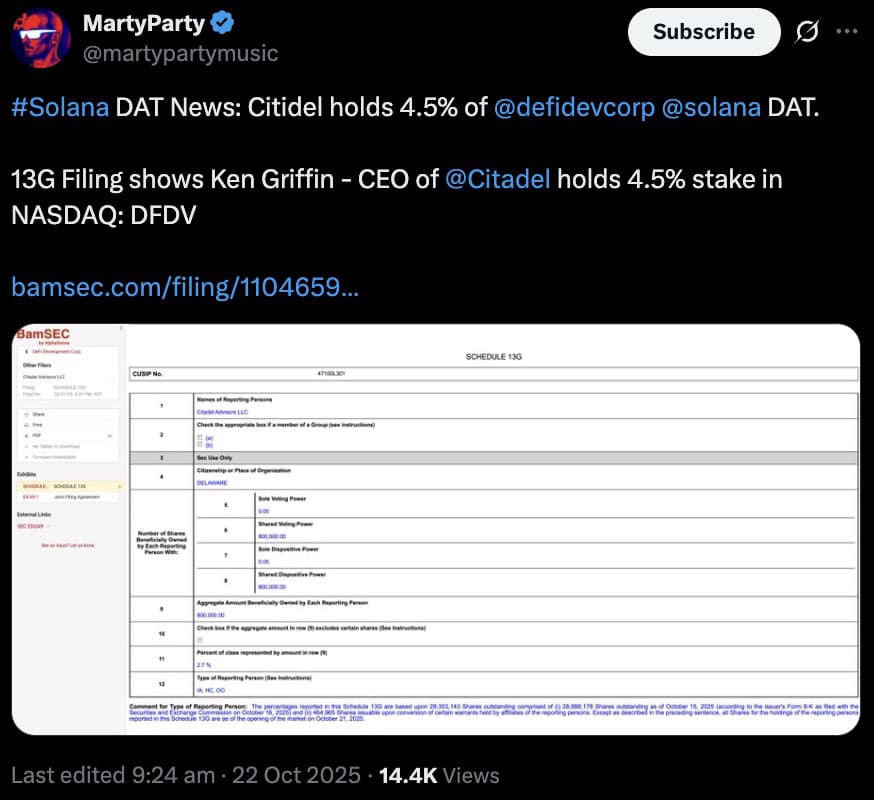
Citadel CEO’s Solana Bet Sparks Altcoin Momentum – Why It’s Time to Invest in $SNORT

Citadel CEO’s Solana Bet Sparks Altcoin Momentum – Why It’s Time to Invest in $SNORT

Ken Griffin, the billionaire founder of Citadel, has just revealed a 4.5% personal stake in DeFi Development Corp, a Nasdaq-listed firm stockpiling Solana ($SOL) as its main treasury asset.

Author: Brave Newcoin
Best Crypto to Buy Now as Crypto RWA Hits $8.3 Billion

Best Crypto to Buy Now as Crypto RWA Hits $8.3 Billion

Quick Facts: 1️⃣ Over $8.3B in real-world assets are already tokenized on-chain and growing fast. 2️⃣ Banks like Goldman Sachs and BNY Mellon are integrating blockchain custody for Treasuries and money-market funds. 3️⃣ $HYPER, $BEST, and $LINK are well-positioned to benefit from the next phase of tokenization. 4️⃣ The shift from DeFi vs. TradFi to […]

Author: Bitcoinist
ZYLO Token — A Leading Contender in the New Digital Gaming Economy

ZYLO Token — A Leading Contender in the New Digital Gaming Economy

The GameFi sector is experiencing a powerful resurgence. After a cooling period in 2023–2024, the industry is once again at the forefront of investor and gamer attention.

Author: Cryptodaily
Tokenization Is Fixing Film Financing, Dethroning Hollywood Studios

Tokenization Is Fixing Film Financing, Dethroning Hollywood Studios

The post Tokenization Is Fixing Film Financing, Dethroning Hollywood Studios appeared on BitcoinEthereumNews.com. Hollywood has hit a breaking point. Audiences are fatigued by franchise sequels and reboots. YouTube has overtaken Disney as the world’s largest distributor. And Gen AI tools like Sora 2 can soon turn anyone into a filmmaker. Yet one thing hasn’t changed: how films get financed. And that’s why we keep getting fewer original films. Decline of original screenplays at the US box office (1984-2023) Source: The Numbers and Box Office Mojo For decades, filmmakers have had only two ways to raise capital: courting wealthy “patrons of the arts” or signing away IP in restrictive studio deals. These small circles still control who the next David Lynch will be, or which film becomes the next Napoleon Dynamite, while everyday fans — the people who live and breathe these films — have never had a seat at the table. (Fewer than 1% of Americans meet SEC “accreditation” standards to invest in most private ventures, including film.) That’s finally changing, thanks to tokenization. The promise of “decentralization in film” has arrived, quietly and legally this time. A few years ago, “Web3 Film” had the right dream but the wrong tools: people were slicing films into NFT frames, touting complex tokenomics and skirting securities laws. None of it worked. Projects like Stoner Cats, Ashton Kutcher’s NFT cartoon, became cautionary tales after the SEC cracked down for selling unregistered securities to unaccredited investors. Today, the difference is compliance. Through licensed platforms operating under SEC exemptions such as Reg CF, production companies can take on thousands of unaccredited investors (even in the U.S.) to back real film projects and share in the upside. Security tokens issued on blockchain rails make it possible to distribute dividends transparently and cost-effectively — and, eventually, trade investors’ stakes on secondary markets. And it’s already working. Tens of thousands of…

Author: BitcoinEthereumNews