Oracle

Oracles are essential infrastructure components that feed real-time, off-chain data (such as price feeds, weather, or sports results) into blockchain smart contracts. Without decentralized oracles like Chainlink and Pyth, DeFi could not function. In 2026, oracles have evolved to support verifiable randomness and cross-chain data synchronization. This tag covers the technical evolution of data availability, tamper-proof price feeds, and the critical role oracles play in ensuring the deterministic execution of complex decentralized applications.

5097 Articles
Created: 2026/02/02 18:52
Updated: 2026/02/02 18:52
Japan’s $200B SBI Group Partners With Chainlink to Advance Tokenized Assets, Cross-Border Payments, and Stablecoin Infrastructure

Japan’s $200B SBI Group Partners With Chainlink to Advance Tokenized Assets, Cross-Border Payments, and Stablecoin Infrastructure

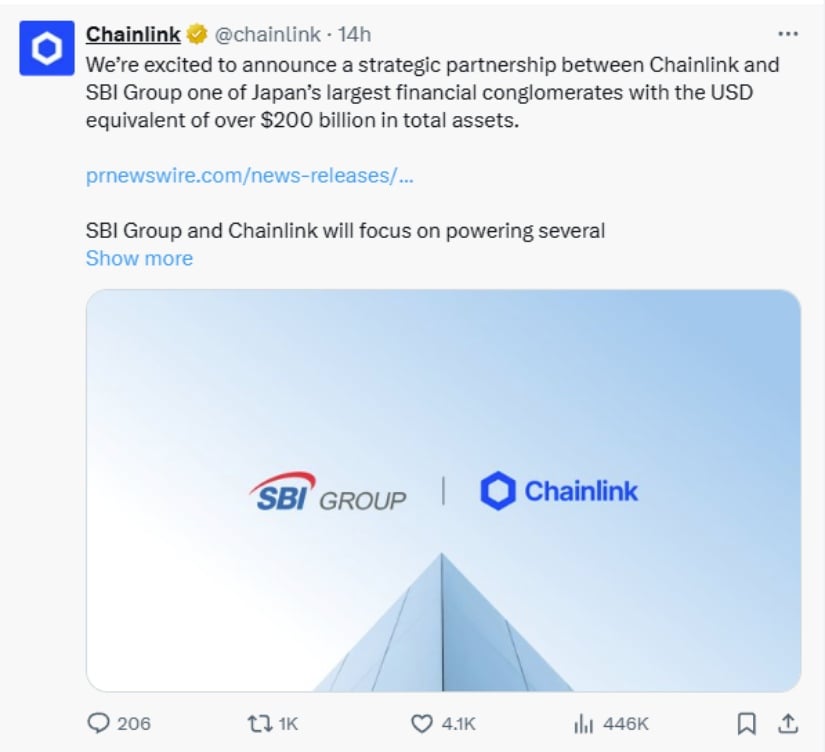
The post Japan’s $200B SBI Group Partners With Chainlink to Advance Tokenized Assets, Cross-Border Payments, and Stablecoin Infrastructure appeared on BitcoinEthereumNews.com. Japan’s SBI Group, one of the country’s largest financial conglomerates with over $200 billion in total assets, has formed a strategic partnership with blockchain oracle provider Chainlink to accelerate institutional adoption of digital assets globally Japan’s SBI Group, one of the country’s largest financial conglomerates with over $200 billion in total assets, has formed a strategic partnership with blockchain oracle provider Chainlink to accelerate institutional adoption of digital assets globally. The collaboration focuses on enabling tokenized real-world assets (RWAs) such as real estate and bonds, as well as advancing cross-border payments and stablecoin infrastructure. SBI Group and Chainlink will utilize Chainlink’s Cross-Chain Interoperability Protocol (CCIP), SmartData (NAV), and Proof of Reserve technologies to enhance transparency, compliance, and reliability in digital asset transactions. The partnership aims to support Asia’s financial institutions, starting with Japan, by integrating blockchain tools for tokenized securities, stablecoin audits, and cross-border settlement systems. SBI Holdings’ Chairman and CEO Yoshitaka Kitao emphasized the complementary strengths of the two companies in driving compliant cross-border transactions and widespread digital asset adoption in the region. This initiative aligns with growing interest among Japanese banks, with 76% reportedly eyeing tokenized securities. The partnership is seen as a key development in institutional blockchain infrastructure and digital asset growth in Asia’s financial sector. This is an AI-generated article powered by DeepNewz, curated by The Defiant. For more information, including article sources, visit DeepNewz. Source: https://thedefiant.io/news/tradfi-and-fintech/japans-200b-sbi-group-partners-chainlink-to-advance-tokenized-assets-cross-52384350

Author: BitcoinEthereumNews
Prediction Market Kalshi to Expand Onchain Presence

Prediction Market Kalshi to Expand Onchain Presence

The post Prediction Market Kalshi to Expand Onchain Presence appeared on BitcoinEthereumNews.com. The controversial company has unveiled its new head of crypto, influencer John Wang. Prediction market Kalshi revealed its new head of crypto today, a trading and crypto influencer known as John Wang, who is tasked with “bringing new crypto markets to life, growing Kalshi’s builder ecosystem, and leading the push onchain,” according to an article Wang published on X. Prediction markets have been a hot sector in crypto over the last few months, with Wang leading the push on social media and spending the last few weeks bullposting prediction markets. In a particularly viral tweet on Aug. 18, he said, “Mark my words: prediction markets will be 10x bigger than memecoins.” Kalshi also recently expanded its sports betting markets through a new partnership with Robinhood. The activation enables National Football League (NFL) and National Collegiate Athletic Association (NCAA) American football betting markets on Robinhood, facilitated by Kalshi. Market leader Polymarket, on the other hand, announced a partnership with Elon Musk’s X in June, making the decentralized prediction market the official partner of X. Controversial Past Polymarket has been the crypto-native favorite among prediction markets since activity on the platform exploded leading up to the 2024 presidential election. It’s gearing up for an even bigger 2025, as Polymarket plots a return to the United States after acquiring a compliant platform through a $112 million deal in July. Part of the favoritism also lies in crypto-natives’ general disdain for Kalshi and some of the company’s previous tactics. Niko Kampouris, a social media specialist at Uniswap, called out Kalshi after the news broke today, saying, “Sorry, but Kalshi lost all respect after their coordinated polymarket propaganda tour during the election cycle. They tried destroying something that was built by one of our own. Don’t really care who they hire to help save face.…

Author: BitcoinEthereumNews
Animoca Sees RWAs Becoming the Future of Finance

Animoca Sees RWAs Becoming the Future of Finance

The post Animoca Sees RWAs Becoming the Future of Finance appeared on BitcoinEthereumNews.com. Blockchain Tokenization of real-world assets (RWAs) is only scratching the surface of its potential, according to a new research paper from Animoca Brands. The Web3 investment firm believes the sector could eventually grow to represent a significant slice of the $400 trillion traditional finance market. Trillions Still Untapped Researchers Andrew Ho and Ming Ruan highlighted that RWAs currently make up just $26 billion of the possible market, a fraction of the opportunity across private credit, government bonds, commodities, equities, and alternative funds. They described the current phase as an early-stage race, with asset managers rushing to build platforms that can manage the “full lifecycle” of tokenized products. “This is a strategic land grab,” the report noted, arguing that whoever gains control of end-to-end infrastructure will capture the most value as the sector matures. Momentum Builds to All-Time High Industry tracker RWA.xyz shows the tokenized market has reached $26.5 billion, the highest level to date and up 70% since January. That growth has been fueled largely by two categories — private credit and U.S. Treasurys — which together account for nearly 90% of current tokenized value. Animoca’s researchers said this growth reflects “clear momentum and rising institutional confidence” as more firms experiment with onchain versions of traditional instruments. Ethereum Leads, But Multichain Future Ahead Ethereum remains the dominant chain for RWA issuance, hosting 55% of all tokenized value, or roughly $156 billion when including stablecoins. Its advantage grows to 76% once layer-2 solutions like Arbitrum, Polygon, and ZKsync are factored in, thanks to its security and deep DeFi ecosystem. Still, Animoca expects a multichain reality. Purpose-built blockchains and high-throughput networks are starting to attract tokenization projects, with interoperability likely to determine long-term winners. Boost for ETH and LINK The growing focus on RWAs has also benefited Ethereum’s native token, ETH, which…

Author: BitcoinEthereumNews
SBI Group Partners with Chainlink to Transform Asian Finance

SBI Group Partners with Chainlink to Transform Asian Finance

Japan's financial giant SBI Group has joined forces with blockchain oracle platform Chainlink in a major partnership that could reshape how Asian financial institutions use crypto technology. The deal, announced on August 25, 2025, marks the fourth crypto partnership SBI has made in just one week.

Author: Brave Newcoin
Price Falls Despite Major SBI Group Partnership

Price Falls Despite Major SBI Group Partnership

The post Price Falls Despite Major SBI Group Partnership appeared on BitcoinEthereumNews.com. Native token of oracle network Chainlink LINK$23.33 declined in tandem with the broader crypto market despite a fresh partnership with Japanese financial giant SBI Group. LINK declined to $24.4, down more than 6% over the past 24 hours, CoinDesk data shows. That’s a sharp reversal from the Friday’s year-to-date peak over $27. The downward trajectory accelerated through successive trading sessions with persistent lower peaks, whilst the concluding hour exhibited stagnation with negligible volume, suggesting potential consolidation, according to CoinDesk Research’s technical analysis model. On the news side, SBI Group, one of Japan’s largest financial conglomerates, said on Monday it has teamed up with Chainlink to develop tokenized assets and stablecoin solutions in Japan, with future plans to expand into other Asia-Pacific markets. SBI will use Chainlink’s Cross-Chain Interoperability Protocol (CCIP) to support transactions across different blockchains while maintaining compliance. The firms will also test tokenized funds by bringing net asset value data on-chain and explore payment-versus-payment settlement for foreign exchange and cross-border transactions. Chainlink’s Proof of Reserve will be used to verify stablecoin reserves. SBI and Chainlink have previously collaborated under Singapore’s Project Guardian, a Monetary Authority of Singapore (MAS) initiative exploring blockchain use in finance. Technical Indicators Analysis Resistance established at $26.61 with sharp reversal upon elevated volume activity. Critical support emerged at $24.37 with purchasing interest. Extraordinary volume of 7,850,571 units during peak volatility, substantially exceeding 24-hour average of 2,687,393. Systematic lower peak formations indicating bearish momentum acceleration. Disclaimer: Parts of this article were generated with the assistance from AI tools and reviewed by our editorial team to ensure accuracy and adherence to our standards. For more information, see CoinDesk’s full AI Policy. Source: https://www.coindesk.com/markets/2025/08/25/chainlink-partners-with-sbi-group-advance-tokenized-assets-stablecoins-in-japan

Author: BitcoinEthereumNews
Tokenization Boom: Animoca Sees RWAs Becoming the Future of Finance

Tokenization Boom: Animoca Sees RWAs Becoming the Future of Finance

The Web3 investment firm believes the sector could eventually grow to represent a significant slice of the $400 trillion traditional […] The post Tokenization Boom: Animoca Sees RWAs Becoming the Future of Finance appeared first on Coindoo.

Author: Coindoo
Malaysia launched its first locally designed AI chip, the MARS1000

Malaysia launched its first locally designed AI chip, the MARS1000

Malaysia has taken a bold step into the global artificial intelligence race with the launch of its first domestically designed processor, a sign that the country wants to be more than just a supporting player in the semiconductor supply chain. The MARS1000, developed by Kuala Lumpur-based chipmaker SkyeChip, was unveiled this week as Malaysia’s first […]

Author: Cryptopolitan
Chainlink Teams Up With Japan’s SBI Group: Could This Deal Ignite the Next Tokenization Wave?

Chainlink Teams Up With Japan’s SBI Group: Could This Deal Ignite the Next Tokenization Wave?

Chainlink, the leading blockchain oracle network, has announced a unique partnership with Japan’s SBI Group, a financial giant managing over $200 billion in assets. Related Reading: Solana’s Rally Gains Traction – Why Its Price Could Surge To New ATHs The collaboration is set to accelerate the adoption of tokenized real-world assets (RWAs), stablecoins, and blockchain-powered […]

Author: Bitcoinist
Cap Labs attracts capital with EigenLayer-backed credit model

Cap Labs attracts capital with EigenLayer-backed credit model

The post Cap Labs attracts capital with EigenLayer-backed credit model appeared on BitcoinEthereumNews.com. Cap Labs’ new stablecoin cUSD has seen rapid adoption since launch, climbing to $67.85 million in circulation over the past week, according to DefiLlama.  Etherscan shows 2,735 holders of the token to date. The jump signals strong demand for Cap’s yield-layered digital dollar model, which combines regulated reserve assets with EigenLayer-powered credit underwriting. Built atop the newly launched Cap Stablecoin Network (CSN), cUSD is designed as a 1:1 redeemable stablecoin backed by assets like PayPal’s PYUSD, BlackRock-managed BUIDL, and Franklin Templeton’s BENJI. The yield-bearing version stcUSD — minted by staking cUSD — is enabled by a three-party system of lenders, operators, and restakers. Cap’s core innovation lies in its structure: operators borrow stablecoins to deploy yield strategies, restakers underwrite the operator’s credit risk, and lenders (stcUSD holders) earn a floating yield, currently around 12%, depending on market demand and operator performance. While restaker collateral provides protection against operator default, stcUSD holders are still exposed to fluctuating yield dynamics. cUSD’s impressive growth; Source: DefiLlama Unlike many past stablecoin launches, Cap’s model is carefully tuned to comply with the GENIUS Act, the sweeping US stablecoin legislation that prohibits interest-bearing payment tokens. Speaking at the Stablecoin Summit in Cannes in June, Cap Labs founder Benjamin Lens was blunt: “They said no yield, and it’s pretty clear — there’s no way around it. They do not want stablecoins giving yield to retail investors,” Lens said. Thus, stcUSD is a separate ERC-4626 vault token, which users can mint by staking cUSD. The yield is generated through a marketplace of borrowing and restaking, not directly from Cap Labs. “Genius Act covers companies that are generating yield on behalf of users and giving them to the users,” Lens said in Cannes, whereas Cap is “an immutable open protocol like Ethereum, like Bitcoin.” Combined with the fact that…

Author: BitcoinEthereumNews
tokenization of real assets in Japan

tokenization of real assets in Japan

The post tokenization of real assets in Japan appeared on BitcoinEthereumNews.com. Japan pushes on on-chain finance: SBI Group and Chainlink initiate a collaboration to bring RWAs, regulated stablecoins, and services for institutions on an industrial infrastructure ready for the capital markets. With assets under management exceeding 200 billion USD (see PR Newswire), SBI offers critical mass and access to counterparties; Chainlink provides connectivity, verifications, and cross-chain interoperability. The goal is clear: to convert traditional assets into tokenized instruments, with deeper liquidity and faster settlement. According to data collected by market analysts and official communications from the parties involved, the partnership is designed to launch initial pilot initiatives on institutional use cases between the end of 2024 and 2025. Industry observers note how the adoption of oracles and Proof of Reserve mechanisms increases transparency — a factor considered crucial for attracting regulated issuers and institutional investors. The partnership: what it really entails The agreement aims at the development of institutional use cases for tokenized real-world assets (RWAs), tokenized funds, and stablecoin compliant with Japanese regulations, with an initial focus on the domestic market and on compliant cross-border transactions. According to the official announcement (PR Newswire), the collaboration aims to strengthen institutional adoption and the scalability of issuance, exchange, and control processes. It should be noted that the use cases will be designed with security and compliance requirements from the outset. Key data at a glance AUM SBI: greater than 200 billion USD (size data; not exclusively related to RWAs; data reported by SBI in public communications, updated 2024). Technologies: Chainlink https://chain.link/cross-chain (interoperability) and https://chain.link/proof-of-reserve (proof of reserves). Market: Japan as a launch point, with extension towards cross-border flows. International references: the topic of tokenization has been analyzed by international authorities — see the report from the Bank for International Settlements (CPMI) dated October 17, 2024, which highlights opportunities and risks for central…

Author: BitcoinEthereumNews