Oracle

Oracles are essential infrastructure components that feed real-time, off-chain data (such as price feeds, weather, or sports results) into blockchain smart contracts. Without decentralized oracles like Chainlink and Pyth, DeFi could not function. In 2026, oracles have evolved to support verifiable randomness and cross-chain data synchronization. This tag covers the technical evolution of data availability, tamper-proof price feeds, and the critical role oracles play in ensuring the deterministic execution of complex decentralized applications.

5129 Articles
Created: 2026/02/02 18:52
Updated: 2026/02/02 18:52
Cardano ETF Rumors Build as DOT and LINK Rally With Altcoin Buzz

Cardano ETF Rumors Build as DOT and LINK Rally With Altcoin Buzz

The post Cardano ETF Rumors Build as DOT and LINK Rally With Altcoin Buzz appeared on BitcoinEthereumNews.com. Crypto News Cardano ETF rumors are gaining traction in August 2025, boosting ADA’s price outlook. Polkadot and Chainlink also rally as traders prepare for altseason. The rumors regarding a Cardano (ADA) ETF have reached serious traction in August 2025 attracting new excitement to the market. The catalyst was Grayscale filing an updated S-1 filing with the US Securities and Exchange Commission (SEC) in order to advance its Cardano ETF filing. The proposal outlines that the ETF would be traded on NYSE Arca where it would directly hold ADA but have Coinbase Custody acting as security. That setup eliminates exposure to leverage, or derivatives, which is safer to the traditional investors. Polymarket data show that the probability of an SEC approval of a Cardano ETF has now increased to approximately 87% the previous month-of-time probability of about 63-75%. Such an increase of probability has increased confidence in ADA. The coin has already overcome the resistance of $0.85 on the charts and analysts have a belief that it can move beyond 1.00 should support be maintained. Others even have an eye on a 40-55% price increase in the event that the ETF is cleared. In addition to the ETF buzz, the continued activity of Cardano such as smart contract upgrades, developer tools, and the Midnight privacy protocol have provided investors with grounds to remain optimistic. The only catch is timing. The SEC has already pushed its final decision date of August 27 to October 26 because of its analysis of nearly 100 crypto ETF applications. However, as analysts note, Cardano is among the companies that are on top when regulatory clarity comes. Polkadot (DOT) Polkadot has been trading in the range of $3.80-$4.20 up until August. It is now trading near 3.85 which is a little lower than the position it was…

Author: BitcoinEthereumNews
Cardano ETF Rumors Build — DOT and LINK Rally With Altcoin Buzz

Cardano ETF Rumors Build — DOT and LINK Rally With Altcoin Buzz

The rumors regarding a Cardano (ADA) ETF have reached serious traction in August 2025 attracting new excitement to the market. […] The post Cardano ETF Rumors Build — DOT and LINK Rally With Altcoin Buzz appeared first on Coindoo.

Author: Coindoo
Experts Pick 3 Cryptos To Hold Instead Of Ripple (XRP) For Big 2025 Gains: Chainlink, VeChain And Layer Brett

Experts Pick 3 Cryptos To Hold Instead Of Ripple (XRP) For Big 2025 Gains: Chainlink, VeChain And Layer Brett

The post Experts Pick 3 Cryptos To Hold Instead Of Ripple (XRP) For Big 2025 Gains: Chainlink, VeChain And Layer Brett appeared on BitcoinEthereumNews.com. The market is changing, and there is speculation as investors look beyond Ripple (XRP) for bigger opportunities in 2025. While established players like Chainlink and VeChain continue to build solid foundations, a new meme token is coming: Layer Brett.  This Ethereum Layer 2 memecoin is already drawing attention for its blend of meme culture and real utility, with its presale live at just $0.0053. Analysts are starting to believe it could be one of the next 100x altcoins heading into the crypto bull run of 2025. Layer Brett: Breaking Chains On Layer 2 Unlike the original Brett token stuck on Base, Layer Brett has moved to Ethereum Layer 2, bringing lightning-fast transactions and gas fees slashed to pennies. Ethereum Layer 1 remains secure but often congested, with transaction costs spiking above $10. Layer Brett solves that problem, offering scalability and performance that older meme tokens lacked. This is more than just a speculative meme token. With its ERC-20 design, $LBRETT combines viral appeal with real infrastructure advantages.  Compared to Ripple (XRP), which has faced regulatory battles, or projects like Chainlink and VeChain, which grow steadily but at slower rates, Layer Brett has the flexibility to expand quickly in the booming Layer 2 sector, projected to handle trillions annually. The advantage of staking and low-cap potential For early buyers, the big draw isn’t just the low entry price; it’s the staking rewards. By purchasing $LBRETT during the crypto presale, investors can immediately stake tokens via MetaMask or Trust Wallet for high APYs powered by Layer 2 efficiency.  In contrast, holding LINK or VET long-term often means waiting on ecosystem adoption for significant returns. Key benefits include: Layer 2 Speed: Transactions processed in seconds with minimal fees. Presale Access: $LBRETT available at $0.0053 for early backers. Staking Rewards: Early adopters can secure…

Author: BitcoinEthereumNews
Cardano eyes Q4 push – But without Chainlink, can momentum last?

Cardano eyes Q4 push – But without Chainlink, can momentum last?

The post Cardano eyes Q4 push – But without Chainlink, can momentum last? appeared on BitcoinEthereumNews.com. Key Takeaways Cardano gained 40% in Q3, but weak on-chain activity and delayed Chainlink integration kept DeFi growth on hold. Cardano’s [ADA] price action shows three consecutive monthly gains. In fact, since Q3 began, ADA has rallied 40% off its $0.57 base, hinting at a potential double-digit leg in September. Yet, this price resilience isn’t translating into on-chain dominance.  On-chain slump despite price rally Reinforcing this, key metrics like Daily Active Addresses have dropped nearly 100% over the past three months, while Total Value Locked (TVL) has fallen to half of its $721 million peak seen during the election run. Source: DeFilLama That kind of divergence usually screams potential manipulation. That explains why Cardano’s stuck in a tight range across multiple timeframes. Even with steady MoM inflows, it can’t crack key psychological resistance, with underlying positioning feeding a volatility loop. On top of that, derivatives positioning added volatility. On the 18th of August, ADA hit $0.96 while Open Interest (OI) climbed to $1.87 billion. Lacking follow-through, the token fell back to $0.80, with OI easing to $1.54 billion by press time. Why Chainlink integration matters for Cardano  Cardano runs on a unique setup. Unlike Ethereum [ETH], Cardano is built on a unique architecture with its own programming language (Plutus) and consensus protocol (Ouroboros), which makes plugging into stuff like Chainlink messy. Since Chainlink [LINK] is built for EVM chains, integrating it on Cardano means extra dev glue, custom adapters, and higher costs.  Cardano’s Charles Hoskinson noted, “Chainlink gave us an absurd number (price) for integration,” adding that Sergey Nazarov “knows he’s sitting on a golden egg.” Source: Artemis Terminal The result? Slower on-chain activity and fewer DeFi projects going live, because accessing reliable oracle data (a key piece for smart contracts) is harder and pricier to access, something Chainlink could…

Author: BitcoinEthereumNews
5 Altcoins to Watch in September as the Market Dips

5 Altcoins to Watch in September as the Market Dips

The post 5 Altcoins to Watch in September as the Market Dips appeared on BitcoinEthereumNews.com. Sei (SEI) is in the spotlight with its new “parallelized EVM” and a recent spot ETF filing by 21Shares Cardano and Chainlink are making major moves in real-world adoption, including a US government contract Newcomers WLFI and Pyth Network are gaining traction with a high-profile launch and a new data deal September has kicked off with a market-wide pullback, but smart money knows that dips are for buying strength. While the broader market is weak, a handful of altcoins have major, distinct catalysts that could allow them to outperform.  Here are five projects – Sei, Cardano, Chainlink, WLFI, and Pyth that traders are watching for a potential September rebound. Sei (SEI): The “Parallelized EVM” and an ETF Filing Sei is positioning itself as one of the fastest L1s, and two major catalysts are putting it in the institutional spotlight. What is the big tech upgrade? Sei just launched its mainnet beta v2, which introduced the first “parallelized EVM.” This is a major technical upgrade designed to process transactions much faster, with the team claiming it will eventually handle 100,000 complex transactions per second. Is there institutional interest? Yes. 21Shares just filed for a spot Sei ETF with the SEC. An ETF filing is a massive signal of mainstream interest and a potential catalyst for a major price re-rating. With Sei trading at $0.2785 and holding a $1.67 billion market cap, investors see the current pullback as an appealing entry point. Related: Weekly Token Unlocks: ARB, APT, SEI Prices Rally Despite $120 Million in New Supply Cardano (ADA) & Chainlink (LINK): The Real-World Adoption Plays While other projects focus on speculation, Cardano and Chainlink are making serious moves into real-world and government infrastructure. What’s the catalyst for Cardano? Founder Charles Hoskinson is pushing for deeper DeFi integration, teasing potential collaborations with…

Author: BitcoinEthereumNews
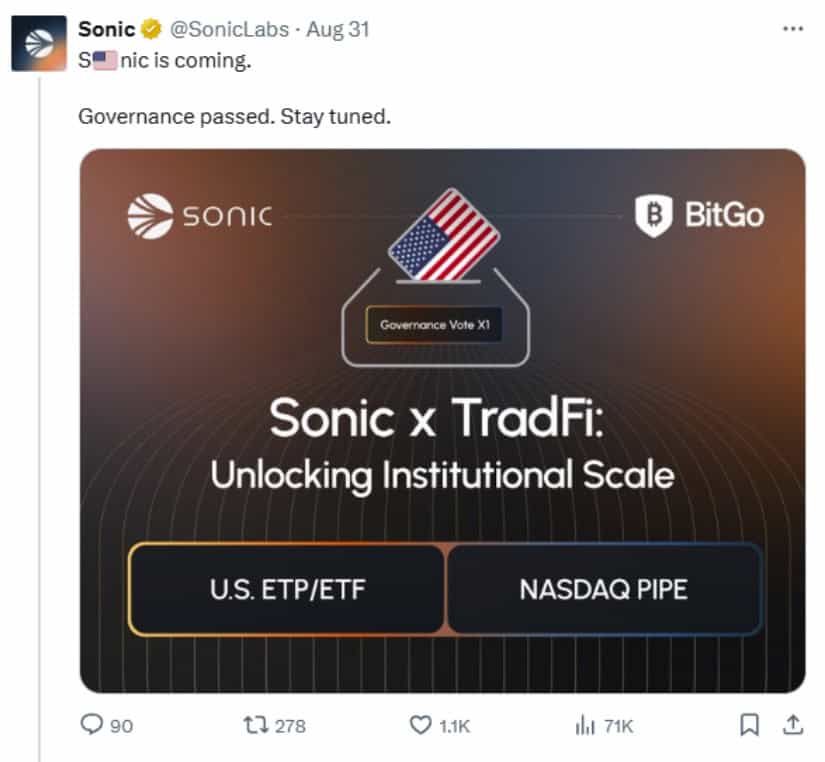
Sonic Labs Secures Community Approval for Historic $200M Traditional Finance Expansion

Sonic Labs Secures Community Approval for Historic $200M Traditional Finance Expansion

The vote, conducted from August 20-31, concluded with 99.99% approval from token holders, representing nearly 860 million S tokens—well above the required 700 million token threshold.

Author: Brave Newcoin
Five sectors Warren Buffett continues to avoid in 2025

Five sectors Warren Buffett continues to avoid in 2025

Legendary investor Warren Buffett’s iconic warning from his 1983 shareholder letter – likening major reinvestment in weak industries to “struggling in quicksand” – remains a cornerstone of Berkshire Hathaway’s capital discipline.In 2025, as speculative fervor returns to global markets, Buffett’s refusal to chase structurally flawed sectors offers a sobering counterweight.His approach favors durable moats, consistent cash generation, and industry structures that reward restraint as much as selection. Here are five sectors he continues to sidestep – and why.Airlines: high altitude, low returnsBuffett’s brief flirtation with airline stocks in the late 2010s ended abruptly during the COVID-19 crisis, and his skepticism hasn’t softened.Airline stocks remain plagued by overcapacity, volatile fuel costs, and limited pricing power. Even in 2025, with travel rebounding and carriers touting efficiency gains, Buffett sees the industry’s economics as fundamentally broken.Fixed costs are high, competition is fierce, and margin are razor-thin. “Problem isn’t management,” he once said. “It’s the industry.” For Berkshire, the skies are still off-limits.Biotech and pharma: complexity without clarityDespite their potential for innovation, biotech and pharmaceutical stocks rarely meet Buffett’s criteria for predictability and durable advantage.Drug pipelines are expensive and uncertain, regulatory hurdles are steep, and cash flows are often binary – hinging on approvals or patent cliffs.In 2025, with AI-driven drug discovery and gene therapies gaining traction, the “Oracle of Omaha” remains unconvinced.He prefers businesses with clear earnings visibility and long-term pricing power – not moonshots with scientific risk and opaque economics.Electric vehicles: hype over moatBuffett’s avoidance of EV manufacturers, including Tesla Inc, reflects his discomfort with sectors driven by innovation cycles rather than structural advantage.EV stocks face brutal competition, high R&D costs, and uncertain profitability. While Berkshire has exposure to battery tech and charging infrastructure through its energy holdings, it steers clear of the automakers themselves.In Buffett’s view, the race to scale in EVs resembles a capital-intensive sprint with no guaranteed winner –  a classic quicksand scenario.Early-stage tech: growth without guardrailsBuffett has long resisted investing in early-stage tech startups, citing their lack of durable moats and unpredictable business models.In 2025, with venture capital pouring into AI, fintech, and the metaverse, Berkshire remains on the sidelines.While Apple remains a core holding, it’s the exception – not the rule. Buffett favours companies with entrenched customer bases and pricing power, not those burning cash in pursuit of scale. “We don’t do hope-based investing,” he’s said.Commoditized manufacturing and low-margin retailWarren Buffett’s original investment in Berkshire Hathaway’s textile business –  and his eventual exit – taught him a lasting lesson: commoditized sectors with weak pricing power and constant reinvestment needs rarely compound capital.In 2025, that logic still applies to low-margin retail and basic manufacturing. These industries face relentless competition, shrinking margins, and little room for differentiation.Buffett’s playbook favors businesses that can raise prices without losing customers – not those that fight for survival on volume alone.The post Five sectors Warren Buffett continues to avoid in 2025 appeared first on Invezz

Author: Coinstats
from 24 to 50 billion in 12 months. Regulations and institutions ignite the market

from 24 to 50 billion in 12 months. Regulations and institutions ignite the market

The post from 24 to 50 billion in 12 months. Regulations and institutions ignite the market appeared on BitcoinEthereumNews.com. The market for tokenized real assets has entered a phase of institutional scale: over twelve months, it would have risen from about $24 billion to over $50 billion – as shown by data from 21.co and confirmed by analyses from RWA.xyz – and are consistent with international reports on the subject. Among these, the BIS report published on October 17, 2024, and the IMF note on January 29, 2025, Bank for International Settlements (BIS)International Monetary Fund (IMF) – due to the arrival of large managers and greater regulatory clarity between the USA and Europe. From regulated stablecoins to on-chain government bond funds, tokenization is gradually but consistently becoming an increasingly significant liquidity infrastructure for finance. In this context, the convergence between technology and regulations generates more robust trust mechanisms and more predictable operational processes. According to the data collected by our research team on on‑chain transactions (dataset updated to July 2025), the market‑making component on tokenized assets has shown an increase in average order sizes of ~35% YoY in professional markets. Industry analysts also observe a growth in integrations between institutional custody and smart contracts on authorized platforms, with effective settlement times reduced in many cases to under 24 hours for on‑chain monetary products (learn more on Cryptonomist). What is the tokenization of real assets Tokenization converts rights to physical or financial assets into tokens on blockchain. The result is a digital unit that represents shares of real estate, bonds, credits, or money market funds, with technical properties that facilitate circulation and control. It should be noted that representation on distributed ledgers also allows for lifecycle automations (coupons, maturities) that are difficult to achieve in legacy systems. Fractionalization: access to minimum amounts and greater inclusion. Transferability: near-instant settlement, 24/7. Traceability: on-chain auditability and automated reporting. Composability: use of tokens as…

Author: BitcoinEthereumNews
UAE’s G42 seeks to diversify chip suppliers beyond Nvidia for AI campus

UAE’s G42 seeks to diversify chip suppliers beyond Nvidia for AI campus

The post UAE’s G42 seeks to diversify chip suppliers beyond Nvidia for AI campus appeared on BitcoinEthereumNews.com. UAE-backed technology firm G42 is exploring other AI chip suppliers beyond Nvidia to expand its semiconductor supply options. The company already initiated negotiations with AMD, Cerebras Systems, and Qualcomm to provide the AI chips that will power its AI campus.  G42 announced plans to build an AI data center campus with a 5 gigawatt capacity in a collaboration between the UAE and the U.S. The announcement came during President Donald Trump’s visit to the country, which attracted more than $200 billion in signed deals. Trump’s visit secured multiple chip export deals with the UAE, which sparked concerns among senior U.S. officials. They cited national security reasons and economic control surrounding the deals.  UAE pushes a ‘digital embassy’ model for governments According to a recent Cryptopolitan report, in July, Huawei was pushing to sell its Ascend 910B AI chips and CloudMatrix 384 systems to G42. However, the discussions remain in the early stages, with no binding agreements formed. The report revealed that Huawei’s chip supply capacity remains limited compared to Nvidia, which already has substantial supply deals in the region.  In an exclusive report by Semafor, AWS, Microsoft, Meta, and xAI are among the companies involved in talks with G42 to secure the projected 5 gigawatt data center capacity in the UAE. The UAE has boasted the project as the most significant AI infrastructure outside of the U.S. One gigawatt of the project has already been committed to Trump’s Stargate AI initiative.   The Stargate AI initiative aims to advance AI infrastructure worldwide with partners including SoftBank, Oracle, OpenAI, and MGX. President Trump announced early this year that the plan for private sector investment is valued at an estimated $500 billion.  G42’s data center campus will utilize Nvidia’s Grace Blackwell GB300 systems, representing about 20% of the campus’s total scope. The facility…

Author: BitcoinEthereumNews
Tokenized real assets: from 24 to 50 billion in 12 months. Regulations and institutions ignite the market

Tokenized real assets: from 24 to 50 billion in 12 months. Regulations and institutions ignite the market

The market for tokenized real assets has entered an institutional scale phase: within twelve months it would have risen from approximately $24 billion to over $50 billion.

Author: The Cryptonomist