Dapp

Dapps are digital applications that run on a P2P network of computers rather than a single server, typically utilizing smart contracts to ensure transparency and uptime. In 2026, Dapps have achieved mass-market appeal through Account Abstraction, allowing for a "Web2-like" user experience with the security of Web3. This tag covers the entire ecosystem of decentralized software—from social media and productivity tools to governance platforms and identity management.

4987 Articles
Created: 2026/02/02 18:52
Updated: 2026/02/02 18:52
Next 1000x Cryptos to Buy as Institutions Hold 12% of All Bitcoin

Next 1000x Cryptos to Buy as Institutions Hold 12% of All Bitcoin

The post Next 1000x Cryptos to Buy as Institutions Hold 12% of All Bitcoin appeared on BitcoinEthereumNews.com. Crypto News 15 September 2025 | 10:39 Watch out for the next 1000x crypto as institutions now hold around 12.3% of the total Bitcoin supply, which pushes the coin’s value further. Funds and public companies now hold nearly 1/8 of the total Bitcoin supply, according to the latest data released by Bitcoin macroeconomic strategy provider Ecoinometrics. The number, which roughly translates to about 2.5M of the total supply of 21M $BTC, reflects the rapid Bitcoin strategy expansion in the last year. For instance, Strategy remains the leading holder, with its 638,460 $BTC. Since Bitcoin’s launch in 2009, crypto king has increased by 188,260,209%. While few coins could ever replicate its success, there are still a few with the potential to be the next 1000x crypto. We’ll cover some of the most promising ones here, including Bitcoin Hyper ($HYPER) and Best Wallet Token ($BEST). Strategy, Metaplanet Lead Bitcoin Acquisition In an X post on Saturday, Ecoinometrics revealed that public companies and funds now hold 12.3% of all Bitcoin. With the coin’s supply capped at 21M, this translates to roughly 2.5M $BTC held by these institutions. Michael Saylor’s Strategy holds about 25% of institutionally-held Bitcoins with its 638,460 $BTC holdings. This year alone, the company has amassed a whopping 192,060 $BTC, thanks to its DCA strategy and HODLing mindset. Another notable institution is Japan’s Metaplanet, which holds 20,136 $BTC at the moment, overtaking Riot Platforms as the number six in the list of top Bitcoin treasury companies. Growing institutional adoption has helped push Bitcoin’s price upwards, which reached a new ATH last month at $124K. This is a considerable growth considering its price was only $0.10 15 years ago, translating to a growth of about 1,240,000x. This kind of exponential growth might be difficult to replicate, but there are still many promising…

Author: BitcoinEthereumNews
As Public Companies Now Hold 12.3% of Total Bitcoin Supply, Check Out Presales That Could be the Next 1000x Crypto

As Public Companies Now Hold 12.3% of Total Bitcoin Supply, Check Out Presales That Could be the Next 1000x Crypto

Funds and public companies now hold nearly 1/8 of the total Bitcoin supply, according to the latest data released by […] The post As Public Companies Now Hold 12.3% of Total Bitcoin Supply, Check Out Presales That Could be the Next 1000x Crypto appeared first on Coindoo.

Author: Coindoo
Shiba Inu & Dogecoin Holders Made Over 100x Returns; Where Can The Same Gains Be Made Today

Shiba Inu & Dogecoin Holders Made Over 100x Returns; Where Can The Same Gains Be Made Today

Shiba Inu and Dogecoin created crypto legends—delivering 100x returns and changing lives in the process. But those stories are written. The question now is: where can the same kind of gains be made today? With the market hunting for the next breakout, attention is turning to newer, faster-moving tokens. And for a growing number of […] The post Shiba Inu & Dogecoin Holders Made Over 100x Returns; Where Can The Same Gains Be Made Today appeared first on Live Bitcoin News.

Author: LiveBitcoinNews
Figure and DefiLlama’s “RWA Data Falsification” Dispute: What Qualifies as an “On-Chain Asset”?

Figure and DefiLlama’s “RWA Data Falsification” Dispute: What Qualifies as an “On-Chain Asset”?

By Ethan, Odaily Planet Daily In the DeFi world, TVL is a crucial metric—it serves as both a symbol of protocol strength and a barometer of user trust. However, a controversy surrounding the fabrication of $12 billion in Reliable Validation Area (RWA) assets quickly eroded user trust. On September 10, Figure co-founder Mike Cagney took the lead in firing on the X platform, publicly accusing the on-chain data platform DefiLlama of refusing to display its RWA TVL simply because of "insufficient number of fans on social platforms" and questioning the fairness of its "decentralization standard." A few days later, DefiLlama co-founder 0xngmi published a long article titled "The Problem in RWA Metrics" in response, revealing the data anomalies behind Figure's claimed $12 billion scale, pointing out that its on-chain data is unverifiable, the assets lack a real transfer path, and there is even suspicion of evading due diligence. As a result, a full-scale battle for trust over "on-chain verifiability" and "off-chain mapping logic" broke out. Timeline of events: Figure initiated the attack, and DefiLlama responded strongly. The controversy was sparked by a tweet from Figure co-founder Mike Cagney. On September 10th, he announced on the X platform that Figure's home equity line of credit (HELOCs) had been successfully listed on CoinGecko. He also accused DefiLlama of refusing to display Figure's $13 billion TVL on the Provenance Chain. He directly criticized DefiLlama's "censorship logic," even claiming that they denied its inclusion on the list due to "X's insufficient number of followers." (Odaily Note: Mike Cagney's reference to $13 billion here is inconsistent with the $12 billion figure reported in 0xngmi's response later in the article.) About an hour after this statement was made, Provenance Blockchain CEO Anthony Moro (who, judging by the context, appears to have intervened without fully understanding the background) commented on the same thread, expressing strong distrust of the industry data platform DefiLlama: Later, Figure co-founder Mike Cagney added that he understood the development costs of integrating the new L1, but also said that Coingecko and DefiLlama had never asked Figure for fees or tokens to clarify their implication of "paying to be on the list." On September 12, Jon Ma, co-founder and CEO of L1 data dashboard Artemis (also seemingly without full knowledge of the details of the dispute), publicly extended an olive branch. During this period, public opinion clearly favored Figure - many onlookers pointed the finger at DefiLlama's "credibility and neutrality." It wasn't until September 13th that DefiLlama co-founder 0xngmi published a lengthy article titled "The Problem in RWA Metrics," systematically disclosing his due diligence findings and four questions, that the narrative began to reverse. Opinion leaders like ZachXBT then reposted the article in support, emphasizing that "these metrics are not 100% verifiable on-chain," and DefiLlama's position gained wider support. DefiLlama's findings: Data mismatch In the long article "The Problem in RWA Metrics", 0xngmi announced the results of the DefiLlama team's due diligence on Figure, listing multiple anomalies one by one: The scale of assets on the chain is seriously inconsistent with the declared scale Figure claims that the scale of RWA issued on its chain has reached 12 billion US dollars, but the actual assets that can be verified on the chain are only about 5 million US dollars of BTC and 4 million US dollars of ETH. Among them, the 24-hour trading volume of BTC is even only 2,000 US dollars. Insufficient stablecoin supply The total supply of Figure's own stablecoin YLDS is only 20 million. In theory, all RWA transactions should be based on this, but the supply is far from enough to support a transaction volume of US$12 billion. Suspicious asset transfer patterns Most RWA asset transfers are not initiated by the actual asset holders, but rather through other accounts. Many addresses themselves have almost no on-chain interactions and are suspected to be just database mirrors. Lack of on-chain payment traces The vast majority of Figure's loan processes are still completed using fiat currency, and there are almost no corresponding payment and repayment records on the chain. 0xngmi added: “We’re unsure how Figure’s $12 billion in assets are actually being traded. Most holders don’t appear to be using their own keys to transfer these assets — are they simply mirroring their internal databases onto the chain?” Community Statement: DefiLlama Receives Overwhelming Support As the controversy spread, community opinion almost overwhelmingly supported DefiLlama, but in the process, some voices from different perspectives also emerged. ZachXBT (Chain Detective): They bluntly stated that Figure’s actions were “blatant pressure” and made it clear: “No, your company is trying to use indicators that are not 100% verifiable on the chain to publicly pressure participants like DefiLlama who have been proven to be honest.” Conor Grogan (Coinbase Board Member): He directed his criticism at those institutional figures who were lobbied by Figure and who privately questioned DefiLlama when the controversy was still murky. He wrote: "I have received numerous private inquiries from individuals from large cryptocurrency institutions and venture capital firms to contact DefiLlama and our partners. Every one of these people needs to be called out and asked how they can work in this industry if they can't even verify things themselves." Conor's remarks echoed the thoughts of many people: if even basic on-chain verification cannot be completed independently, then the credibility of these institutions in the RWA and DeFi sectors will be greatly reduced. Ian Kane (Head of Partnerships, Midnight Network): A more technical suggestion was made, suggesting that DefiLlama could add a new metric, "active TVL," in addition to the existing TVL tracking, to show the actual transfer rate of RWA over a given period. He gave an example: "For example, two DApps each minted $100 billion in TVL (a total of $200 billion). DApp 1 has $100 billion sitting idle, with perhaps only 2% of its funds flowing, generating $2 billion in active locked value. DApp 2, on the other hand, has 30% of its funds flowing, generating $30 billion in active locked value (15 times that of DApp 1)." In his opinion, such a dimension can not only show the total scale, but also avoid "stagnant or show-off TVL." At the same time, ZachXBT also noticed that Figure co-founder Mike Cagney kept forwarding some "support comments" that were suspected to be automatically generated by AI, and publicly pointed this out, further arousing disgust with Figure's public opinion manipulation. Conclusion: The price of trust has just begun to show The dispute between Figure and DefiLlama may seem like a ranking issue, but it actually hits the core weakness of the RWA track - what exactly is considered an "on-chain asset." The core contradiction of this turmoil is actually on-chain fundamentalism vs. off-chain mapping logic. DefiLlama insists on only counting TVL that can be verified on the chain, adhering to open source adapter logic, and refusing to accept asset data that fails to meet transparency requirements. Figure's model: While assets may exist in the real world, the business logic relies heavily on traditional financial systems, with the on-chain portion merely being a database echo. In other words, users cannot use on-chain transactions to prove the transfer of assets, which conflicts with the "verifiability" standard of DeFi natives. The so-called $12 billion is equal to 0 if it cannot be verified on the chain. In an industry where transparency and verifiability are the bottom line, any attempt to bypass on-chain verification and use database numbers to impersonate on-chain TVL will ultimately undermine user and market trust. This controversy may just be the beginning. Similar issues will continue to arise as more RWA protocols emerge. The industry urgently needs to establish clear and unified verification standards, otherwise "virtual TVL" will continue to expand, becoming the next landmine that erodes trust.

Author: PANews
Shiba Inu Price Prediction; Pepe Latest News & Where To Invest Today For Potential 100x Returns

Shiba Inu Price Prediction; Pepe Latest News & Where To Invest Today For Potential 100x Returns

The post Shiba Inu Price Prediction; Pepe Latest News & Where To Invest Today For Potential 100x Returns appeared on BitcoinEthereumNews.com. Shiba Inu price prediction and the latest news on PEPE indicate the growing need for change in the meme scene. This is where Layer Brett($LBRETT), a new Layer 2 crypto project blending meme appeal with real utility, comes in.  With its presale underway, $LBRETT is currently priced at $0.058. It’s capturing market attention, aiming to disrupt the meme token landscape while offering substantial staking rewards up to 727% APY for early participants. Analysts predict $LBRETT could see explosive gains. Layer Brett: Where meme meets mechanism Layer Brett outpaces many existing meme tokens by focusing on a Layer 2 blockchain architecture for Ethereum. Why settle for slower, costlier transactions? $LBRETT offers near-instant speeds, processing 10,000 transactions per second (TPS) with gas fees as low as $0.0001.  This technical foundation provides true scalability, differentiating it from utility-free origins like the original Brett or much of the PEPE ecosystem. The project also features gamified staking and an evolving ecosystem, a real game-changer. This superior approach impacts future price prediction models. Layer Brett is a next-generation Layer 2 memecoin built on Ethereum, fusing meme culture with real blockchain utility. It isn’t just another memecoin; it’s purpose-built for performance, scale, and user rewards. $LBRETT escapes the congestion and high gas fees of Ethereum Layer 1, delivering a faster, more cost-effective blockchain experience. The project notes: “The network processes transactions off-chain.” Users connect their MetaMask or Trust Wallet, choose ETH, USDT, or BNB for payment, then buy and stake $LBRETT directly through the dApp. This simple setup unlocks amplified staking rewards, leveraging Layer 2’s efficiency.  With transparent tokenomics and a capped supply of 10 billion $LBRETT tokens, the project offers a controlled growth trajectory. Staking is on-chain, requires no KYC, and assets remain in complete control. This ensures user autonomy. Shiba Inu price prediction and market…

Author: BitcoinEthereumNews
Dogecoin News Today: DOGE ETF Approved As Prices Could Be Heading To $1

Dogecoin News Today: DOGE ETF Approved As Prices Could Be Heading To $1

Currently priced at $0.058, this ERC-20 token is a Layer 2 crypto built to fuse meme culture with genuine blockchain utility. It aims to offer high-speed, low-cost transactions. This isn't just hype.

Author: Cryptodaily
Solana News: Why SOL Holders Are Turning To Layer Brett As Analysts Predict This Trending Meme To Surge

Solana News: Why SOL Holders Are Turning To Layer Brett As Analysts Predict This Trending Meme To Surge

Recent Solana news indicates growing investor interest; however, there is also increasing interest in newer tokens. Layer Brett ($LBRETT) tokens are currently priced at $0.058. Solana holders are increasingly eyeing this trending meme coin, a new Ethereum Layer 2 protocol, as analysts predict a significant surge.

Author: Cryptodaily
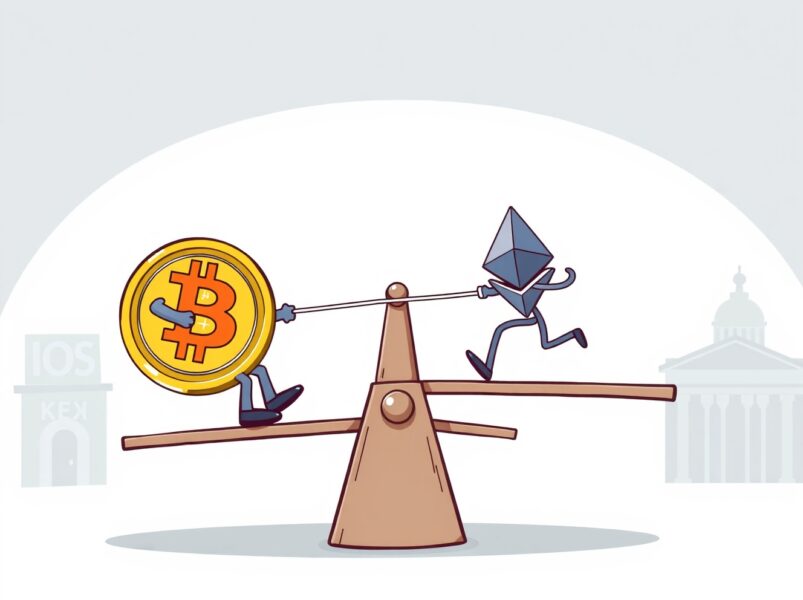
Crucial ETH/BTC Ratio: Why Ethereum Struggles Against Bitcoin’s Dominance

Crucial ETH/BTC Ratio: Why Ethereum Struggles Against Bitcoin’s Dominance

BitcoinWorld Crucial ETH/BTC Ratio: Why Ethereum Struggles Against Bitcoin’s Dominance The cryptocurrency market is a dynamic landscape, and one of the most closely watched metrics by investors is the ETH/BTC ratio. This ratio measures Ethereum’s value relative to Bitcoin, offering insights into which of these crypto giants is currently outperforming the other. Recently, however, this crucial indicator has faced significant headwinds. Despite a wave of institutional interest in Ethereum and ETH itself reaching impressive new all-time highs, the ETH/BTC ratio has notably failed to reclaim the critical 0.05 level. This persistent struggle raises important questions for investors and market watchers alike. What exactly is holding Ethereum back from truly breaking free of Bitcoin’s gravitational pull? Understanding the ETH/BTC Ratio: A Key Metric for Investors The ETH/BTC ratio is more than just a number; it’s a barometer for market sentiment and capital flow between the two largest cryptocurrencies. When the ratio rises, it suggests that capital is flowing from Bitcoin into Ethereum, indicating stronger confidence or higher growth expectations for ETH. Conversely, a falling ratio often points to Bitcoin’s relative strength or a broader market shift towards the perceived safety of BTC. Understanding this dynamic is vital for anyone navigating the crypto space. It helps investors gauge potential shifts in market leadership and adjust their portfolios accordingly. Historical Performance: Why Has the ETH/BTC Ratio Faced Resistance? Looking back at history provides crucial context for the current performance of the ETH/BTC ratio. On-chain analyst James Check highlighted that Ethereum has only outperformed Bitcoin during roughly 15% of its existence. Its most significant bull runs, where ETH truly shone, occurred between 2015 and 2017. This period was characterized by groundbreaking innovations like the introduction of smart contracts and the explosive ICO boom, which were unique to Ethereum at the time. However, since 2020, Bitcoin has largely maintained a relative advantage. This suggests that while Ethereum brings innovation, Bitcoin often retains its position as the market’s primary store of value and first mover. The recent struggle below 0.05 continues this trend, even as Ethereum’s ecosystem expands. The Paradox of Institutional Interest: What’s Holding ETH Back? It seems counterintuitive, doesn’t it? Ethereum is attracting substantial institutional interest, with new investment products and corporate adoption on the rise. Yet, the ETH/BTC ratio remains stubbornly below 0.05. This paradox can be attributed to several factors. Firstly, institutional capital often prioritizes established assets with clear regulatory pathways, and Bitcoin, as the pioneer, still holds an edge in this regard. Secondly, while institutional demand for ETH is growing, it might not yet be strong enough to consistently outpace Bitcoin’s broader market dominance or absorb profit-taking pressure. Moreover, the sheer size and liquidity of Bitcoin’s market mean it can often absorb large inflows without significant price impact on the ratio, while Ethereum’s movements are more reactive. Expert Outlook: What’s Next for the ETH/BTC Ratio? So, what does the future hold for the ETH/BTC ratio? Analysts offer mixed perspectives. Jake Kennish from Nansen, a crypto data analytics firm, predicted that Ethereum might be due for a short-term correction. As ETH hovers near its previous all-time highs, some consolidation is natural before a potential new peak. He suggested it could take several weeks or even months for Ethereum to establish a truly new price ceiling and, consequently, influence the ratio more significantly. Investors should watch for catalysts such as major Ethereum network upgrades (like the upcoming Dencun or future Pectra upgrades), which could inject new life and utility into the ecosystem, potentially boosting the ETH/BTC ratio. Navigating the Market: Actionable Insights for Investors For investors, understanding the current state of the ETH/BTC ratio offers valuable insights. Diversify Wisely: Don’t put all your eggs in one basket. While Ethereum has immense potential, Bitcoin’s stability often provides a foundational layer for crypto portfolios. Monitor Key Events: Keep an eye on Ethereum’s development roadmap, especially major upgrades. These can be significant catalysts for price action and ratio shifts. Analyze Market Sentiment: Understand whether the broader market is in a “risk-on” phase (favoring altcoins like ETH) or a “risk-off” phase (favoring Bitcoin). Long-Term Vision: Both assets have strong fundamentals. Short-term fluctuations in the ETH/BTC ratio should be viewed within a broader, long-term investment strategy. Remember, market analysis is crucial, and staying informed about both Bitcoin and Ethereum’s individual trajectories is key. Summary: The Enduring Battle for Crypto Dominance The ongoing struggle of the ETH/BTC ratio below 0.05 highlights the complex dynamics at play within the cryptocurrency market. Despite Ethereum’s innovative strength and growing institutional appeal, Bitcoin’s historical dominance and market depth continue to exert significant influence. While experts predict potential short-term corrections for ETH, the long-term outlook remains tied to Ethereum’s ability to deliver on its technological promises and attract sustained, deep institutional capital. For now, the battle for crypto dominance continues, making the ETH/BTC ratio a fascinating indicator to watch. Frequently Asked Questions (FAQs) Q1: What does the ETH/BTC ratio signify? A1: The ETH/BTC ratio indicates Ethereum’s value relative to Bitcoin. A rising ratio suggests Ethereum is outperforming Bitcoin, while a falling ratio means Bitcoin is showing stronger relative performance. It helps investors understand capital flow between the two assets. Q2: Why is the ETH/BTC ratio struggling to reclaim 0.05? A2: The ETH/BTC ratio is struggling due to several factors, including Bitcoin’s historical dominance since 2020, its perceived status as a safer institutional asset, and the market’s absorption of new ETH supply or profit-taking. Despite institutional interest in ETH, it hasn’t yet translated into sustained outperformance against BTC. Q3: Has Ethereum ever significantly outperformed Bitcoin? A3: Yes, Ethereum significantly outperformed Bitcoin during its early years, particularly between 2015 and 2017. This period was driven by the introduction of smart contracts and the ICO boom, which were revolutionary developments unique to Ethereum. Q4: What role does institutional interest play in the ETH/BTC ratio? A4: While institutional interest in Ethereum is growing, it’s not always enough to consistently boost the ETH/BTC ratio above key resistance levels. Institutional capital often flows into Bitcoin first due to its established nature and regulatory clarity. However, sustained institutional adoption of Ethereum could become a long-term catalyst. Q5: What factors could help improve the ETH/BTC ratio in the future? A5: Future Ethereum network upgrades (like Dencun or Pectra), increased utility and adoption of decentralized applications (dApps), and a broader market shift towards “risk-on” assets could potentially help improve the ETH/BTC ratio. Continued, deep institutional investment into Ethereum-specific products would also be a significant driver. Did this analysis of the ETH/BTC ratio help you understand the market better? Share your thoughts and this article with your network on social media to spark further discussion about the future of Ethereum and Bitcoin! To learn more about the latest crypto market trends, explore our article on key developments shaping Ethereum price action. This post Crucial ETH/BTC Ratio: Why Ethereum Struggles Against Bitcoin’s Dominance first appeared on BitcoinWorld.

Author: Coinstats
A Blockchain Platform Where DApps Can Achieve High-Speed And Low-Latency Interactions

A Blockchain Platform Where DApps Can Achieve High-Speed And Low-Latency Interactions

The post A Blockchain Platform Where DApps Can Achieve High-Speed And Low-Latency Interactions appeared on BitcoinEthereumNews.com. IOST (Internet of Services Token) is a cryptocurrency and blockchain platform designed to provide a scalable and efficient infrastructure for building decentralized applications (DApps). IOST tries to address some of the scalability and performance challenges faced by existing blockchain networks by introducing innovative consensus mechanisms and technologies.  Proof of Believability It uses a unique consensus mechanism called “Proof of Believability” (PoB), which aims to improve network scalability while maintaining security and decentralization. PoB enables faster transaction confirmation times and higher throughput compared to some traditional blockchain networks, making IOST suitable for high-frequency transactions. Moreover, IOST implements sharding, a technique that divides the network into smaller shards to process transactions in parallel, further enhancing scalability. Gas-free transactions IOST introduces a concept called “Gas-Free Services,” allowing DApp users to interact with DApps without paying transaction fees. Developers can choose to subsidize user transactions. The platform also supports decentralized identity solutions, enabling users to have control over their personal data and digital identities. IOST is the native utility token of the IOST platform. It is used for transactions, staking, voting, and participating in the platform’s ecosystem. IOST token holders can participate in network governance and consensus by staking tokens and voting for validators. Disclaimer. This article is for informational purposes only and should not be viewed as an endorsement by CoinIdol. They are not a recommendation to buy or sell cryptocurrency. Readers should do their research before investing in funds. Source: https://coinidol.com/iost-internet-of-services-token/

Author: BitcoinEthereumNews
Cardano, Pi Network Or Layer Brett; Which Of These Is Set For 40x Gains In 2025?

Cardano, Pi Network Or Layer Brett; Which Of These Is Set For 40x Gains In 2025?

The post Cardano, Pi Network Or Layer Brett; Which Of These Is Set For 40x Gains In 2025? appeared on BitcoinEthereumNews.com. Crypto News 14 September 2025 | 19:30 As altcoins seem to be rallying again, investors are in search of the next big opportunity. Everyone wants a coin that can turn $1,000 into $50,000 in a few months, and names like Cardano (ADA) and Pi Network (PI) are popping up. Both coins have recorded significant growth in the past, and analysts are tipping them for gains this year. However, a new Ethereum-based meme coin called Layer Brett (LBRETT) is crafting a strong narrative on presale. After raising over $3.5 million in a couple of weeks, LBRETT is going viral, causing analysts to tip it for 40x gains in the coming months. How does Layer Brett stand out compared to established altcoins like PI and ADA? Let’s find out. Layer Brett could deliver 40x gains in 2025 Currently in presale, Layer Brett is being called the most exciting meme coin of 2025. But since it’s not the only presale meme coin, why is Layer Brett getting such optimistic narratives? Unlike typical meme projects that rely only on hype, Layer Brett combines viral meme branding with Ethereum Layer-2 scalability. The platform supports traders looking for faster and cheaper transactions, setting it apart from many competitors in the meme coin space that lack utility and focus only on social media hype. Additionally, Layer Brett supports developers with a scalable platform that lets them host decentralized applications (dApps) and smart contracts. The strong Layer Brett staking APY of over 700% also attracts investors looking to earn passive income while holding their LBRETT tokens for potential post-launch gains. Analysts are already suggesting that Brett’s presale trajectory mirrors early Shiba Inu or Dogecoin, which produced life-changing returns for those who entered early. The combination of a low market cap, meme virality, and various use cases for traders…

Author: BitcoinEthereumNews