Dapp

Dapps are digital applications that run on a P2P network of computers rather than a single server, typically utilizing smart contracts to ensure transparency and uptime. In 2026, Dapps have achieved mass-market appeal through Account Abstraction, allowing for a "Web2-like" user experience with the security of Web3. This tag covers the entire ecosystem of decentralized software—from social media and productivity tools to governance platforms and identity management.

4926 Articles
Created: 2026/02/02 18:52
Updated: 2026/02/02 18:52
Beldex Launches $150,000 Creator Leaderboard Campaign With Kaito to Reward Community Voices

Beldex Launches $150,000 Creator Leaderboard Campaign With Kaito to Reward Community Voices

The post Beldex Launches $150,000 Creator Leaderboard Campaign With Kaito to Reward Community Voices appeared on BitcoinEthereumNews.com. This content is provided by a sponsor. In the ever-changing world of Web3, communities don’t just support projects — they shape their future. Beldex, a confidentiality-focused project known for building decentralized and confidential dApps, is giving its community a chance to participate in shaping its future through an ambitious new campaign. This campaign for creators, […] Source: https://news.bitcoin.com/beldex-launches-150000-creator-leaderboard-campaign-with-kaito-to-reward-community-voices/

Author: BitcoinEthereumNews
Can You Handle Missing These 6 Top Coins to Invest in 2025 Once More?

Can You Handle Missing These 6 Top Coins to Invest in 2025 Once More?

In 2025, the search for top coins to invest in 2025 is more intense than ever, with presales turning early […] The post Can You Handle Missing These 6 Top Coins to Invest in 2025 Once More?  appeared first on Coindoo.

Author: Coindoo
Best 1000x Crypto Presale in 2025?

Best 1000x Crypto Presale in 2025?

The post Best 1000x Crypto Presale in 2025? appeared on BitcoinEthereumNews.com. Crypto News 30 September 2025 | 12:15 BullZilla rockets with 4885% ROI as whales pile into the best 1000x crypto presale in 2025; ADA eyes $0.5095 drop, XRP nears ETF deadlines. Is the next wealth-shaping presale already underway while the market debates ADA’s weakness and XRP’s ETF race? That’s the question traders are asking as September 2025 turns red for most altcoins yet green for one meme-fueled monster: BullZilla ($BZIL). While Cardano slides toward $0.5095 support and Ripple whales stir ahead of key ETF deadlines, BullZilla has already unleashed a presale unlike anything seen this year. With $710,000+ raised, 29 billion tokens sold, and over 2,300 holders, the project’s progressive price engine is cranking every 48 hours or each time $100,000 floods in. For investors hunting the best 1000x crypto presale in 2025, $BZIL is proving that the real gains don’t wait for approval; they roar into existence. BullZilla’s Progressive Price Engine Creates Asymmetric Upside What happens when you combine degen storytelling with tokenomics designed to climb relentlessly? BullZilla answers with its progressive price engine, a feature that lifts its price every 48 hours or after each $100,000 milestone. This system is engineered for acceleration. Presale Stats Table Stage Price per $BZIL Tokens Sold Holders Funds Raised ROI Potential (to $0.00527) 4th (Red Candle Buffet) $0.00010574 29B+ 2,300+ $710,000+ 4885.25% Stage 4D ROI for Earliest Joiners $0.00006574 N/A N/A N/A 1738.96% Next Stage (5A) $0.00011241 Increasing Fast Growth Pending +6.30% from current Consider this: a $6,500 investment at the current stage buys around 61.47 million BZIL tokens at $0.00010574 each. Once listed at $0.00527, that allocation becomes $323,000+, a staggering 4885% gain. This highly affordable entry won’t last. Each whale buy pulls the presale closer to the next stage, and with stages moving every two days, hesitation on the best…

Author: BitcoinEthereumNews
As ADA Slips and XRP Awaits ETFs, Michael Saylor’s Scarcity Strategy Meets BullZilla’s Roar Burn: Best 1000x Crypto Presale in 2025?

As ADA Slips and XRP Awaits ETFs, Michael Saylor’s Scarcity Strategy Meets BullZilla’s Roar Burn: Best 1000x Crypto Presale in 2025?

Is the next wealth-shaping presale already underway while the market debates ADA’s weakness and XRP’s ETF race? That’s the question […] The post As ADA Slips and XRP Awaits ETFs, Michael Saylor’s Scarcity Strategy Meets BullZilla’s Roar Burn: Best 1000x Crypto Presale in 2025? appeared first on Coindoo.

Author: Coindoo
Anoma Launches Mainnet as Inclusive Web3 Operating System on Ethereum

Anoma Launches Mainnet as Inclusive Web3 Operating System on Ethereum

Anoma showcases its Ethereum mainnet with the $XAN token as introducing intent-based architecture to unify liquidity, dApps, and multi-chain Web3 ecosystems.

Author: Blockchainreporter
IOSG: Analyzing how the Hyperliquid ecosystem gave rise to the "Robinhood moment" of mobile crypto trading

IOSG: Analyzing how the Hyperliquid ecosystem gave rise to the "Robinhood moment" of mobile crypto trading

By Max @IOSG Key Points TL;DR Retail investing in traditional finance (tradfi) has gone mobile (zero commission + app user experience), and this trend is spreading to the cryptocurrency field - retail users are looking for a fast, familiar, low-friction mobile native trading experience. Hyperliquid's technology stack (HyperEVM + CoreWriter + builder code) significantly lowers the development threshold for mobile front-ends, while taking into account the execution efficiency of CEX-like and the advantages of DEX (self-custody, fast coin listing, and fewer geographical/KYC restrictions). A wave of native mobile apps built on HL has begun: BasedApp, Mass.Money, Dexari, and Supercexy. These apps generate an average daily trading volume of $50,000 USD (with a monthly recurring revenue of $1.5 million USD), representing approximately 3-6% of HL perpetual contract trading volume, and target diverse user groups (crypto-native users, Web2 retail users, and professional traders). Why now? Hyper-speculation and the creator content cycle have increased retail users’ risk appetite; mobile apps have shortened user onboarding time, simplified the complexity of crypto, and added sticky features (copy trading, fiat currency deposits, card payments, money markets, and income tools). Core arguments: Crypto mobile trading fronts benefit from strong tailwinds from Web2 mass adoption and retail activity. For the cryptocurrency market to grow in scale and transaction volume, it needs to provide more crypto-native mobile applications for mainstream Web2 consumers. Compared with the Web3 business model, this field has real sustainable scale revenue characteristics and extremely low marginal cost of expansion. The past few months have seen a significant increase in the number of mobile trading and DeFi applications targeting retail consumers, many of which are built on Hyperliquid's infrastructure. This article aims to delve deeper into this vertical, analyzing the applications currently dominating the market and providing relevant insights. background Overall, retail investor participation in traditional investments has grown dramatically over the past decade. This trend began in 2019, when several major US brokerages reduced stock trading commissions to zero to compete with Robinhood, significantly reducing trading costs for small accounts. The 2020 pandemic accelerated this process: lockdowns, stimulus checks, and continuously optimized mobile experiences brought millions of new investors into the market. By 2022, the Federal Reserve's Survey of Consumer Finances showed a significant increase in stock market participation—58% of US households owned stocks directly or indirectly, and direct ownership jumped from 15% to 21%, the largest increase on record. Retail trading continues to play a significant role in daily market activity: it currently accounts for 20-30% of US stock trading volume, far exceeding pre-pandemic levels. This phenomenon is not limited to the United States but is also evident globally: the number of investment accounts in India has surged from tens of millions pre-pandemic to over 200 million by 2025. Investment channels are also continuing to expand—ETF inflows reached a record high in 2024-2025, and the popularity of fractional share trading and mobile brokerage services has provided retail investors with more convenient investment tools. The cost impact of zero commissions, the access impact of mobile trading applications, and the liquidity impact of ETFs have collectively driven retail investors to enter the public markets on a large scale, making consumer-grade investment applications a significant structural force in the market. Mobile Trading App Since 2021, the mobile trading app vertical within the retail trading market has continued to expand, driven by the increasing penetration of mobile devices and the rise of a new generation of independent decision-making investors. The global investment app market is projected to reach approximately $254.9 billion by 2033, growing at a compound annual growth rate (CAGR) of 19.1%. Why are mobile trading apps so popular among retail investors? The main reasons can be summarized into two dimensions: #Socially driven (everything is gamified and gambling-like) Contemporary social culture is dominated by dopamine loops, gamification mechanisms, and hyper-speculative behavior. The rise of the creator economy and short-form video platforms like TikTok and YouTube Shorts has reshaped user behavior, driving a demand for instant gratification. Mobile trading apps perfectly fit this need on multiple levels. On the social media front, communities like Wall Street Bets on platforms like Reddit are flooded with users showcasing massive gains and losses. Single-day gains and losses exceeding $100,000 have become normalized, and retail users are becoming increasingly desensitized to such sums. Many users separate their Robinhood account funds from real money, viewing their portfolios as mere chips in a game. Coupled with rising living costs, a widening wealth gap, and negative sentiment surrounding "involution," many working-class individuals believe the only way to achieve the American Dream is through "hyper-speculation"—taking extreme risks for outsized returns. Mobile trading apps have successfully capitalized on this social and cultural trend. By offering short-term options, leveraged products, instant execution, and a gamified interface, these apps have successfully lured users away from casinos and into the stock market. Users can simultaneously experience the dopamine rush, gaming thrills, and speculative trading experiences all on a single mobile device. #Application Features Mobile trading apps have significantly improved their features across multiple dimensions. Onboarding, they have condensed the account opening process from days of tedious paperwork to a near-instant online experience. All user processes, from identity verification to trade execution, are integrated into a single interface, enabling users to fully manage their portfolios. By removing friction points from traditional brokerage models and incorporating new value propositions like fractional share purchases and recurring investments, these platforms lower both the financial and cognitive barriers to entry. By incorporating familiar consumer design language from mainstream apps, they shorten the trading decision-making process, while personalized features like curated target lists and portfolio performance analysis maintain user engagement. Furthermore, post-investment features like detailed performance reporting and automated tax filing make the experience more akin to a full-service financial application, enabling users to complete all operations, rather than a simple trading terminal. On the social side, content elements further lower the barrier to use by providing an easily shareable interface, fostering social engagement and incentives (e.g., usage driven by the WSB forum). These characteristics collectively explain why mobile platforms have become the default investment channel and a persistent driver of retail market participation. How does this impact the cryptocurrency industry? The mobile-first application trend has extended from traditional finance/Web2 markets to the Web3 field. The surge in cryptocurrency wallet app usage over the past five years demonstrates market demand for mobile-native crypto products. Since trading and earning are inherent features of cryptocurrencies, perpetual swaps and DeFi are naturally the first areas to be transformed in this "mobile" era. With the rise of Hyperliquid since the end of 2024 and the launch of its modular high-performance trading infrastructure, many mobile perpetual contract DEX transactions and DeFi front-end products began to be built on HL infrastructure and flooded into the market. Why Hyperliquid and DEX? From a developer's perspective, HyperEVM's infrastructure is highly attractive due to the powerful tools it provides. CoreWriter and precompiled contracts allow smart contracts on HyperEVM to interact directly with HyperCore perpetual contract positions, enabling unique use cases and near-instant execution. Builder Code provides a clear incentive layer for developers, enabling them to earn a share of transaction fees when users trade through their front-ends. These features not only lower the barrier to entry for development but also make HyperEVM one of the most developer-friendly platforms, attracting top teams and talent. This is why 99% of mobile crypto trading front-ends are built on Hyperliquid. As for why DEXs? Traders are generally drawn to their structural advantages: broader access by eliminating KYC and jurisdictional restrictions, faster coin listings and a wider selection of tokens, and the ability to manage funds autonomously. Previously, CEXs attracted retail users because they significantly reduced the complexity of market participation: offering multiple trading markets within a single, mature web application, instant execution, low slippage, and high liquidity, along with integrated support features like wallet management, stable returns, and fiat currency access. However, this required users to assume significant counterparty risk and forgo the right to self-custody their assets. Hyperliquid is the platform that perfectly integrates all of these elements. This on-chain decentralized exchange combines the structural advantages of a DEX perpetual contract platform with CEX-level liquidity, execution efficiency, and overall user experience. This makes it the ideal liquidity infrastructure for building mobile crypto trading applications. So how does all this relate to mobile wallet transactions? Thanks to the availability of this modular, high-performance architecture, the development costs of building a mobile trading front-end have become extremely low - this is why a large number of related applications have begun to emerge on the market. Most mobile trading front-ends currently offer similar functionality centered around perpetual contract trading, but some are beginning to go beyond perpetual contracts to offer users a wider range of ancillary products. Generally speaking, these apps generally offer the following features: Fiat currency deposit channels: Supports credit/debit cards, bank transfers, Apple Pay, Google Pay, Venmo and other deposit methods Investment strategy tools: Provide fixed investment plans, stop-loss and take-profit functions, and early access to new tokens Money Market Integration: One-Stop Access to DeFi Lending Protocols Earn interest: Earn income through automatic compounding vaults Dapp Explorer: Search and connect to emerging decentralized applications Debit/Credit Card Services: Directly use self-managed funds for spending These features are made possible by Hyperliquid's infrastructure, which greatly simplifies the development of the core perpetual contract product, freeing the team to focus on innovation in other derivative areas. Due to the modular nature of the entire ecosystem, most HL-based projects can easily achieve parallel development in multiple areas. The rich functionality offered by many applications is primarily due to: 1. the low development threshold of Hypercore's developer code; 2. the high willingness to integrate with other protocols. In addition, major applications are competing mainly in terms of user experience/interface design and social brand building. The most promising representatives in the market include: #Basedapp Currently, Based App is the most popular and fastest-growing mobile trading front-end application in the market. In addition to offering perpetual contracts and spot trading, the platform also innovatively offers debit/credit card solutions directly connected to users' trading wallets, supporting payment needs in everyday scenarios. Its long-term goal is to transform into an emerging digital bank similar to Etherfi. #Mass.Money Following closely in the mobile trading front-end competition is Mass.money. Unlike its "Based App" platform, this platform focuses more on the Web2 retail user base, a positioning fully reflected in its product design: in addition to standard HL perpetual contracts and spot trading, it also integrates Apple Pay deposit channels, social copy trading functionality, access to DeFi money markets, and cross-chain EVM spot exchange, among other full-featured services. Its interface design deeply incorporates gamification elements, drawing heavily on the design language of Web2 consumer applications. However, due to their higher fee model and broader product portfolio, their revenue per user and transaction volume are significantly higher than BasedApp. #Dexari Following closely behind Mass.money is Dexari, a mobile trading front-end designed for professional traders, focusing purely on trading functionality. Key product features include HL perpetual contracts and spot trading, with a user experience and interface design focused on asset discovery, analytical tools, and execution efficiency. Their goal is to become the Axiom (professional trading benchmark) of mobile trading front-ends. #Supercexy Last but not least, Supercexy. This platform has opted for a purely mobile-first approach and is also optimizing its web-based perpetual contract DEX trading experience, aiming to provide a CEX-like experience, but built entirely on Hyperliquid infrastructure. With DeFi staking and money market access integrated into its product suite, the app primarily serves Web3-native traders. Comprehensive perspective Overall Overview Overall, the combined average daily revenue for all relevant mobile trading frontends (including some not mentioned here) is approximately $50,000, equivalent to approximately $1.5 million in monthly recurring revenue (MRR). These apps account for approximately 3%-6% of Hyperliquid's total perpetual contract volume. For reference, Hyperliquid's HLP vault accounts for approximately 5%. Hyperliquid Mobile Trading Front-End Revenue Summarize Core Viewpoint Cryptocurrency mobile trading frontends benefit from strong tailwinds from the Web2 crowd and retail activity The trend of hyper-speculativeness in society has fundamentally altered retail consumer behavior. As evidenced by the growth of Polymarket and Kalshi, most users in the current environment adopt high-risk strategies. With speculative demand at an all-time high, mobile trading apps are the product form most directly benefiting. As mentioned earlier, traditional financial mobile apps like Robinhood, Wealthsimple, and TD Ameritrade have seen significant increases in user growth and adoption, primarily due to their low barriers to entry and their willingness to promote short-term, highly leveraged, and gambling-like products. Clearly, retail users need easy ways to gain risk exposure and allocate capital, and mobile trading apps are the most logical solution. Mobile cryptocurrency trading apps are fundamentally no different and can similarly benefit from this consumer behavior if they effectively build discoverability. Robinhood, Wealthsimple, and Revolut, all integrating crypto products into their apps, are a testament to this. Despite charging significantly higher fees, these traditional financial apps have seen significant adoption of crypto products within their apps, demonstrating a strong demand among retail users for convenient mobile access to the crypto market. Without dedicated mobile crypto trading apps, the Web3 market will cede significant value capture opportunities to Web2 competitors. For the cryptocurrency market to achieve growth in scale and transaction volume, it needs to provide more crypto-native mobile applications for mainstream Web2 consumers. There has been virtually no new retail inflows since 2023. The total stablecoin market capitalization is only about 25% above its 2021 all-time high, a dismal four-year growth rate for any sector—and this is happening against the backdrop of the most favorable regulatory environment for stablecoins and strong presidential support for the crypto industry. The market needs solutions to attract new retail liquidity, but significant barriers to new retail capital entry remain unaddressed. The primary obstacles are: first, the public's perception of complex operational processes for participating in the crypto market; second, a lack of accessible applications that truly understand the needs of Web2 users. Web2 retail users don't use complex wallets or transfer funds across multiple chains. They need products packaged in a familiar format, offering easy onboarding and a user-friendly experience, similar to accounts like Robinhood or Wealthsimple. Cryptocurrency mobile trading front-ends are the solution—they package products in traditional financial formats familiar to Web2 users, fundamentally removing the cognitive barrier to entry and lowering the barrier to participation. This is the only effective way for cryptocurrencies to break through Web3 circles and gain mainstream exposure. A real revenue model with sustainable economies of scale and very low expansion costs compared to the Web3 business model Mobile cryptocurrency trading frontends mark the beginning of a new generation of applications in the Web3 market—a more sustainable and compliant path to development. Unlike previous traditional crypto products (whether infrastructure or DApps), most projects haven't focused on scaling or revenue generation because these weren't core incentives. Most founders' North Star metric was acquiring initial users at any cost, no matter how inefficient or extractive their growth funnels were. They then raised venture capital, locked up tokens through over-the-counter sales, or waited out vesting periods without improving their products. Typical examples include Story Protocol ($IP), Blast, and Sei Network ($SEI). Crypto mobile trading frontends take the opposite approach: leveraging existing infrastructure to optimize scale, generating revenue first and raising capital later. By acting as aggregators of diverse products and employing a base fee structure, these frontends possess the structural advantage of integrating across multiple verticals at minimal cost, while simultaneously focusing on the user experience interface to drive user acquisition and retention. This combination means revenue generation from day one, with continued exponential growth over time. The end result is a more sustainable, real-world commercial and value layer for Web3, replacing the extractive model of the past. This will bring growing credibility to the entire Web3 industry.

Author: PANews
M3 DAO Joins Forces with LinkLayerAI to Bring Smart Capabilities to Web3 Users, Driving Customer Engagement

M3 DAO Joins Forces with LinkLayerAI to Bring Smart Capabilities to Web3 Users, Driving Customer Engagement

By partnering with LinkLayerAI, M3 DAO improves liquidity and efficiency in its platform and enables its members to engage with DApps more seamlessly.

Author: Blockchainreporter
Best Crypto to Buy as Strategy Buys $22M Bitcoin in Full Market Recovery

Best Crypto to Buy as Strategy Buys $22M Bitcoin in Full Market Recovery

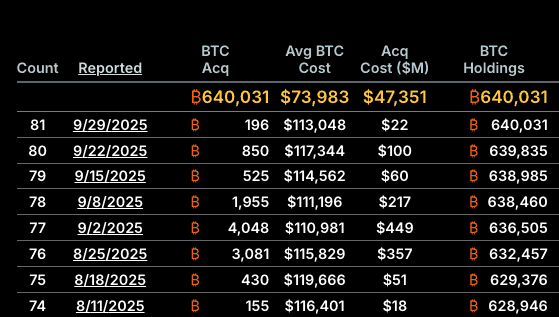
The post Best Crypto to Buy as Strategy Buys $22M Bitcoin in Full Market Recovery appeared on BitcoinEthereumNews.com. There’s no stopping the Michael Saylor-led Strategy as it bought an additional 196 Bitcoin ($BTC) yesterday, worth around $22M. This recent acquisition is its eighth-straight week of Bitcoin purchases, which further extended its lead as the largest Bitcoin treasury company. Continued bullishness on the world’s most valuable cryptocurrency has reflected the crypto market in general, which has been in recovery mode since the week began. It also puts the spotlight on some of the best crypto to buy, including Best Wallet Token ($BEST) and Bitcoin Hyper ($HYPER). Strategy Grows Bitcoin Holdings Even as Its Stock Price Slides to $300 Strategy further cemented its status as the top Bitcoin treasury company with a fresh purchase of 196 $BTC yesterday. Its most recent Bitcoin buy is the third-smallest of the year after its 130 $BTC and 155 $BTC purchases in March and August respectively. Despite that, it remains the top Bitcoin treasury company with its 640,031 $BTC holdings. Source: Strategy This comes after the company’s $MSTR stock price dipped to just above $300 after a rally to $455.90 in July. According to crypto analyst JA Maartun, it is the lowest level the company’s stock has seen in six months. Source: X/@JA_Maartun Despite that, the latest buy signals Strategy’s continued bullishness on Bitcoin, which the company acquired at an average price of $73,983. This also reflects positively on the crypto market, which has bled profusely over the past month. With October historically a period of recovery, this bodes well for some of the best crypto to buy right. Let’s take a look at the top three. 1. Bitcoin Hyper ($HYPER) – Making the Bitcoin Ecosystem Faster, Cheaper, and More Scalable Bitcoin may be the most valuable crypto, but it’s beset with issues. Transactions are typically slow and expensive, and you can’t do much…

Author: BitcoinEthereumNews
The Best Crypto to Buy as Strategy Buys an Additional $22M Worth of Bitcoin

The Best Crypto to Buy as Strategy Buys an Additional $22M Worth of Bitcoin

There’s no stopping the Michael Saylor-led Strategy as it bought an additional 196 Bitcoin ($BTC) yesterday, worth around $22M.

Author: Brave Newcoin
Solana Gaining Ground On Ethereum: These Key Metrics Show Colossal Growth

Solana Gaining Ground On Ethereum: These Key Metrics Show Colossal Growth

In recent months, Solana (SOL) has emerged as a formidable competitor to Ethereum (ETH), consistently outpacing its larger rival in various key metrics. Analysts from The Motley Fool have highlighted that while Solana is sprinting ahead, Ethereum seems to be trotting along in comparison. Ethereum’s Market Lead May Be At Risk  A particularly telling metric in this competition is the total value locked (TVL) within each ecosystem. TVL serves as an indicator of the capital deposited in a blockchain’s decentralized applications (dApps) and smart contracts.  A higher total value locked often signifies greater value within the ecosystem, reflecting growing user engagement and investment. Over the past year, Solana has seen its total value locked soar by approximately 198%, reaching around $38.5 billion.  Related Reading: Bitcoin Could Go To Zero, Hedge Fund CEO Warns Meanwhile, Ethereum has also doubled its total value locked, which now stands at approximately $362.7 billion. However, the growth rate of Solana’s ecosystem outpaces that of Ethereum, signaling a shift in user activity and interest. Despite Ethereum’s substantial lead in TVL, particularly in the stablecoin sector where it hosts around $161.1 billion compared to Solana’s $12.9 billion, the rapid growth of Solana’s ecosystem raises questions about its long-term market share.  The Motley Fool analysts suggest that if this trend continues, Solana could capture a significant portion of the market currently dominated by the Ethereum blockchain. Solana To Dominate The Tokenized Stock Market? One of the key factors contributing to Solana’s growth is its advantage in transaction speed and cost. As the market and interest for real-world asset (RWA) tokenization expands, Solana is said to be positioned as a preferred platform for issuing and trading tokenized stocks.  This segment of the tokenization market is continuously gaining traction, and Solana has already accumulated $69.2 million in tokenized stock value within just the last three months. In contrast, Ethereum holds $274.8 million in tokenized stocks, but much of that flow occurred only recently. Related Reading: XRP Explosion Ahead? Analysts Outline Longevity And Bold $200 Target Moreover, Solana’s total tokenized assets grew by 35% to reach $671.4 million in just 30 days ending on September 24, while Ethereum’s tokenized asset value saw only a modest 2% increase, reaching $9 billion.  The analysts concluded by stressing that the asset tokenization market is still in its early stages, and Solana appears well-positioned to capitalize on this opportunity.  When it comes to price growth, Ethereum is in the lead, having risen by over 50% year-to-date, compared to Solana’s 33% increase in the same period. At the time of writing, the price of SOL hovers just above the $209 mark, representing a 28% gap between current valuations and its record high of $293. Featured image from DALL-E, chart from TradingView.com

Author: NewsBTC