

Zcash (ZEC) was climbing toward $700 and outperforming much of the market when a single disclosure flipped the narrative. On June 5, 2026, word spread that Zcash's Orchard shielded pool had carried a Zcash (ZEC) was climbing toward $700 and outperforming much of the market when a single disclosure flipped the narrative. On June 5, 2026, word spread that Zcash's Orchard shielded pool had carried a
Zcash (ZEC) Orchard Vulnerability Explained: A 4-Year Counterfeiting Bug, a 40% Crash, and an Emergency Hard Fork

作者:OoJae
分享
Zcash (ZEC) was climbing toward $700 and outperforming much of the market when a single disclosure flipped the narrative. On June 5, 2026, word spread that Zcash's Orchard shielded pool had carried a critical cryptographic flaw, one that in theory, could have let an attacker mint unlimited, untraceable counterfeit ZEC. The privacy coin plunged from around $630 to the high-$300s, shedding roughly 40% and dragging the broader privacy sector down with it.
The bug had been live since Orchard launched in May 2022, nearly four years undetected and was found only weeks before by a security researcher running a commissioned audit. Developers patched it within days through an emergency hard fork. But because Orchard is built for privacy, there is no way to prove with certainty whether it was ever exploited, leaving ZEC with a question that code alone can't fully answer.
Key Takeaways
- A critical soundness flaw in Zcash's Orchard shielded pool could have allowed creation of unlimited, undetectable counterfeit ZEC inside the pool.
- It was discovered on May 29, 2026 by researcher Taylor Hornby during a Shielded Labs audit, with help from Anthropic's Claude Opus 4.8 AI model, and patched by June 1.
- The flaw had existed since Orchard's activation in May 2022, roughly four years undetected.
- A full fix shipped via the NU6.2 hard fork on June 3, Shielded Labs reports no evidence of exploitation but says privacy makes it impossible to prove either way.
- ZEC fell roughly 40% (from about $630 toward the high-$300s); a position exit by Arthur Hayes accelerated the sell-off, and volume spiked well above average.
- Orchard held about 4.2 million ZEC (~25% of supply), so confidence in shielded-balance integrity matters for the whole network.
How the Orchard soundness flaw could have minted counterfeit ZEC.
What Actually Went Wrong in Orchard
Orchard is the zero-knowledge shielded pool that gives Zcash its privacy, it hides senders, recipients and amounts using zero-knowledge proofs. The flaw was an “under-constrained” element in the Orchard circuit: an elliptic-curve multiplication that could accept arbitrary false inputs and still be approved, meaning the proof system would validate fraudulent transactions as legitimate.
The practical risk was severe: counterfeit ZEC could be created inside the shielded pool with no on-chain trace, a stealth supply-inflation problem rather than an ordinary double-spend. Zcash's turnstile mechanism limits how value crosses between pools, which constrains leakage to the transparent supply, but the integrity of balances within Orchard itself was the core concern.
How It Was Found — and the AI Angle
Shielded Labs engaged security researcher Taylor Hornby in April 2026 specifically to hunt for protocol bugs before malicious actors could. On May 29 he identified the issue, and — as reported by CoinDesk, The Block and others, used Anthropic's Claude Opus 4.8 to help write a working exploit that generated unlimited, undetectable counterfeit ZEC in a local test (regtest) environment. That proof-of-concept is what made the severity undeniable, and it is a notable example of an AI model assisting offensive security research on a live crypto protocol. The vulnerability had been present since Orchard's activation in May 2022, but it was caught before any known exploitation.
The Fix: Emergency Soft Fork, Then NU6.2
The response was fast and coordinated across Shielded Labs, the Zcash Open Development Lab (ZODL) and the Zcash Foundation, with node operators, miners, exchanges and wallet providers all involved. An emergency patch landed by June 1. The Zebra 4.5.3 release shipped a soft fork that temporarily disabled Orchard actions at a set block height, and Zebra 5.0.0 then activated the NU6.2 hard fork on June 3, restoring functionality with a corrected circuit.
The Market Reaction
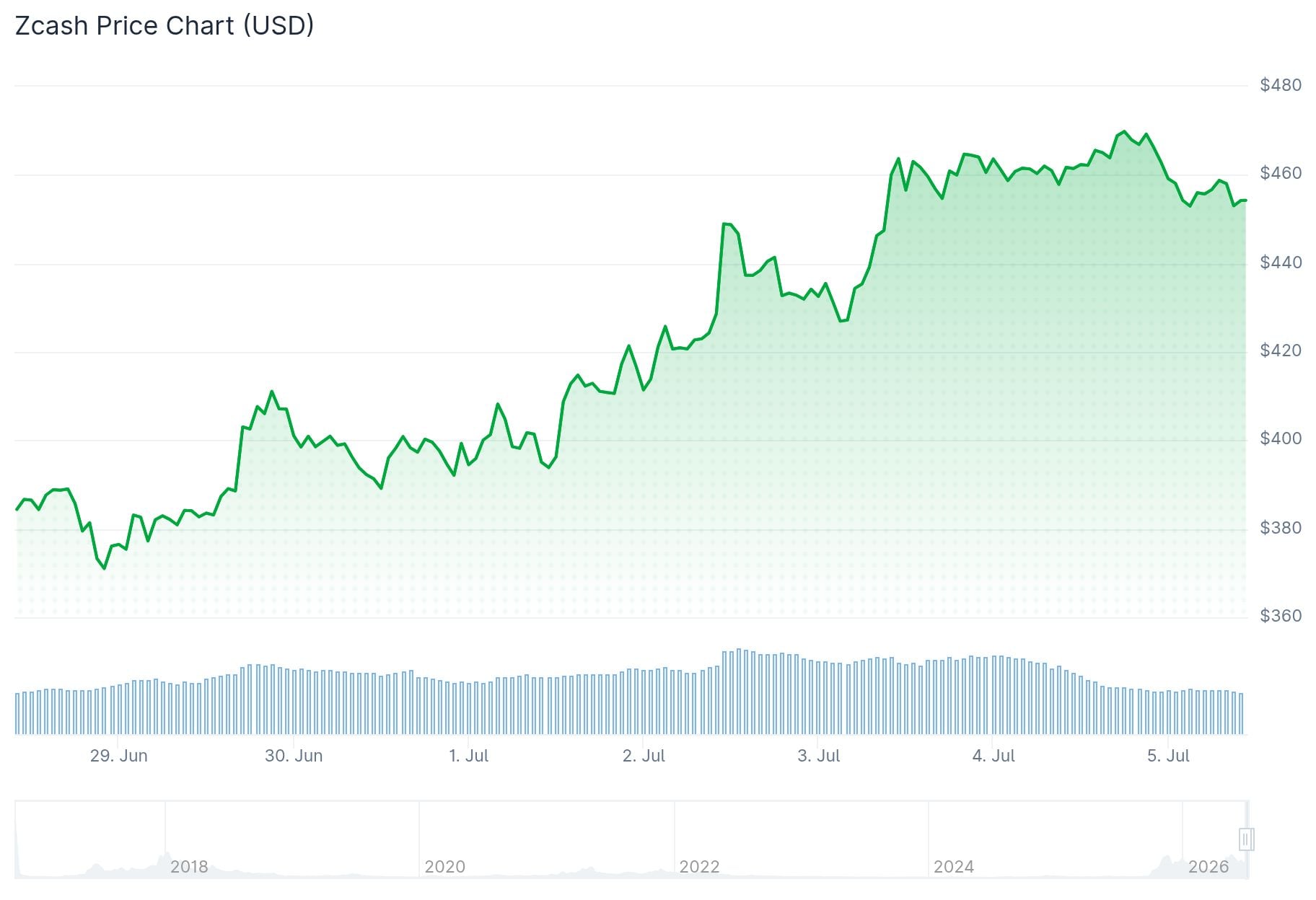
ZEC had been trading near $630–$700 before the news. The NU6.2 patch initially sparked relief, lifting ZEC from about $544 to $624. Then Arthur Hayes, one of the most prominent backers of the privacy-coin narrative exited his position, triggering a cascade that drove the price down toward $309. On June 5, trading volume ran about 68% above the 30-day average, a sign of forced liquidations rather than orderly selling. As at the time of writing, ZEC trades in the mid-$300s (roughly $340–$385 across major trackers) or higher, down around 30% on the week. You can track the live ZEC price for the latest.
ZEC's volatile week around the Orchard disclosure and fix. Source: MEXC
A Trust Test for Privacy Coins
The deeper issue is philosophical. Privacy and auditability pull in opposite directions: because Orchard hides amounts, no one can cryptographically prove the pool was never exploited. To rebuild confidence, Shielded Labs is proposing a network upgrade with new accounting and turnstile measures, and a fresh privacy pool to verify supply integrity, while the Winklevoss twins publicly backed math-based formal verification. Longer-term roadmap items such as Network Upgrade 7 and Project Tachyon aim to harden privacy and security further.
Some context cushions sentiment: U.S. regulators closed their Zcash Foundation investigation in May 2026, Grayscale filed to convert its Zcash Trust into a spot ETF, and an EU policy official clarified that ZEC is not banned in the bloc. Whether that is enough to offset the trust shock will play out over the coming weeks.
Trading ZEC on MEXC — Navigating the Volatility
ZEC/USDT spot and ZEC futures trade on MEXC. Around binary, headline-driven events like this, volatility and liquidation risk spike sharply. Use take-profit and stop-loss orders, keep leverage controlled, and follow on-chain and developer updates closely, particularly progress on the proposed supply-integrity upgrade. You can monitor the live ZEC price and market data and set trigger and execution levels to fit your own risk tolerance.
Conclusion
The Orchard episode is, in one sense, a success story: a serious flaw was caught by a commissioned auditor and patched within days, before any confirmed exploit. In another sense, it exposes the unavoidable tension at the heart of privacy coins, the very feature that protects users also makes it impossible to fully audit the past. ZEC's recovery will hinge less on the patch itself and more on whether the new supply-integrity measures can rebuild trust faster than skeptics can erode it.
Disclaimer: This content is for educational and reference purposes only and does not constitute any investment advice. Digital asset investments carry high risk. Please evaluate carefully and assume full responsibility for your own decisions.
市場機遇
Zcash實時價格 (ZEC)
--
----
USD
Zcash (ZEC) 實時價格圖表
描述:幣圈脈動基於 AI 技術與公開信息,第一時間呈現最熱代幣趨勢。如果想了解更多專業解讀與深度分析,請訪問新手學院。
本頁面分享的文章均源自公開平台,僅供參考。該內容不代表 MEXC 的立場或觀點。所有版權歸 OoJae 所有。如果您認為任何內容侵犯了第三方的權益,請聯絡 service@support.mexc.com 以便及時刪除。 MEXC 不保證任何內容的準確性、完整性或及時性,且不對基於所提供信息而採取的任何行動負責。本內容不構成財務、法律或其他專業建議,亦不應被解釋為 MEXC 的推薦或認可。如需專家見解和深入分析,請造訪 MEXC 學院。




熱門
目前熱門備受市場關注的加密貨幣
加密貨幣價格
按交易量計算交易量最大的加密貨幣