

OverviewMicron reported $41.46 billion in fiscal Q3 2026 revenue on June 24, up 346% year-over-year against a consensus near $35.6 billion. The order book carried the real signal: management announcedOverviewMicron reported $41.46 billion in fiscal Q3 2026 revenue on June 24, up 346% year-over-year against a consensus near $35.6 billion. The order book carried the real signal: management announced
Micron Q3 2026 Earnings Ignite an AI Memory Rally Across Asia: KOSPI, SK Hynix, Samsung and Kioxia Surge

Overview
Micron reported $41.46 billion in fiscal Q3 2026 revenue on June 24, up 346% year-over-year against a consensus near $35.6 billion. The order book carried the real signal: management announced 16 strategic customer agreements representing roughly $100 billion in minimum contracted revenue, structured with take-or-pay clauses across its high-bandwidth memory roadmap, and that single line did more to reprice Asian semiconductor equity than any margin figure could.
What followed was a cross-border repricing event that ran in one overnight cycle. South Korea's KOSPI, which had collapsed close to 10% two sessions earlier, opened more than 5% higher on June 25 and tripped a buy-side sidecar within minutes of the open, with SK Hynix and Samsung Electronics leading the bounce, while in Tokyo, NAND maker Kioxia broke through ¥100,000 per share. The transmission from Boise, Idaho to Seoul and Tokyo carried a lesson that extends past memory chips into every market priced on the AI capital-expenditure thesis, including the digital-asset venues that trade against the same dollar-liquidity conditions.
1. The Print: Reading Micron as a Supply-Constraint Signal
The income statement is best read as a sensor measuring a memory market that is operating under hard physical capacity limits and firm pricing, rather than as a conventional earnings beat. Revenue of $41.46 billion arrived against $23.86 billion the prior quarter and just $9.30 billion a year earlier, adjusted EPS landed at $25.11 versus roughly $20 expected, and gross margin printed a company record near 84.9% as combined data-center revenue cleared $25 billion in the quarter; an annualized run rate above $100 billion with DRAM carrying about 76% of the total mix.
Micron Q3 FY2026 | Reported | Reference |
Revenue | $41.46B | ~$35.6B consensus / $9.30B YoY |
Adjusted EPS | $25.11 | ~$20.20 consensus / $1.91 YoY |
GAAP net income | $28.24B ($24.67/sh) | |
Gross margin | ~84.9% | company record |
Q4 FY2026 guide | $50.0B ± $1.0B | ~$43B consensus |
Margin expansion of that magnitude does not come from operational efficiency but from scarcity, which is why CEO Sanjay Mehrotra's repeated statement that the company can satisfy only a fraction of medium-term demand matters more than the margin itself; a structural supply deficit hands the seller pricing control across the entire contract book. When a manufacturer pre-sells its calendar-2026 HBM in full and then signs $100 billion of minimum-revenue floors on top of that, the cyclical question that has governed memory valuation for two decades, namely when the cycle rolls over, gets pushed out beyond the visible horizon.
2. The Transmission: Why a Boise Filing Moved the Korea Exchange
Micron is the only U.S.-domiciled HBM manufacturer, which makes its filings a live proxy for two companies that do not report on the same calendar, SK Hynix and Samsung, and the market does not wait for Korean earnings to confirm the read, it prices Micron and front-runs the implication immediately.
2.1 KOSPI: Concentration Risk in Both Directions
Two sessions before the print, the KOSPI fell roughly 10% from an all-time high near 9,115 and hit circuit breakers as Samsung and SK Hynix each dropped more than 12%, and the reason the index fell that hard is structural rather than sentimental, because Samsung and SK Hynix together account for close to half of the KOSPI's entire market capitalization, which means that when both memory names move in tandem the index carries no internal hedge and correlation becomes the dominant risk factor.
That same concentration ran in reverse on June 25, when the KOSPI opened about 2.7% higher and extended past 5%, approaching 9,000 intraday and triggering a buy-side sidecar the exchange's program-trading halt that fires when KOSPI 200 futures move 5% or more as SK Hynix jumped roughly 9–12% and Samsung gained around 4–5%. A cold reading requires one correction to the easy narrative, however, because this was not a clean V-shaped recovery: foreign investors remained heavy net sellers and extended a multi-session outflow streak while domestic retail and institutions absorbed the supply, the early surge was not fully held into the close, and two non-Micron catalysts reported Samsung buyback speculation and SK Hynix's U.S. listing news contributed materially to the bid, which means attributing the entire move to one earnings report would misread a multi-factor rally that Micron triggered without single-handedly driving.
2.2 Nikkei: The Tailwind That Was Already Blowing
Tokyo told a parallel story built on different inputs, as the Nikkei 225 climbed back toward its record near 72,781 led by memory and chip-equipment names, but a weakening yen and a sharp drop in crude Brent fell under $73, its lowest since February were independent tailwinds for an import-dependent economy and both pre-dated the Micron release. Kioxia, the NAND maker that recently overtook Toyota as Japan's most valuable listed company, rose roughly 7–8% and pierced ¥100,000 per share, while Tokyo Electron, a wafer-fab equipment supplier, gained about 8% on the logic that an extended AI capex cycle lifts equipment orders, and both Advantest and SoftBank followed.
3. The Financing Shift: Asian Memory Goes Hunting for U.S. Multiples
The more durable consequence concerns capital formation rather than price, because a persistent gap between U.S. and Asian equity multiples for identical exposure is now pulling Asian hardware giants toward Wall Street listings. SK Hynix moved to raise roughly $29 billion through a U.S. American Depositary Receipt offering reports place the figure between $26 billion and $29.4 billion issuing new shares with trading targeted for mid-July pending regulatory clearance, while Kioxia has signaled its own U.S. depositary-share plan reportedly aimed at spring 2027.
The arbitrage is straightforward, since American AI capital assigns a richer multiple to memory exposure than Asian markets do for the same underlying cash flows, and bringing equity to where the deepest institutional liquidity sits is a direct attempt to close that discount. There is a second-order read here for anyone tracking global liquidity, because the AI hardware complex is now actively competing for the same pool of dollar liquidity that funds risk assets broadly from equities, credit, and the digital-asset markets that have spent this cycle trading as a high-beta expression of dollar-liquidity conditions which means that when $29 billion of new memory paper targets U.S. desks, it draws from a finite allocation that other risk assets are simultaneously bidding for.
4. The Risk Ledger: What the Rally Is Pricing Out
Every contracted-revenue floor and sold-out-supply claim deserves the opposing case stated with equal weight, beginning with the fact that cyclicality has not been repealed: memory remains the most cyclical segment in semiconductors, and while take-or-pay clauses smooth the near term, they do not abolish the cycle, because coordinated capacity additions across Micron, SK Hynix, and Samsung are the historical mechanism by which every memory upcycle ends, and the supply that feels scarce today is being built right now.
Concentration compounds that exposure, since a KOSPI that draws roughly half its value from two correlated names is a structurally fragile index, and the June 23 crash and the June 25 rebound are the same risk factor expressed with opposite signs, an investor long the KOSPI for AI exposure is in practice running a concentrated two-name memory bet wearing the costume of a diversified index. The contracted order book introduces a further dependency, because the $100 billion in minimum revenue is only as sound as the hyperscalers standing behind it, and take-or-pay obligations assume those counterparties remain willing and able to pay through any moderation in AI capex; if the spending thesis driving Microsoft, Meta, Amazon, and Google softens, the contracts get tested at precisely the moment the spot market also weakens, layering correlated counterparty risk on top of correlated price risk. The foreign-flow divergence reinforces the caution rather than resolving it, since a rebound bought by Korean retail and institutions against persistent foreign selling carries a specific failure mode whenever domestic leverage is the marginal buyer absorbing foreign exits.
5. What It Means for Allocators
The semiconductor sector can no longer be modeled through isolated domestic lenses, because a constrained hardware ecosystem with multi-year supply lockups transmits a guidance revision in Idaho into the equity risk premium in Seoul and Tokyo inside a single overnight session, and the Micron print both stabilized the KOSPI after a violent correction and reinforced that physical AI hardware still sits at the base of the entire trade, beneath the models, the tokens, and the narratives layered on top of it. For the crypto-native reader the connection is liquidity rather than analogy, since the same dollar-liquidity backdrop that funds $29 billion ADR raises and bids up HBM suppliers also sets the tide for digital assets, which means that when the hardware layer absorbs capital this aggressively, the liquidity it consumes is worth tracking directly.
FAQ
What were Micron's Q3 2026 earnings?
Revenue of $41.46 billion (up 346% YoY), adjusted EPS of $25.11, and a record gross margin near 84.9%, reported June 24, 2026, with both figures beating consensus of roughly $35.6 billion in revenue and about $20 in EPS.
Why did Micron's results move Asian semiconductor stocks?
Micron is the only U.S.-based HBM manufacturer and trades as a real-time proxy for SK Hynix, Samsung, and Kioxia, so strong guidance signaled that AI memory demand and pricing remain firm and prompted an immediate repricing of its Asian peers.
How far did the KOSPI move?
It opened about 2.7% higher on June 25 and extended past 5%, triggering a buy-side sidecar two sessions after a roughly 10% crash, though the gains were volatile and only partly sustained as foreign investors net sold against domestic buying.
What are the $100 billion customer agreements?
Micron disclosed 16 strategic customer agreements representing roughly $100 billion in minimum contracted revenue, using take-or-pay structure across its HBM roadmap, which transfers demand risk to the customer and converts volatile revenue into something closer to contracted cash flow.
What is Micron's Q4 2026 guidance?
Revenue of $50.0 billion plus or minus $1.0 billion, against roughly $43 billion expected, with gross margin near 86%.
Why are SK Hynix and Kioxia listing in the U.S.?
To arbitrage the multiple gap between U.S. and Asian markets for identical memory exposure, with SK Hynix targeting a roughly $29 billion ADR raise and Kioxia signaling a U.S. depositary-share plan for 2027, both seeking deeper dollar liquidity.
What is the main risk to the AI memory supercycle?
Cyclicality, because coordinated capacity additions across the three major memory makers historically end every upcycle, and the contracted-revenue floors depend on hyperscaler counterparties continuing to pay through any AI capex slowdown.
How does this connect to crypto markets?
Indirectly, through dollar liquidity, since large memory ADR raises and an AI hardware complex absorbing capital draw on the same liquidity pool that funds risk assets, including digital assets that trade as a high-beta expression of liquidity conditions.
Disclaimer: This article is for informational purposes only and does not constitute financial, investment, or trading advice. Digital assets are volatile and you may lose capital. Conduct your own research before making any decision.
市場機遇
4實時價格 (4)
--
----
USD
4 (4) 實時價格圖表
本頁面分享的文章均源自公開平台,僅供參考。該內容不代表 MEXC 的立場或觀點。所有版權歸 Emmanuel Olamiye 所有。如果您認為任何內容侵犯了第三方的權益,請聯絡 service@support.mexc.com 以便及時刪除。 MEXC 不保證任何內容的準確性、完整性或及時性,且不對基於所提供信息而採取的任何行動負責。本內容不構成財務、法律或其他專業建議,亦不應被解釋為 MEXC 的推薦或認可。如需專家見解和深入分析,請造訪 MEXC 學院。
學習更多 4 知識
查看更多
MEXC Global Card vs MEXC Card(APAC)vs MEXC Ether.Fi Card:哪張加密貨幣 Visa 卡最適合您?
自 2026 年 8 月 31 日起,MEXC 的卡片陣容已從兩張擴增為三張 Visa 卡:兩張由 MEXC 自行發行,另一張則是透過 ether.fi 發行的聯名卡。 MEXC Global Card 與 MEXC Card(APAC)屬於託管型卡片,直接動用您存放在 MEXC 的 USDT;MEXC × ether.fi 信用卡則是非託管卡片,讓您在資產仍然屬於自己的情況下進行消費。 兩張 M
2026/09/01

穩定幣 vs 代幣化存款:哪一種可能驅動支付的未來?
兩種版本的貨幣正在競爭上鏈。 其中一種來自幣種。 另一種則來自銀行。 USDT 和 USDC 等穩定幣已經證明,以美元計價的價值可以透過區塊鏈網路全天 24 小時在全球流轉。 銀行正在開發另一種模式:代幣化存款。 銀行不是創建一個由儲備資產支撐的獨立數位代幣,而是在可程式化基礎設施上呈現既有的存款餘額。 國際清算銀行如今在這場辯論中表明了明確立場。 在 8 月 28 日的傑克遜霍爾經濟研討會上,B
2026/09/01

俄羅斯最大銀行俄羅斯聯邦儲蓄銀行:首年交易規模達 $46 十億
俄羅斯新的受監管幣種話題正開始成形,而其最重要的參與者之一可能是一家傳統銀行。 俄羅斯最大放貸機構 Sberbank 預計,在新框架實施的第一年,受監管的俄羅斯交易所上的加密貨幣交易額將達到最高 4 兆盧布,或約 $46.43 十億。 到 2029 年,根據俄羅斯國家新聞機構 TASS 對俄羅斯聯邦儲蓄銀行副董事長 Anatoly Popov 的採訪,該數字可能達到約 7.5 兆盧布,或 $87.
2026/09/01
4 最新動態
查看更多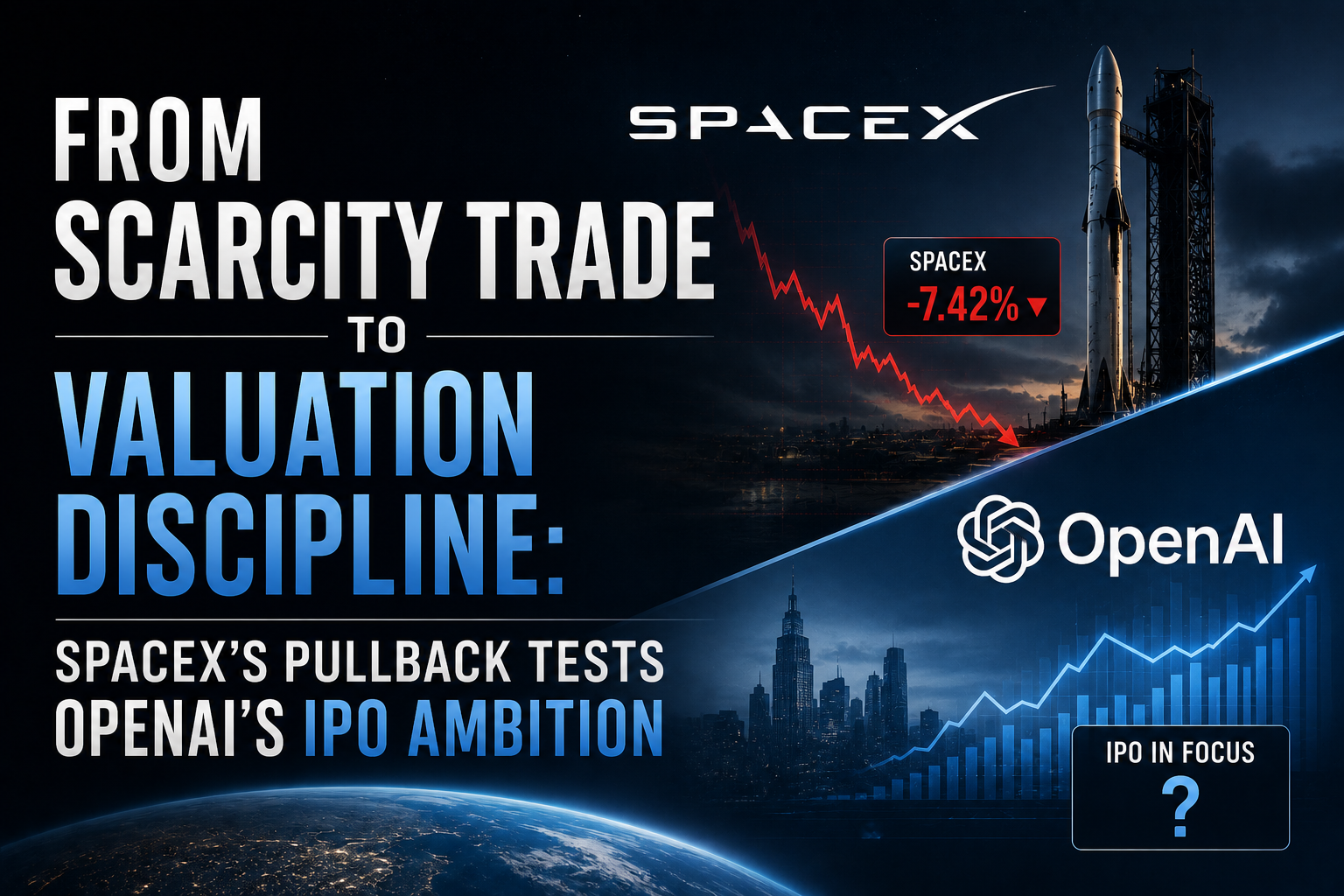
從稀缺交易到估值紀律:SpaceX的回調考驗OpenAI的IPO野心
據報導,OpenAI 傾向將其 IPO 推遲至 2027 年,但更強烈的市場訊號來自 SpaceX。SpaceX 於 6 月 22 日收盤下跌了 16.4%,收於 154.60 美元,較盤中高點 225.64 美元降低了 31.5%,但仍較其 135 美元的 IPO 價格高出 14.5%。這一走勢使 SpaceX 從一個由稀缺性驅動的 IPO 成功案例,轉變為 AI 相關超大型上市週期中首個重大公開市場壓力測試。
OpenAI 的問題不在於需求,而在於估值。路透社引用《紐約時報》的報導指出,OpenAI 正考慮等待至 2027 年,以維持高達 1 兆美元的估值目標,而顧問將此選擇定調為:要麼等待達到該估值,要麼以較低目標提前上市。
預測市場已開始反映這種謹慎態度。Polymarket 的 OpenAI IPO 市場近期顯示,OpenAI 在 2026 年 12 月 31 日前完成 IPO 的機率約為四分之一,這表明交易者不再將近期上市視為明確的基本情境。對於加密貨幣交易者而言,這使得 AI 上市前的曝險從單向的稀缺性交易,轉變為與公開市場基準掛鉤的估值紀律交易。
2026/06/29

Coldcard Mk3 警告隨 $38M Bitcoin 掃蕩而來,但原因仍未確認
比特幣硬體錢包製造商 Coinkite 已警告用戶,Coldcard 裝置存在種子生成問題,影響範圍涵蓋所有 4.0.1 及更高版本的 Mk3 韌體。此警告是在安全研究人員調查一宗涉及 594.48 BTC(價值約 3,800 萬美元)的協調性盜取事件時出現的。然而,目前尚無公開的技術證據證實 Coldcard 的問題導致了這些轉帳。
2026/07/31

Mastercard 完成對 BVNK 的收購,金額高達 18 億美元——穩定幣進入全球支付核心
Mastercard 於三月宣布該交易後,已於 2026 年 8 月 3 日(UTC +8)完成對穩定幣基礎設施供應商 BVNK 的收購。
2026/08/04
熱門
目前熱門備受市場關注的加密貨幣
加密貨幣價格
按交易量計算交易量最大的加密貨幣