

Key takeawaysUnitree Robotics opened on the Shanghai STAR Market, 629.44% above its issue price, briefly valuing the first humanoid robotics company to list in mainland China at about $66 billion, befKey takeawaysUnitree Robotics opened on the Shanghai STAR Market, 629.44% above its issue price, briefly valuing the first humanoid robotics company to list in mainland China at about $66 billion, bef
Inside the 629% Surge: What Unitree's Shanghai Debut Says About Scarcity, Valuation, and China's Robot Trade

Key takeaways
Unitree Robotics opened on the Shanghai STAR Market, 629.44% above its issue price, briefly valuing the first humanoid robotics company to list in mainland China at about $66 billion, before closing at roughly $50 billion. The retail tranche was oversubscribed more than 8,000 times, a STAR Market record, with 9.8 million accounts competing for approximately 9.7 million shares against a freely circulating float near 7.4% of share capital. Founder Wang Xingxing's 121.4 million shares were worth about 103 billion yuan at the close, and DeepSeek founder Liang Wenfeng's research vehicle took 933,399 shares under a 36-month lockup. The business underneath is real and profitable, with 2025 revenue of 1.708 billion yuan, net profit of 278.21 million yuan and a 60.27% gross margin, but the IPO priced at 219 times earnings and closed near 1,300 times, while first-half 2026 adjusted net profit is guided to fall between 6.43% and 21.97%. In late July, Washington added foreign-made humanoid and quadruped robots to the FCC Covered List, and overseas sales were about 44% of main-business revenue last year.
Overview
Unitree Robotics opened at 1,100 yuan on Wednesday, 629.44% above where the underwriters priced it, and for a few minutes the Hangzhou company formally registered as Yushu Technology was worth 444.9 billion yuan, roughly $66 billion. By the close it was worth 342 billion. It was produced by a genuinely extraordinary demand imbalance running against a float of about 7.4%, in a market where the average new Shanghai listing this year has opened up around 466% anyway. Underneath sits a company that is profitable, first in the world by humanoid unit shipments, and decelerating hard enough that management has guided first-half profit to shrink. This article works through the demand, the supply, who actually collected, what the financials support, and the trade restriction that sits outside every one of those calculations.
1. The Demand Side: 9.8 Million Accounts, 9.7 Million Shares
The subscription data explains the opening price better than any thesis about embodied intelligence. Unitree's retail tranche was oversubscribed more than 8,000 times, a record for the STAR Market, drawing total retail orders above 7.07 trillion yuan. Roughly 9.8 million retail accounts applied for approximately 9.7 million shares. The average applicant was chasing less than one share. Whoever won a single lot held a paper gain near 475,000 yuan seconds after the open. That is the mechanical result of nine million people bidding for a stack of shares small enough to fit in a few thousand hands.
The regulatory path matched the enthusiasm. The Shanghai Stock Exchange accepted the application on March 20, 2026, and the CSRC approved registration about 104 days later, the fastest turnaround in STAR Market history. CITIC Securities sponsored and led the underwriting. The offering raised 6.099 billion yuan against a 4.2 billion yuan target, selling 40.4464 million new shares equal to 10% of enlarged capital, with proceeds directed to AI model development, robot hardware research, new products and manufacturing capacity. The listing landed on the opening day of the World Robot Conference in Beijing, where Unitree drew crowds around a three-metre rideable machine that switches between bipedal and quadrupedal modes. Stephen Innes of Quintex Intel read the session as the market signalling where speculative attention is rotating next, with embodied AI as the new object of desire.
2. The Supply Side: What a 7.4% Float Does
Ten percent of the company was offered, close to a fifth of that tranche went to strategic investors under lockups, and what remains genuinely circulating is roughly 7.4% of share capital, with some analyses putting it nearer 7.36%. When demand of the scale described above meets a supply of that size, the clearing price stops being a judgment about discounted cash flows and becomes an artifact of scarcity. The same structure produced ChangXin Memory Technologies' 466% first-day surge on the same exchange earlier this year. And the market's own baseline is instructive: with new Shanghai listings averaging first-day gains around 466%, Unitree's 460% close sits almost exactly at the norm. Anyone reading this from crypto will recognise the shape immediately. Low float against high fully diluted valuation is the same critique aimed at token launches for the last three years, and it produces the same distortion: a price discovered by a sliver tells you very little about the whole.
3. Who Got Paid, and When They Can Collect
Wang Xingxing, 36, founded the company in 2016 and controls 68.78% of voting rights. His 121.4 million shares were worth roughly 103 billion yuan at the close, with Reuters putting his paper wealth above $12 billion. Wang sat in the front row at President Xi Jinping's symposium with senior Chinese technology executives last year, which is its own signal about where robotics sits in Beijing's industrial priorities.
The allocation drawing the most attention went to Hangzhou DeepSeek Artificial Intelligence Basic Technology Research, Liang Wenfeng's vehicle, which took 933,399 shares for about 141 million yuan, 2.31% of the offering, alongside a strategic cooperation memorandum on embodied intelligence and large models. At the opening price that position showed a gain near 886 million yuan.
It carries a 36-month lockup. So does the rest of the strategic tranche, which includes a Tencent platform, CNPC's Kunlun Capital, China Southern Power Grid's finance arm, Tianyi Capital and the National Council for Social Security Fund, several at around 0.2233% of shares with 0.11% voting rights. Among pre-IPO holders, Meituan is the largest outside investor, with Tencent, Alibaba, Ant Group, China Mobile, Geely, HongShan and Xiaomi holding through affiliates.
Which means the enormous first-day wealth was almost entirely uncollectable. Locked holders cannot sell until 2029, insiders cannot sell, the retail investors who could sell were the small minority who won an allocation.
4. The Business Underneath: Profitable, Slowing, Expensive
Strip out the float mechanics and Unitree is a better company than most of what lists into hype cycles. Revenue went from 159 million yuan in 2023 to 392.77 million in 2024 to 1.708 billion in 2025, a 226.8% compound rate. Net profit moved from an 11.15 million yuan loss to 94.5 million to 278.21 million, on a 60.27% gross margin. Stripping non-recurring items, principally share-based payment, 2025 profit was 600.1 million yuan, which is where the higher figures in circulation come from. The company shipped more than 5,500 humanoids last year, first globally at a 32.4% share, and sold 33,294 quadrupeds and 5,632 humanoids across 2023 to 2025. Hong Kong-listed UBTech and Dobot are both still loss-making, at 37.7% and 46.1% gross margins. The IPO priced at 219 times earnings, already aggressive. At the close the stock traded near 1,300 times trailing earnings and roughly 210 times sales, for a company that earned about $41 million on $252 million of revenue.
And growth is decelerating into that multiple; First-quarter 2026 revenue rose 68.49% to 422.8 million yuan, down from 332.64% a year earlier, while adjusted net profit fell 52.55% to 40.25 million and attributable net profit fell 47.69%, weighed by a Spring Festival Gala campaign and climbing R&D and sales spend. First-half guidance is revenue growth of 35.62% to 45.41% against an adjusted net profit decline of 6.43% to 21.97%.
There is also a question the shipment numbers do not answer. Unitree sells substantially to universities and research institutions, not into the large-scale factory deployment that would justify a valuation of this size. Management frames the spending surge as a deliberate move from hardware vendor to embodied-AI platform, open-sourcing the UnifoLM-WMA-0 world model in September 2025 and releasing UnifoLM-VLA-0 in January 2026. That pivot may well be correct. It is not yet in the earnings, and the earnings are what the multiple is measured against.
5. The Risk That Sits Outside the Multiple
In late July 2026 the FCC added foreign-made humanoid and quadruped robots to its Covered List on national security grounds, and Washington banned imports of new foreign-made robots. China's commerce ministry threatened countermeasures. Overseas sales were about 44% of Unitree's main-business revenue in 2025, with the United States alone at 13.3%. The prospectus names the US as a key market and flags American trade restrictions as a geopolitical risk. The company says its existing models hold US approvals; future ones could be barred. Every other risk here is a question about execution, and execution is at least partly within management's control. For a first-listed pure-play carrying several hundred times earnings, the valuation requires the addressable market to expand, and the largest Western market has just started moving the other way.
6. What the Debut Actually Settled
The questions that actually determine whether the valuation holds were not on the ballot on Wednesday, and they arrive on a schedule. The nearest is the first-half report, which will show whether the guided profit contraction reads as investment in the platform pivot or as deceleration in the underlying business. Behind it sits the commercialisation question: whether the customer base moves from universities and research institutions toward the factory deployment that a valuation of this size assumes. Further out is the 44% of main-business revenue earned overseas, and whether it survives a US import ban the company cannot negotiate its way around. Furthest out, and least discussed this week, is what a register this concentrated does when lockups start expiring into a float this small. For now, the most useful way to hold Wednesday's numbers is to keep them separate. The company is real, profitable, and first in the world by humanoid shipments.
Frequently Asked Questions
What were the listing details for the Unitree Robotics IPO?
Unitree Robotics, formally Yushu Technology, listed on the Shanghai STAR Market under ticker 688836.SH on August 19, 2026. It issued 40.45 million shares at 150.80 yuan each, 10% of post-offering capital, raising 6.1 billion yuan (about $904 million) against a 4.2 billion yuan target. The stock opened at 1,100 yuan, up 629.44%, and closed at 845 yuan, up 460.34%.
Is Unitree worth $66 billion?
That figure reflects the opening price only. Shares faded through the session to close at 845 yuan, a market capitalisation near 342 billion yuan or about $50 billion. At the 150.80 yuan offer price the company was valued around 61 billion yuan, roughly $9 billion. Treat the $66 billion as the peak of a first-minute print rather than a standing valuation.
Why does the 7.4% free float matter so much?
Because it sets the price. After a 10% offering and lockups on strategic allocations, only about 7.4% of share capital trades freely. When roughly 9.8 million retail accounts bid for 9.7 million shares against that supply, the clearing price reflects scarcity rather than valuation, and the same structure creates supply pressure later when lockups expire.
Is Unitree Robotics profitable?
Yes, and it is a rare profitable name in humanoid robotics. 2025 revenue was 1.708 billion yuan with net profit of 278.21 million and a 60.27% gross margin. But first-quarter 2026 adjusted net profit fell 52.55% year-on-year, and the company guides first-half adjusted net profit to decline 6.43% to 21.97% even as revenue grows 35.62% to 45.41%.
How much did founder Wang Xingxing make?
Wang holds about 121.4 million shares and 68.78% of voting rights. At the closing price the stake was worth roughly 103 billion yuan, with Reuters putting his paper wealth above $12 billion. It is locked and unrealised, so the figure moves with the share price.
Did DeepSeek invest in Unitree?
Yes. Hangzhou DeepSeek Artificial Intelligence Basic Technology Research, founded by Liang Wenfeng, took 933,399 shares for about 141 million yuan as a strategic placement investor, 2.31% of the offering, with a strategic cooperation memorandum on embodied intelligence and AI models. The 36-month lockup means any gain stays on paper until 2029.
Why did Chinese stocks fall on Unitree's debut day?
The Shanghai Composite fell around 2% to 2.4%, the CSI300 2.4%, and the STAR Market Composite 7.2%. Reuters attributed the selling to semiconductor and robotics weakness alongside soft corporate earnings and economic concerns. Rotation into the IPO may have contributed, but the decline was broad and Hong Kong-listed robotics names actually rose
Disclaimer: This article is for informational purposes only and does not constitute financial, investment, or trading advice. Equities and digital assets are volatile and you may lose capital. Conduct your own research before making any decision.
市場機遇
4實時價格 (4)
--
----
USD
4 (4) 實時價格圖表
本頁面分享的文章均源自公開平台,僅供參考。該內容不代表 MEXC 的立場或觀點。所有版權歸 Emmanuel Olamiye 所有。如果您認為任何內容侵犯了第三方的權益,請聯絡 service@support.mexc.com 以便及時刪除。 MEXC 不保證任何內容的準確性、完整性或及時性,且不對基於所提供信息而採取的任何行動負責。本內容不構成財務、法律或其他專業建議,亦不應被解釋為 MEXC 的推薦或認可。如需專家見解和深入分析,請造訪 MEXC 學院。
學習更多 4 知識
查看更多
穩定幣 vs 代幣化存款:哪一種可能驅動支付的未來?
兩種版本的貨幣正在競爭上鏈。 其中一種來自幣種。 另一種則來自銀行。 USDT 和 USDC 等穩定幣已經證明,以美元計價的價值可以透過區塊鏈網路全天 24 小時在全球流轉。 銀行正在開發另一種模式:代幣化存款。 銀行不是創建一個由儲備資產支撐的獨立數位代幣,而是在可程式化基礎設施上呈現既有的存款餘額。 國際清算銀行如今在這場辯論中表明了明確立場。 在 8 月 28 日的傑克遜霍爾經濟研討會上,B
2026/09/01
俄羅斯最大銀行俄羅斯聯邦儲蓄銀行:首年交易規模達 $46 十億
俄羅斯新的受監管幣種話題正開始成形,而其最重要的參與者之一可能是一家傳統銀行。 俄羅斯最大放貸機構 Sberbank 預計,在新框架實施的第一年,受監管的俄羅斯交易所上的加密貨幣交易額將達到最高 4 兆盧布,或約 $46.43 十億。 到 2029 年,根據俄羅斯國家新聞機構 TASS 對俄羅斯聯邦儲蓄銀行副董事長 Anatoly Popov 的採訪,該數字可能達到約 7.5 兆盧布,或 $87.
2026/09/01
幣種代幣回購創下 $640M 新高:回購真的能創造長期價值嗎?
幣種專案在 2026 年花費創紀錄金額回購自家代幣。 根據區塊鏈分析公司 Allium Labs 的數據(由 金融時報 報導),幣種團體截至 2026 年 8 月 25 日在代幣回購上花費約 $638 million — commonly rounded to $640 million — on token buybacks through August 25, 2026。相比之下,2025 年約
2026/09/01
4 最新動態
查看更多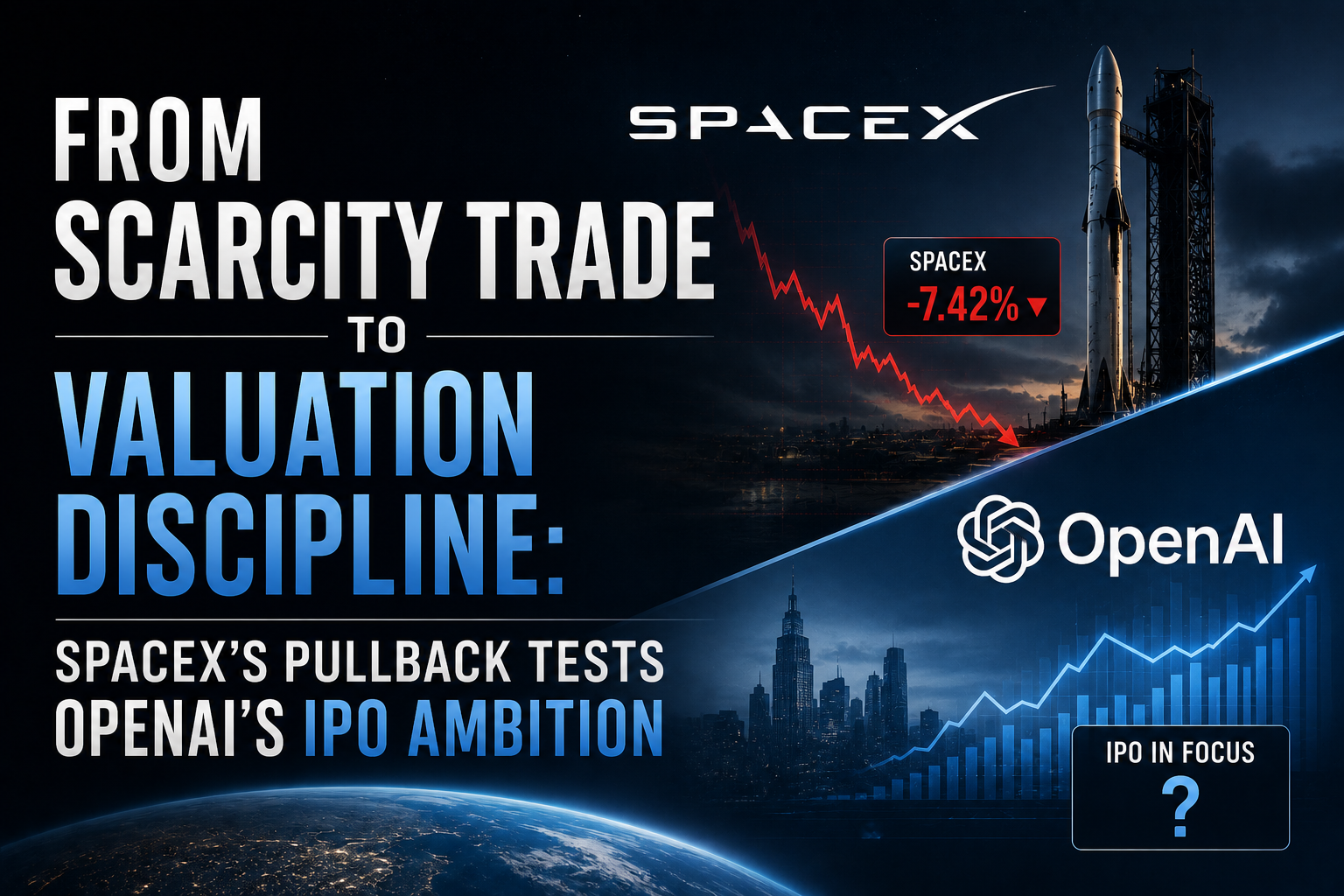
從稀缺交易到估值紀律:SpaceX的回調考驗OpenAI的IPO野心
據報導,OpenAI 傾向將其 IPO 推遲至 2027 年,但更強烈的市場訊號來自 SpaceX。SpaceX 於 6 月 22 日收盤下跌了 16.4%,收於 154.60 美元,較盤中高點 225.64 美元降低了 31.5%,但仍較其 135 美元的 IPO 價格高出 14.5%。這一走勢使 SpaceX 從一個由稀缺性驅動的 IPO 成功案例,轉變為 AI 相關超大型上市週期中首個重大公開市場壓力測試。
OpenAI 的問題不在於需求,而在於估值。路透社引用《紐約時報》的報導指出,OpenAI 正考慮等待至 2027 年,以維持高達 1 兆美元的估值目標,而顧問將此選擇定調為:要麼等待達到該估值,要麼以較低目標提前上市。
預測市場已開始反映這種謹慎態度。Polymarket 的 OpenAI IPO 市場近期顯示,OpenAI 在 2026 年 12 月 31 日前完成 IPO 的機率約為四分之一,這表明交易者不再將近期上市視為明確的基本情境。對於加密貨幣交易者而言,這使得 AI 上市前的曝險從單向的稀缺性交易,轉變為與公開市場基準掛鉤的估值紀律交易。
2026/06/29

Coldcard Mk3 警告隨 $38M Bitcoin 掃蕩而來,但原因仍未確認
比特幣硬體錢包製造商 Coinkite 已警告用戶,Coldcard 裝置存在種子生成問題,影響範圍涵蓋所有 4.0.1 及更高版本的 Mk3 韌體。此警告是在安全研究人員調查一宗涉及 594.48 BTC(價值約 3,800 萬美元)的協調性盜取事件時出現的。然而,目前尚無公開的技術證據證實 Coldcard 的問題導致了這些轉帳。
2026/07/31

Mastercard 完成對 BVNK 的收購,金額高達 18 億美元——穩定幣進入全球支付核心
Mastercard 於三月宣布該交易後,已於 2026 年 8 月 3 日(UTC +8)完成對穩定幣基礎設施供應商 BVNK 的收購。
2026/08/04
熱門
目前熱門備受市場關注的加密貨幣
加密貨幣價格
按交易量計算交易量最大的加密貨幣