PayPal accepts defeat: now the fintech giant finally wants to play in Africa

In 2008, the World Bank published a piece titled “PayPal (not) in Africa“. The intention was to call out the fintech platform for sidelining the continent, where millions of entrepreneurs, freelancers, and small business owners desperately needed access to global payment infrastructure.
The piece highlighted a glaring absence: while anyone could set up a PayPal account in Africa, there was no way to transfer money out. No withdrawal. No receiving funds from overseas clients. Just a one-way street that left countless African professionals locked out of the global digital economy.
Sixteen years later, the frustration endures. Yet something has shifted. The company is finally talking about Africa, not as a conqueror, but as a partner that has finally accepted its limits.
The payments giant recently announced plans to launch its PayPal World platform across Africa in 2026.
Otto Williams, PayPal’s Senior Vice President, Regional Head for the Middle East and Africa, confirmed at Abu Dhabi Finance Week that the company is actively pursuing partnerships with African fintech players. This signals a dramatic reversal of decades of reluctance.
But this raises the question: why now? And perhaps more importantly, what took so long?
Why the PayPal model struggled in Africa
To understand PayPal’s long absence, you need to understand its core imperative: trust. In the early 2000s, Africa represented a high-risk proposition. The company cited disproportionately high rates of chargebacks and fraudulent transactions.
In 2004, the fintech restricted users in Ghana, Nigeria, and several other countries from receiving funds, claiming stolen credit cards from the West were being used to syphon money. Without robust national ID systems at the time, PayPal viewed the continent as an existential threat to its network integrity.
Also, its traditional model was built for Western banking, where it required users to link credit cards or bank accounts, which were not readily available to most Africans.
Compliance with anti-money laundering laws was expensive in regions where regulatory infrastructure was weak. For years, the math simply didn’t add up as the cost of building compliance outweighed the potential revenue.
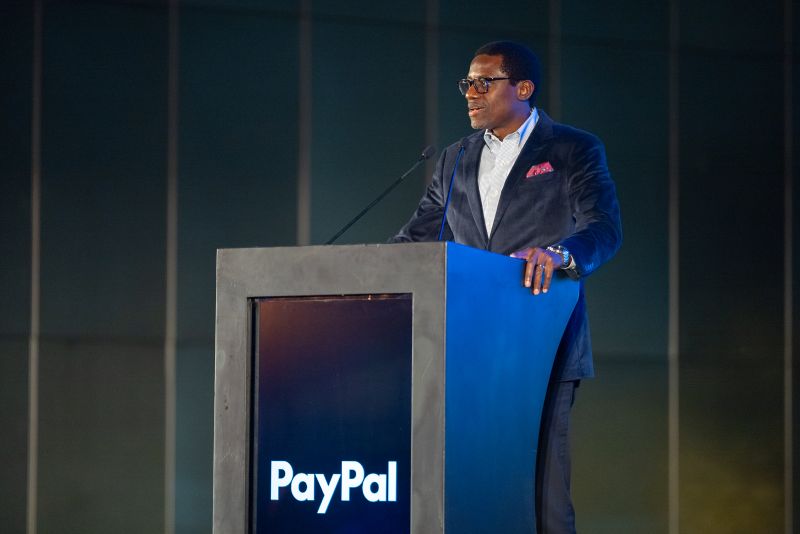 Otto Williams, PayPal’s Senior Vice President, Regional Head for the Middle East and Africa
Scepticism about this new 2026 promise is high, and for good reason. The company has tried to enter Africa before with “half-measures” that often felt like PR wins rather than actual solutions.
In 2014, a partnership with First Bank of Nigeria was restricted to bank customers and was “send-only.” First Bank had said in one document: In 2021, a partnership with Flutterwave helped businesses but did little for the average person. These attempts failed because they tried to force Africans into a restricted Western banking box.
Meanwhile, since PayPal’s exit, Africa built its own world. Kenya’s M-Pesa revolutionised finance, processing KSh 39.39 trillion (around $300 billion) in Kenya alone. Today, Africa accounts for 70% of global mobile money transaction value.
Homegrown giants like Flutterwave and Paystack filled the void, solving the “last-mile” problems PayPal once deemed impossible.
The new strategy for PayPal World
The 2026 strategy for PayPal World is a quiet admission that the company cannot win the “wallet war” in Africa. Instead of trying to get you to open a PayPal account, the company is now trying to be the “bridge” for the wallet you already use.
Three fundamental shifts made this viable. First, regulatory maturity has improved with systems like Nigeria’s Bank Verification Number (BVN). Second, PayPal no longer has to build from scratch, they can partner with established giants like Safaricom and MTN.
Finally, there is economic pressure. As Western markets slow down, Africa’s young, urban population represents the last major frontier for growth.
For the average user, this is a major shift. In the past, you had to move into PayPal’s “house” and follow its strict rules. If they didn’t like your activity, they locked you out. With PayPal World, they are simply building a door between your house (like M-Pesa or MTN MoMo) and the rest of the world.
Ayrıca Şunları da Beğenebilirsiniz

BFX Presale Raises $7.5M as Solana Holds $243 and Avalanche Eyes $1B Treasury — Best Cryptos to Buy in 2025

SoFi Bank unveils SoFiUSD stablecoin to power translations for businesses