Stablecoins like USDT and USDC are now dominating transactions in Venezuela. Hyperinflation and a lack of trust in local banks are driving this crypto adoption Stablecoins like USDT and USDC are now dominating transactions in Venezuela. Hyperinflation and a lack of trust in local banks are driving this crypto adoption

Stablecoins Fuel Everyday Crypto Adoption in Venezuela: TRM Labs

2025/12/15 00:00

Stablecoins like USDT and USDC are now dominating transactions in Venezuela. Hyperinflation and a lack of trust in local banks are driving this crypto adoption and “on-chain dollarization.”

Stablecoins are rapidly becoming an essential tool for everyday economic life in Venezuela. These digital currencies, mainly USDT (Tether) and USDC (Circle), now function as a replacement for existing retail banking. They make daily transactions from payroll to cross-border purchases possible.

Venezuelans Adopt Stablecoins Amid Severe Economic Instability

The prime cause of this movement is hyperinflation. Decades of serious economic instability and hyperinflation have destroyed the value of the bolivar. Inflation reached maximum levels at about 80,000% in 2018, and was an estimated 180% in 2025. This collapse has created the need for the citizenry to look for stable alternatives.

Related Reading: Crypto News: Venezuela to Integrate Bitcoin and Stablecoins into Banking Network | Live Bitcoin News

Pegged to the U.S. dollar, stablecoins offer a stable store of value. This is a function that the dysfunctional Bolivar does not provide. The trend represents a peculiar “on-chain dollarization” thanks to the substitution of stable digital currencies in place of the national currency for everyday economic activity.

Dominance Over Bitcoin Signals Functional Utility

Stablecoins are the runaway winner for transactions in Venezuela. They are responsible for 56.4% of the total crypto transactions as of late 2024. This is significantly higher as compared to just 12% of Bitcoin. This underlines their function as a medium of exchange and a down-to-practice financial tool. People use them for utility rather than only for speculative investments.

Remittances are a very important use case. Standard international money transfer services are often slow, costly, or completely unavailable. Consequently, stablecoins have become an important tool for Venezuelans. They enable them to receive funds from family members abroad at a low cost and speed.

A lack of faith in domestic financial institutions has also been a factor. Eroding trust in the banking system and a low banking environment have led people to use blockchain-based solutions.
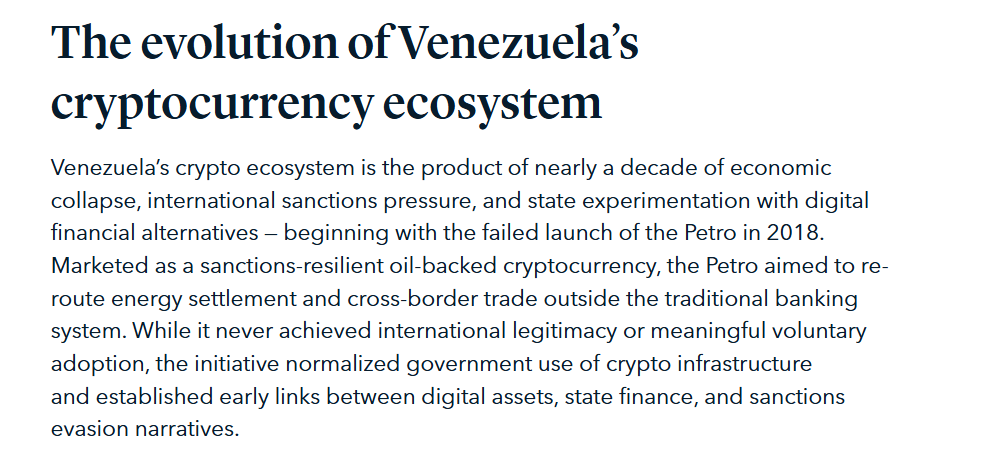
Stablecoins like USDT and USDC are now dominating transactions in Venezuela. Hyperinflation and a lack of trust in local banks are driving this crypto adoption and "on-chain dollarization."                                                  Source: TRM

Everyday commerce has evolved in accordance with this reality. Businesses Small corner stores to national retail chains, are now accepting crypto payments. They use such platforms as Binance and Airtm. Furthermore, some employees are paid with stablecoins.

Traditional Finance Blurs Lines with Digital Assets

This trend of adoption is not limited to Venezuela’s retail economy alone. Interactive Brokers Group Inc. has recently opened up stablecoins as a funding source for individual brokerage accounts for retail investors. This is a significant step in the distinctions between traditional and digital finance are becoming blurred.

The feature is being introduced as time goes by. It is beginning with a fraction of qualified U.S. clients. This new ability implies that consumers can pay directly from cryptocurrency wallets. This eliminates the necessity of having to draw from a bank account.

While the use of cryptocurrency is widely tolerated in Venezuela, the regulatory ambiguity remains. Despite unclear regulations and infrastructure challenges, people increasingly rely on stablecoins. Ultimately, this cements its fundamental role in the economy of Venezuela.

The post Stablecoins Fuel Everyday Crypto Adoption in Venezuela: TRM Labs appeared first on Live Bitcoin News.

Piyasa Fırsatı
Fuel Logosu
Fuel Fiyatı(FUEL)
$0,00182
$0,00182$0,00182
0,00%
USD
Fuel (FUEL) Canlı Fiyat Grafiği
Sorumluluk Reddi: Bu sitede yeniden yayınlanan makaleler, halka açık platformlardan alınmıştır ve yalnızca bilgilendirme amaçlıdır. MEXC'nin görüşlerini yansıtmayabilir. Tüm hakları telif sahiplerine aittir. Herhangi bir içeriğin üçüncü taraf haklarını ihlal ettiğini düşünüyorsanız, kaldırılması için lütfen service@support.mexc.com ile iletişime geçin. MEXC, içeriğin doğruluğu, eksiksizliği veya güncelliği konusunda hiçbir garanti vermez ve sağlanan bilgilere dayalı olarak alınan herhangi bir eylemden sorumlu değildir. İçerik, finansal, yasal veya diğer profesyonel tavsiye niteliğinde değildir ve MEXC tarafından bir tavsiye veya onay olarak değerlendirilmemelidir.

Ayrıca Şunları da Beğenebilirsiniz

Son of filmmaker Rob Reiner charged with homicide for death of his parents

Son of filmmaker Rob Reiner charged with homicide for death of his parents

FILE PHOTO: Rob Reiner, director of "The Princess Bride," arrives for a special 25th anniversary viewing of the film during the New York Film Festival in New York
Paylaş
Rappler2025/12/16 09:59
Addressing the sustainability question: The Web3 energy narrative

Addressing the sustainability question: The Web3 energy narrative

The post Addressing the sustainability question: The Web3 energy narrative appeared on BitcoinEthereumNews.com. contributor Posted: September 22, 2025 The environmental impact of blockchain technology remains a significant public concern in September 2025. For Web3 to achieve widespread legitimacy, it must present a credible narrative and technological path towards sustainability. The models pioneered by Oraichain, Pinlink, and RSS3 showcase how decentralized networks can be designed for efficiency and can contribute to a more sustainable digital economy. Oraichain, as a sovereign Layer 1, is built on a Delegated Proof-of-Stake (DPoS) consensus mechanism. This is inherently more energy-efficient than the Proof-of-Work systems that drew early criticism. By design, its security model relies on economic staking rather than raw computational power, allowing the network to process complex AI computations with a minimal energy footprint compared to its predecessors, aligning its operations with a greener Web3. Pinlink’s DePIN model promotes a more efficient use of existing hardware resources. The relentless construction of massive, power-hungry data centers by tech giants is a major source of energy consumption. Pinlink’s approach is to unlock the value in dormant or underutilized GPUs already in circulation around the world. This “recycling” of computing capacity reduces the need for new hardware manufacturing and makes the overall digital infrastructure ecosystem more resource-efficient. RSS3 contributes to sustainability through its distributed and lightweight design. Unlike a centralized data indexer that requires massive, concentrated server farms, the RSS3 network is run by a global collection of independent nodes. These nodes can be operated on low-power, consumer-grade hardware, distributing the energy load and avoiding the inefficiencies of large-scale, centralized data centers. This architectural choice makes its information layer inherently more sustainable and resilient. Disclaimer: This is a paid post and should not be treated as news/advice. Next: As Bitcoin’s sell pressure grows, are investors seeking safety in altcoins? Source: https://ambcrypto.com/addressing-the-sustainability-question-the-web3-energy-narrative/
Paylaş
BitcoinEthereumNews2025/09/23 09:02
Alcohol Still Leads Restaurant Beverage Orders, According To Harris Poll

Alcohol Still Leads Restaurant Beverage Orders, According To Harris Poll

The post Alcohol Still Leads Restaurant Beverage Orders, According To Harris Poll appeared on BitcoinEthereumNews.com. A new Harris Poll reveals millennials and Gen X still drive alcohol sales in restaurants, while Gen Z mixes drinks, formats, and expectations. Alcohol may still be the default for many American diners, but the latest Harris Poll suggests drinking habits are shifting. While older generations continue to reach for beer, wine, and cocktails, Gen Z is redefining what it means to drink out, focusing more on flexibility, aesthetics, and mood than tradition. Millennials are still loyal alcohol buyers when dining out, but Gen Z’s beverage habits are harder to pin down, according to new Harris Poll data. getty What the new Harris Poll reveals about U.S. beverage behavior In a nationally representative survey conducted by Harris in partnership with eMarketer, 36 percent of Americans reported that alcohol is their preferred restaurant beverage, slightly ahead of soda at 29 percent and water at 21 percent. But in practice, the most commonly ordered items are still non-alcoholic: 89 percent said they ordered water in the past 30 days, and 78 percent ordered soda. Alcohol remains a strong presence, with 69 percent of diners saying they ordered at least one alcoholic drink recently. Cocktails topped the alcohol category, followed by beer, spirits, and wine. While the overall preference is clear, the details begin to diverge once you look at generational breakdowns. Millennials still drive alcohol sales, especially with repeat orders Millennials continue to be the most reliable customers for restaurants selling alcohol. Fifty percent say alcohol is their default drink when dining out, compared to just 25 percent of Gen Z. They also reported significantly more repeat orders over the past month—especially for beer, spirits, and wine. This makes millennials a priority for alcohol brands and on-premise sales strategies. Libby Rodney, the Chief Strategy Officer at The Harris Poll, explained it this…
Paylaş
BitcoinEthereumNews2025/09/24 02:21