

IBM Unveiled the World’s First Sub-1 Nanometer Chip. Here’s Why Quantum Policy Matters
Key Stats for IBM Stock
- Past week’s performance: +7.7%
- 52-week range: $212 to $332
- Valuation model target price: $321
- Implied upside: +24.3% over 2.5 years
Run IBM’s valuation alongside software and quantum peers with TIKR (It’s free) >>>
Nanometer Chips, Quantum Policy, and an Analyst Upgrade in the Same Week
International Business Machines Corporation (IBM) gained roughly 2.4% over the past week. The stock held near $258 as three distinct catalysts landed almost simultaneously. Together, they revealed something important about IBM’s positioning heading into the second half of 2026.
On June 25, IBM unveiled technology for a chip smaller than 1 nanometer. A nanometer is one-billionth of a meter. Shrinking chip geometries below that threshold has long been considered a fundamental physics challenge. IBM’s research division reached this milestone using novel materials. So the development could accelerate roadmaps for next-generation AI and quantum processors.
 IBM Revenues (TIKR)
Two days earlier, JPMorgan upgraded IBM to Overweight from Neutral and raised its price target to $291. Analyst Brian Essex cited accelerating software momentum as the key driver. Red Hat and OpenShift migrations were specifically highlighted. The firm said IBM’s software segment continues to improve recurring revenue, margins, and cash flow. Generative AI now represents approximately 30% of IBM’s consulting backlog, a figure the CFO confirmed on the Q1 call.
That same day, President Trump signed executive orders targeting a research-capable quantum computer by 2028. The orders also mandate federal migration to quantum-resistant cryptography by 2031. Because the Commerce Department had already named IBM as the top intended recipient of $1 billion in CHIPS Act quantum funding, the policy timing was unusually favorable. Going forward, IBM stock will be tested by whether Q2 results on July 22 confirm the software acceleration JPMorgan cited.
See analysts’ growth forecasts and price targets for IBM (It’s free) >>>
IBM’s Valuation: Steady Returns in a Market That Wants Excitement
 IBM Guided Valuation Model (TIKR)
Under valuation model assumptions realized through 12/31/28, the stock is modeled using:
- Revenue Growth (CAGR): 5.3%
- Operating Margins: 22.0%
- Exit P/E Multiple: 20.2x
Based on these inputs, the model estimates a target price of $321, implying 24.3% total upside from the current share price of $258 and a 9% annualized return over the next 2.5 years.
A 9% annualized return is not the flashiest number. But context matters here. IBM pays a dividend yielding 2.6%. It also carries a 5-year beta of just 0.58, so it moves at roughly half the volatility of the broader market. For investors who want AI and quantum exposure without pure-play risk, the total return, inclusive of dividends, lands closer to 11% annually.
 IBM Guided Valuation Model (TIKR)
The 5.3% revenue CAGR is conservative relative to IBM’s 7.6% one-year growth. It reflects sluggish consulting and a declining legacy infrastructure segment. However, the Software segment is the real growth engine. It carries IBM’s highest margins, and both generative AI and Red Hat contributions are most visible there. If software grows at 10% or more while consulting stabilizes, the blended CAGR could outperform the base case.
The 22.0% operating margin target is a step up from the current LTM EBIT margin of 18.8%. Yet the gap is credible because of the software mix shift. Platforms like Red Hat OpenShift and IBM WatsonX carry dramatically higher margins than consulting services. So as IBM’s revenue mix shifts toward software, the 22% target becomes achievable without heroic assumptions.
How IBM’s Earnings Profile Compares to Accenture and Microsoft
IBM’s Q1 2026 net income rose 14% year over year to $1.2 billion. Revenue climbed 9% to $15.6 billion. But the EPS story is more nuanced than those headlines suggest. Generative AI now represents approximately 30% of IBM’s consulting backlog. That is the clearest signal yet that AI is becoming a measurable earnings driver, not just a narrative one.
Accenture (ACN) is the most direct consulting peer. However, its June earnings warning told a cautionary tale. Accenture flagged that the U.S.-Iran conflict was weighing on its technology consulting revenue, and the stock fell sharply. IBM’s earnings profile is less exposed to that geography concentration. Its software revenue mix, now roughly 45% of total revenue, provides a recurring earnings base that pure consulting firms cannot match. So while Accenture trades at a higher forward P/E, its near-term earnings visibility has become shakier.
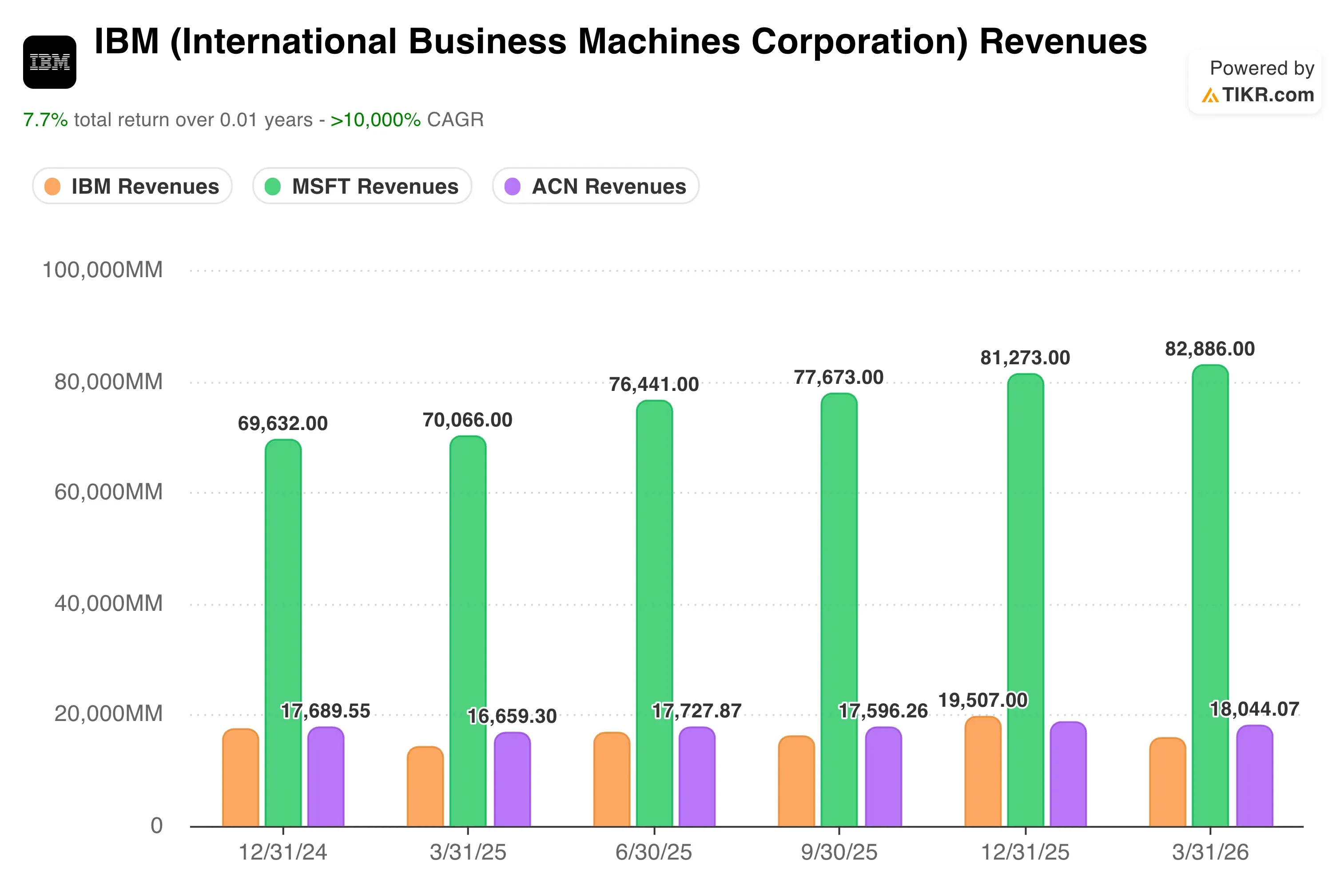 IBM Revenues vs ACN and MSTF (TIKR)
Microsoft (MSTF) is the more aspirational comparison for IBM’s AI software ambitions. Microsoft’s adjusted EPS growth has been running in the mid-to-high teens, driven by Azure and Copilot. IBM’s forward EPS CAGR is more modest at roughly 5%, consistent with the model. However, IBM’s NTM P/E of 20.6x is less than two-thirds of Microsoft’s multiple. Therefore, investors pay a meaningful discount for IBM’s earnings stream relative to the sector leader.
The earnings leverage story runs through the software mix shift. As Red Hat OpenShift and watsonx grow their revenue share, gross margins should expand, and operating leverage should compound. The model’s 22.0% operating margin target does not require IBM to match Microsoft’s margins. It simply requires software to grow faster than consulting and infrastructure, and the backlog data already supports that direction.
See what IBM’s 30% AI backlog means for investors as the stock slides in 2026 >>>
What’s Driving IBM Stock Going Forward?
IBM’s most immediate catalyst is Q2 2026 earnings, scheduled for July 22. The JPMorgan upgrade rested on expected software acceleration in the second half of 2026. So Q2 is the first real test of that thesis. If the Software segment delivers above-consensus growth and the generative AI backlog continues expanding, the stock could sustain momentum toward the $321 model target.
The quantum opportunity is longer-dated but increasingly concrete. The $1 billion CHIPS Act award for IBM’s Anderon quantum foundry in New York is now locked in. Trump’s executive orders mandating quantum-ready cryptography by 2031 also create a federally anchored revenue stream. IBM has committed $10 billion to quantum over the next five years, with a large-scale system targeted for 2029. Because federal policy now supports the timeline, commercialization risk is meaningfully lower than it was a year ago.
The Google Cloud partnership, announced June 4, adds a go-to-market channel for IBM’s enterprise AI practice. The two companies are combining IBM’s consulting expertise with Google Cloud’s infrastructure. Together, they help large enterprises move AI projects from pilot to production. Most enterprise AI deployments need both model infrastructure and human systems integration. That is precisely where IBM’s consulting business adds durable value, and so the partnership plays to IBM’s existing strengths.
The dividend, at $1.69 per quarter or roughly $6.76 annually, provides a 2.6% yield. That makes IBM one of the few AI-adjacent stocks with meaningful income. The payout ratio of 58.4% is sustainable given IBM’s free cash flow of $14.7 billion in 2025. Because the dividend has been raised consistently for decades, it anchors institutional ownership even during periods of softer growth.
Estimate a company’s fair value instantly (Free with TIKR) >>>
Should You Invest in International Business Machines?
The only way to really know is to look at the numbers yourself. TIKR gives you free access to the same institutional-quality financial data that professional analysts use to answer exactly that question.
Pull up IBM, and you’ll see years of historical financials, what Wall Street analysts expect for revenue and earnings in the quarters ahead, how valuation multiples have moved over time, and whether price targets are trending up or down.
You can build a free watchlist to track IBM alongside every other stock on your radar. No credit card required. Just the data you need to decide for yourself.
Analyze IBM stock on TIKR Free→
Looking for New Opportunities?
- See what stocks billionaire investors are buying so you can follow the smart money.
- Analyze stocks in as little as 5 minutes with TIKR’s all-in-one, easy-to-use platform.
- The more rocks you overturn… the more opportunities you’ll uncover. Search 100K+ global stocks, global top investor holdings, and more with TIKR.
Disclaimer:
Please note that the articles on TIKR are not intended to serve as investment or financial advice from TIKR or our content team, nor are they recommendations to buy or sell any stocks. We create our content based on TIKR Terminal’s investment data and analysts’ estimates. Our analysis might not include recent company news or important updates. TIKR has no position in any stocks mentioned. Thank you for reading, and happy investing!
Ayrıca Şunları da Beğenebilirsiniz

Bitget Launches Visa-Powered Crypto Card for Everyday Spending in APAC

BetOnline Take The Prize Easter Promotion Offers $30k in Cash Prizes!
Michael Saylor’s Bitcoin Treasury Strategy Has Finally Hit Its Breaking Point
Popüler Haberler
Daha fazla
