EU Lawmakers Call for Clear DeFi, Staking, NFT Rules Under MiCA
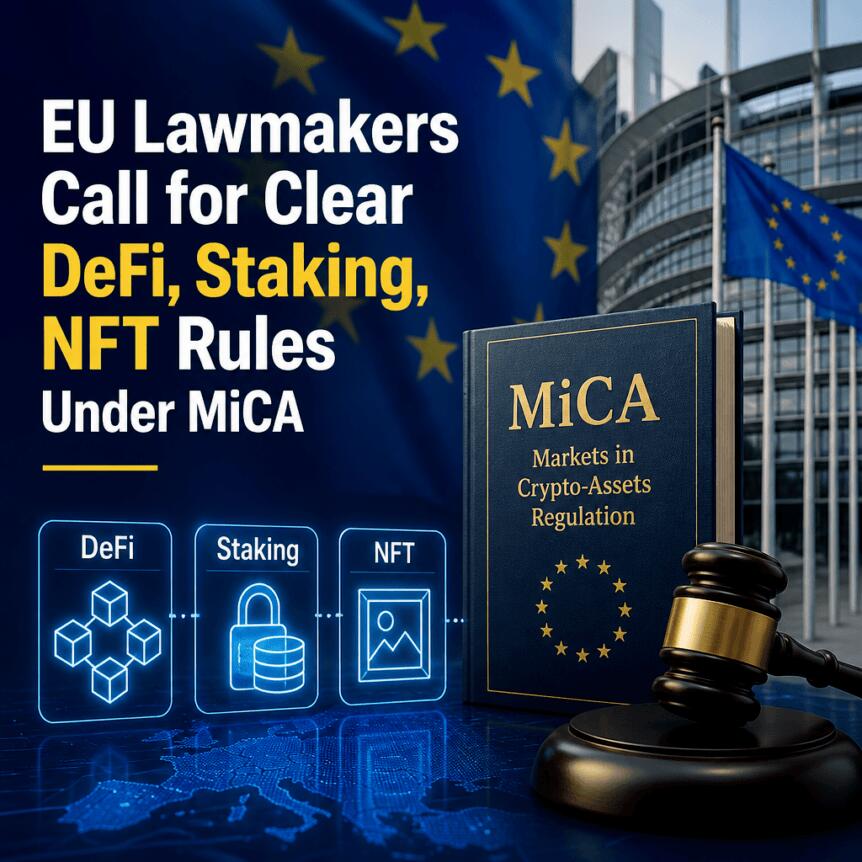
The European Parliament’s Committee on Economic and Monetary Affairs (ECON) has asked the European Commission to examine whether additional parts of the crypto sector—such as crypto lending and borrowing, staking, non-fungible tokens (NFTs), and decentralized finance (DeFi)—should be brought within the EU’s regulatory perimeter. The request is set out in an own-initiative resolution tabled for the Parliament’s plenary vote, where it is expected to be considered on July 7.
While the measure would not amend the EU’s Markets in Crypto-Assets Regulation (MiCA) or create new legal obligations, it signals how lawmakers may shape subsequent Commission proposals and supervisory priorities. For crypto-asset service providers, banks, and institutional investors, the resolution matters less for immediate enforceable change and more for how it could influence the direction of EU crypto policy—particularly around stablecoins and “tokenization” of traditional financial services.
Key takeaways
- ECON urges the European Commission to assess whether crypto lending/borrowing, staking, NFTs, and DeFi merit additional regulation beyond MiCA.
- The draft resolution supports the development of euro-denominated stablecoins within MiCA and frames them as potentially complementary to tokenized bank deposits and wholesale central bank digital currency models.
- ECON calls for consistent, EU-wide application of MiCA to avoid divergent national rules that could fragment the single market.
- If adopted, the resolution would become the Parliament’s official policy position, but it would not modify MiCA or impose new obligations.
ECON’s resolution: expanding the policy lens beyond MiCA
The recommendations were drafted by Belgian Member of the European Parliament Johan Van Overtveldt and advanced through ECON’s internal negotiations before being tabled for a plenary vote. According to the European Parliament’s procedure documents, the resolution is an own-initiative instrument designed to set out guidance for the Commission regarding the future shape of EU digital asset regulation.
ECON’s central request is forward-looking: the committee asks the Commission to evaluate regulatory coverage for activities that are not uniformly addressed by MiCA’s current scope. The resolution explicitly references crypto lending and borrowing, staking, NFTs, and DeFi—areas that, in practice, span multiple business models and may involve varying degrees of custody, asset pooling, market-making, governance structures, and cross-border service provision.
For compliance teams and regulated intermediaries, the key issue is not simply “whether” these activities should be regulated, but “how” and “under which regime.” MiCA already establishes licensing and authorization requirements for certain crypto-asset service providers, while other frameworks—such as rules on anti-money laundering (AML), consumer protection, and market conduct—may apply depending on structure and distribution. ECON’s call indicates lawmakers want clearer boundaries and regulatory coherence as these products evolve.
Stablecoins and tokenized finance: a more constructive regulatory stance
A major element of the ECON resolution relates to stablecoins, particularly those denominated in euros. The text frames euro stablecoins as potentially supportive of the EU’s payments ecosystem and encourages their development within MiCA’s framework.
That approach reflects a broader policy shift among some European institutions, including a recognition that stablecoins can operate alongside—rather than necessarily replace—existing money and payment rails. ECON links euro-denominated stablecoins to potential integration with tokenized commercial bank deposits and wholesale central bank digital currencies, suggesting that future EU financial infrastructure could incorporate multiple “digital money” channels.
The policy context is particularly sensitive given how stablecoin arrangements interact with banking liquidity and reserve management. In earlier discussions around the banking turbulence in the United States, concerns were tied to reserve custody and banking counterparties. For example, during the collapse of Silicon Valley Bank, USDC issuer Circle reportedly held a material portion of reserves at the bank, and USDC briefly lost its dollar peg. Although those events occurred outside the EU, they continue to influence how European policymakers evaluate reserve quality, redemption arrangements, and systemic risk controls for stablecoins.
ECON’s resolution also aligns with the committee’s parallel work on the euro’s digital future. It references legislative momentum supporting a “coexistence” model for a potential digital euro alongside private digital money solutions—an approach that suggests policymakers may view stablecoins and public digital currency designs as complementary components of a broader digital payments architecture.
MiCA implementation pressure and the question of national divergence
The resolution goes beyond new regulatory topics by focusing on execution and market structure. It urges consistent application of MiCA across member states to preserve a level playing field for crypto firms. This is a crucial compliance concern: when national regulators introduce additional or differing requirements, firms face increased operating cost, legal uncertainty, and fragmentation of distribution strategies within the EU.
ECON’s earlier draft, presented by Van Overtveldt in February, reportedly focused more tightly on MiCA’s existing framework—such as stablecoin classifications and legal certainty for multi-issued stablecoins. Over months of negotiation, the committee incorporated a broader set of policy questions, culminating in the current recommendation set that also calls for reconsideration of regulatory coverage for activities such as DeFi and staking.
At the EU level, the Commission is already working to reassess parts of MiCA’s scope. In May, the European Commission launched a public consultation seeking input on whether the framework should be expanded to cover areas that include DeFi, staking, lending, NFTs, and tokenized financial assets, while also revisiting debates around MiCA’s ban on interest-bearing stablecoins. Although consultations are not binding legislation, they typically shape the Commission’s next steps and can provide a timeline for future legislative proposals.
Implementation is also time-bound. MiCA’s transitional period is set to end on July 1, after which crypto-asset service providers generally need authorization under MiCA to continue operating across the EU. That deadline increases the practical stakes for firms regarding licensing strategy, supervision expectations, and product mapping—especially for services that may fall near the edges between crypto-asset activity and activities that regulators may treat differently under existing financial law.
Institutional implications: compliance, consumer protection, and legal clarity
For banks, payment firms, and institutional investors assessing crypto exposure, the resolution underscores that EU oversight is moving toward a more comprehensive assessment of how crypto activities affect market integrity and risk allocation. Even without immediate amendments to MiCA, the Parliament’s policy position can influence supervisory guidance, regulatory interpretation, and the Commission’s legislative drafting priorities.
Key open questions remain. ECON’s call does not specify a single mechanism for extending regulation, and the outcome of the plenary vote would only establish a non-binding political mandate for the Commission. In practice, the future direction could depend on how the Commission and co-legislators determine which activities are best addressed by MiCA extensions versus other EU regimes (for example, rules tied to financial services licensing, AML/KYC, consumer protection, or market abuse).
Cross-border coordination is also likely to remain a central theme. DeFi and tokenized asset activities often rely on service providers, intermediaries, or infrastructure operating across jurisdictions. As the EU considers regulatory scope expansion, compliance teams will need to monitor how authorization requirements, supervisory expectations, and governance standards may be applied to novel business models—particularly those with decentralized features that complicate “who is responsible” under traditional regulatory frameworks.
Closing perspective
As the July 7 plenary vote approaches, the resolution’s adoption would provide the European Parliament with an explicit mandate on crypto regulatory coverage, reinforcing pressure on the Commission’s ongoing MiCA review process. The central item for observers is how the Commission translates this political direction into concrete legislative options—if any—particularly for stablecoins, DeFi-adjacent services, and staking-related business models.
This article was originally published as EU Lawmakers Call for Clear DeFi, Staking, NFT Rules Under MiCA on Crypto Breaking News – your trusted source for crypto news, Bitcoin news, and blockchain updates.
Ayrıca Şunları da Beğenebilirsiniz

Inside CryptoKaleo’s Recent Commentary — What It Means for Traders

Michael Burry Just Bet Big Microsoft Will More Than Double by 2028

‘I’ll listen to ‘Only the Young’ at home on my own’: Zohran doesn’t know about a Swift-Kelce wedding at MSG, but he’s not going
Popüler Haberler
Daha fazla