

Bango thinks food prices shouldn’t depend on which trader you ask
There are no fixed prices in Nigeria’s commodity markets.
Buy a basket of tomatoes from one trader and walk a few stalls down; the next trader might quote a different price, and the basket itself might not contain the same quantity. For consumers who do not regularly visit markets, navigating that uncertainty can be frustrating.
It was this kind of uncertainty that caught the attention of Ademuyiwa Taofeek, one of Bango’s co-founders, during the 2024 Sallah festivities. The holiday is a Muslim celebration marked by communal prayers, family gatherings, and cooking bulk meals.
While shopping for baskets of tomatoes and peppers in Lagos, he observed that prices were higher than in producing regions like Jos, a city in Plateau State, North-Central Nigeria. When Taofeek questioned the price difference, he received a familiar explanation: it was due to the logistics cost of transporting produce from northern farming communities to Lagos.
Curious, Taofeek decided to test the assumption himself. He sourced the same commodities from Jos, paid to transport them to Lagos, and discovered that even after transport costs, he still spent less than he would have buying them locally.
The experience made him believe that consumers have little visibility into what food commodities cost outside the markets closest to them, and that was a problem.
When he shared the experience with Caleb Adenegan, who recounted the incident to TechCabal and would later become Taofeek’s co-founder, the pair began discussing how technology could help close that information gap.
Before Bango, Adenegan had experimented with building products, including Curri AI, an educational tool that helped teachers create lesson plans and classroom materials and Weeb, a social networking product.
Together, Taofeek and Adenegan saw an opportunity to create a platform where buyers could share what they paid for food commodities, where they bought them, and who sold them. That idea became Bango, a community-driven platform launched in November 2025.
Adenegan told TechCabal in an interview in February that the model mirrors how Nigerians have traditionally shared market information.
“Back in the day, the older generation spoke to each other,” Adenegan said on the call. “People would tell their neighbours where they got an item cheaper. Now the information system is fractured, and it leaves room for sellers to say any price and buyers don’t have an option but to buy it.”
Bango operates in Nigeria’s food and drink market, which is estimated to reach around $98.97 billion by 2033. A 2019 report by the National Bureau of Statistics (NBS) revealed that 56.65% of total household expenditure was spent on food. Bango is trying to carve out a place in that market by helping consumers make more informed food purchasing decisions.
How Bango turns market intelligence into a product
When users open the web app, they see a feed of recent price submissions from other users. A user can search for a specific commodity, such as a basket of tomatoes, and then see results that display a range of prices tied to a market, including its location, the seller’s name and phone number, and the date and quantity of purchase.
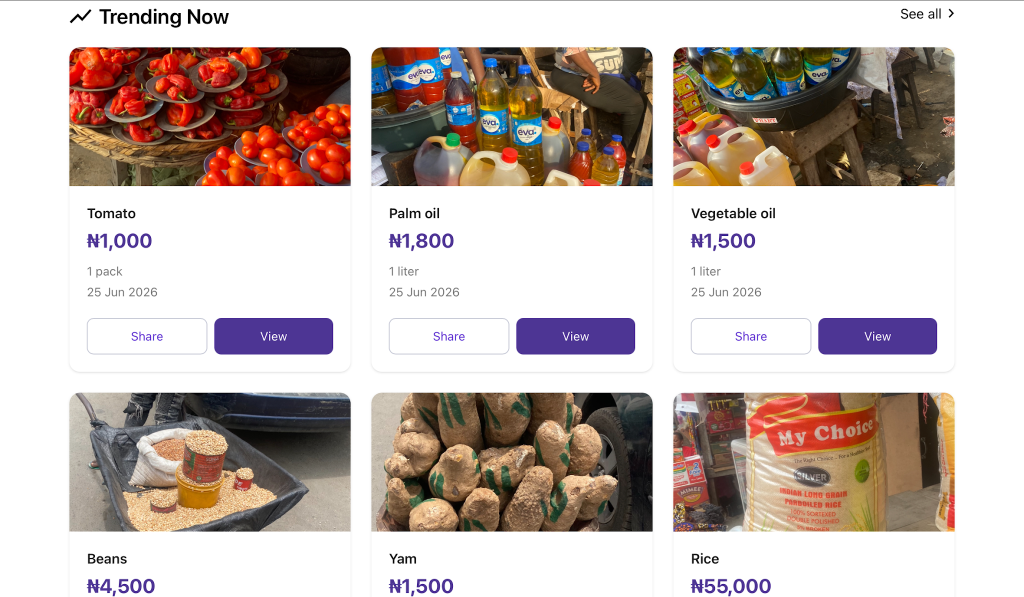 Bango dashboard. Image source: TechCabal
The data is submitted by buyers of the commodity. To submit an entry, a user inputs the commodity name, the price they paid, quantity, market name, state, and location, and attaches a photo. Those submissions become part of the database that future buyers rely on, thereby creating a feedback loop.
However, Adenegan explained that as users adopted the platform, the founders discovered that information alone did not solve the problem. A buyer could find a lower price for tomatoes, peppers, or onions on Bango, but that did not necessarily mean they could access those commodities.
“We have tried to inform people and tell them that these commodities are cheaper elsewhere with Bango,” Adenegan said. “That helps solve the problem to an extent. But what if we can guarantee you this price directly from the farmers?”
That question led to the development of Shopr by Bango, a commerce layer built on top of the startup’s price intelligence infrastructure.
Currently operational only in Abuja, Nigeria’s capital city, Adenegan explained that Shopr enables users to purchase commodities directly through Bango. He said the startup sources produce from a network of farmers and suppliers and has processed between 40 and 50 orders since launching in June.
The service also includes what Adenegan described as shared delivery. Rather than treating each order as a standalone delivery, the company groups orders from customers in the same locality and distributes the logistics costs across them.
To make the model work, Adenegan stated that certain commodities were allocated to specific ordering days. Customers within a particular location are then encouraged to place orders on those days, enabling Bango to aggregate demand and reduce fulfilment costs.
The startup currently handles deliveries through its own logistics infrastructure, a decision, Adenegan said, was deliberate.
“We cannot outsource understanding that process to a third party,” he said. “ We need to understand the process ourselves before we can say we want to bring in a third party to partner with us on it.”
Shopr is not the final piece of Bango’s strategy. According to Adenegan, Bango is preparing to launch Bango Market Day, a waitlist-based system that allows buyers to collectively purchase large volumes of commodities. Under the model, users indicate the quantity of a commodity they want to buy, after which Bango aggregates demand and coordinates supply through its farmer network.
“Our major aim as an entity is to make sure that people can get cheap food commodities at a very low price regardless of how far the market might be from the person,” he said.
How the model operates
Bango currently generates revenue through Shopr, where customers pay both a service fee and a delivery fee on each order.
According to Adenegan, the startup has grown largely through word-of-mouth, attracting up to 2,500 users.
Bango’s Shopr competes directly with commerce platforms like Chowdeck, Mano, GoLemon, and other quick commerce platforms that allow customers to order groceries from supermarkets or neighbourhood personal shoppers. Bango’s differentiation is that it starts with information.
Most grocery platforms focus on selling products. However, Bango first helps users discover where commodities are cheapest before creating mechanisms to access them.
Adenegan noted that the Bango Market Day feature will operate on the same revenue model as Shopr, while introducing an additional waitlist fee for users who want to reserve access before each event. Over time, the founders noted that they plan to introduce a subscription tier that bundles benefits across Bango’s products.
However, the challenge with its model is that transparency is only as good as the quality of the information behind it. A platform built on user-generated data can easily attract the wrong kind of participation.
For instance, traders could try to upload misleading prices that are strategically low to attract footfall or padded with hidden costs. Taofeek argued that while there are no guardrails to prevent such occurrences, the structure of the platform discourages such behaviour.
According to him, the risk is particularly low for traders. Since buyers upload the information rather than sellers, merchants gain little from artificially lowering prices on the platform.
“What we are trying to do is to ensure that there’s competitive pricing so that people can make the right choice,” he said. “If a seller imitates a buyer, they’re on their own because if their price is too high, buyers will go for a cheaper person in that same market, and the seller will be wondering why nobody’s coming to their store.” The founders see that dynamic as one of the platform’s self-correcting mechanisms.
For now, Bango remains a relatively small player in Nigeria’s food economy, but the founders said the platform’s long-term ambition is to build a system that can connect demand directly to supply and reduce the layers between farmers, traders, and consumers.
Part of that vision includes expanding Shopr beyond Abuja and exploring partnerships within the agricultural value chain, which it did not disclose.


Ayrıca Şunları da Beğenebilirsiniz

EUR/GBP Exchange Rate Surges as Bank of England Rate Hike Expectations Intensify – Market Analysis

Anthropic code leak exposes Claude AI internals after release error

In Malaysia, one in four rehab patients now battling addiction and mental illness


Popüler Haberler
Daha fazla
