Solv Protocol and Chainlink have launched a new feed that combines the market price with on-chain verification of BTC reserves for SolvBTC.Solv Protocol and Chainlink have launched a new feed that combines the market price with on-chain verification of BTC reserves for SolvBTC.

Solv and Chainlink integrate Proof of Reserve into SolvBTC: live on-chain anti-manipulation feed on Ethereum

5 min read
solv chainlink proof of reserve solvbt

Solv Protocol and Chainlink have launched a new feed that combines the market price with the on-chain verification of BTC reserves for SolvBTC, with a redemption rate anchored to the collateral and price limits designed to reduce manipulations.

According to data collected by Chainlink Data, the SolvBTC feeds show public timestamps and updates accessible from the mainnet since the announcement. Industry analysts note that the PoR+price model can directly impact over 2 billion dollars in tokenized BTC, reducing the likelihood of depeg during market stress. By monitoring the official pages (Solv and Chainlink Data), it is possible to verify the operational status of the feeds on Ethereum and BOB in real-time.
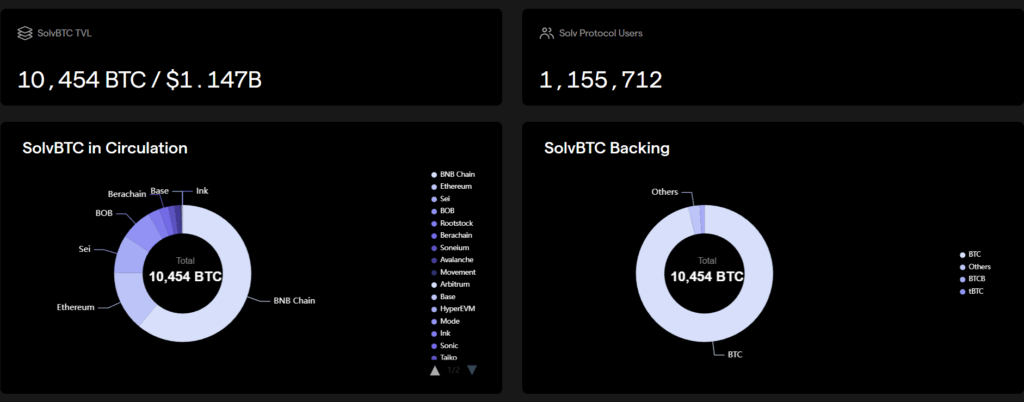
Solv Protocol shows data on its Bitcoin reserves collateralizing SolvBTC. Source: Solv Transparency

SolvBTC: what has been launched and where it is active

The new SolvBTC‑BTC feed combines the traditional exchange rate with the verification of reserves Bitcoin recorded on-chain. Unlike common price oracles, the value is anchored to the underlying collateral, enhancing transparency and consistency at the time of redemption. An interesting aspect is the immediate availability of data for public consultation.

  • Ethereum mainnet: the Proof of Reserve (PoR) feed of SolvBTC is accessible with verifiable data and time-stamps.
  • BOB network: the SolvBTC/BTC feed is operational for on‑chain pricing.
  • Cross‑chain expansion: further integrations are in preparation, aiming to standardize the PoR + price model across multiple networks.

Why it impacts the price of SolvBTC

The feed directly integrates reserve coverage into the price calculation. This way, the redemption rate reflects not only the market spot price but also the actual availability of the BTC held, reducing possible misalignments between theoretical value and the value actually redeemable. It should be noted that the effect is particularly significant during times of volatility.

How the Protection Mechanism Works

The logic of the feed is structured to limit unjustified deviations, integrating multiple components into a single reference:

  • Market Data: The BTC price is aggregated from Chainlink’s decentralized oracles, as indicated by Chainlink Data.
  • Proof of Reserve: the feed includes the on-chain verification of SolvBTC’s BTC reserves, with public time-stamps ensuring transparency.
  • Upper/lower limits: price bands derived from collateral coverage act to exclude outliers and mitigate manipulation attempts.
  • Updates: the feed updates based on the frequency and thresholds configured on the oracle network; the related timestamps can be accessed via Chainlink Data.

Practical Examples (Simplified Scenarios)

  • Full coverage (≈100%): the redemption rate remains close to the BTC spot price (except for fees or intra-chain slippage); in practice, 1 BTC remains equal to 1 BTC, meaning a redemption of ≈ 1:1.
  • Coverage decreasing (e.g., 98%): with reduced coverage, the feed applies limits to reflect the lower collateral; for example, with 98% coverage, 1 BTC might be redeemable at ≈ 0.98 BTC until reserves are restored to 100%.
  • Anomalous event: if the market rises while the reserve does not update in real-time, the upper band limits the deviation, helping to reduce the risk of spurious liquidations and possible depeg events.

Advantages for DeFi and lending protocols

For decentralized finance and lending protocols, pricing based on verified collateral helps reduce valuation errors and limit liquidations not backed by real resources, offering greater reliability even in highly volatile contexts. In summary, a more readable risk framework is obtained.

  • Stronger prices for tokenized assets, with a reduced gap between NAV and market price.
  • More readable collateral risk: creditors can assess exposure using verifiable and transparent data.
  • Cross-chain integration: Consistent feeds across multiple networks reduce friction between protocols and vaults, facilitating wider adoption.

Limits and Risks Still Present

Despite the model increasing the resilience of the system, some risk factors remain. It must be said that no setup is free of dependencies.

  • Smart contract risk: bugs or incorrect configurations can compromise the effectiveness of the PoR and the feed.
  • Oracle dependencies: network congestion or outages can delay updates, affecting the timeliness of the data.
  • Bridging and custody: if the custody of BTC or the bridges used do not ensure transparency, the effectiveness of PoR can be called into question.
  • Partial coverage: in case of a decrease in reserves, the redemption rate immediately drops, protecting the system but penalizing the redeemable value; a factor that will need to be constantly monitored.

Implementation and Roadmap

  • Status: the feed is active on the Ethereum mainnet and the SolvBTC/BTC feed is already available on the BOB network, according to the information provided by the teams and visible on the official data pages.
  • Roadmap: further developments are planned towards other EVM networks and integrations with vaults, DEX, and lending protocols, with the idea of promoting a gradual adoption of the model.
  • Operational transparency: the feed, both for the Proof of Reserve and the price feed, displays time-stamps and update statuses; further details (such as the exact frequency of updates and the total amount of verified reserves) are yet to be officially confirmed.

Key Terms (mini-glossary)

  • Proof of Reserve (PoR): on-chain verification of the reserves that ensure the backing of a tokenized asset.
  • Decentralized oracles: a network of independent nodes that publish data on the blockchain, helping to reduce single points of failure. Learn more about Decentralized oracles.
  • Redemption rate: amount of collateral redeemable per unit of token, with a dynamic mechanism linked to the state of the collateral.
Market Opportunity
Bitcoin Logo
Bitcoin Price(BTC)
$73,698.77
$73,698.77$73,698.77
-0.56%
USD
Bitcoin (BTC) Live Price Chart
Disclaimer: The articles reposted on this site are sourced from public platforms and are provided for informational purposes only. They do not necessarily reflect the views of MEXC. All rights remain with the original authors. If you believe any content infringes on third-party rights, please contact service@support.mexc.com for removal. MEXC makes no guarantees regarding the accuracy, completeness, or timeliness of the content and is not responsible for any actions taken based on the information provided. The content does not constitute financial, legal, or other professional advice, nor should it be considered a recommendation or endorsement by MEXC.

You May Also Like

Shocking OpenVPP Partnership Claim Draws Urgent Scrutiny

Shocking OpenVPP Partnership Claim Draws Urgent Scrutiny

The post Shocking OpenVPP Partnership Claim Draws Urgent Scrutiny appeared on BitcoinEthereumNews.com. The cryptocurrency world is buzzing with a recent controversy surrounding a bold OpenVPP partnership claim. This week, OpenVPP (OVPP) announced what it presented as a significant collaboration with the U.S. government in the innovative field of energy tokenization. However, this claim quickly drew the sharp eye of on-chain analyst ZachXBT, who highlighted a swift and official rebuttal that has sent ripples through the digital asset community. What Sparked the OpenVPP Partnership Claim Controversy? The core of the issue revolves around OpenVPP’s assertion of a U.S. government partnership. This kind of collaboration would typically be a monumental endorsement for any private cryptocurrency project, especially given the current regulatory climate. Such a partnership could signify a new era of mainstream adoption and legitimacy for energy tokenization initiatives. OpenVPP initially claimed cooperation with the U.S. government. This alleged partnership was said to be in the domain of energy tokenization. The announcement generated considerable interest and discussion online. ZachXBT, known for his diligent on-chain investigations, was quick to flag the development. He brought attention to the fact that U.S. Securities and Exchange Commission (SEC) Commissioner Hester Peirce had directly addressed the OpenVPP partnership claim. Her response, delivered within hours, was unequivocal and starkly contradicted OpenVPP’s narrative. How Did Regulatory Authorities Respond to the OpenVPP Partnership Claim? Commissioner Hester Peirce’s statement was a crucial turning point in this unfolding story. She clearly stated that the SEC, as an agency, does not engage in partnerships with private cryptocurrency projects. This response effectively dismantled the credibility of OpenVPP’s initial announcement regarding their supposed government collaboration. Peirce’s swift clarification underscores a fundamental principle of regulatory bodies: maintaining impartiality and avoiding endorsements of private entities. Her statement serves as a vital reminder to the crypto community about the official stance of government agencies concerning private ventures. Moreover, ZachXBT’s analysis…
Share
BitcoinEthereumNews2025/09/18 02:13
United States Building Permits Change dipped from previous -2.8% to -3.7% in August

United States Building Permits Change dipped from previous -2.8% to -3.7% in August

The post United States Building Permits Change dipped from previous -2.8% to -3.7% in August appeared on BitcoinEthereumNews.com. Information on these pages contains forward-looking statements that involve risks and uncertainties. Markets and instruments profiled on this page are for informational purposes only and should not in any way come across as a recommendation to buy or sell in these assets. You should do your own thorough research before making any investment decisions. FXStreet does not in any way guarantee that this information is free from mistakes, errors, or material misstatements. It also does not guarantee that this information is of a timely nature. Investing in Open Markets involves a great deal of risk, including the loss of all or a portion of your investment, as well as emotional distress. All risks, losses and costs associated with investing, including total loss of principal, are your responsibility. The views and opinions expressed in this article are those of the authors and do not necessarily reflect the official policy or position of FXStreet nor its advertisers. The author will not be held responsible for information that is found at the end of links posted on this page. If not otherwise explicitly mentioned in the body of the article, at the time of writing, the author has no position in any stock mentioned in this article and no business relationship with any company mentioned. The author has not received compensation for writing this article, other than from FXStreet. FXStreet and the author do not provide personalized recommendations. The author makes no representations as to the accuracy, completeness, or suitability of this information. FXStreet and the author will not be liable for any errors, omissions or any losses, injuries or damages arising from this information and its display or use. Errors and omissions excepted. The author and FXStreet are not registered investment advisors and nothing in this article is intended…
Share
BitcoinEthereumNews2025/09/18 02:20
CME Group to launch Solana and XRP futures options in October

CME Group to launch Solana and XRP futures options in October

The post CME Group to launch Solana and XRP futures options in October appeared on BitcoinEthereumNews.com. CME Group is preparing to launch options on SOL and XRP futures next month, giving traders new ways to manage exposure to the two assets.  The contracts are set to go live on October 13, pending regulatory approval, and will come in both standard and micro sizes with expiries offered daily, monthly and quarterly. The new listings mark a major step for CME, which first brought bitcoin futures to market in 2017 and added ether contracts in 2021. Solana and XRP futures have quickly gained traction since their debut earlier this year. CME says more than 540,000 Solana contracts (worth about $22.3 billion), and 370,000 XRP contracts (worth $16.2 billion), have already been traded. Both products hit record trading activity and open interest in August. Market makers including Cumberland and FalconX plan to support the new contracts, arguing that institutional investors want hedging tools beyond bitcoin and ether. CME’s move also highlights the growing demand for regulated ways to access a broader set of digital assets. The launch, which still needs the green light from regulators, follows the end of XRP’s years-long legal fight with the US Securities and Exchange Commission. A federal court ruling in 2023 found that institutional sales of XRP violated securities laws, but programmatic exchange sales did not. The case officially closed in August 2025 after Ripple agreed to pay a $125 million fine, removing one of the biggest uncertainties hanging over the token. This is a developing story. This article was generated with the assistance of AI and reviewed by editor Jeffrey Albus before publication. Get the news in your inbox. Explore Blockworks newsletters: Source: https://blockworks.co/news/cme-group-solana-xrp-futures
Share
BitcoinEthereumNews2025/09/17 23:55
