

Will Pi Network Price Surge After Mainnet Anniversary?

Pi Network marks one year since mainnet launch as PI price trades near $0.17, posting weekly gains amid upgrades and key resistance levels.
Pi Network price action has remained under close observation after the project marked one year since its mainnet launch on February 19.
The anniversary aligned with increased trading activity, while investors assessed technical signals, network upgrades, and supply adjustments that may influence near-term price direction.
Price Performance During the Anniversary Period
Pi Network traded above $0.17 on February 19, rising over 20% from its yearly low as the mainnet anniversary approached.
The milestone was supported by more than 16 million migrated Pioneers and recent Protocol 23 upgrades focused on utility and growth.
Over the last seven days, Pi Coin gained close to 20%, although price action showed mixed signals.
A decline of around 5% was recorded within the last twenty-four hours. This movement indicated short-term selling pressure after recent gains, while the broader trend remained stable.
Market behavior suggested that the rally was driven mainly by anniversary-related attention.
There was no evidence of sudden speculative spikes. Instead, price movement appeared gradual, with buyers and sellers maintaining balance throughout the period.
Network Upgrades and Token Supply Adjustments
The anniversary also coincided with continued development activity on the network.
Developers implemented Protocol Version 19.6, which focused on improving node synchronization and overall system reliability.
These updates aimed to support smoother operations as network participation continues to expand.
Another notable development involved changes to the token release schedule.
The number of tokens unlocked each month was reduced, which lowered the circulating supply growth rate.
Market participants often track such adjustments, since reduced supply can affect trading dynamics over time.
Community discussions also intensified around a possible exchange listing. Some market participants speculated about a potential listing on Kraken.
However, no official confirmation has been issued, and no formal statements have been released by the exchange or the project.
Related Reading: Pi Network Launches New Library for Fast Pi Payment Integration
Technical Indicators and Short-Term Structure
As of February 20, Pi Coin traded near $0.1756, holding above a key short-term support zone.
The Relative Strength Index stood around 44, indicating neutral momentum. This level suggested that the market was neither overbought nor oversold.
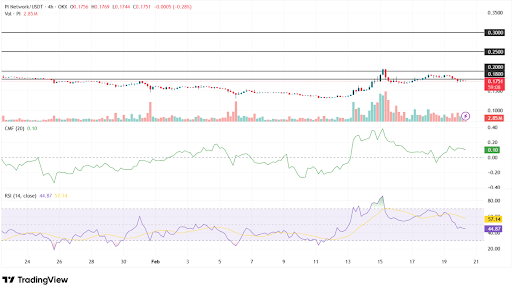 Pi Network chart shows consolidation and momentum indicators. Source: TradingView
The Chaikin Money Flow indicator remained slightly positive at 0.10. This reading pointed to mild accumulation, while trading volume stayed consistent.
Support continued to form near the $0.1750 level, which held during recent price fluctuations.
Resistance levels were observed around $0.20 and $0.25. A sustained move above these zones could alter the current structure.
Chart data from TradingView showed consolidation, with price moving within a defined range as traders awaited clearer signals.
The post Will Pi Network Price Surge After Mainnet Anniversary? appeared first on Live Bitcoin News.
You May Also Like

Q4 2024 Growth Beats Expectations With 0.9% Surge

Vitalik Buterin Explains How Crypto Can Protect Users When Perfect Security Remains Impossible

BitGo wins BaFIN nod to offer regulated crypto trading in Europe
BitGo’s move creates further competition in a burgeoning European crypto market that is expected to generate $26 billion revenue this year, according to one estimate. BitGo, a digital asset infrastructure company with more than $100 billion in assets under custody, has received an extension of its license from Germany’s Federal Financial Supervisory Authority (BaFin), enabling it to offer crypto services to European investors. The company said its local subsidiary, BitGo Europe, can now provide custody, staking, transfer, and trading services. Institutional clients will also have access to an over-the-counter (OTC) trading desk and multiple liquidity venues.The extension builds on BitGo’s previous Markets-in-Crypto-Assets (MiCA) license, also issued by BaFIN, and adds trading to the existing custody, transfer and staking services. BitGo acquired its initial MiCA license in May 2025, which allowed it to offer certain services to traditional institutions and crypto native companies in the European Union.Read more