The post OP Crashes 25% After Base Moves Away From OP Stack appeared on BitcoinEthereumNews.com. OP fell nearly 25% after Base revealed stack migration plans. BaseThe post OP Crashes 25% After Base Moves Away From OP Stack appeared on BitcoinEthereumNews.com. OP fell nearly 25% after Base revealed stack migration plans. Base

OP Crashes 25% After Base Moves Away From OP Stack

  • OP fell nearly 25% after Base revealed stack migration plans.
  • Base holds $3.85 billion TVL, deeply tied to Optimism revenue.
  • The move is technical, but investors fear economic impact on Superchain.

OP dropped nearly 25% in 24 hours after Base revealed it is moving away from the OP Stack to its own unified technical stack. The sell-off pushed OP toward $0.12, as investors quickly reassessed the long-term impact on Optimism and its Superchain ecosystem.

Why Base Matters So Much

Base launched in 2023 and rapidly became one of the most widely used Ethereum layer-2 networks. Today, it has about $3.85 billion locked in the protocol. When Base first went live, both teams shared that Base could earn up to 118 million OP tokens over six years, tying its growth closely to Optimism’s economics.

Because Base generated significant activity and revenue within the Superchain model, any structural change immediately affects how investors value OP.

What Is Actually Changing?

Base clarified that this move does not mean it is cutting ties with Optimism entirely. The company said it will continue working with Optimism for support and remain compatible with OP Stack standards during the transition.

For everyday users and developers, nothing changes immediately.

The shift is mainly technical. By controlling its own stack, Base says it can ship upgrades faster and simplify how the network operates behind the scenes. The goal is to double its pace of major upgrades to around six per year, compared to three today.

In its blog post, the team wrote:

“This unification does not mean Base will be built in isolation. The protocol remains public and specified in the open, and alternative implementations are welcome and encouraged.”

Related: French Banking Giant Société Générale Launches Euro Stablecoin to XRPL Network

Why OP Reacted So Sharply

The market reaction is largely economic, not functional. Investors worry that if Base operates independently, Optimism could lose a major revenue and activity driver.

In simple terms, Base was one of the strongest engines powering the Superchain. If that engine changes structure, valuation assumptions change too.

OP’s chart is clearly trending down. The token recently hit a low near $0.1283 and is struggling to hold that level. 

If strong buying does not step in soon, the price could fall even further because current support looks weak. Next level to watch is the breaking above the $0.1450 resistance level, before considering any bullish move.

What Happens Next?

For now, Base continues operating normally. Node operators will need to migrate to the new Base client in the coming months, but no urgent action is required.

The bigger question is whether Optimism can maintain growth without relying so heavily on Base. The next few months will reveal whether OP’s price drop is a short-term overreaction or a sign of deeper changes in Ethereum’s layer-2 landscape.

Related: XRP Ledger Activates “Members-Only” DEX Upgrade, Will XRP React?

Disclaimer: The information presented in this article is for informational and educational purposes only. The article does not constitute financial advice or advice of any kind. Coin Edition is not responsible for any losses incurred as a result of the utilization of content, products, or services mentioned. Readers are advised to exercise caution before taking any action related to the company.

Source: https://coinedition.com/op-crashes-25-after-base-moves-away-from-op-stack/
Market Opportunity
OP Logo
OP Price(OP)
$0.1224
$0.1224$0.1224
-0.89%
USD
OP (OP) Live Price Chart
Disclaimer: The articles reposted on this site are sourced from public platforms and are provided for informational purposes only. They do not necessarily reflect the views of MEXC. All rights remain with the original authors. If you believe any content infringes on third-party rights, please contact service@support.mexc.com for removal. MEXC makes no guarantees regarding the accuracy, completeness, or timeliness of the content and is not responsible for any actions taken based on the information provided. The content does not constitute financial, legal, or other professional advice, nor should it be considered a recommendation or endorsement by MEXC.
Tags:

You May Also Like

Pippin (PIPPIN) Price Prediction 2026–2030: Can PIPPIN Hit $0.70 Soon?

Pippin (PIPPIN) Price Prediction 2026–2030: Can PIPPIN Hit $0.70 Soon?

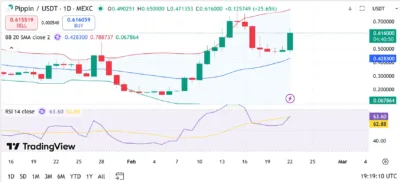
PIPPIN has surged sharply on the daily timeframe, printing a powerful bullish candle with over 25% gains. RSI is holding above 60, signaling strengthening momentum
Share
Coinstats2026/02/23 04:29
Will Cardano Reach $10 by 2030? Analysts Break Down ADA’s Growth Cycles

Will Cardano Reach $10 by 2030? Analysts Break Down ADA’s Growth Cycles

The post Will Cardano Reach $10 by 2030? Analysts Break Down ADA’s Growth Cycles appeared first on Coinpedia Fintech News Cardano (ADA) is trading at $0.9024 with a market cap of $32.91 billion. Experts say ADA has the potential to climb much higher, with some placing long-term targets as high as $10. The token continues to benefit from stronger visibility, rising liquidity, and increasing inflows from both institutional and retail markets. Can Cardano Hit $10 …
Share
CoinPedia2025/09/18 17:19
Crypto whale loses $6M to sneaky phishing scheme targeting staked Ethereum

Crypto whale loses $6M to sneaky phishing scheme targeting staked Ethereum

The post Crypto whale loses $6M to sneaky phishing scheme targeting staked Ethereum appeared on BitcoinEthereumNews.com. A crypto whale lost more than $6 million in staked Ethereum (stETH) and Aave-wrapped Bitcoin (aEthWBTC) after approving malicious signatures in a phishing scheme on Sept. 18, according to blockchain security firm Scam Sniffer. According to the firm, the attackers disguised their move as a routine wallet confirmation through “Permit” signatures, which tricked the victim into authorizing fund transfers without triggering obvious red flags. Yu Xian, founder of blockchain security company SlowMist, noted that the victim did not recognize the danger because the transaction required no gas fees. He wrote: “From the victim’s perspective, he just clicked a few times to confirm the wallet’s pop-up signature requests, didn’t spend a single penny of gas, and $6.28 million was gone.” How Permit exploits work Permit approvals were originally designed to simplify token transfers. Instead of submitting an on-chain approval and paying fees, a user can sign an off-chain message authorizing a spender. That efficiency, however, has created a new attack surface for malicious players. Once a user signs such a permit, attackers can combine two functions—Permit and TransferFrom—to drain assets directly. Because the authorization takes place off-chain, wallet dashboards show no unusual activity until the funds move. As a result, the assets are gone when the approval executes on-chain, and tokens are redirected to the attacker’s wallet. This loophole has made permit exploits increasingly attractive for malicious actors, who can siphon millions without needing complex hacks or high-cost gas wars. Phishing losses The latest theft highlights a wider trend of escalating phishing campaigns. Scam Sniffer reported that in August alone, attackers stole $12.17 million from more than 15,200 victims. That figure represented a 72% jump in losses compared with July. According to the firm, the most significant share of August’s damages came from three large accounts that accounted for nearly half…
Share
BitcoinEthereumNews2025/09/19 02:31