Michael Saylor’s Strategy has just announced a new Bitcoin purchase, suggesting the price dip hasn’t stopped the company from buying more. Strategy Has Made A Fresh Addition To Its Bitcoin Treasury As announced by Strategy chairman Michael Saylor in a new post on X, the company has completed a new Bitcoin acquisition involving 3,018 BTC. […]Michael Saylor’s Strategy has just announced a new Bitcoin purchase, suggesting the price dip hasn’t stopped the company from buying more. Strategy Has Made A Fresh Addition To Its Bitcoin Treasury As announced by Strategy chairman Michael Saylor in a new post on X, the company has completed a new Bitcoin acquisition involving 3,018 BTC. […]

Strategy Buys The Bitcoin Dip: Saylor Unveils New $357 Million Purchase

3 min read

Michael Saylor’s Strategy has just announced a new Bitcoin purchase, suggesting the price dip hasn’t stopped the company from buying more.

Strategy Has Made A Fresh Addition To Its Bitcoin Treasury

As announced by Strategy chairman Michael Saylor in a new post on X, the company has completed a new Bitcoin acquisition involving 3,018 BTC. The firm purchased these coins for $356.9 million or an average price of $115,829 per token.

According to the filing with the US Securities and Exchange Commission (SEC), the purchase occurred between August 18th and 24th. This is the same window in which BTC faced a drawdown. Thus, it seems the company wasn’t dissuaded by the bearish price action.

In fact, the firm’s purchase this week was significantly bigger than last week’s buy, which involved an amount of 430 BTC ($51.4 million), or the one from the week before, coming at 155 BTC.

Following the latest acquisition, Strategy’s total Bitcoin holdings have grown to 632,457 BTC. At the current exchange rate, this converts to almost $71.1 billion, which is nearly 53% above the company’s cost basis of $46.5 billion.

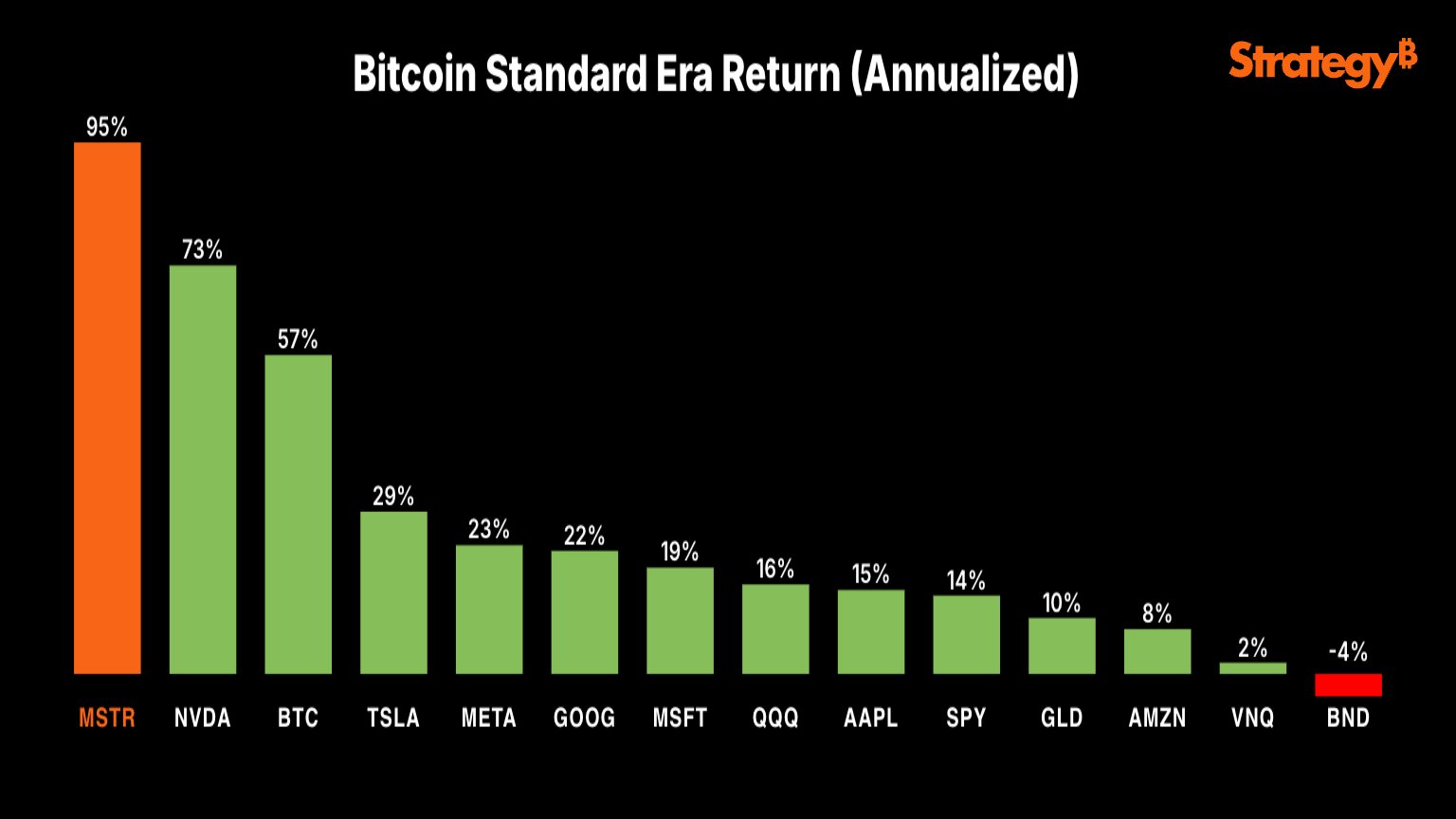
The profit-loss balance of the Bitcoin holdings isn’t the only thing the firm is doing well on. As Saylor shared in an X post, Strategy has shown an impressive stock performance as well.
Strategy Bitcoin

“Five years ago, $MSTR adopted the Bitcoin Standard. Since then, we’ve outperformed every asset class and every Magnificent 7 stock,” explains the Strategy chairman. The success of Saylor’s firm started a trend of other companies also adopting a BTC treasury strategy.

An example of this is Japan’s Metaplanet. Led by president Simon Gerovich, the firm has consistently been buying BTC much like Strategy. On Sunday, Gerovich unveiled a fresh purchase of 103 BTC ($11.7 million), which took the company’s reserve to 18,991 BTC (acquired for a total of $1.95 billion).

The treasury strategy wave has now expanded into the altcoins, with SharpLink being a prominent example. The firm’s Ethereum holdings currently sit at 740,760 ETH. Now, news has come out that Galaxy Digital, Jump Crypto, and Multicoin Capital are planning a $1 billion Solana accumulation spree for a SOL treasury.

In some other news, the CryptoQuant Bull Score Index is currently flagging the market as entering a bearish phase, as explained in an X post by Julio Moreno, CryptoQuant’s head of research. The Bull Score Index combines different on-chain metrics to determine what part of the cycle Bitcoin is in right now.

Bitcoin Bull Score Index

As displayed in the above chart, the Bitcoin indicator has gone down recently. “The Bull Score Index is now at 40 and switched to the ‘Getting Bearish’ phase,” notes Moreno.

BTC Price

Bitcoin’s bearish form has continued during the past day as its price has dropped to the $110,900 level.

Bitcoin Price Chart

Market Opportunity
Threshold Logo
Threshold Price(T)
$0.006655
$0.006655$0.006655
-4.99%
USD
Threshold (T) Live Price Chart
Disclaimer: The articles reposted on this site are sourced from public platforms and are provided for informational purposes only. They do not necessarily reflect the views of MEXC. All rights remain with the original authors. If you believe any content infringes on third-party rights, please contact service@support.mexc.com for removal. MEXC makes no guarantees regarding the accuracy, completeness, or timeliness of the content and is not responsible for any actions taken based on the information provided. The content does not constitute financial, legal, or other professional advice, nor should it be considered a recommendation or endorsement by MEXC.

You May Also Like

eurosecurity.net Expands Cryptocurrency Asset Recovery Capabilities Amid Rising Investor Losses

eurosecurity.net Expands Cryptocurrency Asset Recovery Capabilities Amid Rising Investor Losses

New York, NY/ GlobePRWire / Feb 6, 2026 – eurosecurity.net announces the expansion of its cryptocurrency asset recovery services, reflecting increased demand from
Share
CryptoReporter2026/02/06 17:24
Ethereum to boost scalability and roll out Fusaka upgrade on Dec 3

Ethereum to boost scalability and roll out Fusaka upgrade on Dec 3

Ethereum's Fusaka update may happen on December 3, based on the date set in the latest developer call.
Share
Cryptopolitan2025/09/19 17:00
Google Cloud taps EigenLayer to bring trust to agentic payments

Google Cloud taps EigenLayer to bring trust to agentic payments

The post Google Cloud taps EigenLayer to bring trust to agentic payments appeared on BitcoinEthereumNews.com. Two days after unveiling AP2 — a universal payment layer for AI agents that supports everything from credit cards to stablecoins — Google and EigenLayer have released details of their partnership to bring verifiability and restaking security to the stack, using Ethereum. In addition to enabling verifiable compute and slashing-backed payment coordination, EigenCloud will support insured and sovereign AI agents, which introduce consequences for failure or deviation from specified behavior. Sovereign agents are positioned as autonomous actors that can own property, make decisions, and execute actions independently — think smart contracts with embedded intelligence. From demos to dollars AP2 extends Google’s agent-to-agent (A2A) protocol using the HTTP 402 status code — long reserved for “payment required” — to standardize payment requests between agents across different networks. It already supports stablecoins like USDC, and Coinbase has demoed an agent checkout using its Wallet-as-a-Service. Paired with a system like Lit Protocol’s Vincent — which enforces per-action policies and key custody at signing — Google’s AP2 with EigenCloud’s verifiability and cross-chain settlement could form an end-to-end trust loop. Payments between agents aren’t as simple as they are often made to sound by “Crypto x AI” LARPs. When an AI agent requests a payment in USDC on Base and the payer’s funds are locked in ETH on Arbitrum, the transaction stalls — unless something abstracts the bridging, swapping and delivery. That’s where EigenCloud comes in. Sreeram Kannan, founder of EigenLayer, said the integration will create agents that not only run on-chain verifiable compute, but are also economically incentivized to behave within programmable bounds. Through restaked operators, EigenCloud powers a verifiable payment service that handles asset routing and chain abstraction, with dishonest behavior subject to slashing. It also introduces cryptographic accountability to the agents themselves, enabling proofs that an agent actually executed the task it…
Share
BitcoinEthereumNews2025/09/19 03:52