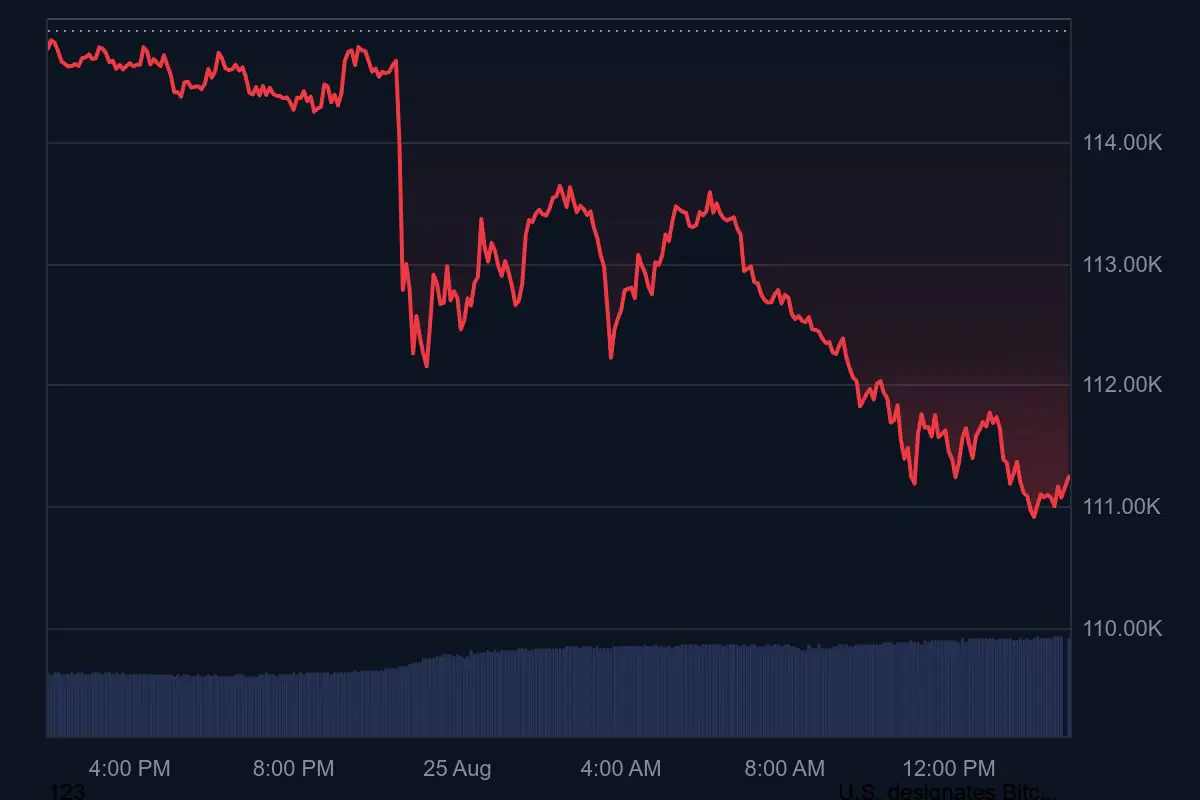
The move came alongside a 2.88% slide in the wider crypto market, highlighting fragile sentiment and risk-off positioning among traders. […] The post Bitcoin Retreats to $111,000 as Liquidations Spark Volatility Storm appeared first on Coindoo.The move came alongside a 2.88% slide in the wider crypto market, highlighting fragile sentiment and risk-off positioning among traders. […] The post Bitcoin Retreats to $111,000 as Liquidations Spark Volatility Storm appeared first on Coindoo.

Bitcoin Retreats to $111,000 as Liquidations Spark Volatility Storm

2025/08/25 20:06
3 min read

The move came alongside a 2.88% slide in the wider crypto market, highlighting fragile sentiment and risk-off positioning among traders.

Central bank hesitation rattles risk markets

At the macro level, investors face growing uncertainty around U.S. monetary policy. While rate cut expectations for September remain high, Federal Reserve officials have emphasized data dependency, tempering market optimism. The dollar index (DXY) firmed as a result, pressuring Bitcoin and other risk assets.
Meanwhile, Brazil’s rejection of a Bitcoin reserve strategy removed a potential source of sovereign demand. Analysts note the decision contrasts with El Salvador’s pro-Bitcoin stance and limits BTC’s appeal as a hedge for emerging economies.

Chart signals warn of deeper correction

From a technical perspective, Bitcoin’s price action turned sharply bearish after failing to hold the 23.6% Fibonacci level at $121,295. A drop through the 30-day moving average ($116,518) confirmed a breakdown, pushing momentum indicators into negative territory.

The MACD histogram’s decline to -493.51 suggests continued selling pressure, while the RSI at 44.28 reflects space for further downside before oversold signals emerge. Traders now monitor $113,927 as the critical Fib support, with the risk of a fall toward $110,000 if momentum persists.

READ MORE:

From $2.98 Peak to $0.36: Pi Coin’s Market Rollercoaster and What’s Next in 2026

Derivatives market adds fuel to the fire

Excessive leverage remains a key factor. Within 24 hours, the market saw $272 million in long liquidations, triggering a feedback loop of forced selling. With perpetual futures volume at $1.66 trillion and open interest nearing $999 billion, conditions remain ripe for heightened swings. Negative funding rates underline the bearish tilt.

Outlook: stabilization or further pain?

Bitcoin’s retracement underscores the fragility of the current market structure. Unless macro catalysts improve or liquidations ease, BTC may continue to face pressure. Market participants will look for direction at the Jackson Hole Symposium (Aug 25–26), where central bankers could provide critical policy signals.

Until then, the battle is set around $111,060 support. Holding that zone could enable a rebound toward $119,339, but failure risks a decisive slide into the $110K range—a level last tested in early August.


The information provided in this article is for informational purposes only and does not constitute financial, investment, or trading advice. Coindoo.com does not endorse or recommend any specific investment strategy or cryptocurrency. Always conduct your own research and consult with a licensed financial advisor before making any investment decisions.

The post Bitcoin Retreats to $111,000 as Liquidations Spark Volatility Storm appeared first on Coindoo.

Market Opportunity
Movement Logo
Movement Price(MOVE)
$0.02191
$0.02191$0.02191
-8.32%
USD
Movement (MOVE) Live Price Chart
Disclaimer: The articles reposted on this site are sourced from public platforms and are provided for informational purposes only. They do not necessarily reflect the views of MEXC. All rights remain with the original authors. If you believe any content infringes on third-party rights, please contact service@support.mexc.com for removal. MEXC makes no guarantees regarding the accuracy, completeness, or timeliness of the content and is not responsible for any actions taken based on the information provided. The content does not constitute financial, legal, or other professional advice, nor should it be considered a recommendation or endorsement by MEXC.

You May Also Like

Cashing In On University Patents Means Giving Up On Our Innovation Future

Cashing In On University Patents Means Giving Up On Our Innovation Future

The post Cashing In On University Patents Means Giving Up On Our Innovation Future appeared on BitcoinEthereumNews.com. “It’s a raid on American innovation that would deliver pennies to the Treasury while kneecapping the very engine of our economic and medical progress,” writes Pipes. Getty Images Washington is addicted to taxing success. Now, Commerce Secretary Howard Lutnick is floating a plan to skim half the patent earnings from inventions developed at universities with federal funding. It’s being sold as a way to shore up programs like Social Security. In reality, it’s a raid on American innovation that would deliver pennies to the Treasury while kneecapping the very engine of our economic and medical progress. Yes, taxpayer dollars support early-stage research. But the real payoff comes later—in the jobs created, cures discovered, and industries launched when universities and private industry turn those discoveries into real products. By comparison, the sums at stake in patent licensing are trivial. Universities collectively earn only about $3.6 billion annually in patent income—less than the federal government spends on Social Security in a single day. Even confiscating half would barely register against a $6 trillion federal budget. And yet the damage from such a policy would be anything but trivial. The true return on taxpayer investment isn’t in licensing checks sent to Washington, but in the downstream economic activity that federally supported research unleashes. Thanks to the bipartisan Bayh-Dole Act of 1980, universities and private industry have powerful incentives to translate early-stage discoveries into real-world products. Before Bayh-Dole, the government hoarded patents from federally funded research, and fewer than 5% were ever licensed. Once universities could own and license their own inventions, innovation exploded. The result has been one of the best returns on investment in government history. Since 1996, university research has added nearly $2 trillion to U.S. industrial output, supported 6.5 million jobs, and launched more than 19,000 startups. Those companies pay…
Share
BitcoinEthereumNews2025/09/18 03:26
XRP Ledger Unlocks Permissioned Domains With 91% Validator Backing

XRP Ledger Unlocks Permissioned Domains With 91% Validator Backing

XRP Ledger activated XLS-80 after 91% validator approval, enabling permissioned domains for credential-gated use on the public XRPL. The XRP Ledger has activated
Share
LiveBitcoinNews2026/02/06 13:00
TrendX Taps Trusta AI to Develop Safer and Smarter Web3 Network

TrendX Taps Trusta AI to Develop Safer and Smarter Web3 Network

The purpose of collaboration is to advance the Web3 landscape by combining the decentralized infrastructure of TrendX with AI-led capabilities of Trusta AI.
Share
Blockchainreporter2025/09/18 01:07