

Amazon Air: How Owning Logistics Became Amazon’s Boldest CX Strategy
When Control Becomes the Customer Experience: What CX Leaders Can Learn from Amazon Air
Ever promised a customer something you technically could deliver—until a partner said no?
It’s December. Orders surge. Expectations peak. One broken link in your ecosystem threatens the entire experience.
That was in Amazon in December 2014.
A Seattle warehouse ran out of Kindle devices days before Christmas. Trucks were too slow. Courier partners were fully booked. The “Out of Stock” message loomed—something Amazon’s culture simply doesn’t tolerate.
What followed wasn’t just a logistics fix.
It was a strategic CX decision that reshaped global delivery economics.
This is the story of Amazon Air—and why CX leaders should study it as a masterclass in experience control, systems thinking, and long-term CX resilience.
What Is the Core CX Problem Amazon Faced?
Short answer: Amazon’s customer promise exceeded the limits of its partner ecosystem.
Amazon didn’t lack demand, inventory, or intent. It lacked control at the moment of truth. When FedEx and UPS couldn’t reroute planes, Amazon discovered a dangerous CX truth:
Why This Wasn’t Just a Logistics Issue
Retail leaders often treat logistics as a cost center. Amazon treated it as a CX dependency.
At Christmas scale, delivery speed isn’t operational—it’s emotional.
- Gifts delayed break trust.
- Apologies don’t replace presence.
- Refunds don’t save memories.
CX leaders know this intuitively. Amazon operationalized it brutally.
What Did Amazon Do When Partners Couldn’t Deliver?
Short answer: It paid more now to learn less later—and then redesigned the system.
In 2014, Amazon used expensive chartered planes to move Kindles to Seattle. The crisis was solved. But the lesson lingered.
The takeaway wasn’t “book earlier next year.”
It was “we can’t outsource our customer promise.”
That insight triggered Project Aerosmith.
What Was Project Aerosmith?
Short answer: Amazon’s decision to internalize air cargo as a CX capability.
Amazon leased 40 cargo planes through ATSG and Atlas Air. Maintenance, staffing, and compliance stayed external. Operational control stayed with Amazon.
The planes—Boeing 737s and 767s—were branded Amazon Air.
This wasn’t about owning planes.
It was about owning outcomes.
Why Owning Outcomes Matters More Than Owning Assets
CX leaders often confuse asset ownership with control. Amazon didn’t.
They asked a sharper question:
The answer was air capacity during peak demand.
By leasing, Amazon achieved:
- Predictable availability
- Route flexibility
- Surge resilience
- Faster learning loops
All without airline-level risk.
When Did Amazon Know This Was Working?
Short answer: When dependency risk disappeared—even as volume exploded.
Just two years later, Amazon invested $1.5 billion in a global air hub in Cincinnati, capable of handling 200+ daily movements.
This wasn’t expansion for ego.
It was insurance for experience.
By then, Amazon Air had shifted from contingency to core.
What Changed During COVID—and Why It Matters to CX Leaders
Short answer: Amazon capitalized on asymmetry while others froze.
During COVID:
- Passenger airlines grounded planes.
- Aircraft flooded desert storage.
- Freight capacity became scarce.
Meanwhile:
- Customers stayed home.
- Orders surged.
- Delivery expectations tightened.
Amazon didn’t hesitate.
In January 2021, it bought 11 Boeing 767s outright.
Soon after, Amazon took a stake in ATSG.
This marked a strategic pivot—from user of capacity to shaper of capacity.
What CX Principle Was Amazon Applying Here?
Short answer: Design for peak stress, not average performance.
Most CX systems optimize for “normal days.”
Amazon optimized for December 21st.
This principle applies everywhere:
- Contact centers during outages
- Apps during flash sales
- Healthcare during emergencies
- Banks during market crashes
CX excellence isn’t proven on good days.
How Does Amazon Air Mirror AWS?
This is where the story deepens.
Years earlier, Amazon faced another internal bottleneck: infrastructure.
Teams wasted time building servers. Capacity sat idle during non-peak periods. Scaling was painful.
So Amazon built a shared internal service.
Then externalized it.
That service became Amazon Web Services.
AWS didn’t start as a business idea.
It started as a CX enabler for internal teams.
Amazon Air followed the same playbook.
What Pattern Should CX Leaders Notice?
Short answer: Amazon spins internal friction into external advantage.
Pattern recognition matters in strategy.
Amazon repeatedly:
- Encounters CX friction at scale
- Builds internal systems to solve it
- Perfects those systems under pressure
- Externalizes them as revenue engines
AWS did it to servers.
Amazon Air did it to logistics.
Since 2024, Amazon Air competes directly with FedEx and UPS. .
That’s not diversification.
That’s system confidence.
What Can CX Leaders Learn from This?
1. Control Is a CX Strategy
If your experience depends on partners, ask:
- Where do they fail under stress?
- What incentives don’t align?
- What delays cascade emotionally?
You don’t need to own everything.
You need to own failure points.
2. Journey Fragmentation Is a Leadership Choice
Amazon didn’t accept fragmented accountability.
Too many CX teams hear:
Customers hear none of that.
Amazon collapsed silos by redesigning the system.
3. Internal Tools Are Strategic Gold
If your teams built:
- Journey orchestration tools
- AI routing logic
- Capacity dashboards
- Workforce optimization systems
Ask:
Internal excellence often hides future differentiation.
Common CX Pitfalls Amazon Avoided
- Over-optimizing for cost instead of certainty
- Delegating accountability to vendors
- Treating peak demand as an anomaly
- Separating operations from experience design
Most CX failures aren’t design failures.
They’re system ownership failures.
A CX Framework Inspired by Amazon Air
The “Experience Control Matrix”
| CX Layer | Owned | Partnered | Exposed Risk |
|---|---|---|---|
| Promise Definition | ✓ | Low | |
| Inventory Visibility | ✓ | Low | |
| Last-Mile Delivery | ✓ | High | |
| Surge Capacity | ✓ | Critical |
Rule: Anything in the “Critical” column deserves redesign.
Why This Matters Now More Than Ever
AI is amplifying both capability and fragility.
- Bots fail fast at scale.
- Journey gaps widen instantly.
- One broken handoff becomes viral.
CX leaders can’t afford brittle ecosystems.
Amazon didn’t wait for perfection.
It built resilience.
FAQs: What CX Leaders Are Asking
How is Amazon Air a CX story, not just logistics?
Because delivery speed, reliability, and recovery shape emotional trust more than marketing ever can.
Should every company internalize logistics?
No. But every company should internalize experience accountability at stress points.
How does this apply outside retail?
Healthcare, banking, SaaS, and telecom face identical peak-load trust moments.
Is this strategy affordable for mid-size firms?
Yes—through selective control, not asset ownership.
What’s the biggest CX lesson here?
Don’t outsource the moment your customer remembers you by.
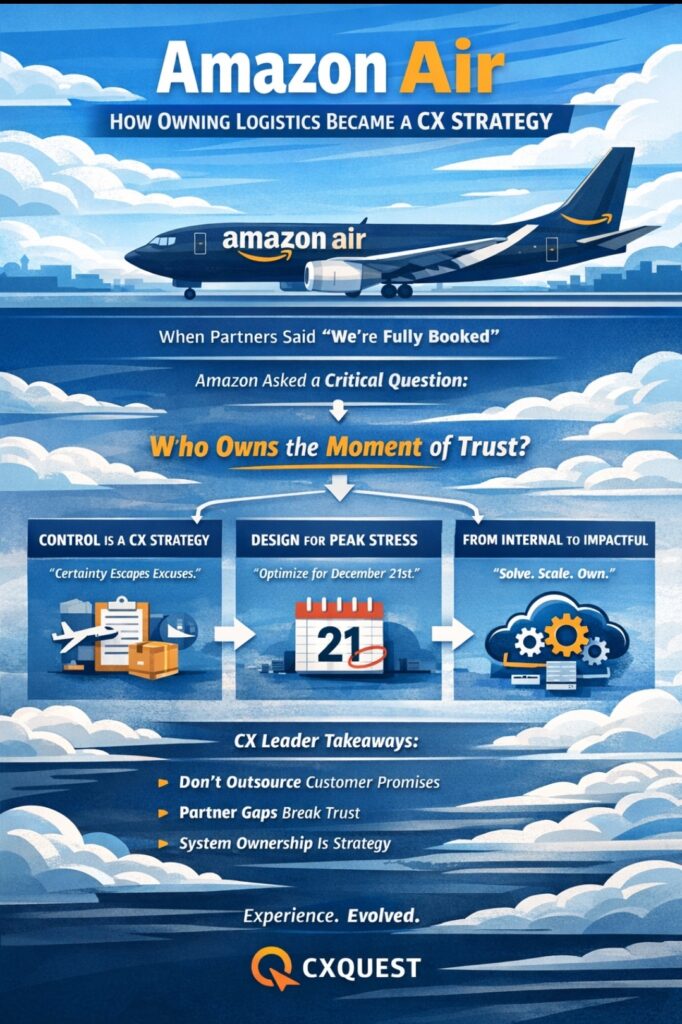
Actionable Takeaways for CX Leaders
- Map your journey’s December 21st moments.
- Identify partners who block surge responsiveness.
- Redesign ownership at emotional failure points.
- Treat internal tools as future platforms.
- Align incentives with customer promises.
- Invest in resilience before optimization.
- Measure CX under stress, not averages.
- Build systems that protect trust—not excuses.
Amazon didn’t build planes to beat airlines.
It built certainty to protect trust.
For CX leaders navigating AI gaps, siloed teams, and fragmented journeys, that’s the strategy that still flies.
The post Amazon Air: How Owning Logistics Became Amazon’s Boldest CX Strategy appeared first on CX Quest.
You May Also Like

Top 5 Trending Cryptos Today: What’s Hot in the Market

Google Becomes Latest in Agentic AI Stablecoin Payments Race
