Saifedean Ammous—best known in the Bitcoin community as the author of The Bitcoin Standard—has attacked Argentine President Javier Milei’s stabilization program as a bond-fueled “fiat fraud,” arguing that the policy mix flatters official statistics while deepening the country’s dependence on multilateral lenders and peso-denominated carry trades. In a lengthy X post on August 20, Ammous […]Saifedean Ammous—best known in the Bitcoin community as the author of The Bitcoin Standard—has attacked Argentine President Javier Milei’s stabilization program as a bond-fueled “fiat fraud,” arguing that the policy mix flatters official statistics while deepening the country’s dependence on multilateral lenders and peso-denominated carry trades. In a lengthy X post on August 20, Ammous […]

Bitcoin Author Saifedean Exposes Milei’s ‘Economic Miracle’ As Fiat Fraud

5 min read

Saifedean Ammous—best known in the Bitcoin community as the author of The Bitcoin Standard—has attacked Argentine President Javier Milei’s stabilization program as a bond-fueled “fiat fraud,” arguing that the policy mix flatters official statistics while deepening the country’s dependence on multilateral lenders and peso-denominated carry trades.

In a lengthy X post on August 20, Ammous framed last week’s bond rollover as a reality check: “Argentina’s Javier Milei regime tried to roll over bonds by offering investors an insane 69% interest rate, and only succeeded in rolling over 61% of them. Even a 69% annual interest rate isn’t enough to tempt investors to risk lending to the Milei ponzi.” He punctuated the thread with a line he says Milei himself used after a memecoin debacle: “No Crying in the Casino!”

Bitcoin Vs. Fiat: Milei Picks His Side

Ammous’ critique is explicitly Bitcoin-versus-fiat. He claims the administration “reneged on [its] campaign promise to shut down the central bank,” chose to expand money-supply measures instead of “stop[ping] creating money,” and raised taxes while seeking an IMF rescue—moves he calls “the same old fiat banksterism.” The Bitcoin author’s monetary prescription is unambiguous: “After almost two years in office, it would have been absolutely trivial for Milei to bring price inflation down to close to zero with the one simple trick… stop creating money.” In Ammous’ telling, anything short of extinguishing discretionary money creation cannot be sold to Bitcoiners as sound policy.

On debt and multilateral financing, Ammous alleges that the latest arrangements amount to record-breaking exposure to official creditors and a mortgaging of future fiscal space. “With this new $20b in IMF loans, Argentina now has the highest outstanding debt to the IMF in IMF history… borrowing is now at 1,352% of its IMF quota,” he writes, adding that the World Bank and Inter-American Development Bank “also” committed roughly $12 billion and $10 billion, respectively, bringing “a total of $42 billion borrowed from international institutions.” He characterizes the show of support, celebrated by local officials, as a pyrrhic victory for fiat: “Point 5 is not a win, it is an L.”

The Bitcoin-versus-fiat framing extends to prices, exchange rates, and data quality. Ammous argues that government statistics understate the erosion of purchasing power, but says even the official numbers are damning. “After year-on-year price inflation rates rose to almost 300% in the first few months of his presidency, it has declined to the 30–40% range in recent months, and the cumulative price inflation since Milei has taken office is 155%,” he writes. He underscores pressure on the peso by citing both the black-market and official rates: “The black market peso exchange rate has dropped 30% against the dollar in just 21 months… The official rate… has dropped by around 70%, from 400 pesos per dollar to 1,300 pesos per dollar. Just in the last month of July, both rates dropped around 13%.”

Bitcoin Doesn’t Default—Fiat Always Does

Ammous, speaking from a hard-money and Bitcoin perspective, insists that free markets cannot coexist with monetary discretion: “All talk of a free market is empty rhetoric as long as the government manipulates the money.” He links this to the high-yield peso bond complex—what he dubs a “shitcoin casino”—arguing that “the central bank is imposing an interest rate of 65%, making speculation on the government’s bonds the only possibly profitable industry.” In Bitcoin circles, that argument resonates with a longstanding critique: fiat incentives manufacture yield-chasing behavior that collapses when confidence wobbles, while Bitcoin’s fixed issuance schedule avoids that cycle by design.

His post also alleges problematic asset management and bank risk. “Milei shipped off the little that remained of Argentina’s once significant gold reserves to London in search for a quick yield buck,” Ammous claims, before warning that new regulations could again funnel household savings into sovereign risk: “Milei and Caputo are currently trying to force the banks to buy more government bonds, yet again using the savings of Argentinians to prop up the government’s unsustainable debt… bringing back painful memories of the Corralón of 2001.” The Bitcoin author’s broader contention is that fiat systems externalize crisis risk onto depositors and domestic savers, while Bitcoin self-custody avoids those channels.

The administration’s supporters—some of them Bitcoiners—push back. Fernando Nikolić, founder of Perception responded point-by-point that “inflation has dramatically declined,” “GDP growth is projected at 5.5%,” “currency controls were successfully eliminated without crisis,” and “the budget achieved [a] historic surplus.” He framed the outcome as proof that markets and institutions “rewarded Milei’s more gradual approach,” even if it falls short of an immediate central-bank shutdown favored by Austrian economists and many Bitcoin advocates. Ammous dismissed the rebuttal: “You either didn’t read what I wrote or you’re incapable of comprehending what you read… Point 5 is not a win, it is an L. Muted for wasting my time with stupidity.”

Beyond the clash of tone, the substantive disagreement is philosophical and monetary. Ammous’ benchmark is Bitcoin-standard discipline: close the central bank, anchor money supply, let relative prices reset, and rebuild on hard money—painful initially, in his view, but durable.

The government’s approach is classic fiat stabilization: disinflate with tight policy, widen financing buffers with IMF/WB/IDB lines, normalize the FX regime, and nurse domestic markets back to depth—politically survivable if growth returns, but reliant on confidence, rollover capacity, and high local-currency rates that Bitcoiners see as the hallmark of fiat fragility.

For now, both narratives point to the same hinge variables: peso rollover capacity at “insane” yields, the pace of disinflation, the behavior of parallel exchange rates, and whether multilateral support remains politically and financially sustainable. If those levers tighten simultaneously, Bitcoin’s critique will look prescient; if they hold, the case for a fiat stabilization hardens. In Ammous’ words, however, Bitcoin is the only durable exit: “It would have been absolutely trivial… stop creating money.”

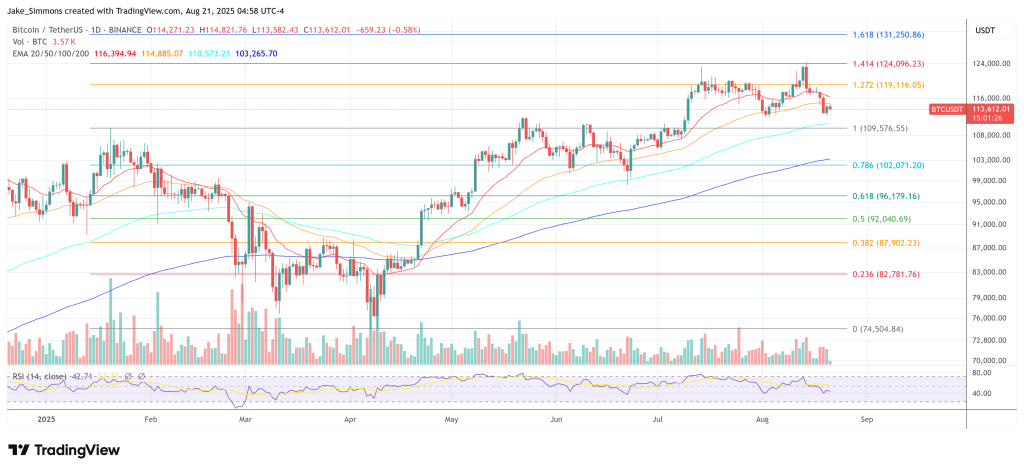
At press time, Bitcoin traded at $113,612.
Bitcoin price
Market Opportunity
BarnBridge Logo
BarnBridge Price(BOND)
$0.07334
$0.07334$0.07334
+2.93%
USD
BarnBridge (BOND) Live Price Chart
Disclaimer: The articles reposted on this site are sourced from public platforms and are provided for informational purposes only. They do not necessarily reflect the views of MEXC. All rights remain with the original authors. If you believe any content infringes on third-party rights, please contact service@support.mexc.com for removal. MEXC makes no guarantees regarding the accuracy, completeness, or timeliness of the content and is not responsible for any actions taken based on the information provided. The content does not constitute financial, legal, or other professional advice, nor should it be considered a recommendation or endorsement by MEXC.

You May Also Like

Shocking OpenVPP Partnership Claim Draws Urgent Scrutiny

Shocking OpenVPP Partnership Claim Draws Urgent Scrutiny

The post Shocking OpenVPP Partnership Claim Draws Urgent Scrutiny appeared on BitcoinEthereumNews.com. The cryptocurrency world is buzzing with a recent controversy surrounding a bold OpenVPP partnership claim. This week, OpenVPP (OVPP) announced what it presented as a significant collaboration with the U.S. government in the innovative field of energy tokenization. However, this claim quickly drew the sharp eye of on-chain analyst ZachXBT, who highlighted a swift and official rebuttal that has sent ripples through the digital asset community. What Sparked the OpenVPP Partnership Claim Controversy? The core of the issue revolves around OpenVPP’s assertion of a U.S. government partnership. This kind of collaboration would typically be a monumental endorsement for any private cryptocurrency project, especially given the current regulatory climate. Such a partnership could signify a new era of mainstream adoption and legitimacy for energy tokenization initiatives. OpenVPP initially claimed cooperation with the U.S. government. This alleged partnership was said to be in the domain of energy tokenization. The announcement generated considerable interest and discussion online. ZachXBT, known for his diligent on-chain investigations, was quick to flag the development. He brought attention to the fact that U.S. Securities and Exchange Commission (SEC) Commissioner Hester Peirce had directly addressed the OpenVPP partnership claim. Her response, delivered within hours, was unequivocal and starkly contradicted OpenVPP’s narrative. How Did Regulatory Authorities Respond to the OpenVPP Partnership Claim? Commissioner Hester Peirce’s statement was a crucial turning point in this unfolding story. She clearly stated that the SEC, as an agency, does not engage in partnerships with private cryptocurrency projects. This response effectively dismantled the credibility of OpenVPP’s initial announcement regarding their supposed government collaboration. Peirce’s swift clarification underscores a fundamental principle of regulatory bodies: maintaining impartiality and avoiding endorsements of private entities. Her statement serves as a vital reminder to the crypto community about the official stance of government agencies concerning private ventures. Moreover, ZachXBT’s analysis…
Share
BitcoinEthereumNews2025/09/18 02:13
United States Building Permits Change dipped from previous -2.8% to -3.7% in August

United States Building Permits Change dipped from previous -2.8% to -3.7% in August

The post United States Building Permits Change dipped from previous -2.8% to -3.7% in August appeared on BitcoinEthereumNews.com. Information on these pages contains forward-looking statements that involve risks and uncertainties. Markets and instruments profiled on this page are for informational purposes only and should not in any way come across as a recommendation to buy or sell in these assets. You should do your own thorough research before making any investment decisions. FXStreet does not in any way guarantee that this information is free from mistakes, errors, or material misstatements. It also does not guarantee that this information is of a timely nature. Investing in Open Markets involves a great deal of risk, including the loss of all or a portion of your investment, as well as emotional distress. All risks, losses and costs associated with investing, including total loss of principal, are your responsibility. The views and opinions expressed in this article are those of the authors and do not necessarily reflect the official policy or position of FXStreet nor its advertisers. The author will not be held responsible for information that is found at the end of links posted on this page. If not otherwise explicitly mentioned in the body of the article, at the time of writing, the author has no position in any stock mentioned in this article and no business relationship with any company mentioned. The author has not received compensation for writing this article, other than from FXStreet. FXStreet and the author do not provide personalized recommendations. The author makes no representations as to the accuracy, completeness, or suitability of this information. FXStreet and the author will not be liable for any errors, omissions or any losses, injuries or damages arising from this information and its display or use. Errors and omissions excepted. The author and FXStreet are not registered investment advisors and nothing in this article is intended…
Share
BitcoinEthereumNews2025/09/18 02:20
CME Group to launch Solana and XRP futures options in October

CME Group to launch Solana and XRP futures options in October

The post CME Group to launch Solana and XRP futures options in October appeared on BitcoinEthereumNews.com. CME Group is preparing to launch options on SOL and XRP futures next month, giving traders new ways to manage exposure to the two assets.  The contracts are set to go live on October 13, pending regulatory approval, and will come in both standard and micro sizes with expiries offered daily, monthly and quarterly. The new listings mark a major step for CME, which first brought bitcoin futures to market in 2017 and added ether contracts in 2021. Solana and XRP futures have quickly gained traction since their debut earlier this year. CME says more than 540,000 Solana contracts (worth about $22.3 billion), and 370,000 XRP contracts (worth $16.2 billion), have already been traded. Both products hit record trading activity and open interest in August. Market makers including Cumberland and FalconX plan to support the new contracts, arguing that institutional investors want hedging tools beyond bitcoin and ether. CME’s move also highlights the growing demand for regulated ways to access a broader set of digital assets. The launch, which still needs the green light from regulators, follows the end of XRP’s years-long legal fight with the US Securities and Exchange Commission. A federal court ruling in 2023 found that institutional sales of XRP violated securities laws, but programmatic exchange sales did not. The case officially closed in August 2025 after Ripple agreed to pay a $125 million fine, removing one of the biggest uncertainties hanging over the token. This is a developing story. This article was generated with the assistance of AI and reviewed by editor Jeffrey Albus before publication. Get the news in your inbox. Explore Blockworks newsletters: Source: https://blockworks.co/news/cme-group-solana-xrp-futures
Share
BitcoinEthereumNews2025/09/17 23:55
