TLDR XRP price fell to $1.50, its lowest level since November 2024, down 57% from all-time high Total value locked in XRP Ledger dropped 20% in 30 days to $55 millionTLDR XRP price fell to $1.50, its lowest level since November 2024, down 57% from all-time high Total value locked in XRP Ledger dropped 20% in 30 days to $55 million

XRP Price: Token Falls to $1.50 as Network Metrics Drop 20% – What’s Next?

2026/02/04 16:02
4 min read

TLDR

  • XRP price fell to $1.50, its lowest level since November 2024, down 57% from all-time high
  • Total value locked in XRP Ledger dropped 20% in 30 days to $55 million
  • XRP burn rate has stagnated since August, with only 335 tokens burned on February 3
  • XRP ETFs saw outflows of $404k on Monday after losing $92 million Thursday prior
  • XRPL Permissioned Domains launched February 4 with 91% validator approval for institutional access

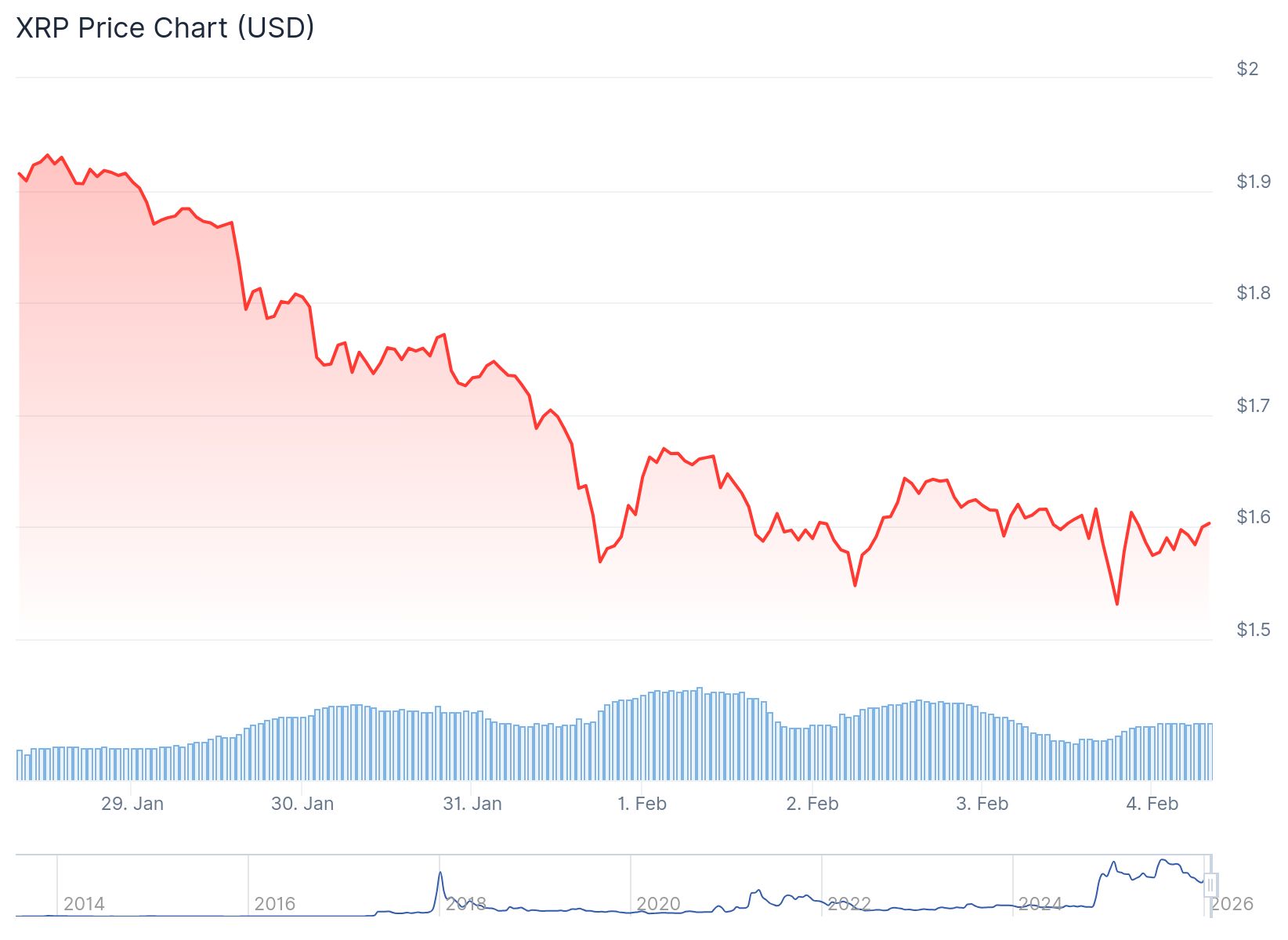
XRP price continued its downward trend this week. The token reached $1.50, marking its lowest point since November 2024.
xrp priceXRP Price

The cryptocurrency has fallen 57% from its all-time high. This decline has pushed XRP into technical bear market territory.

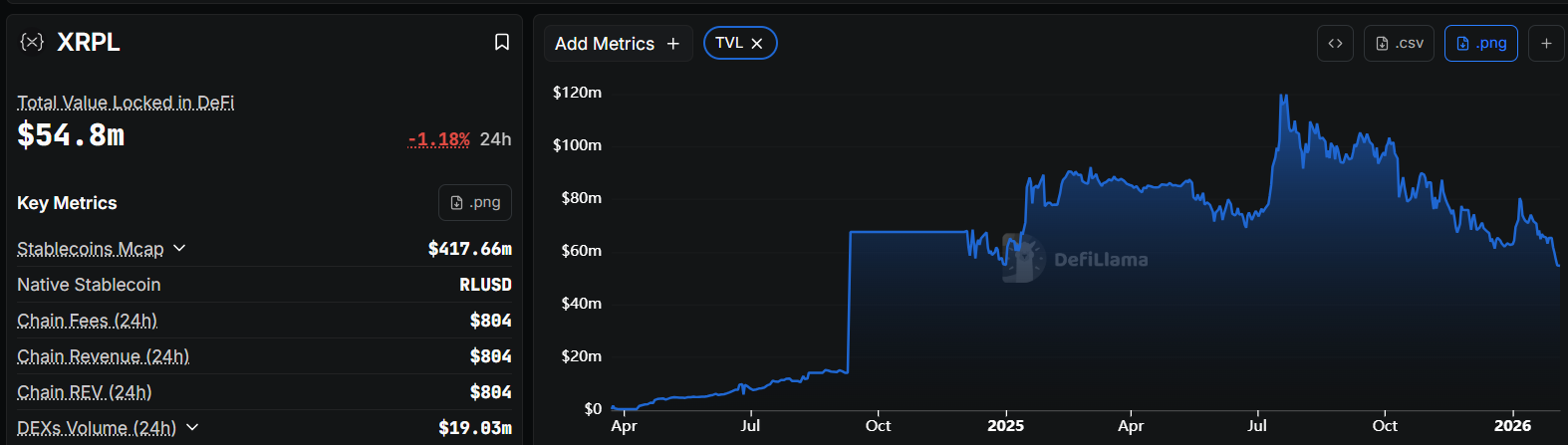
Data from DeFi Llama shows the XRP Ledger is facing challenges in decentralized finance. The network currently hosts 21 protocols with a total value locked of $55 million.
Source: DefiLlama

This represents a drop of over 20% in the past 30 days. The DEX volume in the last 24 hours stood at $145,820.

These figures are small compared to other major networks. Ethereum maintains over $60 billion in total value locked and processed $3.1 million in volume.

The XRP burn rate has declined in recent months. Only 335 XRP tokens were burned on February 3.

This burn rate has remained flat since August of last year. The stagnant burn rate has not provided support for the price.

Stablecoin Growth Provides Bright Spot

XRPL has seen growth in the stablecoin sector. The network’s stablecoin supply increased to over $417 million.

Ripple USD (RLUSD) has become one of the top stablecoins in the industry. This growth represents a positive development for the network.

Real-world asset tokenization has also expanded on XRPL. Data from RWA shows the network has a represented value exceeding $1.47 billion.

This marks a 271% increase over the last 30 days. The growth accelerated on Tuesday when Ctrl Alt tokenized diamonds worth over $129 million.

Other major players in the network include Vert Capital, Guggenheim, and JMWH. These institutions are helping drive adoption in the tokenization space.

Ripple Labs received a Luxembourg license this week. The company previously obtained licenses in the UK and other countries.

It also secured a banking charter in the United States. The company received a money license in the EU as well.

XRP ETF Demand Weakens

Demand for XRP exchange-traded funds has decreased in recent weeks. These funds experienced outflows of over $404k on Monday.

This followed a loss of $92 million on Thursday of the previous week. The outflows reflect reduced investor interest in XRP exposure through traditional financial products.

Technical analysis suggests further downside potential. The token has fallen below all moving averages on the weekly chart.

XRP risks moving below the Major S/R pivot level of the Murrey Math Lines tool. The next key level sits at the psychological $1 mark.

A drop below $1 would point to further declines toward $0.7813. This level represents the Strong, Pivot, Reverse level of the Murrey Math Lines tool.

New Infrastructure Upgrade Goes Live

The XRP Ledger activated Permissioned Domains on February 4, 2026. More than 91% of validators backed the XLS-80 amendment.

Permissioned Domains are managed environments within XRPL. Access and user activity are controlled by credential-based rules.

These domains operate as credential-gated access layers on the public XRPL. The system enables controlled participation while using shared ledger infrastructure.

The XLS-80 proposal builds on the XLS-70 Credentials framework. Domain owners can define rules by specifying accepted credentials.

Accounts with accepted credentials become members automatically. No additional joining steps are required for membership.

The amendment introduces new technical components. These include the PermissionedDomain ledger object and management transactions such as PermissionedDomainSet and PermissionedDomainDelete.

The proposal documentation describes this amendment as foundational. It does not deliver end-user functionality on its own but enables future amendments and features.

The upgrade passed the required validator supermajority threshold of over 80% in late January. The amendment entered a standard two-week activation window before going live February 4.

The post XRP Price: Token Falls to $1.50 as Network Metrics Drop 20% – What’s Next? appeared first on CoinCentral.

Disclaimer: The articles reposted on this site are sourced from public platforms and are provided for informational purposes only. They do not necessarily reflect the views of MEXC. All rights remain with the original authors. If you believe any content infringes on third-party rights, please contact service@support.mexc.com for removal. MEXC makes no guarantees regarding the accuracy, completeness, or timeliness of the content and is not responsible for any actions taken based on the information provided. The content does not constitute financial, legal, or other professional advice, nor should it be considered a recommendation or endorsement by MEXC.

You May Also Like

ETH Leverage ETF: Defiance Unlocks Revolutionary Opportunities for Retail Investors

ETH Leverage ETF: Defiance Unlocks Revolutionary Opportunities for Retail Investors

BitcoinWorld ETH Leverage ETF: Defiance Unlocks Revolutionary Opportunities for Retail Investors The world of cryptocurrency investing is constantly evolving, and a new product from Defiance is set to make waves. They’ve just announced the launch of an innovative ETH leverage ETF, known as ETHI. This isn’t just another investment vehicle; it’s a groundbreaking approach designed to give retail investors enhanced exposure to Ethereum while also generating income through sophisticated options strategies. What Exactly is Defiance’s New ETH Leverage ETF? Defiance’s new offering, ETHI, is an Exchange Traded Fund (ETF) that combines two powerful elements: leverage from an ETH-linked exchange-traded product (ETP) and income generation from options. Essentially, it allows investors to amplify their potential returns from Ethereum’s price movements without directly holding ETH. This particular ETH leverage ETF is tailored for retail investors who are looking for dynamic ways to engage with the crypto market. It aims to provide a more accessible pathway to strategies often reserved for institutional players. By packaging these complex mechanisms into an ETF, Defiance makes them available through traditional brokerage accounts. How Does This Innovative ETH Leverage ETF Generate Income? At the heart of ETHI’s income generation strategy is a credit call spread. This is an options-based approach that involves both selling and buying options simultaneously. Here’s a simplified breakdown: Selling Call Options: The ETF sells call options, which obligate it to sell ETH-linked ETPs at a certain price if the market goes above that level. This generates immediate premium income. Buying Call Options: To limit potential losses from the sold call options, the ETF also buys call options at a higher strike price. This caps the risk, making the strategy more defined. The combination of these actions creates a net credit for the ETF, which is then passed on to investors. This strategic approach provides a unique blend of potential growth from Ethereum’s price and consistent income generation, distinguishing it from simpler investment products. Understanding the mechanics of this ETH leverage ETF is crucial for potential investors. What Are the Benefits and Risks of an ETH Leverage ETF? Like any investment, the Defiance ETHI comes with its own set of advantages and considerations. It’s important for investors to weigh these carefully before committing. Potential Benefits: Enhanced Exposure: Investors gain amplified exposure to Ethereum’s price movements without the complexities of managing leverage directly. Income Generation: The options strategy aims to provide regular income, which can be an attractive feature for many investors. Accessibility: As an ETF, it’s easily traded through standard brokerage accounts, making advanced strategies more accessible to retail investors. Diversification: It offers a novel way to diversify a portfolio beyond traditional assets and direct crypto holdings. Key Risks: Volatility: Ethereum is a highly volatile asset. Leverage can magnify both gains and losses significantly. Options Complexity: While simplified by the ETF structure, the underlying options strategy still carries inherent risks, including potential for capital loss. Management Fees: ETFs typically have management fees, which can impact overall returns over time. Market Timing: The effectiveness of options strategies can be highly dependent on market conditions and timing. Before investing in any ETH leverage ETF, a thorough understanding of these dynamics is essential. Is This Revolutionary ETH Leverage ETF Right for Your Portfolio? Defiance’s ETHI is certainly an intriguing product, but its suitability depends on individual investor profiles. This ETH leverage ETF is generally aimed at those who have a higher risk tolerance and a good understanding of both cryptocurrency markets and options strategies. It’s not a set-it-and-forget-it investment. Potential investors should conduct their own due diligence, perhaps consulting with a financial advisor, to determine if the combination of ETH leverage and options-based income aligns with their financial goals and risk appetite. The innovative nature of this product demands careful consideration. In conclusion, Defiance’s new ETHI represents a significant leap forward in making sophisticated crypto investment strategies available to a broader audience. By combining ETH leverage with a credit call spread options strategy, it offers a unique blend of amplified exposure and potential income. While the potential rewards are compelling, investors must approach this ETH leverage ETF with a clear understanding of the associated risks and ensure it fits their investment profile. This innovative product truly unlocks new avenues for engaging with the dynamic world of Ethereum. Frequently Asked Questions (FAQs) Q1: What is the Defiance ETH Leverage ETF (ETHI)? A1: The Defiance ETH Leverage ETF (ETHI) is an Exchange Traded Fund that combines leveraged exposure to Ethereum (via an ETP) with income generation through an options-based strategy, specifically a credit call spread. Q2: How does the ETH leverage component work? A2: The ETF gains leveraged exposure by investing in an ETH-linked ETP, meaning it aims to amplify the returns (and losses) of Ethereum’s price movements. This allows investors to potentially achieve greater gains than direct ETH ownership, albeit with increased risk. Q3: What is a credit call spread strategy? A3: A credit call spread is an options strategy where the ETF simultaneously sells a call option and buys another call option with a higher strike price. This generates a net premium (credit) for the ETF, providing income while also limiting potential losses from the sold option. Q4: Who is the target audience for this ETH leverage ETF? A4: This ETH leverage ETF is primarily aimed at retail investors who have a higher risk tolerance, a good understanding of cryptocurrency markets, and are looking for advanced strategies to gain amplified exposure to Ethereum with an income component. Q5: What are the main risks associated with investing in ETHI? A5: Key risks include the high volatility of Ethereum, the magnified potential for losses due to leverage, the inherent complexities and risks of options strategies, and the impact of management fees on overall returns. Investors should understand these before investing. Share Your Insights Did you find this article on Defiance’s new ETH leverage ETF insightful? Share your thoughts and this article with your network on social media! Your engagement helps us bring more valuable crypto market analysis to a wider audience. To learn more about the latest crypto market trends, explore our article on key developments shaping Ethereum institutional adoption. This post ETH Leverage ETF: Defiance Unlocks Revolutionary Opportunities for Retail Investors first appeared on BitcoinWorld.
Share
Coinstats2025/09/19 23:35
Curve Finance votes on revenue-sharing model for CRV holders

Curve Finance votes on revenue-sharing model for CRV holders

The post Curve Finance votes on revenue-sharing model for CRV holders appeared on BitcoinEthereumNews.com. Curve Finance has proposed a new protocol called Yield Basis that would share revenue directly with CRV holders, marking a shift from one-off incentives to sustainable income. Summary Curve Finance has put forward a revenue-sharing protocol to give CRV holders sustainable income beyond emissions and fees. The plan would mint $60M in crvUSD to seed three Bitcoin liquidity pools (WBTC, cbBTC, tBTC), with 35–65% of revenue distributed to veCRV stakers. The DAO vote runs from up to Sept. 24, with the proposal seen as a major step to strengthen CRV tokenomics after past liquidity and governance challenges. Curve Finance founder Michael Egorov has introduced a proposal to give CRV token holders a more direct way to earn income, launching a system called Yield Basis that aims to turn the governance token into a sustainable, yield-bearing asset.  The proposal has been published on the Curve DAO (CRV) governance forum, with voting open until Sept. 24. A new model for CRV rewards Yield Basis is designed to distribute transparent and consistent returns to CRV holders who lock their tokens for veCRV governance rights. Unlike past incentive programs, which relied heavily on airdrops and emissions, the protocol channels income from Bitcoin-focused liquidity pools directly back to token holders. To start, Curve would mint $60 million worth of crvUSD, its over-collateralized stablecoin, with proceeds allocated across three pools — WBTC, cbBTC, and tBTC — each capped at $10 million. 25% of Yield Basis tokens would be reserved for the Curve ecosystem, and between 35% and 65% of Yield Basis’s revenue would be given to veCRV holders. By emphasizing Bitcoin (BTC) liquidity and offering yields without the short-term loss risks associated with automated market makers, the protocol hopes to draw in professional traders and institutions. Context and potential impact on Curve Finance The proposal comes as Curve continues to modify…
Share
BitcoinEthereumNews2025/09/18 14:37
Over 260,000 Chrome users hit by 30 fake AI extensions stealing browsing & email data

Over 260,000 Chrome users hit by 30 fake AI extensions stealing browsing & email data

Tens of thousands of people have downloaded what they believed were useful AI tools for their browsers, only to give hackers a direct path into their most private
Share
Cryptopolitan2026/02/13 03:20