TLDR Solana price found support at $100 after a 25% drop from $127, with technical indicators suggesting a potential recovery to $260 Standard Chartered bank predictsTLDR Solana price found support at $100 after a 25% drop from $127, with technical indicators suggesting a potential recovery to $260 Standard Chartered bank predicts

Solana (SOL) Price Prediction: Standard Chartered Predicts $2,000 by 2030 Despite Near-Term Challenges

2026/02/04 15:48
3 min read

TLDR

  • Solana price found support at $100 after a 25% drop from $127, with technical indicators suggesting a potential recovery to $260
  • Standard Chartered bank predicts SOL could reach $2,000 by 2030, representing a 1,900% increase from current prices around $100
  • Solana’s total value locked hit an all-time high of 73.4 million SOL (worth $7.5 billion), marking an 18% increase over one week
  • Daily transactions on Solana reached 109.5 million on Monday, a two-year high, while DEX volume hit eight-month peaks
  • The bank reduced its 2026 price target to $250 from $310 but raised long-term forecasts based on Solana’s micropayment and stablecoin adoption

Solana price dropped 25% from $127 to find support around the $100 level. The cryptocurrency has bounced from this key support zone on multiple timeframes.
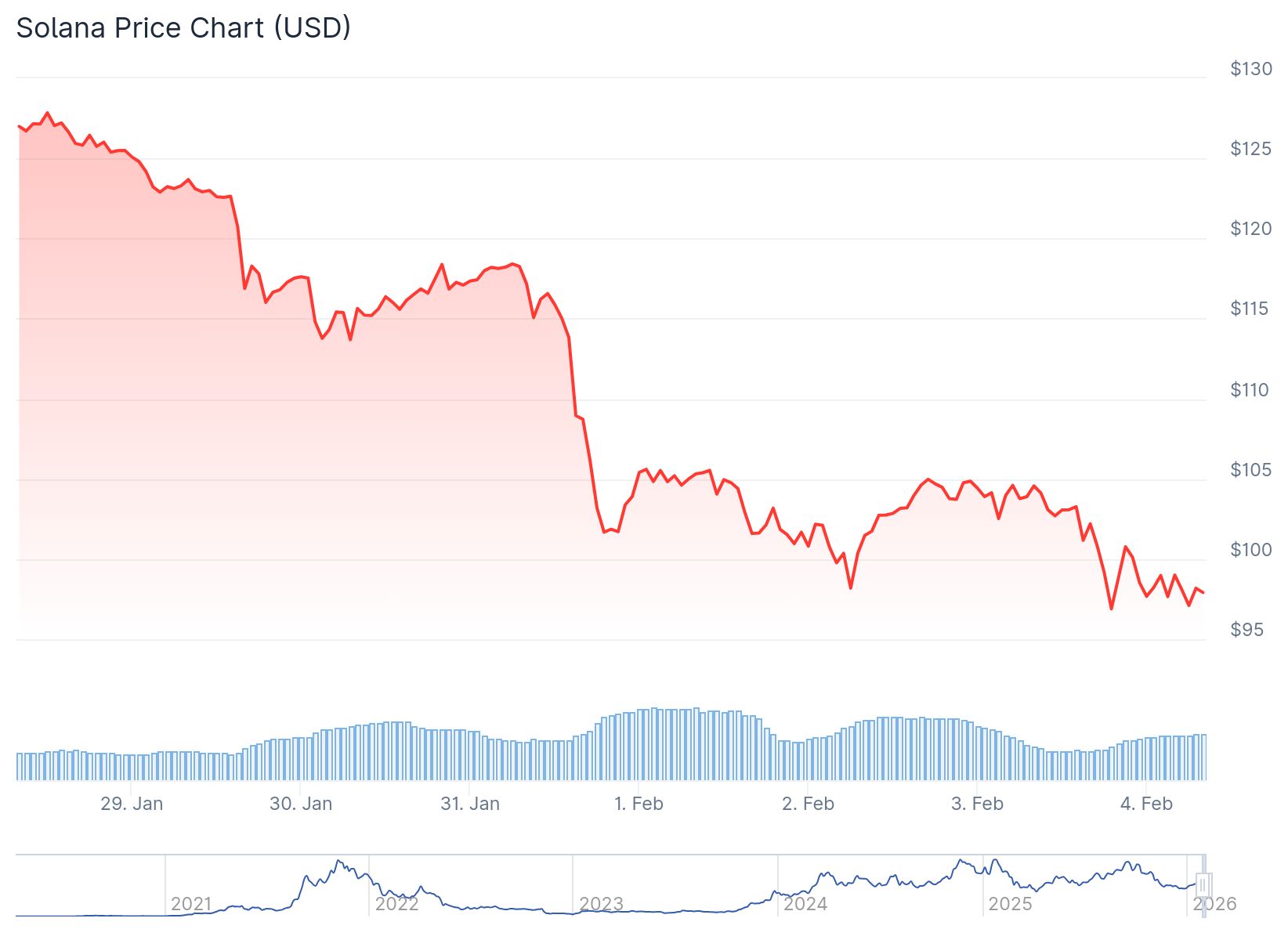
Solana (SOL) PriceSolana (SOL) Price

The four-hour chart shows a possible V-shaped recovery pattern forming. The relative strength index climbed to 36 from oversold conditions at 18.

On the daily chart, the RSI reached oversold levels at 29. This level has previously marked market bottoms for SOL and triggered price rebounds.

Solana now faces several resistance levels on its path higher. The first barrier sits at $113-$115, where key trendlines meet.

The second resistance zone is at $125-$130. This area contains the 50-day exponential and simple moving averages.

Network Activity Reaches New Highs

If SOL breaks above these levels, the price could climb toward $150. This would represent a 44% gain from current prices.

The weekly chart shows strong support for Solana at $95-$100. The last time SOL bounced from this level, it rallied 166% to $250 between April and September 2024.

The 50-week moving averages sit between $140-$160. This zone has historically acted as resistance and could slow any price rally.

Trader Tardigrade noted that SOL’s bounce from the lower boundary of a descending channel could push prices toward $215 at the upper boundary.

Solana’s total value locked reached an all-time high of 73.4 million SOL on Monday. At current rates, this equals about $7.5 billion.

This marks an 18% increase over the past week. The last time this metric hit peak levels was in June 2022 at 68.3 million SOL.

Daily transactions on Solana hit 109.5 million on Monday. This represents a two-year high for the network.

Bank Forecasts Long-Term Price Surge

Daily decentralized exchange volume reached an eight-month high of 51.3 million SOL on Monday. Weekly DEX trading volume hit a 12-month high of 264.8 million SOL.

Daily active addresses on Solana increased 115% during the second half of January.

Standard Chartered bank released new price predictions for Solana. The bank cut its end-2026 target to $250 from $310.

However, the bank raised its long-term forecasts. Standard Chartered now expects SOL to reach $400 by end-2027, $700 by end-2028, and $1,200 by end-2029.

The bank’s end-2030 target sits at $2,000. From current prices around $100, this represents a 1,900% increase.

Geoff Kendrick, Standard Chartered’s Global Head of Digital Assets Research, said the blockchain is evolving into a dominant platform for micropayments and stablecoin transactions.

Stablecoins on Solana turn over two to three times faster than those on Ethereum. Flows on Solana’s decentralized exchanges are shifting from memecoins toward SOL-stablecoin pairs.

Solana’s median gas fee of roughly $0.0007 compares with about $0.015 on Base. This allows the network to process high volumes that other blockchains cannot handle profitably.

The post Solana (SOL) Price Prediction: Standard Chartered Predicts $2,000 by 2030 Despite Near-Term Challenges appeared first on CoinCentral.

Disclaimer: The articles reposted on this site are sourced from public platforms and are provided for informational purposes only. They do not necessarily reflect the views of MEXC. All rights remain with the original authors. If you believe any content infringes on third-party rights, please contact service@support.mexc.com for removal. MEXC makes no guarantees regarding the accuracy, completeness, or timeliness of the content and is not responsible for any actions taken based on the information provided. The content does not constitute financial, legal, or other professional advice, nor should it be considered a recommendation or endorsement by MEXC.

You May Also Like

ETH Leverage ETF: Defiance Unlocks Revolutionary Opportunities for Retail Investors

ETH Leverage ETF: Defiance Unlocks Revolutionary Opportunities for Retail Investors

BitcoinWorld ETH Leverage ETF: Defiance Unlocks Revolutionary Opportunities for Retail Investors The world of cryptocurrency investing is constantly evolving, and a new product from Defiance is set to make waves. They’ve just announced the launch of an innovative ETH leverage ETF, known as ETHI. This isn’t just another investment vehicle; it’s a groundbreaking approach designed to give retail investors enhanced exposure to Ethereum while also generating income through sophisticated options strategies. What Exactly is Defiance’s New ETH Leverage ETF? Defiance’s new offering, ETHI, is an Exchange Traded Fund (ETF) that combines two powerful elements: leverage from an ETH-linked exchange-traded product (ETP) and income generation from options. Essentially, it allows investors to amplify their potential returns from Ethereum’s price movements without directly holding ETH. This particular ETH leverage ETF is tailored for retail investors who are looking for dynamic ways to engage with the crypto market. It aims to provide a more accessible pathway to strategies often reserved for institutional players. By packaging these complex mechanisms into an ETF, Defiance makes them available through traditional brokerage accounts. How Does This Innovative ETH Leverage ETF Generate Income? At the heart of ETHI’s income generation strategy is a credit call spread. This is an options-based approach that involves both selling and buying options simultaneously. Here’s a simplified breakdown: Selling Call Options: The ETF sells call options, which obligate it to sell ETH-linked ETPs at a certain price if the market goes above that level. This generates immediate premium income. Buying Call Options: To limit potential losses from the sold call options, the ETF also buys call options at a higher strike price. This caps the risk, making the strategy more defined. The combination of these actions creates a net credit for the ETF, which is then passed on to investors. This strategic approach provides a unique blend of potential growth from Ethereum’s price and consistent income generation, distinguishing it from simpler investment products. Understanding the mechanics of this ETH leverage ETF is crucial for potential investors. What Are the Benefits and Risks of an ETH Leverage ETF? Like any investment, the Defiance ETHI comes with its own set of advantages and considerations. It’s important for investors to weigh these carefully before committing. Potential Benefits: Enhanced Exposure: Investors gain amplified exposure to Ethereum’s price movements without the complexities of managing leverage directly. Income Generation: The options strategy aims to provide regular income, which can be an attractive feature for many investors. Accessibility: As an ETF, it’s easily traded through standard brokerage accounts, making advanced strategies more accessible to retail investors. Diversification: It offers a novel way to diversify a portfolio beyond traditional assets and direct crypto holdings. Key Risks: Volatility: Ethereum is a highly volatile asset. Leverage can magnify both gains and losses significantly. Options Complexity: While simplified by the ETF structure, the underlying options strategy still carries inherent risks, including potential for capital loss. Management Fees: ETFs typically have management fees, which can impact overall returns over time. Market Timing: The effectiveness of options strategies can be highly dependent on market conditions and timing. Before investing in any ETH leverage ETF, a thorough understanding of these dynamics is essential. Is This Revolutionary ETH Leverage ETF Right for Your Portfolio? Defiance’s ETHI is certainly an intriguing product, but its suitability depends on individual investor profiles. This ETH leverage ETF is generally aimed at those who have a higher risk tolerance and a good understanding of both cryptocurrency markets and options strategies. It’s not a set-it-and-forget-it investment. Potential investors should conduct their own due diligence, perhaps consulting with a financial advisor, to determine if the combination of ETH leverage and options-based income aligns with their financial goals and risk appetite. The innovative nature of this product demands careful consideration. In conclusion, Defiance’s new ETHI represents a significant leap forward in making sophisticated crypto investment strategies available to a broader audience. By combining ETH leverage with a credit call spread options strategy, it offers a unique blend of amplified exposure and potential income. While the potential rewards are compelling, investors must approach this ETH leverage ETF with a clear understanding of the associated risks and ensure it fits their investment profile. This innovative product truly unlocks new avenues for engaging with the dynamic world of Ethereum. Frequently Asked Questions (FAQs) Q1: What is the Defiance ETH Leverage ETF (ETHI)? A1: The Defiance ETH Leverage ETF (ETHI) is an Exchange Traded Fund that combines leveraged exposure to Ethereum (via an ETP) with income generation through an options-based strategy, specifically a credit call spread. Q2: How does the ETH leverage component work? A2: The ETF gains leveraged exposure by investing in an ETH-linked ETP, meaning it aims to amplify the returns (and losses) of Ethereum’s price movements. This allows investors to potentially achieve greater gains than direct ETH ownership, albeit with increased risk. Q3: What is a credit call spread strategy? A3: A credit call spread is an options strategy where the ETF simultaneously sells a call option and buys another call option with a higher strike price. This generates a net premium (credit) for the ETF, providing income while also limiting potential losses from the sold option. Q4: Who is the target audience for this ETH leverage ETF? A4: This ETH leverage ETF is primarily aimed at retail investors who have a higher risk tolerance, a good understanding of cryptocurrency markets, and are looking for advanced strategies to gain amplified exposure to Ethereum with an income component. Q5: What are the main risks associated with investing in ETHI? A5: Key risks include the high volatility of Ethereum, the magnified potential for losses due to leverage, the inherent complexities and risks of options strategies, and the impact of management fees on overall returns. Investors should understand these before investing. Share Your Insights Did you find this article on Defiance’s new ETH leverage ETF insightful? Share your thoughts and this article with your network on social media! Your engagement helps us bring more valuable crypto market analysis to a wider audience. To learn more about the latest crypto market trends, explore our article on key developments shaping Ethereum institutional adoption. This post ETH Leverage ETF: Defiance Unlocks Revolutionary Opportunities for Retail Investors first appeared on BitcoinWorld.
Share
Coinstats2025/09/19 23:35
Curve Finance votes on revenue-sharing model for CRV holders

Curve Finance votes on revenue-sharing model for CRV holders

The post Curve Finance votes on revenue-sharing model for CRV holders appeared on BitcoinEthereumNews.com. Curve Finance has proposed a new protocol called Yield Basis that would share revenue directly with CRV holders, marking a shift from one-off incentives to sustainable income. Summary Curve Finance has put forward a revenue-sharing protocol to give CRV holders sustainable income beyond emissions and fees. The plan would mint $60M in crvUSD to seed three Bitcoin liquidity pools (WBTC, cbBTC, tBTC), with 35–65% of revenue distributed to veCRV stakers. The DAO vote runs from up to Sept. 24, with the proposal seen as a major step to strengthen CRV tokenomics after past liquidity and governance challenges. Curve Finance founder Michael Egorov has introduced a proposal to give CRV token holders a more direct way to earn income, launching a system called Yield Basis that aims to turn the governance token into a sustainable, yield-bearing asset.  The proposal has been published on the Curve DAO (CRV) governance forum, with voting open until Sept. 24. A new model for CRV rewards Yield Basis is designed to distribute transparent and consistent returns to CRV holders who lock their tokens for veCRV governance rights. Unlike past incentive programs, which relied heavily on airdrops and emissions, the protocol channels income from Bitcoin-focused liquidity pools directly back to token holders. To start, Curve would mint $60 million worth of crvUSD, its over-collateralized stablecoin, with proceeds allocated across three pools — WBTC, cbBTC, and tBTC — each capped at $10 million. 25% of Yield Basis tokens would be reserved for the Curve ecosystem, and between 35% and 65% of Yield Basis’s revenue would be given to veCRV holders. By emphasizing Bitcoin (BTC) liquidity and offering yields without the short-term loss risks associated with automated market makers, the protocol hopes to draw in professional traders and institutions. Context and potential impact on Curve Finance The proposal comes as Curve continues to modify…
Share
BitcoinEthereumNews2025/09/18 14:37
Over 260,000 Chrome users hit by 30 fake AI extensions stealing browsing & email data

Over 260,000 Chrome users hit by 30 fake AI extensions stealing browsing & email data

Tens of thousands of people have downloaded what they believed were useful AI tools for their browsers, only to give hackers a direct path into their most private
Share
Cryptopolitan2026/02/13 03:20