

7 Essential Altcoins Every Crypto Investor Should Know
Cryptsy - Latest Cryptocurrency News and Predictions
Cryptsy - Latest Cryptocurrency News and Predictions - Experts in Crypto Casinos
Altcoins can feel like the noisy part of crypto: new tickers every week, big promises, and price charts that can make even seasoned investors sweat. But if you treat them like a serious asset class instead of a lottery ticket, they can play a real role in your portfolio.
You’re not buying “the next Bitcoin.” You’re underwriting networks, payment rails, smart contract platforms, data services, and cross-chain plumbing, that may capture value if adoption keeps rising. In this guide, you’ll get clear examples of altcoins that matter, why they matter, and how to judge any coin before you put your money at risk. And if you want to keep tabs on prices, liquidity, and news without bouncing between tabs, Cryptsy is built for exactly that kind of day-to-day decision-making.
Key Takeaways
- Altcoins can strengthen a crypto portfolio when you treat them as investments in real networks (smart contracts, data, interoperability, payments) rather than bets on “the next Bitcoin.”
- Use these seven essential examples of altcoins—ETH, SOL, ADA, DOT, LINK, AVAX, and XRP—as reference points for the major crypto categories and the different ways tokens capture value.
- Prioritize liquidity signals (consistent volume, tight spreads, orderly trading in selloffs) because thin order books can turn altcoins into positions you can’t exit when volatility spikes.
- Judge altcoins by traction, not hype, by tracking developer activity, real users, fee-generating apps, stablecoin usage, and major integrations that reduce friction.
- Before buying any altcoin, study tokenomics (supply schedule, unlocks, emissions) and identify what creates sustained demand beyond governance narratives.
- Manage altcoin risk with disciplined position sizing, category-based diversification, staged entries, and storage choices that match your intent (exchange for active trading, self-custody for long-term holding).
What Altcoins Are And Why They Matter In A Portfolio
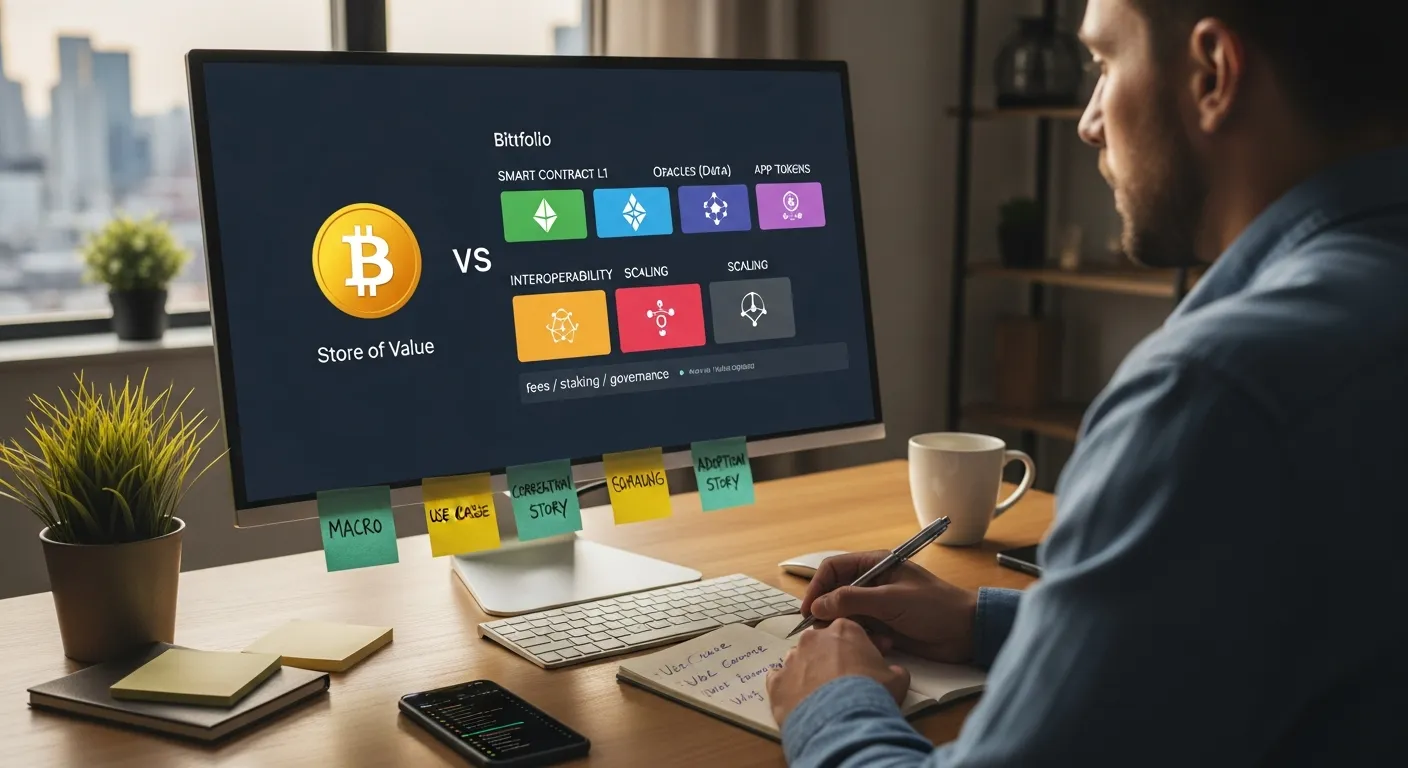
Altcoins are simply cryptocurrencies that aren’t Bitcoin. That definition sounds basic, but the implication is important: most altcoins exist to do something Bitcoin intentionally doesn’t try to do. Bitcoin is built to be hard money, simple, durable, and resistant to change. Altcoins, by contrast, are usually designed to support applications, data services, governance systems, or faster settlement paths.
In a portfolio, that difference can matter. Bitcoin often behaves like the “macro” crypto asset, reacting to liquidity conditions, risk appetite, and big narrative cycles. Many altcoins still correlate with Bitcoin, especially in drawdowns, but they also carry their own adoption stories. If you’re thoughtful about it, altcoins can offer exposure to growth themes inside crypto rather than just the “digital gold” thesis.
How Altcoins Differ From Bitcoin
Bitcoin’s design is conservative by choice: limited scripting, slower base-layer changes, and a culture that values stability over feature velocity. That’s part of what gives it credibility as a store of value.
Altcoins tend to be more flexible. They may use different consensus models, support complex smart contracts, or introduce governance mechanisms that let the community change parameters over time. The tradeoff is real: more features often means a larger attack surface, more dependencies, and sometimes more centralization than Bitcoin.
And then there’s value capture. With Bitcoin, the asset and the network are basically the same story. With altcoins, it’s messier. Some tokens pay for network fees. Some secure the network through staking. Some mainly act as governance or as collateral in apps. You want to understand what a token is actually “for,” because that’s what drives long-term demand.
Common Altcoin Categories By Use Case
In practice, most altcoins fall into a few buckets.
Some are base-layer smart contract networks (often called Layer 1s). These compete on throughput, fees, developer support, and user experience. Others are infrastructure projects, things like oracle networks that feed data onchain, interoperability systems that connect chains, or specialized scaling networks.
Then you have application tokens tied to exchanges, lending markets, gaming ecosystems, and other services. Those can be profitable, but they’re also closer to venture-style bets: product risk, competition risk, and regulatory risk show up fast.
The point isn’t to memorize categories. It’s to stop treating altcoins as interchangeable. If you can’t explain what category a coin belongs to and why anyone needs it, you’re probably not investing, you’re guessing.
How This List Was Chosen (Utility, Adoption, Liquidity, And Risk)
I’ve found that the best “essential” lists do two things at once: they highlight projects with real staying power, and they teach you what to look for when the hype gets loud. This list leans toward networks that have demonstrated utility, developer activity, and meaningful liquidity, because if you can’t enter and exit a position cleanly, your risk goes up even if the idea is good.
You’ll notice I’m not trying to predict the top performer of the next cycle. I’m focusing on examples of altcoins that represent major use cases in crypto and have enough history to evaluate.
Market Structure And Liquidity Signals To Check
Liquidity isn’t a boring detail. It’s the difference between a manageable investment and a trade you can’t unwind when volatility hits.
You want to see consistent trading volume across reputable venues, tight spreads in normal conditions, and derivatives markets that aren’t obviously distorted. Extremely thin order books can make a coin look stable, until the moment you try to sell size.
I also pay attention to how an asset behaves during stress. When the market drops hard, does the coin gap down with zero bids, or does it trade in an orderly way? On platforms like Cryptsy, it helps to watch real-time order flow and major market updates so you can see whether liquidity is real or just a mirage.
Technology And Ecosystem Traction Signals To Check
Tech matters, but “tech” is not the same as a whitepaper.
What you want is traction: developers building, users showing up, and applications that generate fees or meaningful activity. You can often see this indirectly through ecosystem funding, stablecoin usage on the chain, and whether builders keep shipping in bear markets.
It also helps to look at integrations. If wallets, exchanges, and major apps support a network, that’s friction removed for users. Friction is one of the biggest silent killers of adoption, even when the tech is solid.
The 7 Essential Altcoin Examples To Know
If you’re building a serious view of the crypto market, these seven names come up again and again because they anchor big parts of the ecosystem. You don’t have to own all of them. But you should understand what they do, what drives demand for the token, and where the key risks tend to hide.
Ethereum (ETH): Smart Contract Base Layer For Web3
Ethereum is still the reference point for smart contracts. The simplest way to think about ETH is that it’s the asset you pay (directly or indirectly) to use Ethereum’s settlement and security.
Its biggest advantage is the developer and application ecosystem. DeFi, NFTs, onchain identity experiments, stablecoin rails, many of these stories either started on Ethereum or still settle there in some form.
The tradeoffs are familiar: fees can spike during demand surges, and the ecosystem is complex with multiple scaling networks. But if you want “blue chip” exposure to smart contract activity, ETH is usually where the conversation starts.
Solana (SOL): High-Throughput L1 For DeFi And Consumer Apps
Solana’s pitch is speed and low fees without forcing users to think about layers. In my experience watching user behavior, that simplicity matters. People don’t like bridging. They don’t like waiting. They especially don’t like paying $30 for a transaction.
SOL demand ties to network usage, DeFi activity, and consumer-style apps where high throughput is a requirement, not a nice-to-have. The main risks tend to cluster around network resilience, operational complexity, and the reality that fast-growing ecosystems attract both real builders and opportunistic spam.
Cardano (ADA): Research-Driven L1 Focused On Security And Governance
Cardano has always positioned itself as methodical: formal methods, careful releases, and an emphasis on security and governance.
That approach appeals to investors who value predictability and to communities that care about onchain decision-making. The flip side is that slower execution can cost mindshare in a market that rewards speed. When you evaluate ADA, focus on whether real applications and liquidity are growing in a way that matches the ambition.
Polkadot (DOT): Multi-Chain Interoperability And Shared Security
Polkadot is built around the idea that many specialized chains can share security and still communicate. Instead of one chain doing everything, you get a network of chains designed for specific needs.
DOT’s value story links to this multi-chain architecture, including demand for security, interoperability, and the ability for projects to build their own environments without starting from scratch. The risk is that interoperability is a competitive space. A lot of projects claim they’ll connect everything. Few become the default.
Chainlink (LINK): Oracle Network Powering Onchain Data And Cross-Chain Messaging
Smart contracts don’t magically know real-world prices, interest rates, or event outcomes. They need data. Chainlink is the most widely recognized name in that role.
LINK is often discussed as “picks and shovels” for crypto because oracles sit under a lot of DeFi activity. In recent years, cross-chain communication has also become a bigger part of the story, since apps increasingly need to move data and value across networks.
The risks are subtler here: adoption can be broad but uneven, and value capture depends on how the network’s economics translate usage into sustainable token demand.
Avalanche (AVAX): Fast Finality L1 With Subnets For Custom Chains
Avalanche is known for quick finality and a flexible architecture that supports custom networks (often discussed as subnets). That matters if an application or institution wants more control over validators, compliance rules, or performance tuning while still tapping into a larger ecosystem.
AVAX demand connects to network activity and to the use of these custom environments. The question you should keep asking is: are subnets becoming the practical choice for real deployments, or mostly a narrative? The answer can change over time, which is why you track adoption signals, not just announcements.
XRP (XRP): Payments-Focused Network For Transfers And Settlement
XRP centers on fast, low-cost transfers and settlement. It’s one of the longest-running networks in crypto, and it has a strong identity as a payments-focused asset.
For investors, the key is to separate the use case from the noise. Payments is a huge market, but it’s also heavily shaped by regulation, banking partnerships, and real-world integration work that moves slowly. XRP’s risk profile often includes legal and regulatory uncertainty, plus the reality that “payments adoption” can take years to show up in the numbers investors want to see.
How To Evaluate Any Altcoin Before You Buy
The hardest part of altcoin investing isn’t buying. It’s holding through the moments when your thesis gets tested, when price drops, sentiment turns, and your timeline suddenly feels too long.
A solid evaluation process keeps you from making emotional decisions. Not perfect decisions. Just fewer avoidable mistakes.
Tokenomics, Supply Schedule, And Unlocks
Before you buy, you should know three things: how much supply exists now, how much is coming later, and who gets it.
Large unlocks can pressure price even when the project is doing fine. I’ve watched investors get blindsided by this more times than I can count, especially with tokens that had heavy venture allocations or aggressive emissions.
Also ask what creates ongoing demand. Fees? Staking? Collateral use? Governance alone is rarely enough, because most people don’t want to vote, they want the token to have a reason to be held.
Security, Governance, And Centralization Tradeoffs
Every network makes tradeoffs. Some move fast because a small group can push upgrades. Others move slowly because many stakeholders must agree.
You should decide what you’re comfortable with. If a chain relies on a narrow validator set, concentrated token ownership, or a small dev team that controls key infrastructure, that doesn’t automatically make it “bad.” But it changes what kind of risk you’re taking.
Security isn’t only about code, either. Bridges, dependencies, admin keys, and third-party services all matter. If you can’t explain where the weak points are, you probably don’t know what you own.
Catalysts, Roadmaps, And Real-World Demand
Catalysts are useful, but only if they connect to demand. A major upgrade that no one uses is just a headline.
I prefer to look for catalysts that reduce friction for users or bring new users in: better wallet support, stablecoin growth, clearer developer tooling, or integrations with large platforms. Then I ask the uncomfortable question: if the token doubled tomorrow, would the network actually be more valuable, or would it just be more expensive to use?
That mindset keeps you grounded. It pushes you toward networks that are earning usage, not just attention.
Practical Portfolio And Risk Management For Altcoins
Altcoins can reward you, but they punish sloppy positioning. If you treat them like long-term holdings, you need rules. If you treat them like trades, you need even stricter rules.
Position Sizing, Rebalancing, And Diversification By Category
In my experience, most altcoin losses come from size, not from being “wrong.” You can be directionally right and still lose money if you’re overexposed when volatility spikes.
Think in categories rather than tickers. If you already have exposure to multiple smart contract L1s, adding a fourth doesn’t automatically diversify you. It might just concentrate you in the same risk: developer mindshare and network activity.
Rebalancing is where discipline shows. When a coin runs hard, you’ll feel smart. That’s usually when trimming a little makes sense. And when a position is down big, adding “because it’s cheaper” is not a strategy unless the original reasons still hold.
Entry Planning, Volatility, And Downside Protection
Altcoins move fast. If you buy all at once, you’re basically making a bet on your timing.
Staggering entries can help reduce regret, especially in choppy markets. You can also decide ahead of time what would prove you wrong. Not “I’ll sell if I feel nervous,” but a real line tied to the thesis: a key metric collapses, a major security issue appears, liquidity dries up, or a competitor clearly wins.
Downside protection can be as simple as keeping your position size small enough that you don’t panic-sell. That’s not glamorous, but it works.
Secure Storage Basics: Exchanges Vs Self-Custody
Where you hold matters as much as what you hold.
Exchanges are convenient for active management, but you’re taking counterparty risk. Self-custody reduces that risk, but it adds operational risk: you can lose keys, sign a bad transaction, or fall for phishing.
A practical approach is to match storage to intent. If you’re trading, you may keep a portion on an exchange and limit the amount. If you’re investing, moving assets to self-custody is often worth the extra steps. Either way, take security seriously. Most people don’t lose money to market moves, they lose it to avoidable mistakes.
Conclusion
If you want to invest in altcoins without getting pulled around by hype, start with examples that map to real roles in crypto: smart contract platforms, cross-chain systems, data networks, and payment rails. The seven in this guide, ETH, SOL, ADA, DOT, LINK, AVAX, and XRP, aren’t “guaranteed winners,” but they’re essential reference points for understanding where value can accrue.
Your edge won’t come from memorizing tickers. It comes from having a repeatable way to judge utility, adoption, liquidity, and risk before you buy, and from managing position size so volatility doesn’t force bad decisions.
And when you’re doing that day-to-day work, watching market moves, checking liquidity, and staying current on what’s actually changing, having one place like Cryptsy to follow real-time updates and analysis makes the process calmer. Which, in crypto, is a bigger advantage than most people admit.
Frequently Asked Questions About Altcoins
What are altcoins, and why do altcoins matter in a crypto portfolio?
Altcoins are any cryptocurrencies that aren’t Bitcoin. They matter because many are built for things Bitcoin doesn’t prioritize—smart contracts, data services, governance, or faster settlement. In a portfolio, altcoins can add exposure to specific adoption themes beyond Bitcoin’s “digital gold” narrative.
How do altcoins differ from Bitcoin in technology and risk?
Bitcoin is intentionally conservative, optimized for stability and hard-money properties. Altcoins often add features like smart contracts, new consensus models, or onchain governance. The tradeoff is a larger attack surface and sometimes more centralization or dependency risk, so you must understand what the token is actually used for.
What are 7 essential examples of altcoins every crypto investor should know?
Seven widely referenced examples of altcoins are Ethereum (ETH), Solana (SOL), Cardano (ADA), Polkadot (DOT), Chainlink (LINK), Avalanche (AVAX), and XRP (XRP). They map to major crypto use cases—smart contract platforms, interoperability, oracle data, custom networks, and payment rails—making them useful “reference points.”
How do I evaluate an altcoin before buying it?
Evaluate altcoins by checking utility (what drives token demand), adoption traction (developers, users, fees), and liquidity (volume, spreads, orderly trading in stress). Also review tokenomics like supply schedule and unlocks, plus security and governance tradeoffs. A repeatable checklist helps avoid hype-driven decisions.
What liquidity signals should I check before investing in altcoins?
Before buying altcoins, look for consistent volume on reputable venues, tight bid-ask spreads, and order books that aren’t thin. Check how the asset trades during market stress—does it gap down with no bids or remain orderly? Derivatives activity can help, but avoid markets that look distorted or easily manipulated.
What’s the best way to store altcoins—exchange or self-custody?
It depends on your intent. Exchanges are convenient for active trading but add counterparty risk. Self-custody reduces that counterparty risk but increases operational risk (lost keys, phishing, bad signatures). Many investors keep a small trading balance on an exchange and move longer-term holdings to self-custody.
The post 7 Essential Altcoins Every Crypto Investor Should Know first appeared on Cryptsy - Latest Cryptocurrency News and Predictions and is written by Ethan Blackburn
You May Also Like

Three dormant wallets, suspected to belong to the same entity, purchased 5,970 ETH eight hours ago.
NVIDIA Stock Price Analysis as OpenAI Issues Concerns About its Chips
