

How to use Monad 10000 TPS with OnFinality RPC
The launch of Monad sparked attention across the ecosystem for one reason: speed. This new execution-focused L1 is designed to achieve 10,000 TPS while maintaining full EVM compatibility. With the Monad blockchain now supported on OnFinality, developers can build with the same tools they already know but on a significantly faster foundation. In this article, you will learn what Monad is, how it achieves high throughput through parallel execution, what people are building on Monad, and how to access the Monad RPC from OnFinality.
Table of Contents
- What is Monad
- Why Monad Matters
- Key Benefits and Use Cases of Monad
- What People Are Building on Monad
- How Monad Works
- How to Access Monad RPC on OnFinality
- Common Questions about Monad
- Summary
- About OnFinality
What is Monad
Monad is a high-performance L1 blockchain that executes Ethereum transactions at massive scale. It preserves the EVM environment but introduces a redesigned execution engine built for parallelisation. Core characteristics:
- Aims for 10000 transactions per second
- Uses optimistic parallelization to run independent transactions simultaneously
- Ensures deterministic outcomes through conflict detection
- Fully EVM compatible for seamless migration
Why Monad Matters
User activity is growing across DeFi, gaming, consumer apps, and AI-powered agents. These workloads demand higher throughput and faster confirmation. Why Monad stands out:
- Parallel execution L1s are becoming the next major category
- Most L1s operate between 300 to 2000 TPS, while Monad targets 10000+ TPS
- Real-time apps need low-latency execution
- DeFi infrastructure requires predictable performance
Key Benefits and Use Cases of Monad
What Monad enables:
- High-frequency trading systems
- Agent driven automation
- Real time gaming
- High traffic consumer apps
- Payment and settlement rails
Why developers prefer Monad:
- Faster confirmation
- Higher throughput
- EVM compatibility
- No tooling rewrites
What People Are Building on Monad
Monad ecosystem developers are building across multiple categories. DeFi:
- Pancake Swap: performance-focused DEX
- Gearbox Protocol: Permissionless Credit Markets
- LeverUp: LP- Free Perps with 1001x lever
Gaming:
- Lumiterra: AI powered open world game
- Bro Fun: Vegas on Monad
Social:
- Farcaster: Wallet + social media combined
- Fomo: Never miss on next signal
Culture and memecoins:
- Monadverse: NFTs on Monad
- Fluffle: Grow your focus, Evolve dragns
How Monad Works
Monad’s performance comes from four innovations:
- Parallel execution of independent transactions
- Deterministic state updates through conflict detection
- High-performance EVM runtime written in low-level optimised code
- Pipeline architecture overlapping execution, verification, and state writes
How to Access Monad RPC on OnFinality
Developers can connect to Monad using OnFinality’s Dashboard and public RPC endpoints:
For high performance Monad endpoints with support SLAs and higher rate limits:
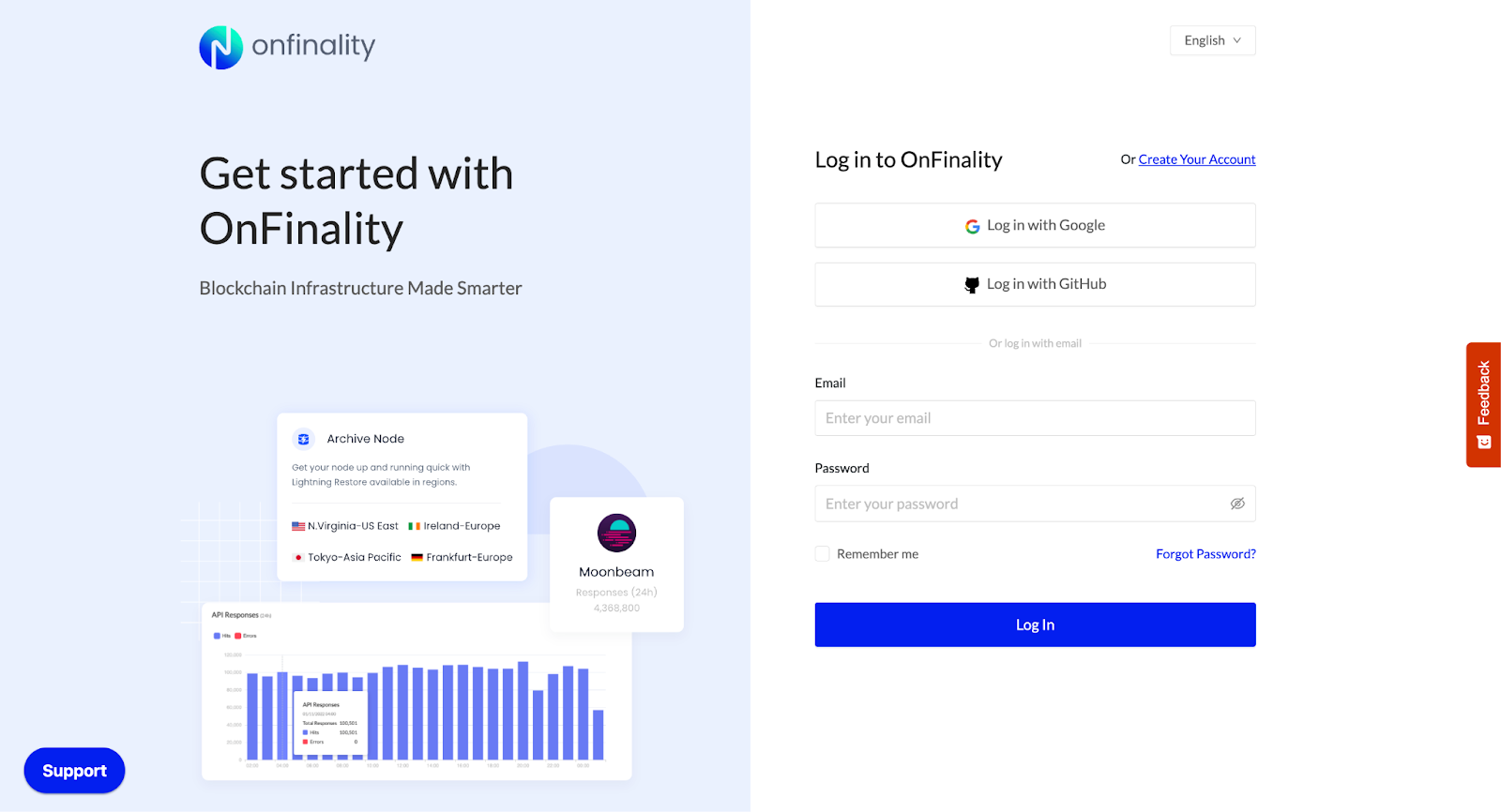
- STEP 1: Login into Onfinality Dashboard
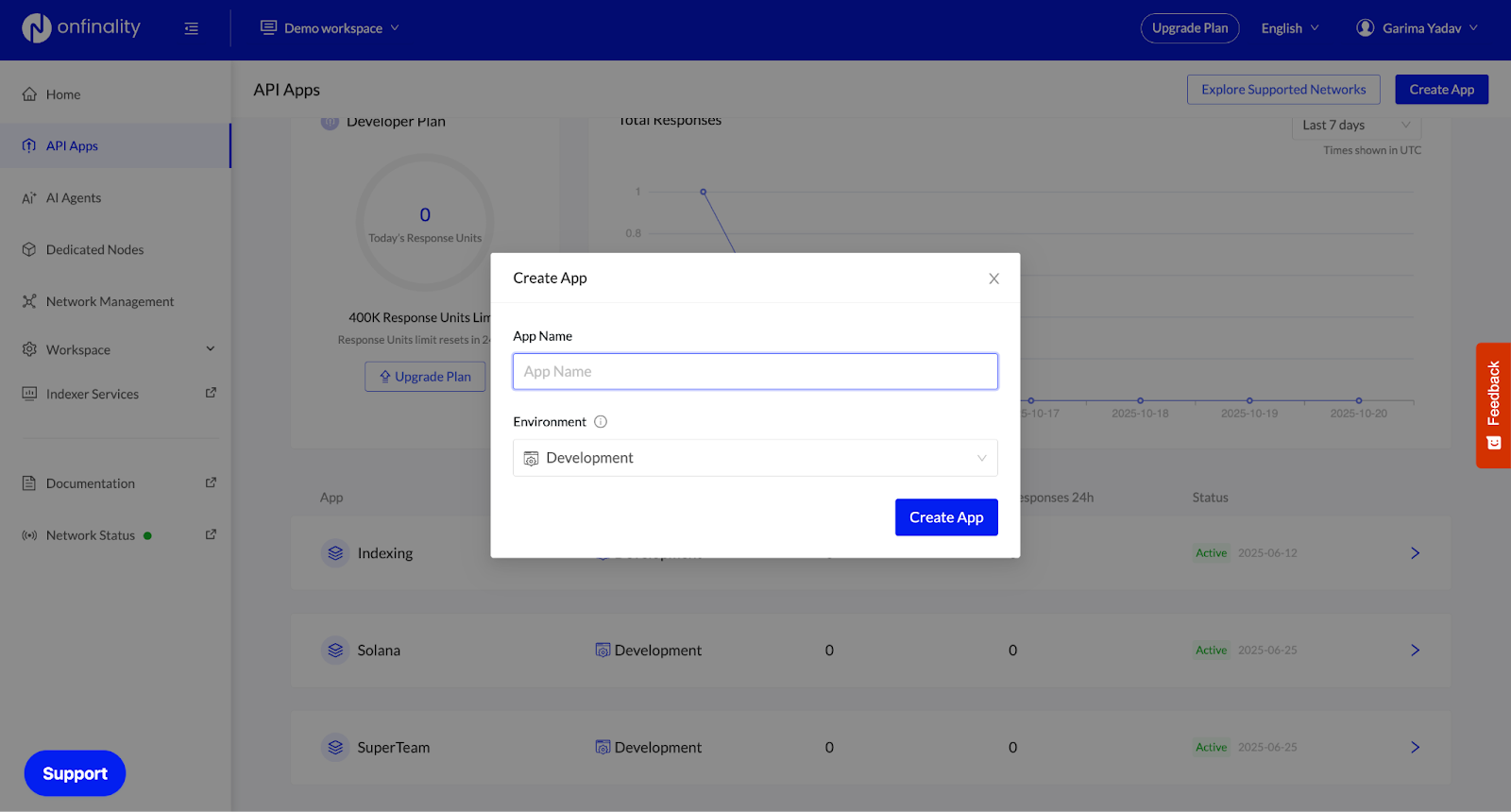
- STEP 2: Create an app on the dashboard
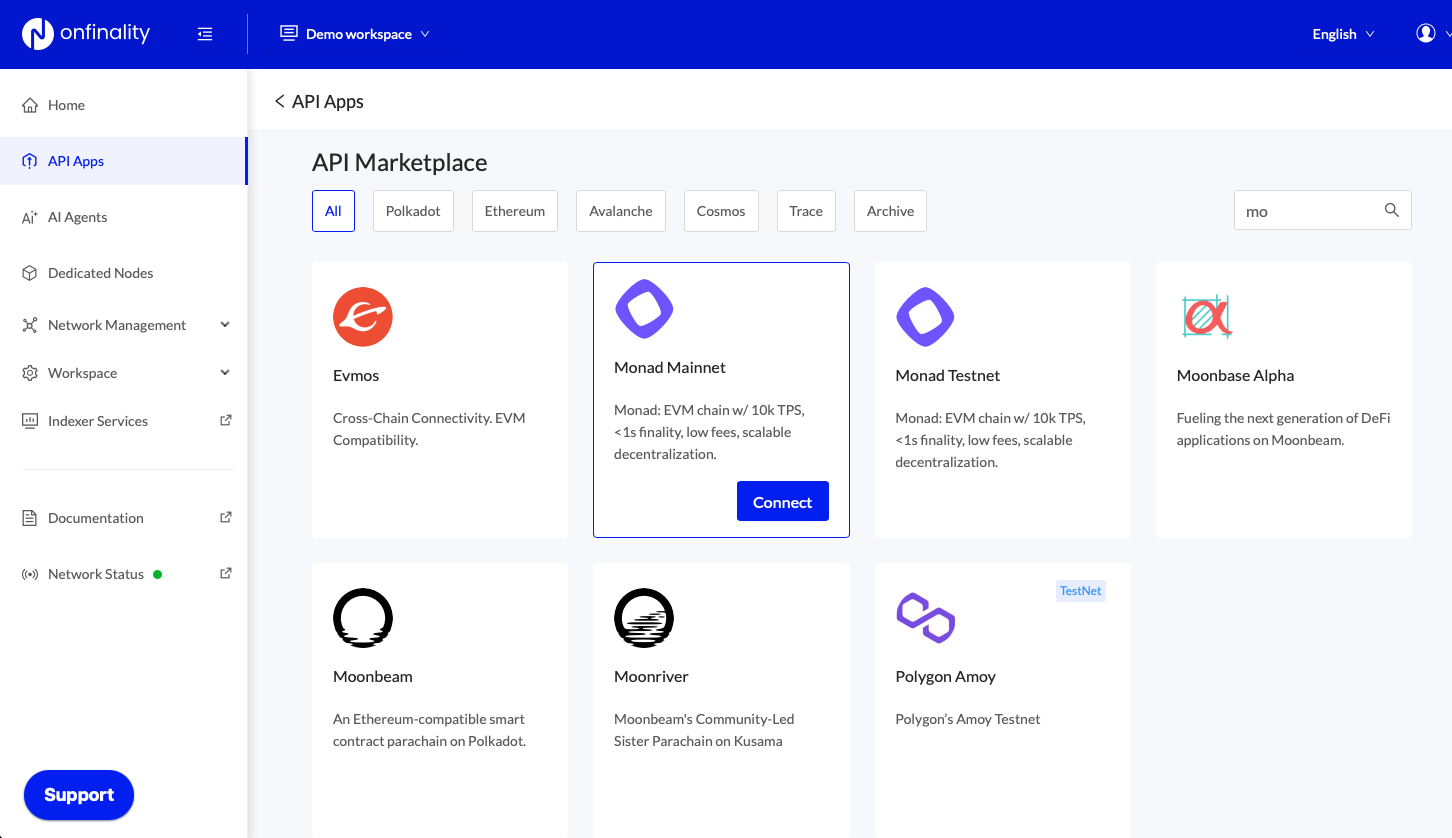
- STEP 3: Select Monad from the network list.
- STEP 4: You can use the Monad RPC and WebSocket link given on the dashboard
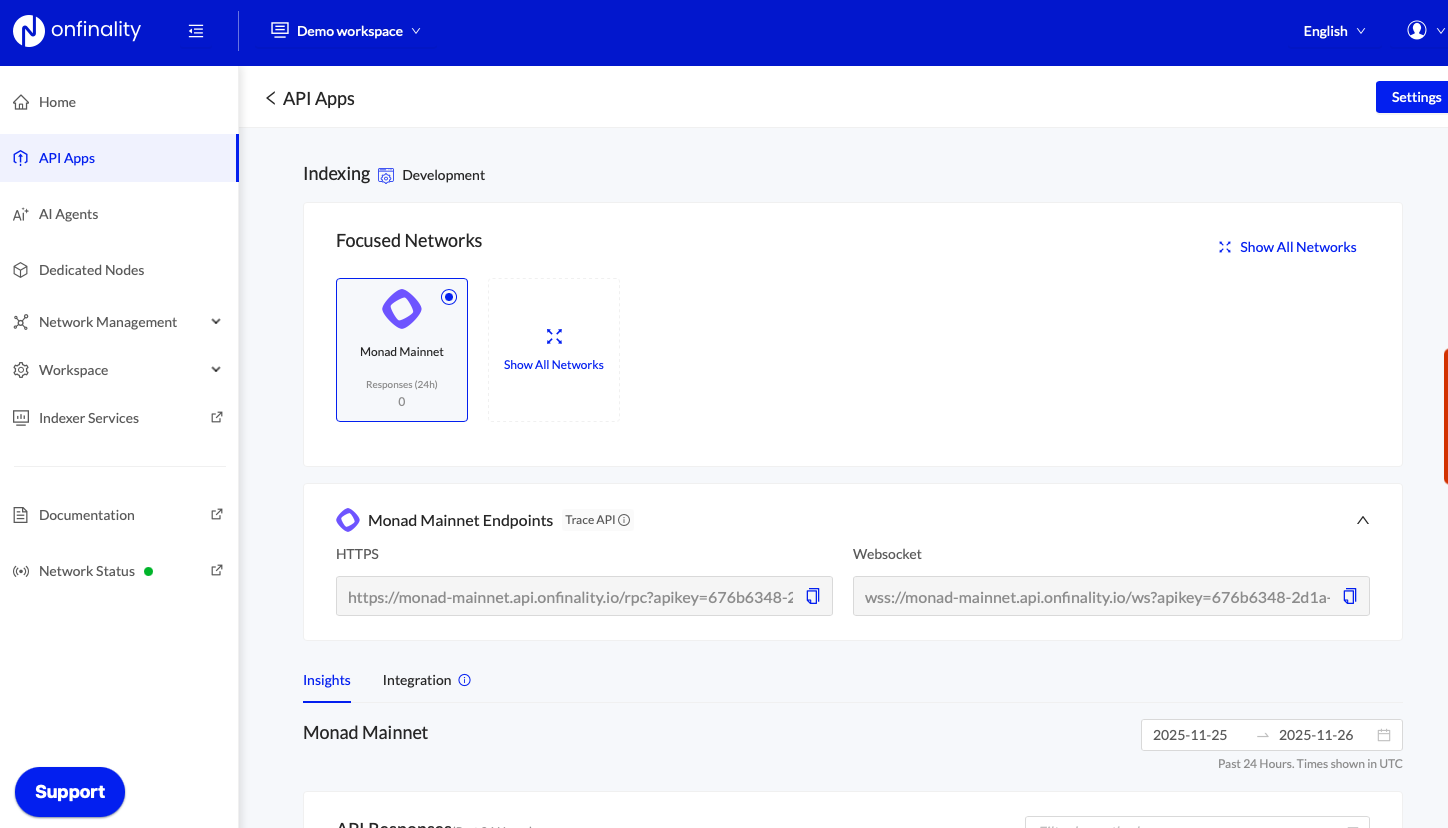
- STEP 5: Use it in your webApp or any of your application to communicate with Monad
Example: You can check whether the RPC is active or not by using the following command on your cli:
curl --location 'https://monad-mainnet.api.onfinality.io/public' \ --header 'content-type: application/json' \ --data '{"id": 1, "jsonrpc": "2.0", "method": "eth_blockNumber", "params": []}'
For deeper configuration, explore the Monad RPC Reference.
Monad Public RPC Endpoints
OnFinality also provides free public Monad RPC endpoints for development & testing purposes
Monad Public RPC Endpoint - Https:https://monad-mainnet.api.onfinality.io/public
Monad Public RPC Endpoint - Web Sockets: wss://monad-mainnet.api.onfinality.io/public-ws
Our public endpoints have rate limits applied and are not intended for production use.
Common Questions about Monad
Is Monad EVM compatible?
Yes, Monad is 100% EVM-compatible at the bytecode level, enabling existing Ethereum smart contracts to run without modifications and work seamlessly with Ethereum's tooling ecosystem.
How does Monad reach 10000 TPS?
Through parallel execution, pipelining, and an optimised EVM runtime.
Which apps benefit most?
DeFi, bots, gaming, and high-volume consumer apps.
Summary
Monad combines full EVM compatibility with a redesigned parallel execution engine targeting 10000 TPS. With OnFinality supporting the Monad mainnet, developers gain a fast and scalable RPC infrastructure ready for production workloads. Start building today by exploring the Monad RPC on OnFinality or browsing more networks on the OnFinality blog.
About OnFinality
OnFinality is a blockchain infrastructure platform that serves hundreds of billions of API requests monthly across more than 130 networks, including Avalanche, BNB Chain, Cosmos, Polkadot, Ethereum, and Polygon. It provides scalable APIs, RPC endpoints, node hosting, and indexing tools to help developers launch and grow blockchain networks efficiently. OnFinality’s mission is to make Web3 infrastructure effortless so developers can focus on building the future of decentralised applications.
App | Website | Twitter | Telegram | LinkedIn | YouTube
You May Also Like

XRP Enters ‘Washout Zone,’ Then Targets $30, Crypto Analyst Says

Republicans are 'very concerned about Texas' turning blue: GOP senator
