Ray Dalio warned the U.S. stands “on the brink” of transitioning from Stage 5 pre-breakdown to Stage 6 systemic collapse as Bitcoin is trading defensively at $88Ray Dalio warned the U.S. stands “on the brink” of transitioning from Stage 5 pre-breakdown to Stage 6 systemic collapse as Bitcoin is trading defensively at $88

Dalio: U.S. Nears Crisis Point as Bitcoin Trapped by American Selling Pressure

2026/01/28 00:34
4 min read

Ray Dalio warned the U.S. stands “on the brink” of transitioning from Stage 5 pre-breakdown to Stage 6 systemic collapse as Bitcoin is trading defensively at $88,000, trapped in a 60-day range by record institutional selling pressure from American counterparties.

The billionaire investor’s latest analysis of the “Big Cycle” coincides with Bitcoin’s failure to live up to its “digital gold” narrative, while traditional safe havens surge to all-time highs.

Dalio’s framework identifies bankrupt government finances and wealth gaps as the “single most reliable leading indicator of civil war or revolution,” conditions he argues now characterize American reality.

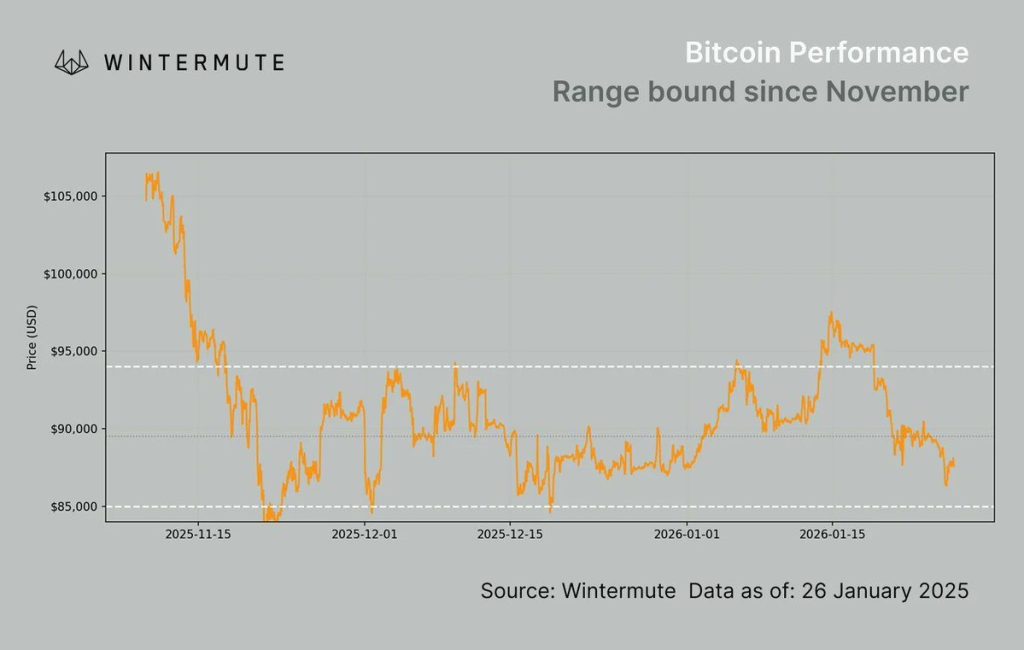
Meanwhile, Wintermute’s desk reports that Bitcoin remains stuck between $85,000 and $94,000 as U.S. spot ETF products hemorrhage capital and the Coinbase premium trades at a persistent discount, indicating that domestic institutions are driving bearish momentum.

Dalio’s Crisis Warning Meets Bitcoin’s Range-Bound Reality

Dalio’s long essay positions current American conditions within Stage 5 of his Big Cycle framework, where “bad financial conditions and intense conflict” precede systemic breakdown.

We are now clearly on the brink of crossing from Stage 5 (pre-breakdown) to Stage 6 (breakdown),” he wrote, pointing to unsustainable debt loads that force governments to either “print a lot of money, which depreciates its value” or implement painful austerity.

The analysis comes as Bitcoin trades range-bound for 60 consecutive days, an unusual pattern for an asset class often marketed as protection against exactly the monetary debasement Dalio describes.
US Near Crisis Bitcoin Selling Pressure - Wintermute Bitcoin Range-bond ChartSource: Wintermute

Gold climbed above $5,066 per ounce on Tuesday while silver surged 6.4% to $110.60, both setting fresh records as investors sought traditional inflation hedges.

Dalio warned that “later stages may involve capital controls, reserve freezes, and cross-border restrictions, turning funds into political tools,” conditions that typically favor “freely transferable assets” and investments “prioritizing resistance to freezing and blockades.

Bitcoin proponents have long argued that crypto fits this profile, yet the asset has failed to attract safe-haven flows amid elevated macro uncertainty.

U.S. Institutions Drive Selling as ETF Flows Turn Negative

Wintermute’s OTC desk identified American selling pressure as the primary force keeping Bitcoin suppressed within its trading range.

The Coinbase premium confirms it. US counterparties are net sellers, more so than Europe (marginal buyers) or Asia (neutral),” the firm’s market update stated, noting that “ETFs drive momentum in this market; when that bid disappears, you get choppy, directionless price action.

U.S. spot Bitcoin ETF products recorded their largest weekly outflow since February 2025 last week, reversing the strong inflows that accompanied January’s brief breakout attempt toward $97,000.

The failure of that rally left Bitcoin back in the middle of its established range, with $85,000 serving as tested support.

CryptoQuant’s on-chain analysis suggests the selling pressure also comes from opportunistic profit-taking rather than forced capitulation.

US Near Crisis Bitcoin Selling Pressure - Bitcoin Miner's Position IndexSource: CryptoQuant

The Miners’ Position Index printed near -1.5, indicating miners “are now selling less than their 1-year average” after aggressive inventory monetization at $110,000-$120,000 levels.

Similarly, exchange whale ratios remain elevated, but deposits fall “well below prior spike highs, implying tactical, price-sensitive distribution rather than all-in capitulation.

US Near Crisis Bitcoin Selling Pressure - Exchange Reserve (All Exchanges)Source: CryptoQuant

Catalyst-Rich Week Could Break Two-Month Deadlock

Speaking with Cryptonews, Arthur Azizov, Founder at B2 Ventures, framed Bitcoin’s weakness within the context of competing safe-haven narratives.

When uncertainty rises, capital first moves into classic defensive assets. We see this now from gold breaking above $5,000,” Azizov said, adding that “Bitcoin is often called ‘digital gold,’ but in reality, it’s still, first and foremost, a risk asset.

Multiple macro catalysts converge this week that could finally break Bitcoin from its compressed range.

The Federal Reserve announces its policy decision on Wednesday alongside key earnings from Microsoft, Meta, Tesla, and Apple, while Trump’s fresh 25% tariff threat against South Korea adds geopolitical uncertainty.

Wintermute analysts expect continued consolidation absent a clear directional catalyst.

Sixty days of compression meeting this much event risk, something gives,” the firm concluded, identifying $85,000 as the critical support level with ETF flow reversal required before Bitcoin can “break convincingly above mid-$90K levels.

Market Performance Indicates Cautious Recovery

Bitcoin traded at $88,553 earlier today and rose 1.4% as Asian markets opened with tentative optimism despite fresh tariff threats.

US Near Crisis Bitcoin Selling Pressure - Bitcoin Price chartSource: TradingView

However, at the time of writing, Bitcoin is back below the $88K support level, pushing the total crypto market cap to $3.06 trillion, down 0.18% on the day.

The uncertain trajectory came as broader risk assets found footing ahead of the Fed decision, though Azizov’s “base case is consolidation,” with expectations that Bitcoin will “hold the $85k–$88k zone,” which previously served as strong support through late 2025.

Disclaimer: The articles reposted on this site are sourced from public platforms and are provided for informational purposes only. They do not necessarily reflect the views of MEXC. All rights remain with the original authors. If you believe any content infringes on third-party rights, please contact service@support.mexc.com for removal. MEXC makes no guarantees regarding the accuracy, completeness, or timeliness of the content and is not responsible for any actions taken based on the information provided. The content does not constitute financial, legal, or other professional advice, nor should it be considered a recommendation or endorsement by MEXC.

You May Also Like

Jerome Powell’s Press Conference: Crucial Insights Unveiled for the Market’s Future

Jerome Powell’s Press Conference: Crucial Insights Unveiled for the Market’s Future

BitcoinWorld Jerome Powell’s Press Conference: Crucial Insights Unveiled for the Market’s Future The financial world, including the dynamic cryptocurrency market, often hangs on every word from the Federal Reserve. Recently, Jerome Powell’s press conference following the Federal Open Market Committee (FOMC) meeting concluded, leaving investors and analysts dissecting his remarks for clues about the future economic direction. This event is always a pivotal moment, shaping expectations for inflation, interest rates, and the overall stability of global markets. What Were the Key Takeaways from Jerome Powell’s Press Conference? During Jerome Powell’s press conference, the Fed Chair provided an update on the central bank’s monetary policy decisions and its economic outlook. His statements often reiterate the Fed’s dual mandate: achieving maximum employment and stable prices. This time was no different, with a strong emphasis on managing persistent inflation. Key points from the recent discussion included: Inflation Control: Powell emphasized the Fed’s unwavering commitment to bringing inflation back down to its 2% target. He reiterated that the fight against rising prices remains the top priority, even if it entails some economic slowdown. Interest Rate Policy: While the Fed’s stance on future interest rate adjustments was discussed, the path remains data-dependent. Powell indicated that decisions would continue to be made meeting-by-meeting, based on incoming economic data. Economic Projections: The updated Summary of Economic Projections (SEP) offered insights into the Fed’s forecasts for GDP growth, unemployment, and inflation. These projections help market participants gauge the central bank’s expectations for the economy’s trajectory. Quantitative Tightening (QT): The ongoing process of reducing the Fed’s balance sheet, known as quantitative tightening, was also a topic. This reduction in liquidity in the financial system has broad implications for asset prices. How Did Jerome Powell’s Remarks Impact Cryptocurrency Markets? The conclusion of Jerome Powell’s press conference often sends ripples through traditional financial markets, and cryptocurrencies are increasingly sensitive to these macroeconomic shifts. Digital assets, once thought to be uncorrelated, now frequently react to the Fed’s monetary policy signals. Higher interest rates, for instance, tend to make riskier assets like cryptocurrencies less attractive. This is because investors might prefer safer, interest-bearing investments. Consequently, we often see increased volatility in Bitcoin (BTC) and Ethereum (ETH) prices immediately following such announcements. The tightening of financial conditions, driven by the Fed, reduces overall liquidity in the system, which can put downward pressure on asset valuations across the board. However, some argue that this growing correlation signifies crypto’s increasing integration into the broader financial ecosystem. It suggests that institutional investors and mainstream finance are now paying closer attention to digital assets, treating them more like other risk-on investments. Navigating the Economic Landscape After Jerome Powell’s Press Conference For cryptocurrency investors, understanding the implications of Jerome Powell’s press conference is crucial for making informed decisions. The Fed’s policy trajectory directly influences the availability of capital and investor sentiment, which are key drivers for crypto valuations. Here are some actionable insights for navigating this environment: Stay Informed: Regularly monitor Fed announcements and economic data releases. Understanding the macroeconomic backdrop is as important as analyzing individual crypto projects. Assess Risk Tolerance: In periods of economic uncertainty and tighter monetary policy, a reassessment of personal risk tolerance is wise. Diversification within your crypto portfolio and across different asset classes can mitigate potential downsides. Focus on Fundamentals: While market sentiment can be swayed by macro news, projects with strong fundamentals, clear use cases, and robust development teams tend to perform better in the long run. Long-Term Perspective: Cryptocurrency markets are known for their volatility. Adopting a long-term investment horizon can help weather short-term fluctuations driven by macro events like Fed meetings. The challenges include potential continued volatility and reduced liquidity. However, opportunities may arise from market corrections, allowing strategic investors to accumulate assets at lower prices. In summary, Jerome Powell’s press conference provides essential guidance on the Fed’s economic strategy. Its conclusions have a profound impact on financial markets, including the dynamic world of cryptocurrencies. Staying informed, understanding the nuances of monetary policy, and maintaining a strategic investment approach are paramount for navigating the evolving economic landscape. The Fed’s actions underscore the interconnectedness of traditional finance and the burgeoning digital asset space. Frequently Asked Questions (FAQs) Q1: What is the Federal Open Market Committee (FOMC)? A1: The FOMC is the monetary policy-making body of the Federal Reserve System. It sets the federal funds rate target and directs open market operations, influencing the availability of money and credit in the U.S. economy. Q2: How do the Fed’s interest rate decisions typically affect cryptocurrency markets? A2: Generally, when the Fed raises interest rates, it makes borrowing more expensive and reduces liquidity in the financial system. This often leads investors to shy away from riskier assets like cryptocurrencies, potentially causing prices to decline. Conversely, lower rates can stimulate investment in riskier assets. Q3: What does “data-dependent” mean in the context of Fed policy? A3: “Data-dependent” means that the Federal Reserve’s future monetary policy decisions, such as interest rate adjustments, will primarily be based on the latest economic data. This includes inflation reports, employment figures, and GDP growth, rather than a predetermined schedule. Q4: Should I change my cryptocurrency investment strategy based on Jerome Powell’s press conference? A4: While it’s crucial to be aware of the macroeconomic environment shaped by Jerome Powell’s press conference, drastic changes to a well-researched investment strategy may not always be necessary. It’s recommended to review your portfolio, assess your risk tolerance, and consider if your strategy aligns with the current economic outlook, focusing on long-term fundamentals. If you found this analysis helpful, please consider sharing it with your network! Your insights and shares help us reach more readers interested in the intersection of traditional finance and the exciting world of cryptocurrencies. Spread the word! To learn more about the latest crypto market trends, explore our article on key developments shaping Bitcoin price action. This post Jerome Powell’s Press Conference: Crucial Insights Unveiled for the Market’s Future first appeared on BitcoinWorld.
Share
Coinstats2025/09/18 16:25
Shiba Inu Price Forecast for Feb 9: Here’s Key Overhead Resistance for Any Move Upwards

Shiba Inu Price Forecast for Feb 9: Here’s Key Overhead Resistance for Any Move Upwards

Shiba Inu remains under pressure as resistance cap rebounds, while falling open interest and weak momentum continue to limit upside potential. The Shiba Inu (SHIB
Share
Coinstats2026/02/09 18:10
Australian regulators ease regulations on stablecoin intermediaries

Australian regulators ease regulations on stablecoin intermediaries

PANews reported on September 18th that, according to Decrypt, the Australian Securities and Investments Commission (ASIC) has granted a regulatory exemption to stablecoin intermediaries, allowing them to distribute cryptocurrencies issued by licensed Australian institutions without having to hold a separate financial services license. The exemption, published Thursday, states that intermediaries distributing stablecoins issued by Australian Financial Services (AFS) licensed issuers no longer need to apply for separate AFS, market, or clearing facility licenses. This measure, effective upon registration of federal legislation, is a significant step forward in addressing Australia's regulatory challenges in the stablecoin market. Blockchain APAC CEO Steve Vallas stated that this move is a temporary transition before broader reforms and is consistent with financial services law. The exemption does not change the determination of whether stablecoins are financial products, but simply "suspends the secondary licensing requirement for distributors of licensed issuers," allowing distribution through licensed channels while maintaining issuer liability and requiring intermediaries to provide product disclosure statements to ensure transparency.
Share
PANews2025/09/18 13:25