

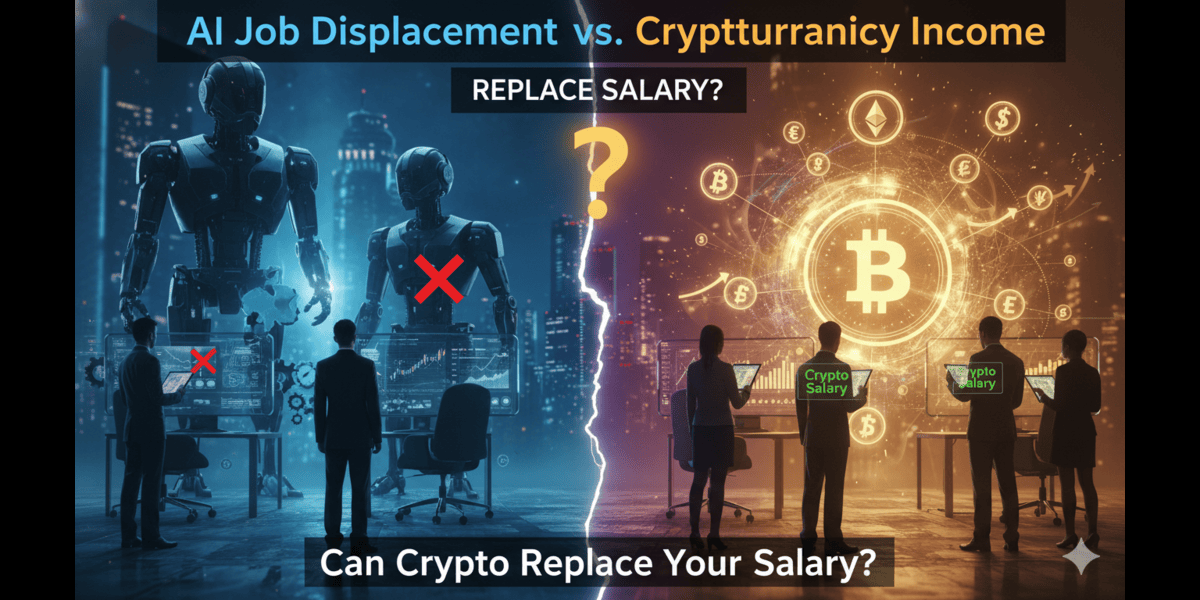
AI Job Displacement vs. Cryptocurrency Income: Can Crypto Replace Your Salary?
BitcoinWorld
AI Job Displacement vs. Cryptocurrency Income: Can Crypto Replace Your Salary?
AI job displacement vs. cryptocurrency income has become a critical debate for workers navigating the fourth industrial revolution. As of early 2026, while Artificial Intelligence (AI) is rapidly automating complex tasks and reshaping labor markets, financial experts warn that cryptocurrency remains too volatile and unregulated to serve as a direct replacement for traditional employment stability. This guide analyzes the scale of AI disruption and explains why relying on digital assets as a primary safety net is a high-risk strategy.
How Is AI Reshaping Global Labor Markets in 2026?
AI is no longer just a futuristic concept; it is actively disrupting labor markets by automating routine and rule-based tasks across every major sector. The impact is uneven, creating a stark divide between roles that can be automated and those requiring uniquely human traits.
- Vulnerable Roles: Unlike previous industrial shifts that affected manual labor, the current AI wave targets white-collar occupations. Roles heavily reliant on non-routine cognitive tasks—such as law, banking, consulting, and administrative support—are now highly exposed to automation.
- Scale of Impact: Data from the International Monetary Fund (IMF) suggests that nearly 40% of global employment is exposed to AI, with advanced economies facing even higher risks. Furthermore, Goldman Sachs estimates that generative AI could impact up to 300 million full-time jobs globally.
- Job Creation: The picture is not entirely bleak. The World Economic Forum estimates that while 85 million jobs may be displaced, AI could create approximately 97 million new jobs in emerging fields like data science, AI ethics, and cybersecurity.
- Skill Shift: The labor market is placing a premium on “human-centric” skills. Demand is surging for creativity, critical thinking, and emotional intelligence—capabilities that AI cannot yet replicate. Career resilience in 2026 depends heavily on reskilling and upskilling.
Why Is Cryptocurrency Not a Viable Replacement for Employment Income?
For those facing job insecurity, the allure of the “crypto economy” can be strong. However, treating cryptocurrency as a survival strategy to replace a steady paycheck is fundamentally problematic due to the asset class’s inherent structure.
- High Volatility: Cryptocurrencies are defined by extreme price variance. A “salary” held in Bitcoin or Ethereum can lose significant purchasing power overnight, making it an unstable source of liquidity for covering essential living expenses like rent or food.
- Regulatory Challenges: Despite growing adoption, most nations do not recognize cryptocurrency as legal tender for salary settlements. The regulatory frameworks remain fragmented, creating significant legal and tax liabilities for individuals attempting to live solely “on-chain.”
- Investment vs. Income: Financial advisors categorize crypto as a speculative investment asset, not a wage replacement. While activities like staking or trading offer profit potential, they carry substantial risk and lack the consistency of a bi-weekly paycheck.
- No Safety Net: Traditional employment provides crucial benefits such as health insurance, pension contributions, and unemployment support. Relying on crypto strips an individual of these safety nets, leaving them vulnerable during periods of personal or economic crisis.
Frequently Asked Questions
Will AI really take my job in the next 5 years?
The risk of AI displacement depends largely on your industry and daily tasks. If your role involves repetitive data processing, drafting standard legal documents, or basic coding, the risk is high. However, roles requiring complex decision-making, empathy, and physical dexterity are less likely to be fully automated in the near term, though they will likely be augmented by AI tools.
Can I live off cryptocurrency trading if I lose my job?
Attempting to replace a full-time income with cryptocurrency trading is extremely risky and not recommended for most people. Unlike a salary, trading profits are irregular and can turn into losses during market downturns. Without a substantial capital base and professional-grade risk management skills, relying on crypto for survival often leads to faster financial ruin.
What is the best strategy to survive AI job disruption?
The most effective survival strategy is reskilling rather than seeking alternative financial systems. Focus on developing skills that AI struggles to replicate, such as strategic leadership, complex problem-solving, and emotional intelligence. Additionally, leveraging existing social safety nets and diversifying income through “gig economy” work is safer than speculating on volatile digital assets.
Conclusion
While AI job displacement poses a genuine threat to the stability of the global workforce in 2026, pivoting to cryptocurrency as a primary income source is a dangerous gamble rather than a solution. The volatility and regulatory uncertainty of the crypto market cannot replicate the security of a traditional wage or the social benefits of employment. For workers aiming to future-proof their lives, the path forward lies in adaptive learning and acquiring the human-centric skills that will drive the new economy, rather than relying on the unpredictable fluctuations of digital currency.
This post AI Job Displacement vs. Cryptocurrency Income: Can Crypto Replace Your Salary? first appeared on BitcoinWorld.
You May Also Like

Coinbase CEO: We will build a financial super application to replace traditional banks

Polygon Tops RWA Rankings With $1.1B in Tokenized Assets
