The post Vitalik Buterin Says Today’s DAOs Are Not Good Enough appeared on BitcoinEthereumNews.com. Blockchain Vitalik Buterin wants the crypto world to stop treatingThe post Vitalik Buterin Says Today’s DAOs Are Not Good Enough appeared on BitcoinEthereumNews.com. Blockchain Vitalik Buterin wants the crypto world to stop treating

Vitalik Buterin Says Today’s DAOs Are Not Good Enough

4 min read
Blockchain

Vitalik Buterin wants the crypto world to stop treating DAOs as finished products and start seeing them as an unsolved design problem.

In a recent post, the Vitalik Buterin argued that decentralized autonomous organizations have drifted far from the ambition that helped spark Ethereum in the first place. DAOs were meant to outperform traditional institutions at coordination and governance. Instead, many have settled into rigid voting machines that mirror the very systems they were supposed to replace.

Key takeaways
  • Vitalik Buterin says today’s DAOs have drifted away from their original purpose and need fundamental redesign.
  • Token-based voting and current oracle systems create structural limits and governance fatigue.
  • Privacy tools, selective AI use, and stronger communication layers are key to building better DAOs.

From bold idea to blunt tool

Buterin’s critique starts with how DAOs are commonly implemented today. Most rely on token-weighted voting to control treasuries and steer decisions. While functional, he believes this approach exposes the same weaknesses found in corporate boards and political systems: slow processes, power concentration, and disengaged participants.

Over time, this has eroded confidence. Many contributors now see DAOs as bureaucratic rather than innovative, leading to skepticism about whether decentralized governance can truly scale.

The deeper technical gap

Rather than focusing only on governance mechanics, Buterin shifted attention to infrastructure problems that DAOs are expected to solve – but currently cannot. One example is oracles, which feed real-world data into blockchains.

He warned that most oracle systems used today are structurally limited. Because token-based oracles can only be as secure as their market value, they struggle to protect large pools of capital without imposing heavy costs. This weakness, he argued, affects core DeFi building blocks like decentralized stablecoins and prediction markets, which still rest on fragile assumptions.

What DAOs should actually be doing

Buterin outlined a broader role for next-generation DAOs, far beyond treasury votes. He pointed to areas such as onchain dispute resolution for complex contracts like insurance, maintaining trusted registries of verified software and token addresses, and coordinating rapid funding for short-lived but high-impact initiatives.

Another overlooked challenge is longevity. Many decentralized projects lose momentum once their original contributors step away. Better DAO structures, he suggested, could help ensure long-term maintenance without relying on informal leadership or centralized foundations.

Why progress keeps stalling

Two human constraints stand in the way: lack of privacy and decision overload.

Public voting, Buterin argued, turns governance into a social performance, where signaling and peer pressure distort outcomes. At the same time, asking participants to weigh in constantly leads to burnout. Engagement spikes early, then fades as staying informed becomes a chore.

A different design path

Buterin sees promise in emerging tools, but with restraint. Zero-knowledge proofs could allow private yet accountable governance. AI could help filter information and reduce cognitive strain – not by replacing humans, but by supporting better judgment.

Equally important, he emphasized, is communication. DAOs need built-in spaces for discussion, coordination, and context-setting. Governance does not start with a vote, he argued – it starts with shared understanding.

The takeaway from Buterin’s message is not incremental improvement, but reinvention. If DAOs are meant to underpin a decentralized future, they must be designed with the same rigor as the blockchains they run on – otherwise, they risk becoming just another layer of digital bureaucracy.


The information provided in this article is for educational purposes only and does not constitute financial, investment, or trading advice. Coindoo.com does not endorse or recommend any specific investment strategy or cryptocurrency. Always conduct your own research and consult with a licensed financial advisor before making any investment decisions.

Author

Kosta joined the team in 2021 and quickly established himself with his thirst for knowledge, incredible dedication, and analytical thinking. He not only covers a wide range of current topics, but also writes excellent reviews, PR articles, and educational materials. His articles are also quoted by other news agencies.

Next article

Source: https://coindoo.com/vitalik-buterin-says-todays-daos-are-not-good-enough/

Market Opportunity
Notcoin Logo
Notcoin Price(NOT)
$0.0003936
$0.0003936$0.0003936
-4.53%
USD
Notcoin (NOT) Live Price Chart
Disclaimer: The articles reposted on this site are sourced from public platforms and are provided for informational purposes only. They do not necessarily reflect the views of MEXC. All rights remain with the original authors. If you believe any content infringes on third-party rights, please contact service@support.mexc.com for removal. MEXC makes no guarantees regarding the accuracy, completeness, or timeliness of the content and is not responsible for any actions taken based on the information provided. The content does not constitute financial, legal, or other professional advice, nor should it be considered a recommendation or endorsement by MEXC.

You May Also Like

Best Crypto to Buy as Saylor & Crypto Execs Meet in US Treasury Council

Best Crypto to Buy as Saylor & Crypto Execs Meet in US Treasury Council

The post Best Crypto to Buy as Saylor & Crypto Execs Meet in US Treasury Council appeared on BitcoinEthereumNews.com. Michael Saylor and a group of crypto executives met in Washington, D.C. yesterday to push for the Strategic Bitcoin Reserve Bill (the BITCOIN Act), which would see the U.S. acquire up to 1M $BTC over five years. With Bitcoin being positioned yet again as a cornerstone of national monetary policy, many investors are turning their eyes to projects that lean into this narrative – altcoins, meme coins, and presales that could ride on the same wave. Read on for three of the best crypto projects that seem especially well‐suited to benefit from this macro shift:  Bitcoin Hyper, Best Wallet Token, and Remittix. These projects stand out for having a strong use case and high adoption potential, especially given the push for a U.S. Bitcoin reserve.   Why the Bitcoin Reserve Bill Matters for Crypto Markets The strategic Bitcoin Reserve Bill could mark a turning point for the U.S. approach to digital assets. The proposal would see America build a long-term Bitcoin reserve by acquiring up to one million $BTC over five years. To make this happen, lawmakers are exploring creative funding methods such as revaluing old gold certificates. The plan also leans on confiscated Bitcoin already held by the government, worth an estimated $15–20B. This isn’t just a headline for policy wonks. It signals that Bitcoin is moving from the margins into the core of financial strategy. Industry figures like Michael Saylor, Senator Cynthia Lummis, and Marathon Digital’s Fred Thiel are all backing the bill. They see Bitcoin not just as an investment, but as a hedge against systemic risks. For the wider crypto market, this opens the door for projects tied to Bitcoin and the infrastructure that supports it. 1. Bitcoin Hyper ($HYPER) – Turning Bitcoin Into More Than Just Digital Gold The U.S. may soon treat Bitcoin as…
Share
BitcoinEthereumNews2025/09/18 00:27
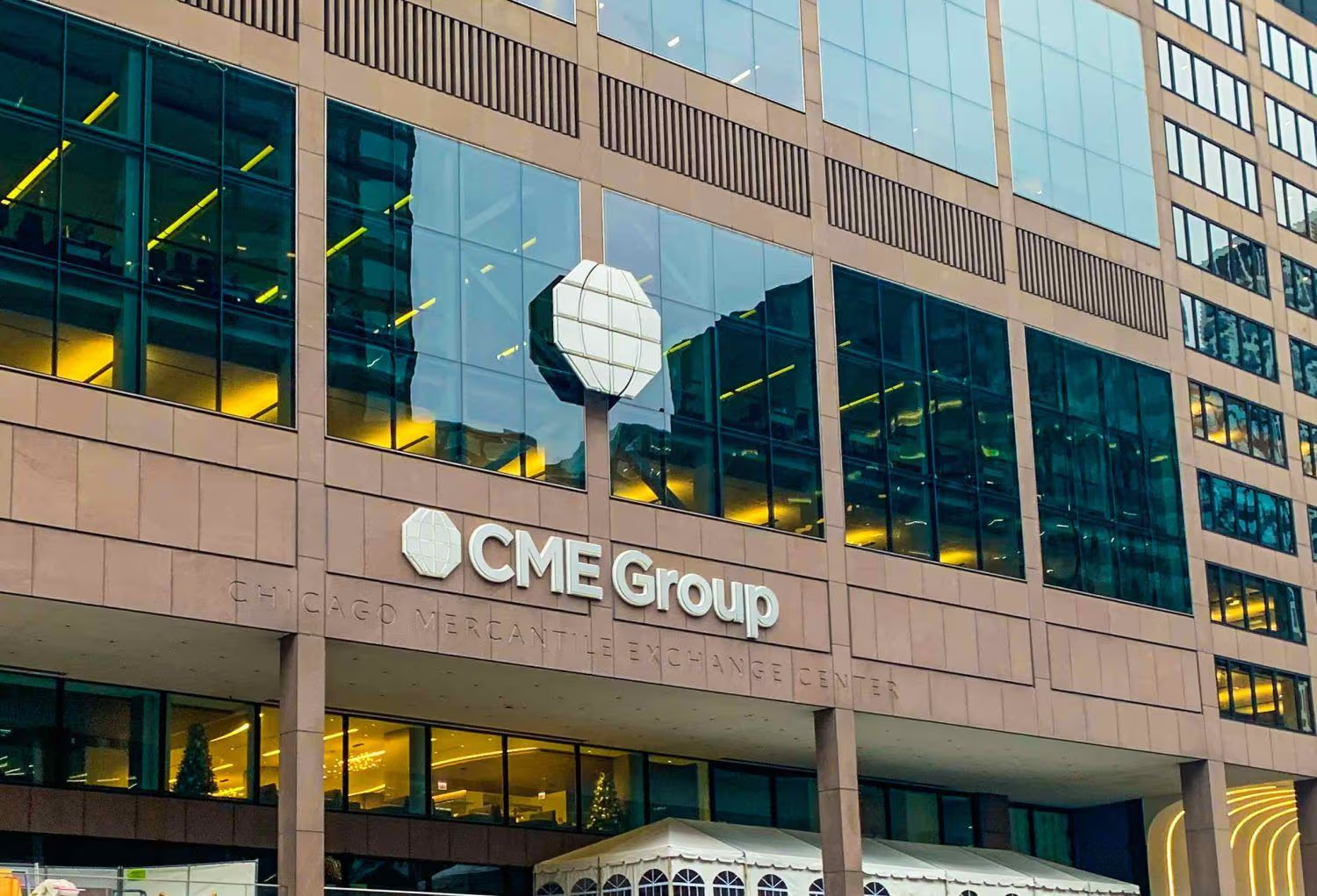
Breaking: CME Group Unveils Solana and XRP Options

Breaking: CME Group Unveils Solana and XRP Options

CME Group launches Solana and XRP options, expanding crypto offerings. SEC delays Solana and XRP ETF approvals, market awaits clarity. Strong institutional demand drives CME’s launch of crypto options contracts. In a bold move to broaden its cryptocurrency offerings, CME Group has officially launched options on Solana (SOL) and XRP futures. Available since October 13, 2025, these options will allow traders to hedge and manage exposure to two of the most widely traded digital assets in the market. The new contracts come in both full-size and micro-size formats, with expiration options available daily, monthly, and quarterly, providing flexibility for a diverse range of market participants. This expansion aligns with the rising demand for innovative products in the crypto space. Giovanni Vicioso, CME Group’s Global Head of Cryptocurrency Products, noted that the new options offer increased flexibility for traders, from institutions to active individual investors. The growing liquidity in Solana and XRP futures has made the introduction of these options a timely move to meet the needs of an expanding market. Also Read: Vitalik Buterin Reveals Ethereum’s Bold Plan to Stay Quantum-Secure and Simple! Rapid Growth in Solana and XRP Futures Trading CME Group’s decision to roll out options on Solana and XRP futures follows the substantial growth in these futures products. Since the launch of Solana futures in March 2025, more than 540,000 contracts, totaling $22.3 billion in notional value, have been traded. In August 2025, Solana futures set new records, with an average daily volume (ADV) of 9,000 contracts valued at $437.4 million. The average daily open interest (ADOI) hit 12,500 contracts, worth $895 million. Similarly, XRP futures, which launched in May 2025, have seen significant adoption, with over 370,000 contracts traded, totaling $16.2 billion. XRP futures also set records in August 2025, with an ADV of 6,600 contracts valued at $385 million and a record ADOI of 9,300 contracts, worth $942 million. Institutional Demand for Advanced Hedging Tools CME Group’s expansion into options is a direct response to growing institutional interest in sophisticated cryptocurrency products. Roman Makarov from Cumberland Options Trading at DRW highlighted the market demand for more varied crypto products, enabling more advanced risk management strategies. Joshua Lim from FalconX also noted that the new options products meet the increasing need for institutional hedging tools for assets like Solana and XRP, further cementing their role in the digital asset space. The launch of options on Solana and XRP futures marks another step toward the maturation of the cryptocurrency market, providing a broader range of tools for managing digital asset exposure. SEC’s Delay on Solana and XRP ETF Approvals While CME Group expands its offerings, the broader market is also watching the progress of Solana and XRP exchange-traded funds (ETFs). The U.S. Securities and Exchange Commission (SEC) has delayed its decisions on multiple crypto-related ETF filings, including those for Solana and XRP. Despite the delay, analysts anticipate approval may be on the horizon. This week, REX Shares and Osprey Funds are expected to launch an XRP ETF that will hold XRP directly and allocate at least 40% of its assets to other XRP-related ETFs. Despite the delays, some analysts believe that approval could come soon, fueling further interest in these assets. The delay by the SEC has left many crypto investors awaiting clarity, but approval of these ETFs could fuel further momentum in the Solana and XRP futures markets. Also Read: Tether CEO Breaks Silence on $117,000 Bitcoin Price – Market Reacts! The post Breaking: CME Group Unveils Solana and XRP Options appeared first on 36Crypto.
Share
Coinstats2025/09/18 02:35
Optimizely Named a Leader in the 2026 Gartner® Magic Quadrant™ for Personalization Engines

Optimizely Named a Leader in the 2026 Gartner® Magic Quadrant™ for Personalization Engines

Company recognized as a Leader for the second consecutive year NEW YORK, Feb. 5, 2026 /PRNewswire/ — Optimizely, the leading digital experience platform (DXP) provider
Share
AI Journal2026/02/06 00:47