The post EUR/USD slides toward 1.1600 as US data beat expectations appeared on BitcoinEthereumNews.com. The Euro (EUR) weakens further against the US Dollar (USDThe post EUR/USD slides toward 1.1600 as US data beat expectations appeared on BitcoinEthereumNews.com. The Euro (EUR) weakens further against the US Dollar (USD

EUR/USD slides toward 1.1600 as US data beat expectations

4 min read

The Euro (EUR) weakens further against the US Dollar (USD) on Thursday as the Greenback extends its advance following the release of weekly US labor-market data. At the time of writing, EUR/USD is hovering near the 1.1600 psychological level, marking its lowest level since December 2.

Data released by the US Department of Labor showed that Weekly Initial Jobless Claims fell to 198,000 in the week ended January 10, undershooting market expectations of 215,000. The previous week’s figure was revised lower to 207,000 from 208,000.

Meanwhile, the four-week moving average of Initial Claims fell to 205,000 from a downwardly revised 211,500.

Regional manufacturing data also improved, with the Empire State index rising into positive territory at 7.7 from -3.7, while the Philadelphia Fed survey climbed to 12.6 from -8.8.

In reaction, the US Dollar Index (DXY), which tracks the Greenback’s value against a basket of six major currencies, climbed to more than one-month highs near 99.35, its strongest level since December 3.

Chicago Fed President Austan Goolsbee welcomed the data, saying he was “not surprised” by the low jobless claims reading and noting that there is still strength in jobs and that overall growth remains “good.” He added that the latest figures point to continued stability in the labor market.

On monetary policy, Goolsbee said he still expects the Federal Reserve (Fed) to cut interest rates this year, but stressed that policymakers need incoming data to affirm that outlook. He added that rates “can still go down a fair amount,” but only if there is firm evidence that inflation is retreating. Goolsbee also reiterated that the most important challenge facing the Fed remains getting inflation back to the 2% target.

Separately, Atlanta Fed President Raphael Bostic struck a more cautious tone, saying the central bank needs to keep policy restrictive because inflation remains too high. Bostic added that he expects inflation pressures to persist through 2026, while projecting economic growth to remain resilient, with GDP growth seen running north of 2% in 2026.

Fed FAQs

Monetary policy in the US is shaped by the Federal Reserve (Fed). The Fed has two mandates: to achieve price stability and foster full employment. Its primary tool to achieve these goals is by adjusting interest rates.
When prices are rising too quickly and inflation is above the Fed’s 2% target, it raises interest rates, increasing borrowing costs throughout the economy. This results in a stronger US Dollar (USD) as it makes the US a more attractive place for international investors to park their money.
When inflation falls below 2% or the Unemployment Rate is too high, the Fed may lower interest rates to encourage borrowing, which weighs on the Greenback.

The Federal Reserve (Fed) holds eight policy meetings a year, where the Federal Open Market Committee (FOMC) assesses economic conditions and makes monetary policy decisions.
The FOMC is attended by twelve Fed officials – the seven members of the Board of Governors, the president of the Federal Reserve Bank of New York, and four of the remaining eleven regional Reserve Bank presidents, who serve one-year terms on a rotating basis.

In extreme situations, the Federal Reserve may resort to a policy named Quantitative Easing (QE). QE is the process by which the Fed substantially increases the flow of credit in a stuck financial system.
It is a non-standard policy measure used during crises or when inflation is extremely low. It was the Fed’s weapon of choice during the Great Financial Crisis in 2008. It involves the Fed printing more Dollars and using them to buy high grade bonds from financial institutions. QE usually weakens the US Dollar.

Quantitative tightening (QT) is the reverse process of QE, whereby the Federal Reserve stops buying bonds from financial institutions and does not reinvest the principal from the bonds it holds maturing, to purchase new bonds. It is usually positive for the value of the US Dollar.

Source: https://www.fxstreet.com/news/eur-usd-slides-toward-11600-as-us-data-beat-expectations-202601151433


Market Opportunity
EUR Logo
EUR Price(EUR)
$1.1843
$1.1843$1.1843
+0.22%
USD
EUR (EUR) Live Price Chart
Disclaimer: The articles reposted on this site are sourced from public platforms and are provided for informational purposes only. They do not necessarily reflect the views of MEXC. All rights remain with the original authors. If you believe any content infringes on third-party rights, please contact service@support.mexc.com for removal. MEXC makes no guarantees regarding the accuracy, completeness, or timeliness of the content and is not responsible for any actions taken based on the information provided. The content does not constitute financial, legal, or other professional advice, nor should it be considered a recommendation or endorsement by MEXC.

You May Also Like

Three dormant wallets, suspected to belong to the same entity, purchased 5,970 ETH eight hours ago.

Three dormant wallets, suspected to belong to the same entity, purchased 5,970 ETH eight hours ago.

PANews reported on February 4 that, according to Lookonchain monitoring, three wallets that had been dormant for four years (likely controlled by the same entity
Share
PANews2026/02/04 11:36
BlackRock Increases U.S. Stock Exposure Amid AI Surge

BlackRock Increases U.S. Stock Exposure Amid AI Surge

The post BlackRock Increases U.S. Stock Exposure Amid AI Surge appeared on BitcoinEthereumNews.com. Key Points: BlackRock significantly increased U.S. stock exposure. AI sector driven gains boost S&P 500 to historic highs. Shift may set a precedent for other major asset managers. BlackRock, the largest asset manager, significantly increased U.S. stock and AI sector exposure, adjusting its $185 billion investment portfolios, according to a recent investment outlook report.. This strategic shift signals strong confidence in U.S. market growth, driven by AI and anticipated Federal Reserve moves, influencing significant fund flows into BlackRock’s ETFs. The reallocation increases U.S. stocks by 2% while reducing holdings in international developed markets. BlackRock’s move reflects confidence in the U.S. stock market’s trajectory, driven by robust earnings and the anticipation of Federal Reserve rate cuts. As a result, billions of dollars have flowed into BlackRock’s ETFs following the portfolio adjustment. “Our increased allocation to U.S. stocks, particularly in the AI sector, is a testament to our confidence in the growth potential of these technologies.” — Larry Fink, CEO, BlackRock The financial markets have responded favorably to this adjustment. The S&P 500 Index recently reached a historic high this year, supported by AI-driven investment enthusiasm. BlackRock’s decision aligns with widespread market speculation on the Federal Reserve’s next moves, further amplifying investor interest and confidence. AI Surge Propels S&P 500 to Historic Highs At no other time in history has the S&P 500 seen such dramatic gains driven by a single sector as the recent surge spurred by AI investments in 2023. Experts suggest that the strategic increase in U.S. stock exposure by BlackRock may set a precedent for other major asset managers. Historically, shifts of this magnitude have influenced broader market behaviors as others follow suit. Market analysts point to the favorable economic environment and technological advancements that are propelling the AI sector’s momentum. The continued growth of AI technologies is…
Share
BitcoinEthereumNews2025/09/18 02:49
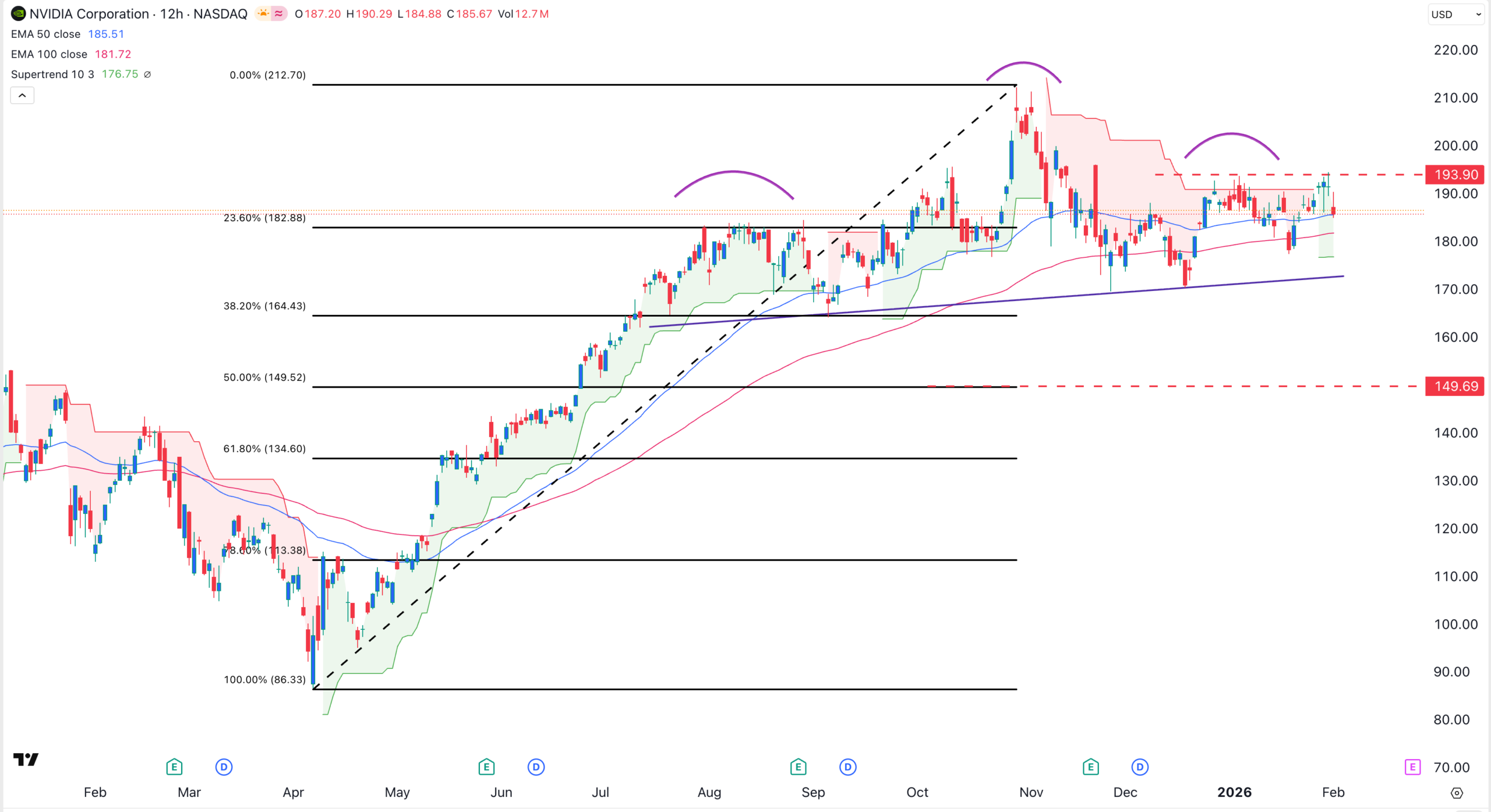
NVIDIA Stock Price Analysis as OpenAI Issues Concerns About its Chips

NVIDIA Stock Price Analysis as OpenAI Issues Concerns About its Chips

Key Insights NVIDIA stock started the week in the red. It crashed by over 2%. Meanwhile, the S&P 500, Dow Jones, and Nasdaq 100 moved close to their all-time highs
Share
Themarketperiodical2026/02/04 11:27