Bitcoin’s Four-Year Cycle Under Scrutiny: Political and Liquidity Factors Take Center Stage While Bitcoin’s traditional four-year cycle, often linked to its halvingBitcoin’s Four-Year Cycle Under Scrutiny: Political and Liquidity Factors Take Center Stage While Bitcoin’s traditional four-year cycle, often linked to its halving

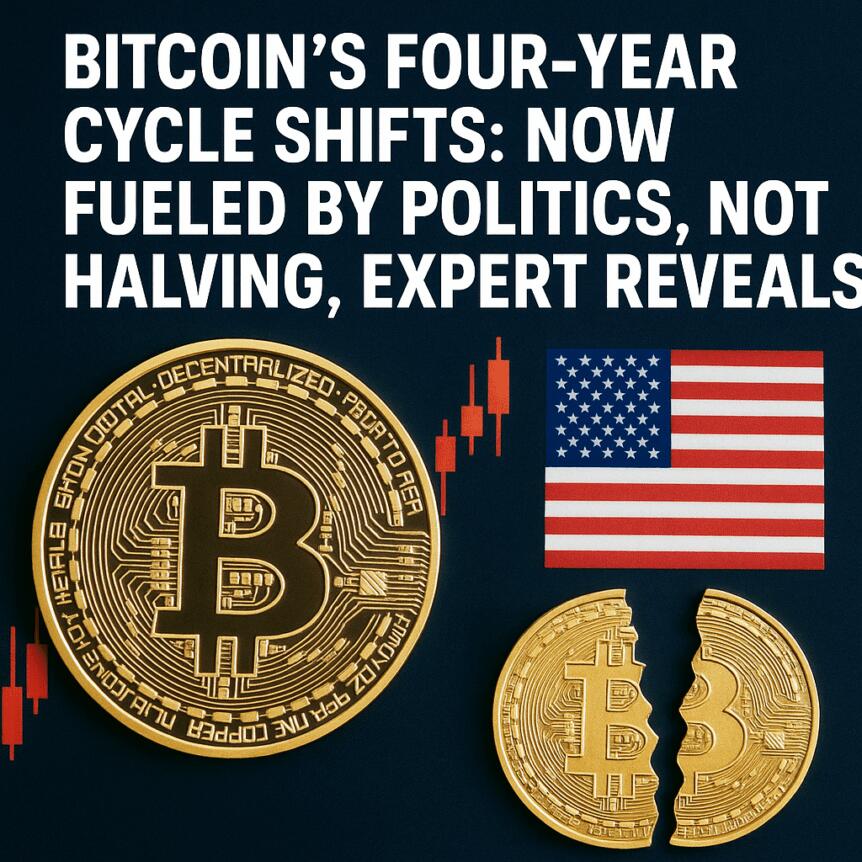
Bitcoin’s Four-Year Cycle Shifts: Now Fueled by Politics, Not Halving, Expert Reveals
2025/12/14 18:39
Bitcoin’s Four-Year Cycle Shifts: Now Fueled By Politics, Not Halving, Expert Reveals

Bitcoin’s Four-Year Cycle Under Scrutiny: Political and Liquidity Factors Take Center Stage

While Bitcoin’s traditional four-year cycle, often linked to its halving events, remains a topic of debate, recent insights suggest that external factors such as political developments and liquidity conditions are now driving market dynamics more than ever. Analysts are reassessing the role of supply cuts, emphasizing the influence of the US election cycle and monetary policy on Bitcoin’s price movements.

Key Takeaways

  • Market peaks in 2013, 2017, and 2021 closely align with US presidential elections and political uncertainty.
  • Bitcoin’s price movements are increasingly influenced by US political events rather than halving schedules.
  • Federal Reserve rate cuts are struggling to reignite Bitcoin’s momentum amid cautious institutional investment.
  • The emphasis shifts from halving-driven cycles to political and liquidity factors in timing market moves.

Tickers mentioned: Bitcoin: BTC

Sentiment: Neutral

Price impact: Neutral. The market appears to be consolidating rather than trending strongly in either direction, as liquidity conditions tighten and institutional caution prevails.

Market context: As macroeconomic factors take precedence, Bitcoin’s cyclical behavior is increasingly correlated with global political and monetary developments rather than its internal supply events.

Rethinking Bitcoin’s Cycles Amid Political and Liquidity Shifts

Recent insights from Markus Thielen, head of research at 10x Research, highlight a paradigm shift in Bitcoin’s traditional four-year cycle. Speaking on The Wolf Of All Streets Podcast, Thielen argued that the cycle isn’t broken but has evolved. Instead of being primarily driven by Bitcoin’s programmed supply reductions, the cycle now responds more to external factors such as US election timelines, central bank policy shifts, and the flow of capital into risk assets.

Historical market peaks in 2013, 2017, and 2021 coincide more with election periods and heightened political uncertainty rather than the timing of halving events. Thielen noted that the political environment, including potential shifts in US congressional power, influences investor sentiment and market outcomes. For example, the possibility of reduced legislative push from a sitting president influences risk appetite, thereby impacting Bitcoin’s price trajectory.

Concurrent to these geopolitical considerations, Bitcoin has struggled to regain upward momentum following the Federal Reserve’s recent rate cut. Unlike previous easing cycles that supported risk assets, institutional investors are adopting a cautious stance amid mixed policy signals and tightening liquidity conditions. Consequently, capital inflows into Bitcoin have slowed compared to last year, dampening the prospects for a substantial rally.

This evolving narrative suggests investors should pay closer attention to political and macroeconomic catalysts rather than relying solely on halving schedules to anticipate market moves. As Thielen emphasized, a deeper understanding of external factors is essential in navigating the current crypto landscape.

Meanwhile, voices like former BitMEX co-founder Arthur Hayes have weighed in, arguing that the four-year cycle has become obsolete, replaced by liquidity-driven market trends more than any predictable timing model. He maintains that Bitcoin’s bull markets are now primarily influenced by global monetary conditions rather than adherence to historical cycles or halving events.

This article was originally published as Bitcoin’s Four-Year Cycle Shifts: Now Fueled by Politics, Not Halving, Expert Reveals on Crypto Breaking News – your trusted source for crypto news, Bitcoin news, and blockchain updates.

Market Opportunity
Nowchain Logo
Nowchain Price(NOW)
$0.00237
$0.00237$0.00237
-3.65%
USD
Nowchain (NOW) Live Price Chart
Disclaimer: The articles reposted on this site are sourced from public platforms and are provided for informational purposes only. They do not necessarily reflect the views of MEXC. All rights remain with the original authors. If you believe any content infringes on third-party rights, please contact service@support.mexc.com for removal. MEXC makes no guarantees regarding the accuracy, completeness, or timeliness of the content and is not responsible for any actions taken based on the information provided. The content does not constitute financial, legal, or other professional advice, nor should it be considered a recommendation or endorsement by MEXC.

You May Also Like

The Channel Factories We’ve Been Waiting For

The Channel Factories We’ve Been Waiting For

The post The Channel Factories We’ve Been Waiting For appeared on BitcoinEthereumNews.com. Visions of future technology are often prescient about the broad strokes while flubbing the details. The tablets in “2001: A Space Odyssey” do indeed look like iPads, but you never see the astronauts paying for subscriptions or wasting hours on Candy Crush.  Channel factories are one vision that arose early in the history of the Lightning Network to address some challenges that Lightning has faced from the beginning. Despite having grown to become Bitcoin’s most successful layer-2 scaling solution, with instant and low-fee payments, Lightning’s scale is limited by its reliance on payment channels. Although Lightning shifts most transactions off-chain, each payment channel still requires an on-chain transaction to open and (usually) another to close. As adoption grows, pressure on the blockchain grows with it. The need for a more scalable approach to managing channels is clear. Channel factories were supposed to meet this need, but where are they? In 2025, subnetworks are emerging that revive the impetus of channel factories with some new details that vastly increase their potential. They are natively interoperable with Lightning and achieve greater scale by allowing a group of participants to open a shared multisig UTXO and create multiple bilateral channels, which reduces the number of on-chain transactions and improves capital efficiency. Achieving greater scale by reducing complexity, Ark and Spark perform the same function as traditional channel factories with new designs and additional capabilities based on shared UTXOs.  Channel Factories 101 Channel factories have been around since the inception of Lightning. A factory is a multiparty contract where multiple users (not just two, as in a Dryja-Poon channel) cooperatively lock funds in a single multisig UTXO. They can open, close and update channels off-chain without updating the blockchain for each operation. Only when participants leave or the factory dissolves is an on-chain transaction…
Share
BitcoinEthereumNews2025/09/18 00:09
PA Daily | Moonshot launches New XAI gork ($gork); analysis shows that Trump’s crypto assets account for about 40% of his total assets

PA Daily | Moonshot launches New XAI gork ($gork); analysis shows that Trump’s crypto assets account for about 40% of his total assets

CryptoQuant predicts three future trend scenarios for Bitcoin: in an optimistic scenario, it will rise to $150,000 to $175,000; Binance Alpha will launch Anon, BEETS and SHADOW; Moonshot announced the launch of New XAI gork ($gork).
Share
PANews2025/05/01 17:30
XRP ETF’s bereiken belangrijke mijlpaal: $1 miljard aan netto instroom

XRP ETF’s bereiken belangrijke mijlpaal: $1 miljard aan netto instroom

De markt voor crypto-exchange-traded funds (ETF’s) heeft opnieuw een belangrijke mijlpaal bereikt. XRP ETF’s hebben gezamenlijk meer dan 1 miljard dollar aan netto
Share
Coinstats2025/12/16 21:01