The Pyth Network announced a new reserve strategy. The protocol will convert one-third of its revenue into open-market PYTH token purchases. The Pyth Network, aThe Pyth Network announced a new reserve strategy. The protocol will convert one-third of its revenue into open-market PYTH token purchases. The Pyth Network, a

Pyth DAO to Convert Revenue Into PYTH Reserves

3 min read

The Pyth Network announced a new reserve strategy. The protocol will convert one-third of its revenue into open-market PYTH token purchases.

The Pyth Network, a blockchain oracle provider, has unveiled a new reserve strategy. The decentralized autonomous organization (DAO) will convert a portion of the protocol’s revenue into PYTH token purchases.

Pyth said the tokens it purchases in  open market would form the new reserve of the network. One third of the revenue generated by the protocol will be used for these systematic purchases. The goal of the network is to scale at a globally scale. The tactic is overtly aimed at raising revenue and thus purchases of tokens.

The introduction of the PYTH Reserve is a mechanism of structure. It turns the protocol revenue into systematic purchases of PYTH tokens. This directly links the adoption of the product to network value. Pyth emphasized that it has achieved product-market fit. Therefore, the network will now recycle value back into the ecosystem.

Related Reading: Pyth Partners with Revolut to Integrate Digital Banking Data into DeFi | Live Bitcoin News

The PYTH DAO Treasury receives a fraction of the protocol’s revenue. It invests these funds into purchasing PYTH tokens on the open market monthly. This allows transparent mathematical control of the relationship between use and long-term value for the network. More usage means more revenue and more revenue means more tokens purchased.
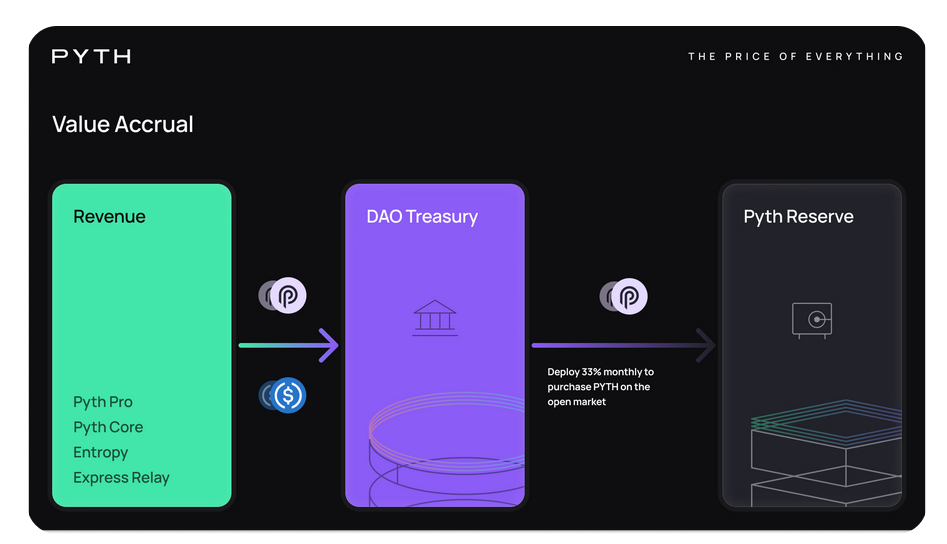
The Pyth Network announced a new reserve strategy. The protocol will convert one-third of its revenue into open-market PYTH token purchases.Source: Pyth Network

First, the DAO announced the initiative on December 12, 2025, confirming monthly treasury buybacks. Moreover, the strategy aims to create consistent and predictable token demand. Meanwhile, the network will scale buybacks alongside revenue growth. Initially, the first month’s buybacks are estimated between $100,000 and $200,000.

Pyth Expands Oracle Revenue Through Institutional Subscriptions

The Pyth Network earns revenue from a number of products and services. These include its standard Pyth Core price feeds on over 100 blockchains. It also includes Pyth Entropy, a random number generation service.

One of the important causes of revenue increase is Pyth Pro. This is a new institutional subscription product. In its first month, Pyth Pro is on its way to achieving an annualized recurring revenue (ARR) of $1M. This proves that the financial institutions are willing to pay for Pyth data.

The network is looking for ambitious growth. It hopes to capture just 1% of an estimated $50 billion market for institutional financial data every year. This would amount to $500 million of revenue per year. As a result of this, there would be significant growth for the PYTH Reserve.

The total supply of PYTH token is 10 billion tokens. Its current circulating quota is about 5.75 billion. The tokens that are not in circulation are subject to a structured cliff vesting schedule. This schedule extends into 2027. This structure fosters long-term commitment on the part of participants. Token holders are involved in the Pyth DAO. They vote on important network parameters such as fees and asset coverage.

The post Pyth DAO to Convert Revenue Into PYTH Reserves appeared first on Live Bitcoin News.

Market Opportunity
Pyth Network Logo
Pyth Network Price(PYTH)
$0.0424
$0.0424$0.0424
-3.37%
USD
Pyth Network (PYTH) Live Price Chart
Disclaimer: The articles reposted on this site are sourced from public platforms and are provided for informational purposes only. They do not necessarily reflect the views of MEXC. All rights remain with the original authors. If you believe any content infringes on third-party rights, please contact service@support.mexc.com for removal. MEXC makes no guarantees regarding the accuracy, completeness, or timeliness of the content and is not responsible for any actions taken based on the information provided. The content does not constitute financial, legal, or other professional advice, nor should it be considered a recommendation or endorsement by MEXC.

You May Also Like

Strategy to initiate a bitcoin security program addressing quantum uncertainty

Strategy to initiate a bitcoin security program addressing quantum uncertainty

Markets Share Share this article
Copy linkX (Twitter)LinkedInFacebookEmail
Strategy to initiate a bitcoin security prog
Share
Coindesk2026/02/06 18:21
Strategic Shift Impacts Crypto Trading Landscape

Strategic Shift Impacts Crypto Trading Landscape

The post Strategic Shift Impacts Crypto Trading Landscape appeared on BitcoinEthereumNews.com. Bybit Delists MILK: Strategic Shift Impacts Crypto Trading Landscape
Share
BitcoinEthereumNews2026/02/06 18:01
SEC clears framework for fast-tracked crypto ETF listings

SEC clears framework for fast-tracked crypto ETF listings

The post SEC clears framework for fast-tracked crypto ETF listings appeared on BitcoinEthereumNews.com. The Securities and Exchange Commission has approved new generic listing standards for spot crypto exchange-traded funds, clearing the way for faster approvals. Summary SEC has greenlighted new generic listing standards for spot crypto ETFs. Rule change eliminates lengthy case-by-case approvals, aligning crypto ETFs with commodity funds. Grayscale’s Digital Large Cap Fund and Bitcoin ETF options also gain approval. The U.S. SEC has approved new generic listing standards that will allow exchanges to fast-track spot crypto ETFs, marking a pivotal shift in U.S. digital asset regulation. According to a Sept. 17 press release, the SEC voted to approve rule changes from Nasdaq, NYSE Arca, and Cboe BZX, enabling them to list and trade commodity-based trust shares, including those holding spot digital assets, without submitting individual proposals for each product. A streamlined path for crypto ETFs Under the new rules, an ETF can be listed without SEC sign-off if its underlying asset trades on a market with surveillance-sharing agreements, has active CFTC-regulated futures contracts for at least six months, or already represents at least 40% of an existing listed ETF. This brings crypto ETFs in line with traditional commodity-based funds under Rule 6c-11, eliminating a process that could take up to 240 days. SEC chair Paul Atkins said the move was designed to “maximize investor choice and foster innovation” while ensuring the U.S. remains the leading market for digital assets. Jamie Selway, director of the division of trading and markets, called the framework “a rational, rules-based approach” that balances access with investor protection. First products already approved Alongside the new standards, the SEC cleared the listing of the Grayscale Digital Large Cap Fund, which tracks spot assets based on the CoinDesk 5 Index. It also approved trading of options tied to the Cboe Bitcoin U.S. ETF Index and its mini version, with…
Share
BitcoinEthereumNews2025/09/18 14:04