Upbit deleted old deposit addresses and required users to generate new ones for safety.Upbit deleted old deposit addresses and required users to generate new ones for safety.

Upbit removes old deposit addresses to protect users

2025/12/05 18:56
4 min read

Today, South Korean crypto exchange Upbit announced that it has deleted old deposit addresses as part of wallet maintenance and security improvements. Upbit revealed that users must create new addresses before making a deposit. 

The exchange warned that if users use the existing addresses, it might take longer for the deposits to be reflected.

Upbit announced that, starting on December 5 at 17:00 KST, deposits and withdrawals for 33 assets across 21 networks will be progressively resumed. The exchange emphasized that deposits and withdrawals will be made sequentially following the reinstatement of deposit and withdrawal services, beginning with network digital assets whose security has been verified.

Upbit implements new measures after Solana exploit

Upbit claimed that new deposit addresses are needed for all digital assets due to security vulnerability improvements. Deposits and withdrawals of digital assets that were suspended for various reasons prior to the inspection may remain suspended until the issue is resolved.

The exchange stated that once the target service’s stability has been verified, any staking requests, NFT deposits, and withdrawals supported by the network or digital asset will be resumed.

As previously reported by Cryptopolitan, the platform initially suspended all its services on November 27 due to a security breach that resulted in the unauthorized withdrawal of approximately 54 billion Korean won ($36.8 million). The attackers stole SOL, USDC, and more than 20 other Solana-based tokens like BONK, JUP, RAY, ORCA, RENDER, PYTH, and TRUMP.

The incident took place the day after Naver Financial announced that it would acquire Dunamu, the parent company of Upbit, for 15.1 trillion won ($10.3 billion) in an all-stock merger that was scheduled to be finalized in June 2026.

To prevent any losses, Upbit promptly suspended all deposits and withdrawals on its platform and transferred any remaining assets to cold storage. In addition to successfully freezing $8.18 million worth of LAYER tokens, the exchange continues to collaborate with authorities and projects to freeze further stolen funds.

Oh Kyung-seok, CEO of Upbit, stated that the exchange will use its own reserves to cover the whole sum, guaranteeing that no customer would suffer personal losses.

North Korean Lazarus group linked to Upbit hacks

Upbit has been hacked before. In 2019, the Lazarus Group was suspected of stealing 58 billion won worth of Ethereum from Upbit. A further inquiry came to the tentative conclusion that the Lazarus Group and other North Korean state-backed units were responsible for the attack.

Notably, the recent breach happened on November 27, the same day as the 2019 hack. 

According to South Korean government officials, the hackers either gained access to administrator accounts or impersonated administrators to approve the transfers. Blockchain analysis reveals that the hacker’s wallet converted Solana to USDC before bridging the cash to the Ethereum network, in what appears to be an effort to conceal the trail.

Immunefi, a blockchain security platform, revealed that Lazarus was responsible for more than $300 million in losses from cryptocurrency hacking incidents in 2023, accounting for 17.6% of all losses.

Over the past decade, the Lazarus Group has been responsible for some of the largest hacks, particularly in the rapidly growing cryptocurrency sector. According to Immunefi, Lazarus began focusing on cryptocurrency protocols after initially gaining notoriety for its 2014 cyberattack on Sony Pictures. 

In March 2023, the Lazarus hacked Ronin Network, a bridge utilized by the well-known Web3 game Axie Infinity, and stole around  $600 million. Lazarus also conducted the cyber heist on the Central Bank of Bangladesh in 2016, resulting in $81 million in losses.

According to blockchain analysis company Elliptic, hackers employed by the North Korean government have taken over $2 billion in cryptocurrency so far this year.

On October 7, Elliptic published a blog post with new forecasts, stating that the firm’s data “shows the largest annual total on record, with three months still to go,” and is based on more than 30 hacks in 2025.

Claim your free seat in an exclusive crypto trading community - limited to 1,000 members.

Disclaimer: The articles reposted on this site are sourced from public platforms and are provided for informational purposes only. They do not necessarily reflect the views of MEXC. All rights remain with the original authors. If you believe any content infringes on third-party rights, please contact service@support.mexc.com for removal. MEXC makes no guarantees regarding the accuracy, completeness, or timeliness of the content and is not responsible for any actions taken based on the information provided. The content does not constitute financial, legal, or other professional advice, nor should it be considered a recommendation or endorsement by MEXC.
Tags:

You May Also Like

Why Smart Whales Abandon Cardano And Solana, Choosing Pepeto Presale For 100x Potential
Why Smart Whales Abandon Cardano And Solana, Choosing Pepeto Presale For 100x Potential

But a new player is emerging quickly: Pepeto (PEPETO), still in presale at just $0.000000153, already garnering over $6.7 million. […] The post Why Smart Whales Abandon Cardano And Solana, Choosing Pepeto Presale For 100x Potential appeared first on Coindoo.
Share
Coindoo2025/09/20 01:35
US Crypto Legislation: Unlocking a New Era for the Market Cycle

US Crypto Legislation: Unlocking a New Era for the Market Cycle

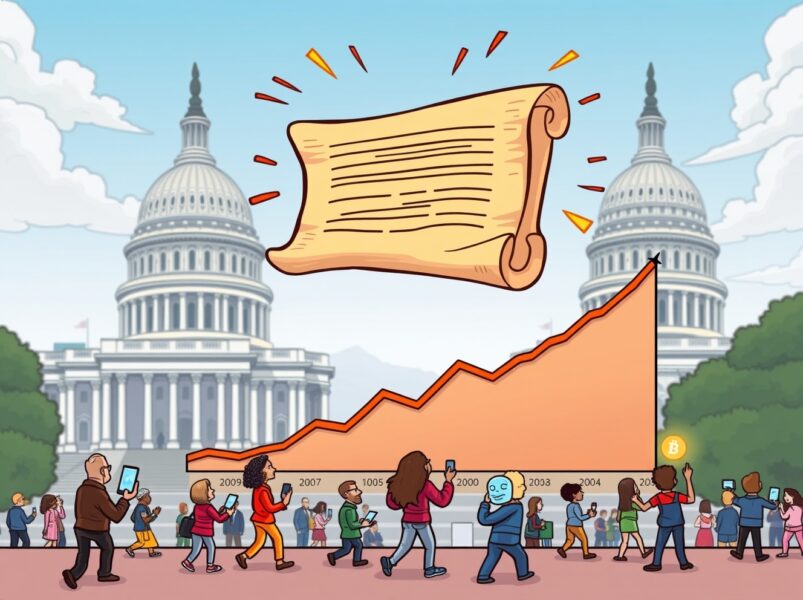
BitcoinWorld US Crypto Legislation: Unlocking a New Era for the Market Cycle Get ready for a potentially monumental shift in the crypto world! Galaxy Digital CEO Mike Novogratz has shared a fascinating prediction: significant US crypto legislation could fundamentally reshape the market’s traditional four-year cycle. This isn’t just speculation; it points to a future where crypto’s trajectory might look very different from what we’ve seen before. How is US Crypto Legislation Changing the Game? In a recent interview with Bloomberg, Novogratz highlighted two key pieces of legislation: the Genius Act and the CLARITY Act. These aren’t just bureaucratic terms; they represent a concerted effort to bring clarity and regulation to the cryptocurrency space. The Genius Act, enacted in July, focuses on stablecoin regulation. This is crucial because stablecoins, which are cryptocurrencies pegged to a stable asset like the US dollar, are becoming central to many digital transactions. The CLARITY Act aims to provide a clearer market structure. This means establishing defined rules for how cryptocurrencies are traded and regulated, making the market more transparent and accessible. Novogratz believes these legislative developments will act as a powerful magnet, drawing a massive influx of new investors into the market. Imagine millions of new participants feeling confident enough to engage with digital assets thanks to clear guidelines. Will We See a Different Crypto Market Cycle This Time? One of Novogratz’s most intriguing predictions challenges the historical pattern of crypto. He suggests that this current cycle might not conclude with the kind of large-scale sell-off that characterized previous Bitcoin (BTC) peaks. Historically, after major bull runs, investors often sold off their holdings, leading to significant market corrections. Consider the cycles of 2017 and 2021. Both saw incredible highs followed by substantial downturns as investors took profits. However, Novogratz argues that the investment environment has undergone a significant transformation. The presence of robust US crypto legislation is a key factor here, fostering a more mature market. The Power of Legitimized Stablecoins and Wider Adoption What exactly is different now? A major part of Novogratz’s argument centers on legalized stablecoins. These digital assets are poised to become seamlessly integrated into our daily lives. Think about using them directly within apps on your iPhone or across various social media platforms. This widespread usability has profound implications: Reduced Volatility Concerns: For everyday transactions, stablecoins offer the speed and efficiency of crypto without the wild price swings often associated with assets like Bitcoin or Ethereum. Easier Onboarding for New Users: When stablecoins are integrated into familiar platforms, the barrier to entry for new users dramatically decreases. People can engage with digital assets without needing to navigate complex exchanges immediately. Mainstream Acceptance: This level of integration pushes cryptocurrency further into the mainstream, moving it beyond niche trading circles and into everyday commerce. The clarity provided by US crypto legislation around these assets builds trust and encourages broader adoption. Navigating the Future: Opportunities and Potential Hurdles While the outlook is overwhelmingly positive, it’s also wise to consider the evolving landscape. The introduction of comprehensive US crypto legislation presents both immense opportunities and potential hurdles. Opportunities: A clearer regulatory framework can attract institutional investors, foster innovation within the blockchain space, and provide consumer protection, all contributing to a more robust and sustainable market. Potential Hurdles: Crafting effective legislation is complex. There might be ongoing debates, adjustments, and unforeseen impacts that could influence market dynamics. The industry will need to adapt to new compliance requirements. Ultimately, a regulated environment aims to create a more predictable and secure space for growth, benefiting both seasoned investors and newcomers alike. A New Dawn for Crypto Market Cycles Mike Novogratz’s vision paints an exciting picture for the future of cryptocurrency. The advent of clear US crypto legislation, particularly the Genius and CLARITY Acts, appears set to usher in a new era. This could mean a departure from the dramatic boom-and-bust cycles of the past, paving the way for more sustained growth and widespread adoption. As stablecoins become integral to our digital interactions, the crypto market is evolving into a more mature, integrated, and accessible financial ecosystem. The potential for a less volatile, more inclusive market is truly transformative. Frequently Asked Questions About Crypto Legislation Q1: What is the significance of the Genius Act and CLARITY Act? A1: The Genius Act focuses on regulating stablecoins, providing a clear framework for their issuance and use. The CLARITY Act aims to establish a clear market structure for cryptocurrencies, defining how they are traded and regulated. Together, they bring much-needed legal certainty to the crypto space. Q2: How could new US crypto legislation prevent large-scale sell-offs? A2: Novogratz suggests that with increased regulatory clarity and the widespread integration of stablecoins into daily apps, the market will attract a broader base of long-term investors. This could lead to more stable growth and reduce the likelihood of the rapid, panic-driven sell-offs seen after previous market peaks. Q3: How will legalized stablecoins change everyday use? A3: Legitimized stablecoins are expected to be integrated into common applications on devices like iPhones and social media platforms. This will make them easier to use for everyday transactions, payments, and remittances, much like traditional digital currency, but with the benefits of blockchain technology. Q4: What are the main benefits of clearer US crypto legislation for investors? A4: Clear legislation provides several benefits: it reduces regulatory uncertainty, which can attract more institutional and retail investors; it offers better consumer protection; and it fosters a more predictable and stable environment for innovation and growth within the crypto market. Q5: Are there any potential challenges with new crypto legislation? A5: While largely positive, challenges could include the complexity of implementing and enforcing new regulations, the need for continuous adaptation as technology evolves, and potential disagreements within the industry or among regulators on specific rules. However, these are part of any maturing market. If you found this article insightful, consider sharing it with your network! Help us spread the word about the exciting future of cryptocurrency and how US crypto legislation is shaping it. Your shares help inform and educate others about these pivotal market changes. To learn more about the latest crypto market trends, explore our article on key developments shaping Bitcoin and Ethereum institutional adoption. This post US Crypto Legislation: Unlocking a New Era for the Market Cycle first appeared on BitcoinWorld.
Share
Coinstats2025/09/24 12:25
XRP Price Prediction February 2026: Senator Warren Warns Fed as Pepeto’s 100x Presale Steals the Spotlight From Ripple

XRP Price Prediction February 2026: Senator Warren Warns Fed as Pepeto’s 100x Presale Steals the Spotlight From Ripple

Senator Elizabeth Warren reportedly sent a letter to Fed Chair Jerome Powell and Treasury Secretary Scott Bessent demanding they not […] The post XRP Price Prediction
Share
Coindoo2026/02/22 05:55