Illicit crypto activity across centralised exchanges has plunged to record lows in 2025, marking a pivotal moment for…Illicit crypto activity across centralised exchanges has plunged to record lows in 2025, marking a pivotal moment for…

Illicit crypto activity falls to a historic low in 2025 — the industry hails a new era of clean trading

2025/11/27 16:59
3 min read
For feedback or concerns regarding this content, please contact us at crypto.news@mexc.com

Illicit crypto activity across centralised exchanges has plunged to record lows in 2025, marking a pivotal moment for an industry long shadowed by concerns over misuse. Independent data from Chainalysis and TRM Labs points to a sharp drop in exposure to wallets linked to scams, hacks and sanctioned entities.

As of June 2025, the seven largest exchanges recorded just 0.018 to 0.023 per cent of total trading activity linked to illicit addresses. This represents a steep decline from levels recorded two years ago. Analysts describe it as evidence of stronger compliance standards and more intelligent transaction monitoring across the crypto ecosystem.

Among the top platforms, Binance stood out. Chainalysis found only 0.007 per cent of Binance’s June 2025 volume came from wallets tied to illicit activity, more than 2.5 times less than the industry average. TRM Labs’ independent analysis corroborates this, placing Binance’s “direct exposure” at 0.016 per cent, versus roughly 0.023 per cent for its peers.

As Binance processes daily volumes comparable to all its six largest competitors combined, maintaining these low ratios is especially significant.
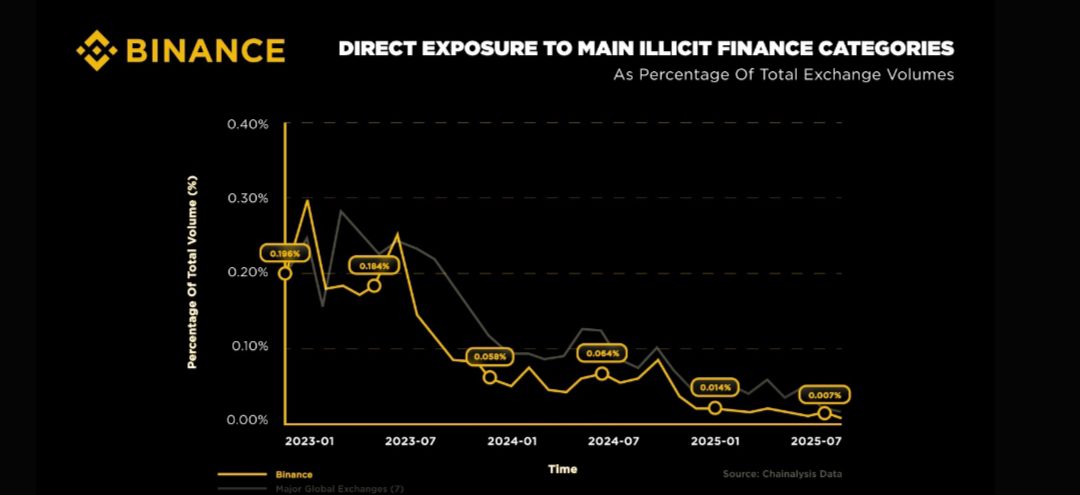
Illicit crypto activity falls to a historic low in 2025 — the industry hails a new era of clean tradingIllicit crypto activity falls to a historic low in 2025

“Direct exposure” here refers to the share of an exchange’s volume that interacts with wallets verified to be involved in scams, hacks, sanctions-evading operations or other illicit activities. A lower figure suggests that suspicious transactions are being caught, blocked or reported before they can circulate broadly.

What the sharp decline in illicit crypto activities means for the ecosystem 

Industry-wide, this decline reflects more than just Binance’s progress. It points to broader changes, better compliance protocols, improved tracking technology, and greater coordination between exchanges, analytics firms and law enforcement.

Illicit crypto activity falls to a historic low in 2025 — the industry hails a new era of clean tradingIllicit crypto activity falls to a historic low in 2025

Between January 2023 and June 2025, Binance reportedly cut its illicit exposure by 96–98 per cent. Even as its daily trading volume soared (with 217 million trades daily and over $90 billion processed), it kept illicit flows at near-negligible levels.

According to the reports, achievements like this are underpinned by structured compliance programmes. Binance alone now employs over 1,280 staff in compliance, risk and investigations; that’s about 22 per cent of its workforce. The exchange also leverages AI-powered monitoring systems, responds to hundreds of thousands of law-enforcement requests, conducts investigator trainings, and participates in multi-exchange anti-money laundering networks such as the Beacon Network and the T3+ programme.

Also read: Stablecoins shed $6 billion in November, its largest monthly drop since 2022

Crucially, the data provides context against claims that crypto is a primary vehicle for financial crime. Research referenced by NASDAQ, the United Nations and the IMF suggests trillions are laundered annually through traditional banking systems in the form of anonymous fiat transfers, offshore accounts and shell companies. Compared to this, while traces of illicit activity still exist, the sheer scale of global crypto trading means illicit volume is now a tiny fraction of overall activity. 

Illicit crypto activity falls to a historic low in 2025 — the industry hails a new era of clean tradingIllicit crypto activity falls to a historic low in 2025

The near-universal drop in illicit exposure across major exchanges suggests the narrative around crypto as a haven for criminal finance is becoming outdated. Instead, exchanges are evolving into highly monitored, regulated hubs, and users benefit from safer, more transparent markets.

As the industry continues to grow, maintaining these gains is critical. That means continued investment in compliance tools, cooperation with regulators and law-enforcement agencies, and transparent reporting. The 2025 data shows that with diligence and technology, crypto can scale without sacrificing integrity.

Disclaimer: The articles reposted on this site are sourced from public platforms and are provided for informational purposes only. They do not necessarily reflect the views of MEXC. All rights remain with the original authors. If you believe any content infringes on third-party rights, please contact crypto.news@mexc.com for removal. MEXC makes no guarantees regarding the accuracy, completeness, or timeliness of the content and is not responsible for any actions taken based on the information provided. The content does not constitute financial, legal, or other professional advice, nor should it be considered a recommendation or endorsement by MEXC.

You May Also Like

Ethereum spot ETFs had a total net outflow of $1.8898 million yesterday, with Fidelity FETH leading the way with a net outflow of $29.1892 million.

Ethereum spot ETFs had a total net outflow of $1.8898 million yesterday, with Fidelity FETH leading the way with a net outflow of $29.1892 million.

PANews reported on September 18 that according to SoSoValue data, the total net outflow of Ethereum spot ETF was US$1.8898 million yesterday (September 17, US Eastern Time). The Ethereum spot ETF with the largest single-day net inflow yesterday was Blackrock ETF ETHA, with a single-day net inflow of US$25.8636 million. The current historical total net inflow of ETHA has reached US$13.255 billion. The second is Grayscale Ethereum Mini Trust ETF ETH, with a single-day net inflow of US$6.382 million. The current historical total net inflow of ETH has reached US$1.431 billion. The Ethereum spot ETF with the largest single-day net outflow yesterday was the Fidelity ETF FETH, with a single-day net outflow of US$29.1892 million. The current historical total net inflow of FETH has reached US$2.768 billion. As of press time, the total net asset value of the Ethereum spot ETF was US$29.719 billion, the ETF net asset ratio (market value as a percentage of Ethereum's total market value) reached 5.47%, and the historical cumulative net inflow has reached US$13.659 billion.
Share
PANews2025/09/18 11:54
Michael Saylor Pushes Digital Capital Narrative At Bitcoin Treasuries Unconference

Michael Saylor Pushes Digital Capital Narrative At Bitcoin Treasuries Unconference

The post Michael Saylor Pushes Digital Capital Narrative At Bitcoin Treasuries Unconference appeared on BitcoinEthereumNews.com. The suitcoiners are in town.  From a low-key, circular podium in the middle of a lavish New York City event hall, Strategy executive chairman Michael Saylor took the mic and opened the Bitcoin Treasuries Unconference event. He joked awkwardly about the orange ties, dresses, caps and other merch to the (mostly male) audience of who’s-who in the bitcoin treasury company world.  Once he got onto the regular beat, it was much of the same: calm and relaxed, speaking freely and with confidence, his keynote was heavy on the metaphors and larger historical stories. Treasury companies are like Rockefeller’s Standard Oil in its early years, Michael Saylor said: We’ve just discovered crude oil and now we’re making sense of the myriad ways in which we can use it — the automobile revolution and jet fuel is still well ahead of us.  Established, trillion-dollar companies not using AI because of “security concerns” make them slow and stupid — just like companies and individuals rejecting digital assets now make them poor and weak.  “I’d like to think that we understood our business five years ago; we didn’t.”  We went from a defensive investment into bitcoin, Saylor said, to opportunistic, to strategic, and finally transformational; “only then did we realize that we were different.” Michael Saylor: You Come Into My Financial History House?! Jokes aside, Michael Saylor is very welcome to the warm waters of our financial past. He acquitted himself honorably by invoking the British Consol — though mispronouncing it, and misdating it to the 1780s; Pelham’s consolidation of debts happened in the 1750s and perpetual government debt existed well before then — and comparing it to the gold standard and the future of bitcoin. He’s right that Strategy’s STRC product in many ways imitates the consols; irredeemable, perpetual debt, issued at par, with…
Share
BitcoinEthereumNews2025/09/18 02:12
Trump White House Registers Aliens.gov—Is the UFO File Drop Imminent?

Trump White House Registers Aliens.gov—Is the UFO File Drop Imminent?

The post Trump White House Registers Aliens.gov—Is the UFO File Drop Imminent? appeared on BitcoinEthereumNews.com. In brief The White House registered aliens.gov
Share
BitcoinEthereumNews2026/03/19 05:33