The post India to Launch ARC Token Stablecoin Backed by Government Securities appeared first on Coinpedia Fintech News India is preparing to take a major step in digital finance with the development of its first sovereign-backed digital token. Polygon has partnered with fintech firm Anq to build a government-backed digital instrument that could redefine how digital money functions in the country. Unlike private stablecoins tied to the U.S. dollar or controlled by corporations, …The post India to Launch ARC Token Stablecoin Backed by Government Securities appeared first on Coinpedia Fintech News India is preparing to take a major step in digital finance with the development of its first sovereign-backed digital token. Polygon has partnered with fintech firm Anq to build a government-backed digital instrument that could redefine how digital money functions in the country. Unlike private stablecoins tied to the U.S. dollar or controlled by corporations, …

India to Launch ARC Token Stablecoin Backed by Government Securities

2025/11/05 21:00
3 min read
ARC Token Stablecoin

The post India to Launch ARC Token Stablecoin Backed by Government Securities appeared first on Coinpedia Fintech News

India is preparing to take a major step in digital finance with the development of its first sovereign-backed digital token. Polygon has partnered with fintech firm Anq to build a government-backed digital instrument that could redefine how digital money functions in the country. Unlike private stablecoins tied to the U.S. dollar or controlled by corporations, this project is directly backed by the Government of India through government securities.

Polygon co-founder Sandeep Nailwal stated in September that he is fully confident India will introduce an INR-backed stablecoin within the next three months, setting high expectations across the crypto and fintech sectors.

A Token Backed by Indian Sovereign Assets

The digital currency model is called the Asset Reserve Certificate, or ARC. Its structure is designed to ensure complete transparency and stability. Each ARC token issued will represent an equivalent value of Indian Government Securities or Treasury Bills held in reserve. In other words, for every token in circulation, there must be an equal amount of sovereign assets backing it.

This creates a non-speculative, fully regulated token that mirrors the value of the Indian Rupee. Unlike dollar-based stablecoins such as USDT and USDC, which move Indian liquidity offshore, ARC is anchored within the Indian financial ecosystem. Any increase in digital token activity would directly support domestic economic operations rather than foreign dollar-backed markets.

  • Also Read :
  •   Canada’s 2025 Federal Budget Reveals Plans to Regulate Stablecoins 
  •   ,

Enhancing the Monetary System Without Challenging It

Polygon and Anq are positioning ARC as a digital asset that complements the Reserve Bank of India rather than competing with it. The design introduces a twin-rupee framework: the RBI’s Digital Rupee acts as the official settlement layer, while ARC becomes a programmable layer built by regulated private players. This enables innovation within the private sector while allowing the RBI to retain full control over monetary policy.

Since ARC tokens are created only when government securities are purchased, this model indirectly supports government funding without requiring new taxation. Demand for ARC is directly linked to demand for government debt instruments, creating a sustainable financial loop.

Mixed Reactions From the Crypto Community

While the project is gaining support, not everyone in the crypto community is convinced. Crypto commentator Josh argues that calling the token “sovereign-backed” is simply a marketing strategy. In his view, the token is fully centralized and censorable, making it no different from a digital rupee rather than a real stablecoin. He believes it contradicts the core purpose of crypto, which values decentralization and permissionless access.

Despite the criticism, India appears committed to exploring a future where digital money is backed by real sovereign assets, not private reserves.

Never Miss a Beat in the Crypto World!

Stay ahead with breaking news, expert analysis, and real-time updates on the latest trends in Bitcoin, altcoins, DeFi, NFTs, and more.

bell icon Subscribe to News

FAQs

How will the ARC token maintain its stability and value?

Each ARC token is fully backed by Indian Government Securities or Treasury Bills, ensuring transparency and one-to-one value support.

How is the ARC different from private stablecoins like USDT or USDC?

Unlike dollar-backed stablecoins, ARC keeps liquidity within India and is supported by sovereign assets, not foreign reserves.

Will the ARC compete with India’s Digital Rupee?

No. ARC complements the RBI’s Digital Rupee, serving as a programmable layer while the Digital Rupee remains the core settlement system.

Disclaimer: The articles reposted on this site are sourced from public platforms and are provided for informational purposes only. They do not necessarily reflect the views of MEXC. All rights remain with the original authors. If you believe any content infringes on third-party rights, please contact service@support.mexc.com for removal. MEXC makes no guarantees regarding the accuracy, completeness, or timeliness of the content and is not responsible for any actions taken based on the information provided. The content does not constitute financial, legal, or other professional advice, nor should it be considered a recommendation or endorsement by MEXC.

You May Also Like

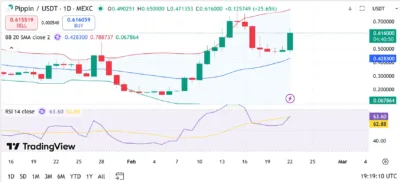
Pippin (PIPPIN) Price Prediction 2026–2030: Can PIPPIN Hit $0.70 Soon?
Pippin (PIPPIN) Price Prediction 2026–2030: Can PIPPIN Hit $0.70 Soon?

PIPPIN has surged sharply on the daily timeframe, printing a powerful bullish candle with over 25% gains. RSI is holding above 60, signaling strengthening momentum
Share
Coinstats2026/02/23 04:29
Will Cardano Reach $10 by 2030? Analysts Break Down ADA’s Growth Cycles

Will Cardano Reach $10 by 2030? Analysts Break Down ADA’s Growth Cycles

The post Will Cardano Reach $10 by 2030? Analysts Break Down ADA’s Growth Cycles appeared first on Coinpedia Fintech News Cardano (ADA) is trading at $0.9024 with a market cap of $32.91 billion. Experts say ADA has the potential to climb much higher, with some placing long-term targets as high as $10. The token continues to benefit from stronger visibility, rising liquidity, and increasing inflows from both institutional and retail markets. Can Cardano Hit $10 …
Share
CoinPedia2025/09/18 17:19
Crypto whale loses $6M to sneaky phishing scheme targeting staked Ethereum

Crypto whale loses $6M to sneaky phishing scheme targeting staked Ethereum

The post Crypto whale loses $6M to sneaky phishing scheme targeting staked Ethereum appeared on BitcoinEthereumNews.com. A crypto whale lost more than $6 million in staked Ethereum (stETH) and Aave-wrapped Bitcoin (aEthWBTC) after approving malicious signatures in a phishing scheme on Sept. 18, according to blockchain security firm Scam Sniffer. According to the firm, the attackers disguised their move as a routine wallet confirmation through “Permit” signatures, which tricked the victim into authorizing fund transfers without triggering obvious red flags. Yu Xian, founder of blockchain security company SlowMist, noted that the victim did not recognize the danger because the transaction required no gas fees. He wrote: “From the victim’s perspective, he just clicked a few times to confirm the wallet’s pop-up signature requests, didn’t spend a single penny of gas, and $6.28 million was gone.” How Permit exploits work Permit approvals were originally designed to simplify token transfers. Instead of submitting an on-chain approval and paying fees, a user can sign an off-chain message authorizing a spender. That efficiency, however, has created a new attack surface for malicious players. Once a user signs such a permit, attackers can combine two functions—Permit and TransferFrom—to drain assets directly. Because the authorization takes place off-chain, wallet dashboards show no unusual activity until the funds move. As a result, the assets are gone when the approval executes on-chain, and tokens are redirected to the attacker’s wallet. This loophole has made permit exploits increasingly attractive for malicious actors, who can siphon millions without needing complex hacks or high-cost gas wars. Phishing losses The latest theft highlights a wider trend of escalating phishing campaigns. Scam Sniffer reported that in August alone, attackers stole $12.17 million from more than 15,200 victims. That figure represented a 72% jump in losses compared with July. According to the firm, the most significant share of August’s damages came from three large accounts that accounted for nearly half…
Share
BitcoinEthereumNews2025/09/19 02:31