Author: seedly.eth The anticipation for "Uptober"'s carnival was met with a severe blow in the second week of October. The market's collective anticipation for "Uptober" was put on hold by Trump's new round of tariff threats. On Friday local time, Trump announced that he would impose an additional 100% tariff on Chinese goods, on top of the 30% tariff already in effect, and that the tariff would take effect on November 1 or earlier. The U.S. stock market suffered its biggest single-day plunge in months, and the cryptocurrency market instantly turned into a bloody slaughterhouse. Bitcoin plummeted from a high of over $122,000 on Friday morning to approximately $104,582.41, a 7% drop in a single day. This drop nearly wiped out all gains since October, returning the price to the level of October 1st. Ethereum saw an even more dramatic drop, with its price plummeting nearly 8% to approximately $3,975, hitting a new low since October. Solana (SOL) followed closely behind, dropping over 7% in a single day to $205. Like Ethereum, Solana also hit its lowest point since October. WLFI (World Liberty Financial), the native token of the Trump family platform, was not spared either. Immediately after Trump announced the tariffs on China, WLFI plummeted by over 17%. According to CoinGlass data, the amount of liquidation in the past 24 hours was nearly 10 billion US dollars, and more than 1.52 million people were liquidated. U.S. stocks had their worst single-day performance since April: The Nasdaq Composite suffered the biggest drop, closing down 3.56%. The S&P 500 closed down 2.71%, its biggest single-day percentage drop since April 10. The Dow Jones Industrial Average closed down 1.90%. After Wall Street closed, market panic did not subside. Technology stocks such as Nvidia, Tesla, Amazon.com and Advanced Micro Devices (AMD) all fell by more than 2% in after-hours trading. Macro risks hit market fragility Analysts generally believe that the market's concerns that the tit-for-tat trade frictions between the two major economies of China and the United States may evolve into a full-scale trade war, thereby stifling global economic growth, are the key to the simultaneous plunge in stocks and cryptocurrencies. "It was a brutal day," said Ram Ahluwalia, founder of the investment firm Lumida Wealth. Trump's tariffs triggered widespread de-risking, with investors seeking safety from volatile assets closely tied to economic growth prospects, such as stocks, tech stocks, and cryptocurrencies. "Trump's news, combined with overbought conditions, led to a sharp market decline," he said. Zaheer Ebtikar, founder and chief investment officer of crypto hedge fund Split Capital, said: "The altcoin market has completely collapsed. The altcoin market has reached its highest level in more than a year. Leverage ratios have been fully reset and the market is in chaos." The sell-off, particularly the biggest drop in months for U.S. stocks, has reignited concerns about whether the market is due for a major downside correction. JPMorgan Chase CEO Jamie Dimon has previously warned that the risk of a major correction on Wall Street has increased within the next six months to two years. Prior to the recent plunge, the US stock market was in the midst of a record-breaking rally, with the S&P 500 and Nasdaq hitting all-time highs on Thursday. So far this year, the Nasdaq has risen approximately 15%, while the S&P 500 has risen approximately 11%. This rally has been driven primarily by enthusiasm surrounding the artificial intelligence (AI) industry. However, some investors believe the current trade tensions are unlikely to drastically alter the market's trajectory. For example, James St. Aubin, chief investment officer at Ocean Park Asset Management, believes that while it is a "significant issue" and could trigger a pullback, he "doesn't necessarily think it will derail the AI theme that has been driving the market." For the cryptocurrency market, the failure of "Uptober" signifies that market sentiment has rapidly shifted from the early-month enthusiasm and expectations of record highs to a more sensitive and cautious outlook regarding macroeconomic risks. Unless the trade tensions quickly de-escalate or strong new positive news emerges, the crypto market will face challenges and may need some time to process this sudden "Red October shock."Author: seedly.eth The anticipation for "Uptober"'s carnival was met with a severe blow in the second week of October. The market's collective anticipation for "Uptober" was put on hold by Trump's new round of tariff threats. On Friday local time, Trump announced that he would impose an additional 100% tariff on Chinese goods, on top of the 30% tariff already in effect, and that the tariff would take effect on November 1 or earlier. The U.S. stock market suffered its biggest single-day plunge in months, and the cryptocurrency market instantly turned into a bloody slaughterhouse. Bitcoin plummeted from a high of over $122,000 on Friday morning to approximately $104,582.41, a 7% drop in a single day. This drop nearly wiped out all gains since October, returning the price to the level of October 1st. Ethereum saw an even more dramatic drop, with its price plummeting nearly 8% to approximately $3,975, hitting a new low since October. Solana (SOL) followed closely behind, dropping over 7% in a single day to $205. Like Ethereum, Solana also hit its lowest point since October. WLFI (World Liberty Financial), the native token of the Trump family platform, was not spared either. Immediately after Trump announced the tariffs on China, WLFI plummeted by over 17%. According to CoinGlass data, the amount of liquidation in the past 24 hours was nearly 10 billion US dollars, and more than 1.52 million people were liquidated. U.S. stocks had their worst single-day performance since April: The Nasdaq Composite suffered the biggest drop, closing down 3.56%. The S&P 500 closed down 2.71%, its biggest single-day percentage drop since April 10. The Dow Jones Industrial Average closed down 1.90%. After Wall Street closed, market panic did not subside. Technology stocks such as Nvidia, Tesla, Amazon.com and Advanced Micro Devices (AMD) all fell by more than 2% in after-hours trading. Macro risks hit market fragility Analysts generally believe that the market's concerns that the tit-for-tat trade frictions between the two major economies of China and the United States may evolve into a full-scale trade war, thereby stifling global economic growth, are the key to the simultaneous plunge in stocks and cryptocurrencies. "It was a brutal day," said Ram Ahluwalia, founder of the investment firm Lumida Wealth. Trump's tariffs triggered widespread de-risking, with investors seeking safety from volatile assets closely tied to economic growth prospects, such as stocks, tech stocks, and cryptocurrencies. "Trump's news, combined with overbought conditions, led to a sharp market decline," he said. Zaheer Ebtikar, founder and chief investment officer of crypto hedge fund Split Capital, said: "The altcoin market has completely collapsed. The altcoin market has reached its highest level in more than a year. Leverage ratios have been fully reset and the market is in chaos." The sell-off, particularly the biggest drop in months for U.S. stocks, has reignited concerns about whether the market is due for a major downside correction. JPMorgan Chase CEO Jamie Dimon has previously warned that the risk of a major correction on Wall Street has increased within the next six months to two years. Prior to the recent plunge, the US stock market was in the midst of a record-breaking rally, with the S&P 500 and Nasdaq hitting all-time highs on Thursday. So far this year, the Nasdaq has risen approximately 15%, while the S&P 500 has risen approximately 11%. This rally has been driven primarily by enthusiasm surrounding the artificial intelligence (AI) industry. However, some investors believe the current trade tensions are unlikely to drastically alter the market's trajectory. For example, James St. Aubin, chief investment officer at Ocean Park Asset Management, believes that while it is a "significant issue" and could trigger a pullback, he "doesn't necessarily think it will derail the AI theme that has been driving the market." For the cryptocurrency market, the failure of "Uptober" signifies that market sentiment has rapidly shifted from the early-month enthusiasm and expectations of record highs to a more sensitive and cautious outlook regarding macroeconomic risks. Unless the trade tensions quickly de-escalate or strong new positive news emerges, the crypto market will face challenges and may need some time to process this sudden "Red October shock."

"Uptober" turns into a "slaughterhouse": Bitcoin flash crashes to $7,000, killing millions of retail investors

2025/10/11 10:00
4 min read

Author: seedly.eth

The anticipation for "Uptober"'s carnival was met with a severe blow in the second week of October.

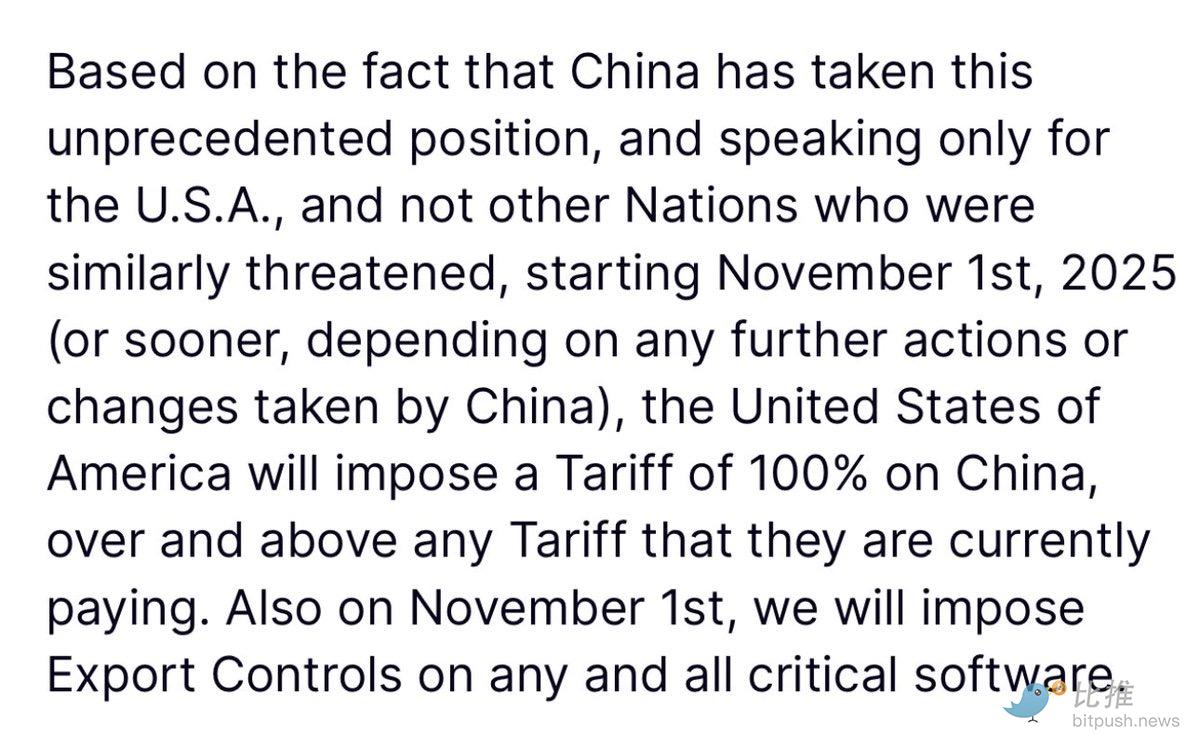
The market's collective anticipation for "Uptober" was put on hold by Trump's new round of tariff threats. On Friday local time, Trump announced that he would impose an additional 100% tariff on Chinese goods, on top of the 30% tariff already in effect, and that the tariff would take effect on November 1 or earlier.
The U.S. stock market suffered its biggest single-day plunge in months, and the cryptocurrency market instantly turned into a bloody slaughterhouse.

Bitcoin plummeted from a high of over $122,000 on Friday morning to approximately $104,582.41, a 7% drop in a single day. This drop nearly wiped out all gains since October, returning the price to the level of October 1st.

Ethereum saw an even more dramatic drop, with its price plummeting nearly 8% to approximately $3,975, hitting a new low since October. Solana (SOL) followed closely behind, dropping over 7% in a single day to $205. Like Ethereum, Solana also hit its lowest point since October.

WLFI (World Liberty Financial), the native token of the Trump family platform, was not spared either. Immediately after Trump announced the tariffs on China, WLFI plummeted by over 17%.
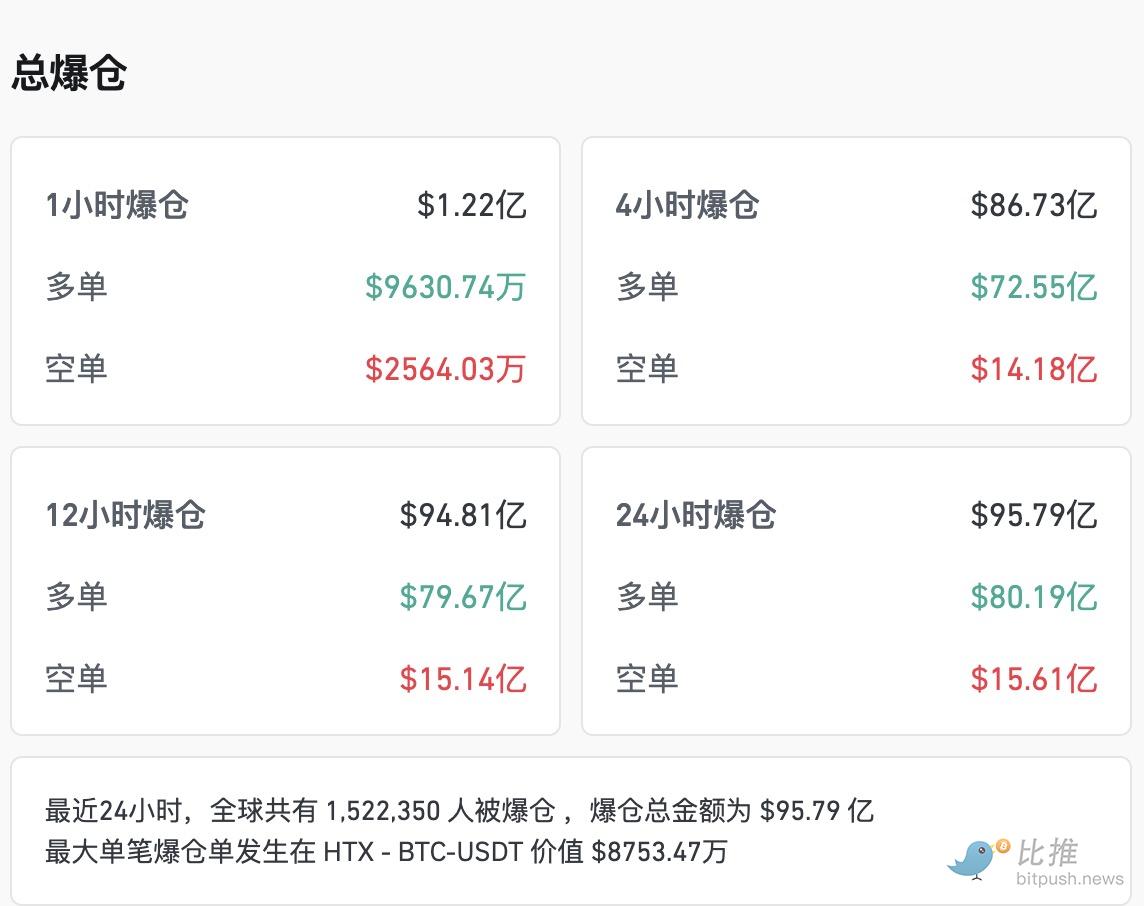
According to CoinGlass data, the amount of liquidation in the past 24 hours was nearly 10 billion US dollars, and more than 1.52 million people were liquidated.

U.S. stocks had their worst single-day performance since April: The Nasdaq Composite suffered the biggest drop, closing down 3.56%. The S&P 500 closed down 2.71%, its biggest single-day percentage drop since April 10. The Dow Jones Industrial Average closed down 1.90%.

After Wall Street closed, market panic did not subside. Technology stocks such as Nvidia, Tesla, Amazon.com and Advanced Micro Devices (AMD) all fell by more than 2% in after-hours trading.

Macro risks hit market fragility

Analysts generally believe that the market's concerns that the tit-for-tat trade frictions between the two major economies of China and the United States may evolve into a full-scale trade war, thereby stifling global economic growth, are the key to the simultaneous plunge in stocks and cryptocurrencies.

"It was a brutal day," said Ram Ahluwalia, founder of the investment firm Lumida Wealth. Trump's tariffs triggered widespread de-risking, with investors seeking safety from volatile assets closely tied to economic growth prospects, such as stocks, tech stocks, and cryptocurrencies. "Trump's news, combined with overbought conditions, led to a sharp market decline," he said.

Zaheer Ebtikar, founder and chief investment officer of crypto hedge fund Split Capital, said: "The altcoin market has completely collapsed. The altcoin market has reached its highest level in more than a year. Leverage ratios have been fully reset and the market is in chaos."

The sell-off, particularly the biggest drop in months for U.S. stocks, has reignited concerns about whether the market is due for a major downside correction. JPMorgan Chase CEO Jamie Dimon has previously warned that the risk of a major correction on Wall Street has increased within the next six months to two years.

Prior to the recent plunge, the US stock market was in the midst of a record-breaking rally, with the S&P 500 and Nasdaq hitting all-time highs on Thursday. So far this year, the Nasdaq has risen approximately 15%, while the S&P 500 has risen approximately 11%. This rally has been driven primarily by enthusiasm surrounding the artificial intelligence (AI) industry.

However, some investors believe the current trade tensions are unlikely to drastically alter the market's trajectory. For example, James St. Aubin, chief investment officer at Ocean Park Asset Management, believes that while it is a "significant issue" and could trigger a pullback, he "doesn't necessarily think it will derail the AI theme that has been driving the market."

For the cryptocurrency market, the failure of "Uptober" signifies that market sentiment has rapidly shifted from the early-month enthusiasm and expectations of record highs to a more sensitive and cautious outlook regarding macroeconomic risks. Unless the trade tensions quickly de-escalate or strong new positive news emerges, the crypto market will face challenges and may need some time to process this sudden "Red October shock."

Market Opportunity
Ethereum Logo
Ethereum Price(ETH)
$2,089.18
$2,089.18$2,089.18
+1.78%
USD
Ethereum (ETH) Live Price Chart
Disclaimer: The articles reposted on this site are sourced from public platforms and are provided for informational purposes only. They do not necessarily reflect the views of MEXC. All rights remain with the original authors. If you believe any content infringes on third-party rights, please contact service@support.mexc.com for removal. MEXC makes no guarantees regarding the accuracy, completeness, or timeliness of the content and is not responsible for any actions taken based on the information provided. The content does not constitute financial, legal, or other professional advice, nor should it be considered a recommendation or endorsement by MEXC.

You May Also Like

Galaxy Digital Authorizes $200M Share Buyback as Stock Rebounds

Galaxy Digital Authorizes $200M Share Buyback as Stock Rebounds

Galaxy Digital Holdings Ltd. announced this week that its board has authorized a $200 million share repurchase program for the company’s Class A common stock. Galaxy
Share
Coinstats2026/02/08 07:30
Kalshi debuts ecosystem hub with Solana and Base

Kalshi debuts ecosystem hub with Solana and Base

The post Kalshi debuts ecosystem hub with Solana and Base appeared on BitcoinEthereumNews.com. Kalshi, the US-regulated prediction market exchange, rolled out a new program on Wednesday called KalshiEco Hub. The initiative, developed in partnership with Solana and Coinbase-backed Base, is designed to attract builders, traders, and content creators to a growing ecosystem around prediction markets. By combining its regulatory footing with crypto-native infrastructure, Kalshi said it is aiming to become a bridge between traditional finance and onchain innovation. The hub offers grants, technical assistance, and marketing support to selected projects. Kalshi also announced that it will support native deposits of Solana’s SOL token and USDC stablecoin, making it easier for users already active in crypto to participate directly. Early collaborators include Kalshinomics, a dashboard for market analytics, and Verso, which is building professional-grade tools for market discovery and execution. Other partners, such as Caddy, are exploring ways to expand retail-facing trading experiences. Kalshi’s move to embrace blockchain partnerships comes at a time when prediction markets are drawing fresh attention for their ability to capture sentiment around elections, economic policy, and cultural events. Competitor Polymarket recently acquired QCEX — a derivatives exchange with a CFTC license — to pave its way back into US operations under regulatory compliance. At the same time, platforms like PredictIt continue to push for a clearer regulatory footing. The legal terrain remains complex, with some states issuing cease-and-desist orders over whether these event contracts count as gambling, not finance. This is a developing story. This article was generated with the assistance of AI and reviewed by editor Jeffrey Albus before publication. Get the news in your inbox. Explore Blockworks newsletters: Source: https://blockworks.co/news/kalshi-ecosystem-hub-solana-base
Share
BitcoinEthereumNews2025/09/18 04:40
First family moves on from Wall Street as Eric Trump backs crypto

First family moves on from Wall Street as Eric Trump backs crypto

Eric Trump says crypto could actually save the U.S. dollar. Not kill it. Not weaken it. On Tuesday, just hours after ringing the Nasdaq opening bell for American Bitcoin’s public debut, a company where he’s got over $500 million stashed, Eric told the Financial Times that crypto is “arguably” the reason the dollar might stay alive. “Mining bitcoin here, and being financially independent and running a kind of financial revolution out of the United States of America…I think it arguably saves the US dollar,” he said. The timing wasn’t random. Eric’s comments came while the dollar was getting dragged. This year, it’s been tanking… fast. The cause? President Donald Trump’s trade war and his endless public jabs at the Federal Reserve, which just slashed interest rates again. The Fed cut rates yesterday, for the first time this year, right after Donald’s latest round of pressure. It’s not helping. Investors are losing confidence in what’s supposed to be the safest currency on Earth. Eric says crypto is fun, family is done with Wall Street Eric isn’t just pushing crypto from the sidelines. His family has gone full throttle into the space. We’re talking a Truth Social Bitcoin ETF, a Bitcoin treasury tied to Trump Media, and two meme coins; $MELANIA and $TRUMP. Eric defended both coins, saying they were meant to be “fun,” and explained why people are buying in: “They want to bet on a coin, or they want to bet on a player. They want to bet on a celebrity, or they want to bet on a famous brand. Or they just love somebody to death, and they want to buy, you know, a kind of small piece of them, via digital currency.” And Eric doesn’t give Wall Street any credit. At all. He made it clear that everything they’ve built was done without the help of big-name banks. “It’s almost like the ultimate revenge against the big banks and modern finance,” he said. That jab came after the Trump Organization filed a lawsuit against Capital One, accusing the bank of closing their accounts in 2021 for political reasons — something the bank denies. But Eric wasn’t done. “You realise you just don’t need them. And frankly, you don’t miss them.” He added that he wasn’t just referring to Capital One, but “all” of Wall Street’s major lenders and their “top people.” Stablecoins, trillions, and the White House betting on crypto Stablecoins have traditional banks spooked. They think cash might flow out of the banking system if coins like Tether or Circle offer better returns. And that fear isn’t fake. It’s growing, especially after Congress passed the first major crypto law in July. Now the White House wants stablecoin issuers to buy up a fat slice of the Treasury’s debt. Why? Because these crypto firms make money on the interest from the bonds they hold. Last year, Eric co-founded World Liberty Financial Inc. (WLFI), a crypto company that runs a stablecoin called USD1, pegged to the U.S. dollar. That project has serious family backing. Donald held 15.75 billion WLFI tokens at the end of 2024, based on official filings. At Wednesday’s trading price, that holding was worth over $3 billion. When asked about the family’s financial gain from crypto, Eric downplayed it. “If my father cared about monetising his life, the last thing he would have done is run for president, where all we’ve done is un-monetise our life.” Your crypto news deserves attention - KEY Difference Wire puts you on 250+ top sites
Share
Coinstats2025/09/18 20:41