Institutional investors expect tokenized assets to take up a much larger role in global portfolios by the end of the decade, with private markets seen as the first to shift. A State Street study published Thursday projects that by 2030, between 10% and 24% of institutional investments could be made through tokenized instruments. Private equity and private fixed income are viewed as the most likely early candidates for tokenization. These markets have long struggled with illiquidity and high operational costs, making them prime targets for digital instruments designed to boost efficiency and unlock liquidity. “The acceleration in adoption of emerging technologies is remarkable. Institutional investors are moving beyond experimentation, and digital assets are now a strategic lever for growth, efficiency, and innovation,” said Joerg Ambrosius, president of Investment Services at State Street. He added that tokenization, artificial intelligence and quantum computing are converging to reshape the future of finance, with early adopters leading the charge. Digital Assets Average 7% of Portfolios, Set to More Than Double in Three Years The research also shows that while tokenization is gaining traction, many investors believe other technologies will have an even greater impact on operations. More than half of respondents pointed to generative AI and quantum computing as more transformative than blockchain, though they see the technologies working in tandem. Currently, institutional portfolios hold an average of 7% in digital assets, according to the study. That figure is expected to rise to 16% within three years. The most common forms are digital cash, along with tokenized versions of listed equities and fixed income. On average, respondents hold 1% of their portfolios in each of these categories. Asset Managers Outpace Owners in Bitcoin, Ethereum and Tokenized Assets Asset managers reported higher exposure than asset owners across nearly every category. 14% of managers said they held 2% to 5% of portfolios in Bitcoin, compared with 7% of asset owners. A small share of managers also admitted to having at least 5% of assets in Ethereum, meme coins or NFTs, pointing to the broader range of risk appetite. Tokenization of real-world assets is another area where managers are ahead. They reported greater exposure to tokenized public assets, tokenized private assets and digital cash than asset owners. Even so, cryptocurrencies remain the biggest driver of returns within digital portfolios. 27% of respondents said Bitcoin is their strongest performer today. A quarter also expect it to remain the top performer in three years. Meanwhile, Ethereum ranked second. 21% cited it as their biggest return generator now, and 22% expect that trend to continue. By contrast, only 13% said tokenized public assets drive most of their digital returns. Just 10% pointed to private assets. These figures are expected to remain mostly unchanged over the next three years. State Street Finds Confidence Growing That Tokenization Trend Is Durable State Street’s study suggests that private assets could be the first major beneficiaries of tokenization. This would likely happen once infrastructure improves and investor confidence matures. Moreover, institutions broadly expect digital assets to become mainstream within a decade. This reflects growing acceptance that the shift is structural rather than cyclical. The findings add weight to the view that tokenization could transform capital markets. By digitizing ownership of assets such as real estate and private credit, institutions could cut settlement times, reduce costs, and expand access to investors who were previously excluded from private marketsInstitutional investors expect tokenized assets to take up a much larger role in global portfolios by the end of the decade, with private markets seen as the first to shift. A State Street study published Thursday projects that by 2030, between 10% and 24% of institutional investments could be made through tokenized instruments. Private equity and private fixed income are viewed as the most likely early candidates for tokenization. These markets have long struggled with illiquidity and high operational costs, making them prime targets for digital instruments designed to boost efficiency and unlock liquidity. “The acceleration in adoption of emerging technologies is remarkable. Institutional investors are moving beyond experimentation, and digital assets are now a strategic lever for growth, efficiency, and innovation,” said Joerg Ambrosius, president of Investment Services at State Street. He added that tokenization, artificial intelligence and quantum computing are converging to reshape the future of finance, with early adopters leading the charge. Digital Assets Average 7% of Portfolios, Set to More Than Double in Three Years The research also shows that while tokenization is gaining traction, many investors believe other technologies will have an even greater impact on operations. More than half of respondents pointed to generative AI and quantum computing as more transformative than blockchain, though they see the technologies working in tandem. Currently, institutional portfolios hold an average of 7% in digital assets, according to the study. That figure is expected to rise to 16% within three years. The most common forms are digital cash, along with tokenized versions of listed equities and fixed income. On average, respondents hold 1% of their portfolios in each of these categories. Asset Managers Outpace Owners in Bitcoin, Ethereum and Tokenized Assets Asset managers reported higher exposure than asset owners across nearly every category. 14% of managers said they held 2% to 5% of portfolios in Bitcoin, compared with 7% of asset owners. A small share of managers also admitted to having at least 5% of assets in Ethereum, meme coins or NFTs, pointing to the broader range of risk appetite. Tokenization of real-world assets is another area where managers are ahead. They reported greater exposure to tokenized public assets, tokenized private assets and digital cash than asset owners. Even so, cryptocurrencies remain the biggest driver of returns within digital portfolios. 27% of respondents said Bitcoin is their strongest performer today. A quarter also expect it to remain the top performer in three years. Meanwhile, Ethereum ranked second. 21% cited it as their biggest return generator now, and 22% expect that trend to continue. By contrast, only 13% said tokenized public assets drive most of their digital returns. Just 10% pointed to private assets. These figures are expected to remain mostly unchanged over the next three years. State Street Finds Confidence Growing That Tokenization Trend Is Durable State Street’s study suggests that private assets could be the first major beneficiaries of tokenization. This would likely happen once infrastructure improves and investor confidence matures. Moreover, institutions broadly expect digital assets to become mainstream within a decade. This reflects growing acceptance that the shift is structural rather than cyclical. The findings add weight to the view that tokenization could transform capital markets. By digitizing ownership of assets such as real estate and private credit, institutions could cut settlement times, reduce costs, and expand access to investors who were previously excluded from private markets

Tokenized Assets Could Form Up to a Quarter of Portfolios By 2030: State Street

2025/10/10 13:21
3 min read

Institutional investors expect tokenized assets to take up a much larger role in global portfolios by the end of the decade, with private markets seen as the first to shift.

A State Street study published Thursday projects that by 2030, between 10% and 24% of institutional investments could be made through tokenized instruments.

Private equity and private fixed income are viewed as the most likely early candidates for tokenization. These markets have long struggled with illiquidity and high operational costs, making them prime targets for digital instruments designed to boost efficiency and unlock liquidity.

“The acceleration in adoption of emerging technologies is remarkable. Institutional investors are moving beyond experimentation, and digital assets are now a strategic lever for growth, efficiency, and innovation,” said Joerg Ambrosius, president of Investment Services at State Street.

He added that tokenization, artificial intelligence and quantum computing are converging to reshape the future of finance, with early adopters leading the charge.

Digital Assets Average 7% of Portfolios, Set to More Than Double in Three Years

The research also shows that while tokenization is gaining traction, many investors believe other technologies will have an even greater impact on operations.

More than half of respondents pointed to generative AI and quantum computing as more transformative than blockchain, though they see the technologies working in tandem.

Currently, institutional portfolios hold an average of 7% in digital assets, according to the study. That figure is expected to rise to 16% within three years. The most common forms are digital cash, along with tokenized versions of listed equities and fixed income. On average, respondents hold 1% of their portfolios in each of these categories.
Asset Managers Outpace Owners in Bitcoin, Ethereum and Tokenized Assets

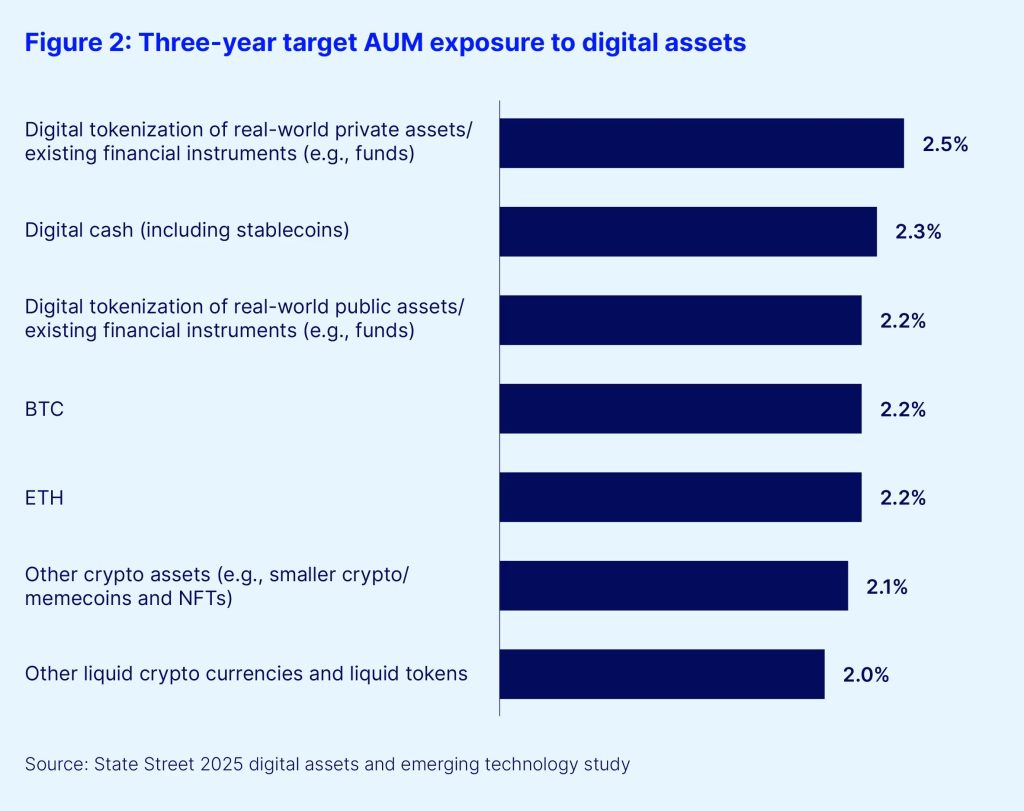
Asset managers reported higher exposure than asset owners across nearly every category. 14% of managers said they held 2% to 5% of portfolios in Bitcoin, compared with 7% of asset owners. A small share of managers also admitted to having at least 5% of assets in Ethereum, meme coins or NFTs, pointing to the broader range of risk appetite.

Tokenization of real-world assets is another area where managers are ahead. They reported greater exposure to tokenized public assets, tokenized private assets and digital cash than asset owners.

Even so, cryptocurrencies remain the biggest driver of returns within digital portfolios.

27% of respondents said Bitcoin is their strongest performer today. A quarter also expect it to remain the top performer in three years.

Meanwhile, Ethereum ranked second. 21% cited it as their biggest return generator now, and 22% expect that trend to continue.

By contrast, only 13% said tokenized public assets drive most of their digital returns. Just 10% pointed to private assets. These figures are expected to remain mostly unchanged over the next three years.

State Street Finds Confidence Growing That Tokenization Trend Is Durable

State Street’s study suggests that private assets could be the first major beneficiaries of tokenization. This would likely happen once infrastructure improves and investor confidence matures.

Moreover, institutions broadly expect digital assets to become mainstream within a decade. This reflects growing acceptance that the shift is structural rather than cyclical.

The findings add weight to the view that tokenization could transform capital markets. By digitizing ownership of assets such as real estate and private credit, institutions could cut settlement times, reduce costs, and expand access to investors who were previously excluded from private markets.

Market Opportunity
FORM Logo
FORM Price(FORM)
$0.2222
$0.2222$0.2222
+1.87%
USD
FORM (FORM) Live Price Chart
Disclaimer: The articles reposted on this site are sourced from public platforms and are provided for informational purposes only. They do not necessarily reflect the views of MEXC. All rights remain with the original authors. If you believe any content infringes on third-party rights, please contact service@support.mexc.com for removal. MEXC makes no guarantees regarding the accuracy, completeness, or timeliness of the content and is not responsible for any actions taken based on the information provided. The content does not constitute financial, legal, or other professional advice, nor should it be considered a recommendation or endorsement by MEXC.

You May Also Like

XRP price prediction as Standard Chartered cuts 2026 target

XRP price prediction as Standard Chartered cuts 2026 target

The post XRP price prediction as Standard Chartered cuts 2026 target appeared on BitcoinEthereumNews.com. XRP price shows mild signs of recovery even as Standard
Share
BitcoinEthereumNews2026/02/17 14:41
This U.S. politician’s suspicious stock trade just returned over 200% in weeks

This U.S. politician’s suspicious stock trade just returned over 200% in weeks

The post This U.S. politician’s suspicious stock trade just returned over 200% in weeks appeared on BitcoinEthereumNews.com. United States Representative Cloe Fields has seen his stake in Opendoor Technologies (NASDAQ: OPEN) stock return over 200% in just a matter of weeks. According to congressional trade filings, the lawmaker purchased a stake in the online real estate company on July 21, 2025, investing between $1,001 and $15,000. At the time, the stock was trading around $2 and had been largely stagnant for months. Receive Signals on US Congress Members’ Stock Trades Stocks Stay up-to-date on the trading activity of US Congress members. The signal triggers based on updates from the House disclosure reports, notifying you of their latest stock transactions. Enable signal The trade has since paid off, with Opendoor surging to $10, a gain of nearly 220% in under two months. By comparison, the broader S&P 500 index rose less than 5% during the same period. OPEN one-week stock price chart. Source: Finbold Assuming he invested a minimum of $1,001, the purchase would now be worth about $3,200, while a $15,000 stake would have grown to nearly $48,000, generating profits of roughly $2,200 and $33,000, respectively. OPEN’s stock rally Notably, Opendoor’s rally has been fueled by major corporate shifts and market speculation. For instance, in August, the company named former Shopify COO Kaz Nejatian as CEO, while co-founders Keith Rabois and Eric Wu rejoined the board, moves seen as a return to the company’s early innovative spirit.  Outgoing CEO Carrie Wheeler’s resignation and sale of millions in stock reinforced the sense of a new chapter. Beyond leadership changes, Opendoor’s surge has taken on meme-stock characteristics. In this case, retail investors piled in as shares climbed, while short sellers scrambled to cover, pushing prices higher.  However, the stock is still not without challenges, where its iBuying model is untested at scale, margins are thin, and debt tied to…
Share
BitcoinEthereumNews2025/09/18 04:02
Pi Network v19–v23 Upgrade: From Experimental Nodes to Enterprise-Ready Infrastructure

Pi Network v19–v23 Upgrade: From Experimental Nodes to Enterprise-Ready Infrastructure

   Pi Network is undergoing a significant transformation with its ongoing v19–v23 upgrade, signaling a shift from a closed exper
Share
Hokanews2026/02/17 14:05