The post What can we build on massively scalable blockchains? appeared on BitcoinEthereumNews.com. Homepage > News > Business > What can we build on massively scalable blockchains? With the BSV Teranode upgrade rolling out, massively scalable blockchain technology is finally here. Teranode can process 1 million transactions per second with fees of fractions of a cent—enough to process all of Visa’s (NASDAQ: V) annual transactions in just 59 hours. With this in mind, let’s look at what we can finally build in the era of scalable blockchain technology. A new internet While specific applications are interesting, let’s take a step back and focus on the bigger picture. The BSV blockchain enables us to rearchitect the internet into a pay-per-packet model. Rather than everyone paying a fixed monthly fee regardless of how much data they use, we can now charge micro cents per MB or KB. Slowly, we’d replace ISPs with metered peer-to-peer mesh networks. Micropayments at scale will allow us to create an ad-free web, too. Publishers will get paid fractions of a cent per page load, image, or video watched. This eliminates ad networks, allowing creators to receive payment instantly with electronic cash. Machine-to-machine commerce also becomes a real possibility. Every API call could cost fractions of a cent, allowing OpenAI, Google (NASDAQ: GOOGL), Microsoft (NASDAQ: MSFT), and all software developers to charge per action rather than rely on subscriptions. Next-generation content economy The last section touched on this, but it’s worth expanding on. The creator economy is broken—with everyone relying on centralized middlemen who control the flow of funds—and scalable, peer-to-peer blockchains can fix that. Micro and nanopayments allow us to stream payments for media. For example, musicians, journalists, and artists can get paid per second of streamed content. Payments can even be split in real-time, with distribution platforms getting a cut of the action. Aside from charging per interaction, creators… The post What can we build on massively scalable blockchains? appeared on BitcoinEthereumNews.com. Homepage > News > Business > What can we build on massively scalable blockchains? With the BSV Teranode upgrade rolling out, massively scalable blockchain technology is finally here. Teranode can process 1 million transactions per second with fees of fractions of a cent—enough to process all of Visa’s (NASDAQ: V) annual transactions in just 59 hours. With this in mind, let’s look at what we can finally build in the era of scalable blockchain technology. A new internet While specific applications are interesting, let’s take a step back and focus on the bigger picture. The BSV blockchain enables us to rearchitect the internet into a pay-per-packet model. Rather than everyone paying a fixed monthly fee regardless of how much data they use, we can now charge micro cents per MB or KB. Slowly, we’d replace ISPs with metered peer-to-peer mesh networks. Micropayments at scale will allow us to create an ad-free web, too. Publishers will get paid fractions of a cent per page load, image, or video watched. This eliminates ad networks, allowing creators to receive payment instantly with electronic cash. Machine-to-machine commerce also becomes a real possibility. Every API call could cost fractions of a cent, allowing OpenAI, Google (NASDAQ: GOOGL), Microsoft (NASDAQ: MSFT), and all software developers to charge per action rather than rely on subscriptions. Next-generation content economy The last section touched on this, but it’s worth expanding on. The creator economy is broken—with everyone relying on centralized middlemen who control the flow of funds—and scalable, peer-to-peer blockchains can fix that. Micro and nanopayments allow us to stream payments for media. For example, musicians, journalists, and artists can get paid per second of streamed content. Payments can even be split in real-time, with distribution platforms getting a cut of the action. Aside from charging per interaction, creators…

What can we build on massively scalable blockchains?

With the BSV Teranode upgrade rolling out, massively scalable blockchain technology is finally here.

Teranode can process 1 million transactions per second with fees of fractions of a cent—enough to process all of Visa’s (NASDAQ: V) annual transactions in just 59 hours.

With this in mind, let’s look at what we can finally build in the era of scalable blockchain technology.

A new internet

While specific applications are interesting, let’s take a step back and focus on the bigger picture. The BSV blockchain enables us to rearchitect the internet into a pay-per-packet model.

Rather than everyone paying a fixed monthly fee regardless of how much data they use, we can now charge micro cents per MB or KB. Slowly, we’d replace ISPs with metered peer-to-peer mesh networks.

Micropayments at scale will allow us to create an ad-free web, too. Publishers will get paid fractions of a cent per page load, image, or video watched. This eliminates ad networks, allowing creators to receive payment instantly with electronic cash.

Machine-to-machine commerce also becomes a real possibility. Every API call could cost fractions of a cent, allowing OpenAI, Google (NASDAQ: GOOGL), Microsoft (NASDAQ: MSFT), and all software developers to charge per action rather than rely on subscriptions.

Next-generation content economy

The last section touched on this, but it’s worth expanding on. The creator economy is broken—with everyone relying on centralized middlemen who control the flow of funds—and scalable, peer-to-peer blockchains can fix that.

Micro and nanopayments allow us to stream payments for media. For example, musicians, journalists, and artists can get paid per second of streamed content. Payments can even be split in real-time, with distribution platforms getting a cut of the action.

Aside from charging per interaction, creators can also get tipped with micropayments. Imagine paying $0.03 every time you post on X or Facebook and then receiving $0.01 for every like, and $0.02 for every share or comment. This is a way for fans and followers to show support for their favorite artists and creators while disincentivizing bot activity.

Micropayments can also empower creators to protect their content from artificial intelligence (AI) models that train on it without their consent. If each piece of content has a digital license attached that requires payment to load or use, then firms like OpenAI will, at the very least, have to pay artists to use their work for model training.

Back to the top ↑

A new financial system

Part of the genius of Satoshi Nakamoto’s original design was that he simultaneously enhanced both transparency and privacy. Public blockchains maintain time-stamped public records of each transaction, but neither the sender nor the receiver is revealed.

A financial system where tokenized stocks, bonds, and even commodities can be transferred directly or via on-chain smart contracts would be revolutionary. It would leave immutable records of transfers and provide clear, undisputable evidence of what happened, when, and which addresses were involved should disputes arise around custody and ownership.

Yet, tokenization and peer-to-peer transfers are only part of the picture. Salaries could be paid every day, minute, or second. Purchases could round up to the nearest cent and be invested or donated to charity immediately, with on-chain records to prove it. Even insurance could be paid on a per-use basis.

While there’s still a long way to go, we’re already seeing major players like BlackRock (NASDAQ: BLK), Citi (NASDAQ: C), and the BIS experimenting with scalable digital ledgers.

Back to the top ↑

Gaming and virtual economies

CoinGeek has extensively covered play-to-earn gaming models. This model can empower independent studios, give players and developers new ways to earn, and reintroduce ownership into gaming.

For example, let’s take a hypothetical multiplayer war game. Imagine that each bullet fired costs $0.001, each kill nets players $0.010 from the opposing team’s balance, and in-game items like skins and weapons could have real monetary value on gaming-focused NFT markets.

This can go a lot further with micro-bounties, spectator-driven rewards (think Twitch overlays with tipping), eSports micro-tournaments, and leaderboards with payouts to each position when players fail to beat their best score.

These ideas aren’t just pipe dreams—Haste Arcade has shown that Instant Leaderboard Payouts are possible, and games like Axie Infinity have demonstrated the significant appetite for blockchain-powered games.

Back to the top ↑

The technology has finally caught up with the dreams

Over the past decade, numerous attempts have been made to develop applications based on the above ideas and others.

That said, blockchains like Ethereum and Solana haven’t scaled big enough to make any of this possible. Every time a large wave of enthusiasm for some blockchain concept or idea emerges, the technology hits a wall, and more people become convinced that blockchain tech is hopeless.

However, that’s all about to change. The original Bitcoin protocol has been restored and scaled to one million transactions per second. Teranode separates node functions into microservices, allowing for horizontal scaling with no hypothetical limits. Bitcoin scales on-chain, just like Satoshi said it did.

With this puzzle piece in place, and with stablecoins like MNEE enabling micropayments denominated in USD alongside smart-contracting languages like sCrypt making many different transaction types possible, entrepreneurs and developers can finally build a blockchain-powered world without limits.

For more information on BSV and the tools and tutorials available for developers, visit bsvassociation.org.

Back to the top ↑

Watch: Unbounded Capital Summit teaches value of scalable blockchain

title=”YouTube video player” frameborder=”0″ allow=”accelerometer; autoplay; clipboard-write; encrypted-media; gyroscope; picture-in-picture; web-share” referrerpolicy=”strict-origin-when-cross-origin” allowfullscreen=””>

Source: https://coingeek.com/what-can-we-build-on-massively-scalable-blockchains/
Market Opportunity
BitcoinSV Logo
BitcoinSV Price(BSV)
$17,07
$17,07$17,07
+0,53%
USD
BitcoinSV (BSV) Live Price Chart
Disclaimer: The articles reposted on this site are sourced from public platforms and are provided for informational purposes only. They do not necessarily reflect the views of MEXC. All rights remain with the original authors. If you believe any content infringes on third-party rights, please contact service@support.mexc.com for removal. MEXC makes no guarantees regarding the accuracy, completeness, or timeliness of the content and is not responsible for any actions taken based on the information provided. The content does not constitute financial, legal, or other professional advice, nor should it be considered a recommendation or endorsement by MEXC.

You May Also Like

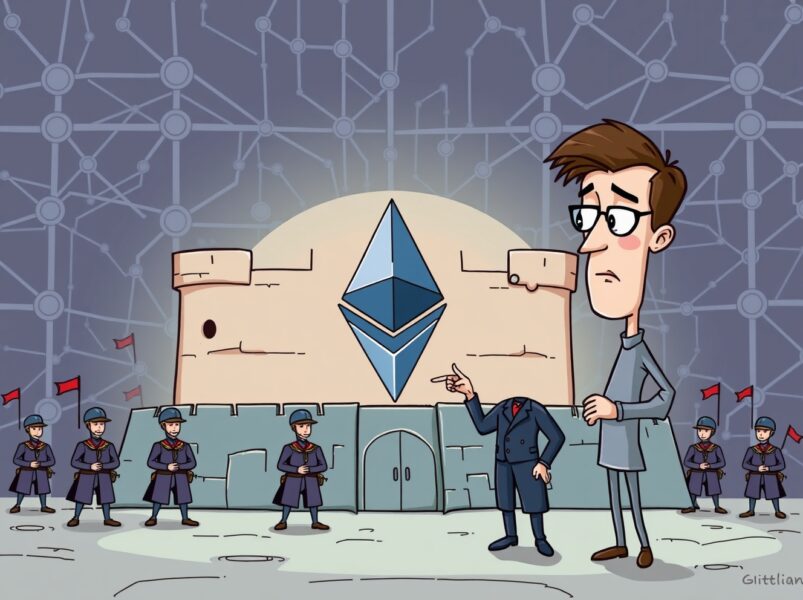
Crucial ETH Unstaking Period: Vitalik Buterin’s Unwavering Defense for Network Security

Crucial ETH Unstaking Period: Vitalik Buterin’s Unwavering Defense for Network Security

BitcoinWorld Crucial ETH Unstaking Period: Vitalik Buterin’s Unwavering Defense for Network Security Ever wondered why withdrawing your staked Ethereum (ETH) isn’t an instant process? It’s a question that often sparks debate within the crypto community. Ethereum founder Vitalik Buterin recently stepped forward to defend the network’s approximately 45-day ETH unstaking period, asserting its crucial role in safeguarding the network’s integrity. This lengthy waiting time, while sometimes seen as an inconvenience, is a deliberate design choice with profound implications for security. Why is the ETH Unstaking Period a Vital Security Measure? Vitalik Buterin’s defense comes amidst comparisons to other networks, like Solana, which boast significantly shorter unstaking times. He drew a compelling parallel to military operations, explaining that an army cannot function effectively if its soldiers can simply abandon their posts at a moment’s notice. Similarly, a blockchain network requires a stable and committed validator set to maintain its security. The current ETH unstaking period isn’t merely an arbitrary delay. It acts as a critical buffer, providing the network with sufficient time to detect and respond to potential malicious activities. If validators could instantly exit, it would open doors for sophisticated attacks, jeopardizing the entire system. Currently, Ethereum boasts over one million active validators, collectively staking approximately 35.6 million ETH, representing about 30% of the total supply. This massive commitment underpins the network’s robust security model, and the unstaking period helps preserve this stability. Network Security: Ethereum’s Paramount Concern A shorter ETH unstaking period might seem appealing for liquidity, but it introduces significant risks. Imagine a scenario where a large number of validators, potentially colluding, could quickly withdraw their stake after committing a malicious act. Without a substantial delay, the network would have limited time to penalize them or mitigate the damage. This “exit queue” mechanism is designed to prevent sudden validator exodus, which could lead to: Reduced decentralization: A rapid drop in active validators could concentrate power among fewer participants. Increased vulnerability to attacks: A smaller, less stable validator set is easier to compromise. Network instability: Frequent and unpredictable changes in validator numbers can lead to performance issues and consensus failures. Therefore, the extended period is not a bug; it’s a feature. It’s a calculated trade-off between immediate liquidity for stakers and the foundational security of the entire Ethereum ecosystem. Ethereum vs. Solana: Different Approaches to Unstaking When discussing the ETH unstaking period, many point to networks like Solana, which offers a much quicker two-day unstaking process. While this might seem like an advantage for stakers seeking rapid access to their funds, it reflects fundamental differences in network architecture and security philosophies. Solana’s design prioritizes speed and immediate liquidity, often relying on different consensus mechanisms and validator economics to manage security risks. Ethereum, on the other hand, with its proof-of-stake evolution from proof-of-work, has adopted a more cautious approach to ensure its transition and long-term stability are uncompromised. Each network makes design choices based on its unique goals and threat models. Ethereum’s substantial value and its role as a foundational layer for countless dApps necessitate an extremely robust security posture, making the current unstaking duration a deliberate and necessary component. What Does the ETH Unstaking Period Mean for Stakers? For individuals and institutions staking ETH, understanding the ETH unstaking period is crucial for managing expectations and investment strategies. It means that while staking offers attractive rewards, it also comes with a commitment to the network’s long-term health. Here are key considerations for stakers: Liquidity Planning: Stakers should view their staked ETH as a longer-term commitment, not immediately liquid capital. Risk Management: The delay inherently reduces the ability to react quickly to market volatility with staked assets. Network Contribution: By participating, stakers contribute directly to the security and decentralization of Ethereum, reinforcing its value proposition. While the current waiting period may not be “optimal” in every sense, as Buterin acknowledged, simply shortening it without addressing the underlying security implications would be a dangerous gamble for the network’s reliability. In conclusion, Vitalik Buterin’s defense of the lengthy ETH unstaking period underscores a fundamental principle: network security cannot be compromised for the sake of convenience. It is a vital mechanism that protects Ethereum’s integrity, ensuring its stability and trustworthiness as a leading blockchain platform. This deliberate design choice, while requiring patience from stakers, ultimately fortifies the entire ecosystem against potential threats, paving the way for a more secure and reliable decentralized future. Frequently Asked Questions (FAQs) Q1: What is the main reason for Ethereum’s long unstaking period? A1: The primary reason is network security. A lengthy ETH unstaking period prevents malicious actors from quickly withdrawing their stake after an attack, giving the network time to detect and penalize them, thus maintaining stability and integrity. Q2: How long is the current ETH unstaking period? A2: The current ETH unstaking period is approximately 45 days. This duration can fluctuate based on network conditions and the number of validators in the exit queue. Q3: How does Ethereum’s unstaking period compare to other blockchains? A3: Ethereum’s unstaking period is notably longer than some other networks, such as Solana, which has a two-day period. This difference reflects varying network architectures and security priorities. Q4: Does the unstaking period affect ETH stakers? A4: Yes, it means stakers need to plan their liquidity carefully, as their staked ETH is not immediately accessible. It encourages a longer-term commitment to the network, aligning staker interests with Ethereum’s stability. Q5: Could the ETH unstaking period be shortened in the future? A5: While Vitalik Buterin acknowledged the current period might not be “optimal,” any significant shortening would likely require extensive research and network upgrades to ensure security isn’t compromised. For now, the focus remains on maintaining robust network defenses. Found this article insightful? Share it with your friends and fellow crypto enthusiasts on social media to spread awareness about the critical role of the ETH unstaking period in Ethereum’s security! To learn more about the latest Ethereum trends, explore our article on key developments shaping Ethereum’s institutional adoption. This post Crucial ETH Unstaking Period: Vitalik Buterin’s Unwavering Defense for Network Security first appeared on BitcoinWorld.
Share
Coinstats2025/09/18 15:30
XRP holders hit new high, but THIS keeps pressure on price

XRP holders hit new high, but THIS keeps pressure on price

The post XRP holders hit new high, but THIS keeps pressure on price appeared on BitcoinEthereumNews.com. Ripple [XRP] remains one of the top five cryptocurrencies
Share
BitcoinEthereumNews2026/02/17 08:49
Will Bitcoin Price Drop to $50,000 by March 2026?

Will Bitcoin Price Drop to $50,000 by March 2026?

The post Will Bitcoin Price Drop to $50,000 by March 2026? appeared on BitcoinEthereumNews.com. Bitcoin is trading around $68,700, down nearly 22% year to date
Share
BitcoinEthereumNews2026/02/17 08:59