Tech startups rarely fail because of markets alone. The biggest risk is the founder. Buzzwords fade, but leadership blind spots like conflict, perfectionism, bottlenecks, and bad hires kill growth. The real question is whether you should be CEO at all.Tech startups rarely fail because of markets alone. The biggest risk is the founder. Buzzwords fade, but leadership blind spots like conflict, perfectionism, bottlenecks, and bad hires kill growth. The real question is whether you should be CEO at all.

The Founder Risk: Why CEOS, Not Markets, Can Make or Break Tech Startups

2025/10/05 01:05
6 min read

Ninety percent of startups fail. The statistic is as familiar as it is grim, but the more revealing number is buried beneath it. Research shows that 65 percent of high-potential startup failures are driven by founder conflict (Wasserman, 2012). Not markets. Not regulators. Not competitors. Founders.

That reality is easy to overlook in a world where investors chase the next hot sector. Analysts pour over market timing, valuations, and technology cycles. Entrepreneurs fill their pitch decks with jargon that signals relevance. But history makes one thing clear: hype cycles change, human blind spots don’t. The biggest macro risk in tech startups is the founder/CEO.

\

From Whitepapers to Revenue: Why Validation Matters More Than Hype

Every cycle has its vocabulary. In 2017, it was ICOs and tokenomics. In 2021, it was NFTs. Today it is AI agents and bitcoin treasuries, often dropped into investor decks with surgical precision. The words may change, but the pattern is the same. Founders reach for jargon to sell potential instead of proving demand.

That worked when capital was cheap and investors tolerated risk with little evidence. You could raise millions on a whitepaper that contained more promises than product. That era is over. Today, investors want proof of demand, roadmaps to revenue, and customers that actually exist. According to CB Insights, 42 percent of startups fail because of “no market need.” That is not a technical failure. That is leadership failing to validate before building.

\

Cofounder Conflict: the Silent Tech Startup Killer

Once founders think they have product-market fit, the next step is usually building a team. Often that means bringing in cofounders. The logic seems sound: shared burden, complementary skills, investor confidence. In practice, it is often a ticking time bomb.

Sixty-five percent of high-potential failures are tied to founder conflict. Equal splits that feel fair in the beginning quickly become unequal when contributions diverge. One founder leaves a secure job to work 80-hour weeks. Another keeps their day job and contributes part-time or in some cases, not at all. The equity split stays the same, resentment festers, and investors quietly walk away when they sense dysfunction.

The mistake is not simply choosing the wrong partner. It is the lack of discipline around how equity is structured, how authority is delegated, and how conflict is managed. Founders treat cofounder selection like a second date marriage proposal, except with millions of dollars on the line and far fewer protections.

\

Perfection vs. Progress: A Common Founder Blind Spot

Suppose you avoid cofounder drama. The next trap is perfectionism. Founders delay launches, polish features, and rewrite code in search of a flawless product. The problem is the market does not wait.

McKinsey has found that startups which ship early and iterate are three times more likely to survive past Series A. Yet many founders stall, building products that nobody asked for. Time, money, and energy are spent chasing an ideal that customers may not even value. Meanwhile, runway evaporates.

The most dangerous part of perfectionism is not the delay itself. It is the culture it creates. Teams become afraid of failure. Feedback loops dry up. Innovation slows. A startup designed to move fast becomes paralyzed by its own expectations.

\

Delegation Bottlenecks: When the Founder is the Choke Point (Micromanager)

Even when founders do ship and grow, the habits that worked in the early days become liabilities. What worked at ten employees fails at fifty. Founders who once knew every customer by name now insist on approving every decision. The result is bottlenecked leadership.

Context switching drains hours. Decisions slow. Teams wait for approvals instead of building. The founder becomes the choke point. Ironically, the refusal to delegate often creates exactly the drop in quality the founder was trying to avoid.

Scaling requires a shift from player to coach. Without that evolution, the company does not scale. It stalls.

\

The Talent Risk: Why One Bad Hire Can Derail a Startup

Hiring feels urgent in the early days. Founders often pull in friends, acquaintances, or the most affordable option to move fast. But the wrong hire at the wrong time can shape culture in ways that are almost impossible to undo.

Harvard Business Review has estimated that as much as 80 percent of employee turnover is tied to bad hiring decisions. SHRM, the Society for Human Resource Management, has highlighted the financial toll, noting that a single bad hire can cost up to six to nine months of that employee’s salary. Beyond cost, 41 percent of employers told SHRM that a poor hire damages team morale and productivity.

In a small startup, those ripple effects hit harder. A single mismatch can create communication breakdowns, stall execution, or embed cultural habits that persist long after the person is gone. Unlike large companies, startups cannot absorb that impact. Early hires don’t just fill roles; they define what the company becomes. And conversely, if you are a bad boss yourself, even the best hires will not be able to save it.

\

Why This Matters Now

Capital markets have shifted. Carta data shows that by Series B, founding teams on average retain only about 23 percent ownership. Control is diluted and investors are less forgiving. The era of raising money on vision alone has ended. Roadmaps must point to revenue, not just narrative. Leadership is now under more scrutiny than ever.

This makes founder risk harder to hide. Buzzwords may still get a first meeting, but they no longer close rounds. If “AI agents” and “bitcoin treasuries” are the only strategy slides, that’s not innovation, it’s decoration. Unless those phrases come with proof of early customers and real execution, they read as filler. Founders who cling to the habits of earlier cycles are being exposed faster, and with far fewer second chances.

Are You the Right Person to Be CEO?

Which leads to the most difficult question for any founder: are you truly the best person to lead your company? Not every visionary is built for the CEO seat. Some founders thrive as product visionaries or CTOs. Others are more effective as board members who set direction and let seasoned operators execute.

Leadership is not a birthright that comes with founding equity. It is a skillset that requires humility, emotional intelligence, and the ability to build systems that scale without you. The smartest founders know when to evolve and when to step aside.

The Founder Risk That Never Goes Away

Markets will rise and fall. Buzzwords will come and go. But the founder remains the constant. The delusion is believing the greatest risk is external when the evidence shows the greatest risk is internal.

The founder risk is not just a factor. It is the factor. Ignore it, and no amount of market opportunity, capital, or timing will save you. Because in the end, the only thing harder to pivot than a failing product is a failing founder.

\

Market Opportunity
Notcoin Logo
Notcoin Price(NOT)
$0.0004083
$0.0004083$0.0004083
+0.51%
USD
Notcoin (NOT) Live Price Chart
Disclaimer: The articles reposted on this site are sourced from public platforms and are provided for informational purposes only. They do not necessarily reflect the views of MEXC. All rights remain with the original authors. If you believe any content infringes on third-party rights, please contact service@support.mexc.com for removal. MEXC makes no guarantees regarding the accuracy, completeness, or timeliness of the content and is not responsible for any actions taken based on the information provided. The content does not constitute financial, legal, or other professional advice, nor should it be considered a recommendation or endorsement by MEXC.

You May Also Like

Bitcoin Hyper Not Far from $20M, Whales Keep Buying: See What This $BTC Layer-2 Plans
Bitcoin Hyper Not Far from $20M, Whales Keep Buying: See What This $BTC Layer-2 Plans

To the uninitiated, Bitcoin and crypto are synonymous – and it’s only fair, given that the granddaddy of all crypto has been the face of the industry ever since it burst onto the scene a few years back. Since 2020, Bitcoin has generated over 1,500% in returns. Basically, crypto is so much about Bitcoin. All […]
Share
Bitcoinist2025/09/22 16:37
ECB-president hernieuwt aanval op Bitcoin terwijl euro daalt

ECB-president hernieuwt aanval op Bitcoin terwijl euro daalt

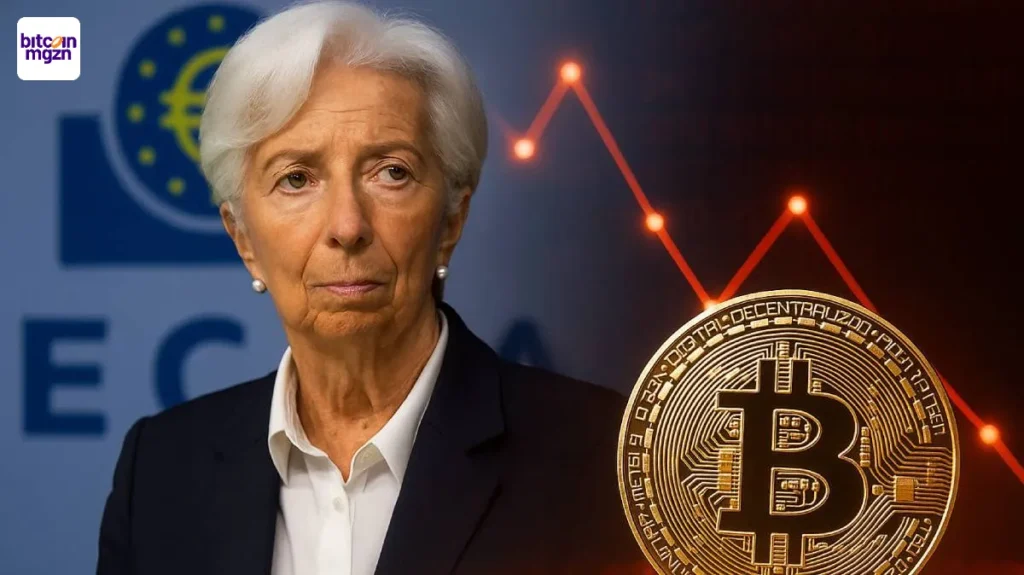
Snelle crypto updates? Connect op Instagram! Check onze Instagram   ECB-president Christine Lagarde noemt Bitcoin waardeloos en waarschuwt voor zijn speculatieve aard. Haar uitspraken komen op een moment dat DeFi groeit en de euro onder druk staat, wat de discussie over geld en controle opnieuw tot leven brengt. ECB houdt vast aan kritiek op Bitcoin en DeFi De Europese Centrale Bank (ECB) blijft vasthouden aan haar scherpe toon over Bitcoin. Volgens president Christine Lagarde ontbreekt de munt het fundament dat echt geld kenmerkt. Ze noemt het een speculatief middel zonder onderliggende waarde, en benadrukt dat de ECB het publieke vertrouwen in geld moet beschermen. Terwijl de digitale economie zich steeds meer richting decentralisatie beweegt, probeert de bank haar rol als stabiele pijler te behouden. ECB (European Central Bank) De European Central Bank (ECB) is de centrale bank van de eurozone en bepaalt samen met de nationale banken het monetaire beleid voor de euro. Ze houdt de inflatie in de gaten, bepaalt de rente en zorgt voor stabiliteit van het financiële systeem. In de cryptowereld speelt de ECB vooral een rol met het onderzoek en de voorbereidingen voor een digitale euro, een eigen centrale bank digitale munt (CBDC). Daarmee wil de bank inspelen op de groei van digitaal geld en alternatieven zoals stablecoins. Voor de crypto-industrie is dit belangrijk omdat een digitale euro de concurrentie en het speelveld voor private stablecoins kan veranderen. De waarschuwing van Lagarde past in een bredere strategie van de ECB. De opkomst van decentrale financiële systemen (DeFi) wordt gezien als een uitdaging voor de invloed van centrale banken. In die waarschuwing lijkt ook iets van zelfbescherming door te klinken: het behoud van macht over monetair beleid. Voorstanders van Bitcoin wijzen juist op de kracht van schaarste, transparantie en onafhankelijkheid; eigenschappen die fiatgeld in hun ogen steeds meer verliest. “How many bitcoin do you own?” That’s how it starts, a stupid question from the host. From there, it goes downhill fast. Christine Lagarde repeats every tired anti-bitcoin cliché the ECB has ever pushed. Let’s go… 1️⃣ “Bitcoin has no intrinsic value.” Neither does fiat.… pic.twitter.com/uMqtEHvkD0 — Eli Nagar (@EliNagarBrr) October 7, 2025 De euro verzwakt terwijl crypto aan invloed wint Ondertussen verliest de euro langzaam maar zeker aan koopkracht. Sinds de invoering in 2002 is de munt ruim veertig procent van haar reële waarde kwijtgeraakt. Dat voedt de twijfel over de houdbaarheid van het huidige fiatstelsel en vergroot de interesse in alternatieven zoals Bitcoin en andere cryptovaluta. Binnen de Europese cryptogemeenschap worden de woorden van de ECB dan ook met de nodige scepsis onthaald. Been 22 years, physical $Euro coins and banknotes entered circulation on January 1st 2002. Since then, this fiasco lost 40% of its buying power according to “official” stats. Won’t even mention real stats, or you’d be dumping ALL your Eurobolivars for #Bitcoin right now. pic.twitter.com/Rp3KinVfPm — Vandelay ₿TC Industries ⚡ (@VandelayBTC) January 3, 2024 DeFi-platforms en stablecoins winnen terrein in Europa, juist omdat ze nieuwe mogelijkheden bieden voor rendement en autonomie. Waar Lagarde waarschuwt voor volatiliteit, zien veel gebruikers vooral vrijheid in een systeem dat zich niets aantrekt van centrale banken. De groei van DeFi laat zien dat vertrouwen niet alleen via instituties ontstaat, maar ook via technologie. Monetaire controle en vertrouwen in het digitale tijdperk De standpunten van de ECB leggen een oud spanningsveld bloot: de strijd tussen stabiliteit en vrijheid. Aan de ene kant verdedigt de bank haar rol als bewaker van orde, aan de andere kant tonen cryptomarkten dat vertrouwen ook buiten traditionele kanalen kan bestaan. Terwijl de ECB pleit voor zekerheid en voorspelbaarheid, zoeken investeerders steeds vaker transparantie en zelfbeschikking. Lagarde’s uitspraken passen in een wereldwijde trend waarin centrale banken proberen hun gezag te behouden in een economie die snel verandert. Toch klinkt steeds luider de vraag of die vorm van controle nog houdbaar is. Nieuwe technologieën maken directe waardeoverdracht mogelijk,zonder tussenkomst van banken. Dat idee wringt natuurlijk met de kern van het bestaande financiële systeem. Exactly. It was narrative management. They feel threatened. That’s why real questions about monetary policy, inflation, and accountability never make it to the script. — Eli Nagar (@EliNagarBrr) October 8, 2025 De toekomst van waarde: centraal of gedecentraliseerd? De discussie tussen de ECB en de cryptowereld draait om meer dan geld. Het gaat om vertrouwen, transparantie en macht over waarde. Zolang de euro verder verzwakt en decentrale technologieën blijven groeien, lijkt de kloof tussen centrale banken en de cryptosector alleen maar groter te worden. Hoeveel invloed de ECB kan behouden, hangt af van haar vermogen zich aan te passen aan dit nieuwe tijdperk. De strijd om waarde is niet enkel economisch, maar ook ideologisch. In dat licht voelt de opkomst van Bitcoin minder als een bedreiging, en meer als een logisch gevolg van de zoektocht naar onafhankelijkheid in geld. Koop je Bitcoin via Best Wallet Best wallet is een topklasse crypto wallet waarmee je anoniem crypto kan kopen. Met meer dan 60 chains gesupport kan je al je main crypto coins aanschaffen via Best Wallet. Best wallet - betrouwbare en anonieme wallet Best wallet - betrouwbare en anonieme wallet Meer dan 60 chains beschikbaar voor alle crypto Vroege toegang tot nieuwe projecten Hoge staking belongingen Lage transactiekosten Best wallet review Koop nu via Best Wallet Let op: cryptocurrency is een zeer volatiele en ongereguleerde investering. Doe je eigen onderzoek. Het bericht ECB-president hernieuwt aanval op Bitcoin terwijl euro daalt is geschreven door Sebastiaan Krijnen en verscheen als eerst op Bitcoinmagazine.nl.
Share
Coinstats2025/10/11 03:16
What SBI Really Owns in Ripple May Surprise XRP Investors

What SBI Really Owns in Ripple May Surprise XRP Investors

The post What SBI Really Owns in Ripple May Surprise XRP Investors appeared on BitcoinEthereumNews.com. SBI Holdings Chairman Yoshitaka Kitao has confirmed that
Share
BitcoinEthereumNews2026/02/16 16:14