

Don't Buy UATF Crypto: The United American Trust Fund Coin Is Full of Red Flags
The name is built to calm you down. "United American Trust Fund" sounds official, stable, maybe even protected.
That’s supposed to make it trustworthy. But it doesn’t.
If a coin borrows the language of government, banking, or public finance, slow down. UATF crypto raises too many warning signs to treat like a normal buy.
Check the proof before you believe the story. And once you do that with UATF, the gaps get hard to ignore.
Here’s what I mean.
Key highlights:
- The UATF crypto project uses official-sounding branding, but that doesn’t mean it’s backed by a government, institution, or regulated trust fund
- The project raises major red flags, including vague claims, weak transparency, and branding that seems designed to create misplaced trust
- The recent price chart adds to the concern. UATF pumped quickly after launch, then collapsed in a few large red candles that look very similar to a rug pull
- With UATF, the safer move is to stay away unless clear, verifiable evidence appears
What UATF crypto claims to be, and why that matters
On the technical side, UATF is a token issued on the Solana blockchain. That's a basic fact, not a stamp of quality. Anyone can launch a token on a public chain.
What matters is the pitch wrapped around it. The name "United American Trust Fund" sounds like a public institution, a legacy fund, or some kind of state-backed account.
Just look at what the home page of their website looks like:

It’s obviously what they’re trying to convey. American pride, family values, patriotism.
All of those evoke feelings. None of those are proof of the project’s legitimacy.
How the name creates a false sense of trust
Words do a lot of work in crypto, especially for new buyers. "United," "American," "trust," and "fund" all carry emotional weight. Put them together and the coin starts to sound safer than it is.
That's how people get nudged into lowering their guard. They stop asking basic questions because the label already answered them in their head. It sounds established, so it must be real. It sounds official, so it must be watched. None of that follows.
The same goes for government-style website names. A domain that looks official is not the same thing as a real .gov website. If a project leans on that kind of confusion, I consider that a warning.
Fancy name is not proof of a real project
A polished logo proves almost nothing. So does a sleek website, a patriotic theme, or serious-looking language about trust and security.
Real projects give you things you can verify. That means:
- Public team members
- Legal business records
- A useful whitepaper
- Token details
- Clear statements that match reality
If a project hints at official backing, there should be hard evidence, not mood and styling.
This is where many risky coins fall apart. They look dressed for a board meeting, but when you check the files, the room is empty.
The biggest red flags hidden behind UATF crypto
Once you strip away the name, the core problem becomes clear. UATF appears to lean on image while leaving out the basics that serious buyers expect.
That doesn't mean every anonymous coin is identical. It does mean you should treat missing proof like a fire alarm, not a footnote.
The chart already looks like a rug pull
The UATF price chart does not look like normal early-stage volatility. The coin launched on June 5, and by June 20, the chart already shows the kind of pattern traders should be very careful with.
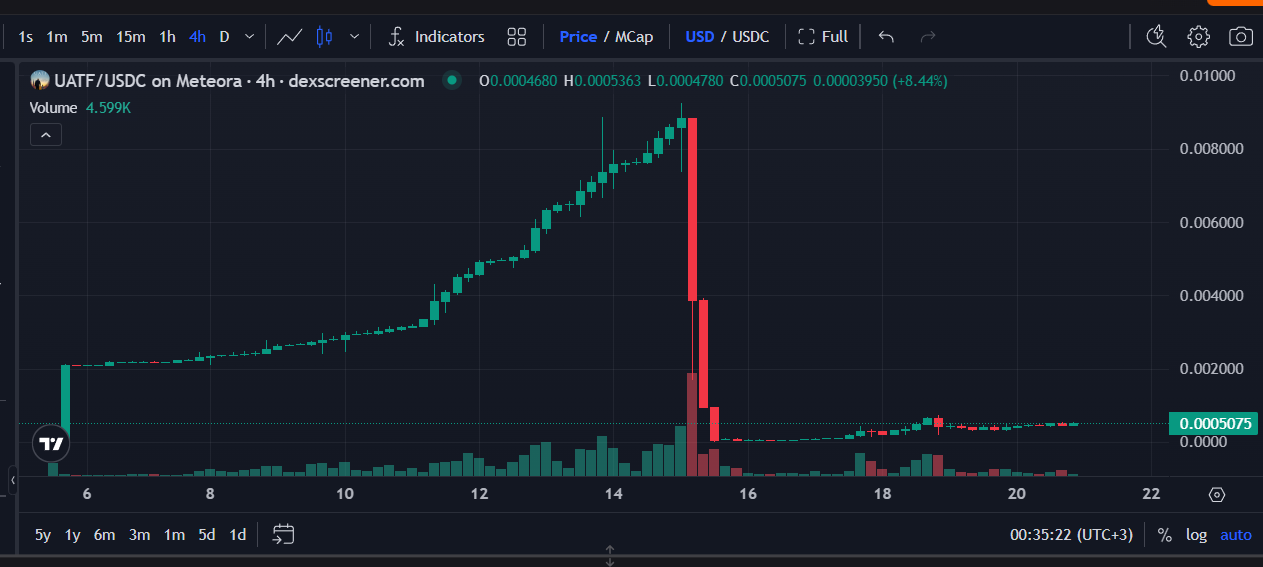
After a sharp run-up, UATF collapsed in a few huge red candles about five days ago. That huge selloff happened in only 12 hours.
This kind of move suggests heavy selling hit the market all at once. It looks like someone with a large position dumped into buyers.
That does not prove intent by itself. But it does make the risk much harder to ignore. A new token that pumps fast, then gets crushed almost instantly, often leaves late buyers holding the bag. But for me, the risk of a crypto rugpull is too big to ignore.
With UATF, the price action adds another major warning sign to an already suspicious setup.
There is no clear team you can verify
If you can't identify the people behind a crypto project, you can't judge their track record. You can't check whether they've built anything before. You can't see if they have a business history, legal issues, or even a real public presence.
And crypto has no customer service desk for bad decisions. If the founders vanish, who answers? If the website changes its claims, who explains? If liquidity dries up, who owns that outcome?
A public team isn't a guarantee of safety. Plenty of bad projects had known faces. But no team at all is worse. That’s how people can launch blockchain scam projects and they’ll never be held responsible.
Anonymous developers asking strangers for money is a hard sell, and it should be.
The project lacks the basics serious investors expect
Creating a token is easy. Building a real project is hard. UATF appears to miss the second part.
The usual questions all seem to run into fog.
- Where is the detailed whitepaper?
- Where are the tokenomics?
- Who controls supply?
- What's the roadmap, and why should anyone trust it?
- Has the token been audited?
- What legal entity, if any, sits behind the brand?
Put the basics side by side and the gap is hard to miss.
| What serious projects usually show | What raises concern with UATF |
| Public founders and business details | Anonymous developers and unclear history |
| A whitepaper with utility and tokenomics | No clear public whitepaper and weak detail |
| Public audit evidence | No solid audit proof visible |
| Clear roadmap and use case | Vague purpose and thin project substance |
| Verifiable backing claims | Official-sounding branding without proof |
The pitch depends more on hype than real value
When the substance is thin, hype has to do the heavy lifting. That's where small, risky tokens often start sounding alike. Big upside. Early access. Get in now. Don't miss the next breakout.
UATF also carries the usual micro-cap danger. Public price pages have shown a small and volatile market value, with wide swings that can move fast in either direction. A coin like that can spike on attention and sink just as fast.
Then there are the side scams that grow around coins like this. "Free UATF" offers, connection traps for your crypto wallets, and any request for your seed phrase or private key are pure danger. No real giveaway needs your seed phrase. That's wallet theft dressed as a bonus.
If the value pitch is mostly excitement, not utility, step back.
How scammers use fake authority to sell risky crypto
This pattern is bigger than one token. Risky crypto projects often borrow the tone of trusted institutions because trust is expensive, but imitation is cheap.
The CFTC has warned people about digital asset fraud that uses false claims, fake authority, and pressure. UATF fits that broad playbook far too well.
Words like trust, fund, and united can be used as bait
Some words hit the brain before logic gets a turn. "Trust" sounds protected. "Fund" sounds managed. "United American" sounds established, maybe patriotic, maybe official.
That emotional shortcut is the whole point. Instead of asking "What does this token do?" people start thinking "Maybe this is safer than the other coins." That's how branding gets used like camouflage.
You can see the same trick in phrases like "secure reserve," "official account," or "backed by American values." Those lines sound comforting, but comfort isn't evidence. Your wallet doesn't care how reassuring the name felt.
Pressure tactics are a warning sign
Scammy crypto pitches love urgency because urgency kills homework. Buy now. Limited window. Early investors only. Claim your free tokens today. Connect your wallet before the offer expires.
None of that proves opportunity. It proves someone wants you moving faster than your judgment.
A good project can survive a night's sleep. A bad one needs you excited, distracted, and in a hurry. If a coin only looks good when you stop asking questions, it never looked good.
What to check before you ever buy a coin like UATF
You don't need to be a blockchain engineer to avoid obvious traps. You need a short list, a little patience, and the willingness to walk away.
Start with proof. Then check utility. Then look outside the project's own bubble.
Look for real names, real documents, and real proof
Before buying any small coin, look for a few basics:
- Founders and core team members with real names and a public history
- A business entity you can verify, if the project claims to be a company or fund
- A whitepaper that explains the token's purpose, supply, and mechanics
- A public token address and on-chain activity you can inspect
- Audit evidence or outside reviews from known firms or analysts
If those pieces are missing, don't make excuses for the project. Move on.
Also remember that exchange pages and price trackers are not endorsements. A coin can appear on a listing page and still be weak, misleading, or dangerous.
Check whether the coin has any real use case
Ask the plain questions:
- What does this token actually do?
- Can it pay for a service?
- Does it power an app people use?
- Does it grant access to something clear and limited?
- Is there any reason for demand besides "maybe it goes up"?
If the answer is fuzzy, that's the answer. A real use case should be easy to explain in a minute. If all roads lead back to hype, the token is running on fumes.
Search for outside warnings, not just project marketing
Never let the project grade its own homework. Search the coin name with words like "scam," "review," "audit," and "rug pull." Read community posts, not only the official account. Check blockchain explorers. Look for scam alerts and watchdog posts.
You don't need every comment to be positive. Crypto communities argue about everything. What you're looking for is a pattern, unclear claims, missing details, copied marketing, angry users, and unanswered questions.
When a project is clean, it usually leaves a trail of proof. When it's shaky, it leaves a trail of noise.
The bottom line: the UATF coin is very sketchy at best
UATF looks official by design, but the design is the problem. A coin with anonymous creators, missing basics, vague value, and authority-themed branding doesn't deserve blind trust.
The safest call is to stay away unless strong, public proof shows up later. That kind of turnaround is rare.
A serious investment should get clearer as you research it. UATF crypto gets murkier. When a coin feels confusing or rushed, trust the evidence and walk.


You May Also Like

LIST: Bayanihan initiatives amid soaring oil prices
ASICID Launches Plug-and-Play Crypto Miners With Up to $25,590 Monthly Revenue
Report reveals what started Trump's feud with Italian pal: 'She doesn't see this as petty'


Trending News
More24/7 Live News
MoreQuick Reads
More
