

Uniswap Price Prediction: Is a $100 UNI Really Possible?
Undervalued DeFi Protocol Nobody Is Talking About
Uniswap Price On June 2026, Standard Chartered initiated formal coverage on Uniswap with a 2030 price target of $100. That is a 40-times return from where UNI is trading today. Standard Chartered is not a crypto-native research shop making social media plays.
It is one of the world's largest international banks, with a balance sheet measured in trillions and research departments that move institutional capital. When they publish a $100 target on a DeFi protocol, it is worth understanding exactly what they see.
What makes this moment particularly interesting is that UNI is simultaneously at one of its most depressed price levels in years. The token is down from its $44.50 all-time high by more than 94%. It traded below $1.80 at its lowest point in 2026's early correction phase. As of June 17, 2026, UNI is trading around $3.28 to $3.56 — up approximately 9.54% today as the broader market recovers on Iran geopolitical de-escalation news. That still puts it 94% below ATH.
The gap between a $100 long-term target from one of the world's most credible institutional analysts and a current price of $3.55 tells you one of two things: either Standard Chartered is dramatically wrong, or the market has not yet absorbed what Uniswap has actually become. This report lays out both cases with the specificity they deserve.
What Uniswap Actually Is in June 2026
There is a version of the Uniswap story that most people have in their heads — an Ethereum-based DEX where you swap tokens through liquidity pools. That version is accurate but about three years out of date. Here is what Uniswap actually is in mid-2026.
$4 Trillion in All-Time Volume — The Infrastructure Reality
Uniswap has facilitated over $4 trillion in cumulative trading volume since its November 2018 launch. That is not a projection — it is a settled number. For context, the New York Stock Exchange processes roughly $20 trillion annually. Uniswap, a smart contract running on Ethereum and a dozen other chains, has processed $4 trillion in eight years entirely through automated, non-custodial code. The 119 million unique swappers who have used it represent a genuine user base, not speculative interest.
Uniswap v4 and the Hook Architecture
Uniswap v4, which launched in late 2024, introduced a 'hooks' architecture that allows third-party developers to add custom logic to liquidity pools — dynamic fees, custom oracles, limit orders, and more — without forking the protocol. This transformed Uniswap from a liquidity infrastructure into a permissionless financial application platform. The protocol is no longer just where you swap. It is the base layer that other DeFi applications build on top of.
Tokenized Securities — June , 2026
In June 2026, Uniswap announced that tokenized securities from issuers including Ondo Finance, xStocks, and Backed Finance are now easily discoverable and tradeable through its main user interface. This means Uniswap's frontend now surfaces tokenized real-world assets — stocks, bonds, and structured products — alongside its traditional DeFi token pairs. The protocol is no longer just DeFi. It is becoming the trading interface for the tokenized financial system.
The Fee Switch and UNI Burns
June 5, 2026, was a notable data point: Uniswap burned 134,000 UNI in a single day — the largest single-day burn in the protocol's history. This was part of the fee switch mechanism that governance finally activated earlier in 2026, which redirects a portion of protocol fees toward UNI token burns rather than exclusively to liquidity providers.
The economic logic is straightforward: as Uniswap's trading volume grows, more fees are collected, more UNI is burned, and the circulating supply decreases. At $4 trillion in cumulative volume, even a tiny fee percentage generates substantial burn fuel.
Defend Developers PAC — June 2026
Uniswap Labs helped launch the Defend Developers PAC in early June 2026 to advocate for legal protections for DeFi builders. This is not just a lobbying play. It signals that the company behind the protocol is engaging at the U.S. policy level — a maturation step that distinguishes serious long-term projects from speculative tokens. The broader implication is that Uniswap considers its regulatory environment a strategic asset worth investing in.
Standard Chartered's $100 Call — What They Actually Said
In June 2026, Standard Chartered published a research note initiating coverage on Uniswap. This is the most significant institutional endorsement UNI has received since Andreessen Horowitz's early venture participation. Here is the substance of what they said:
Standard Chartered forecasts significant expansion in DeFi TVL and tokenized assets, projecting UNI price targets of $6.50 in 2026 and up to $100 by the end of 2030. The bank cites Uniswap's position as a dominant DEX to capture fees from tokenized real-world assets." —Standard Chartered Research, June, 2026
The thesis has three parts. First, they believe DeFi TVL will expand significantly as tokenized real-world assets come on-chain — driven by initiatives like the DTCC-Stellar partnership, BlackRock's tokenized funds, and the broader institutional RWA movement.
Second, they believe Uniswap is structurally positioned to capture a disproportionate share of the trading fees generated by those tokenized assets — as it already does for BUIDL (BlackRock's tokenized money market fund) and now for Ondo, xStocks, and Backed. Third, the combination of fee burns and revenue growth should create a self-reinforcing flywheel where UNI's deflationary mechanics compound with rising protocol revenues.
The $6.50 near-term target for 2026 implies approximately a 2.5x return from current levels. The $100 by 2030 target implies roughly a 40x return. Neither is a conservative call. Both are grounded in a thesis that most of the crypto market has not yet modeled — that Uniswap becomes the primary trading venue for the global tokenized asset market.
X (Twitter) Sentiment — June 17, 2026 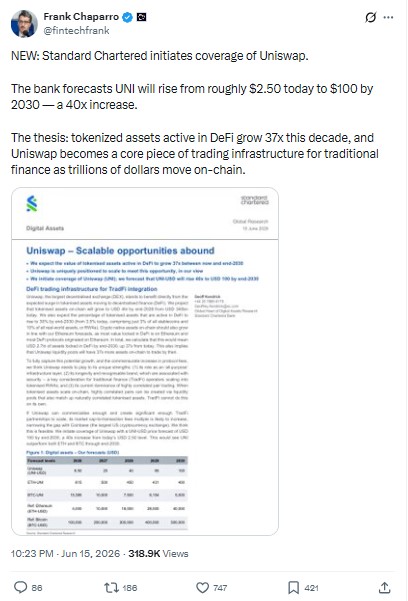
|
OVERALL X SENTIMENT — JUNE , 2026 Bullish: 41% — Standard Chartered $100 target; tokenized securities integration; 134K daily burn; altcoin season positioning. Neutral: 38% — 'Show me $4.10 close first'; watching fee burn pace; waiting for volume confirmation. Bearish (Short-Term): 21% — 200-day SMA falling; still 94% below ATH; fee switch economics complex; price needs time. Coinbase sentiment: 40.94% bullish. Social score 4.6/5. UNI ranked #110 in social mentions volume. |
Technical Analysis — June 16, 2026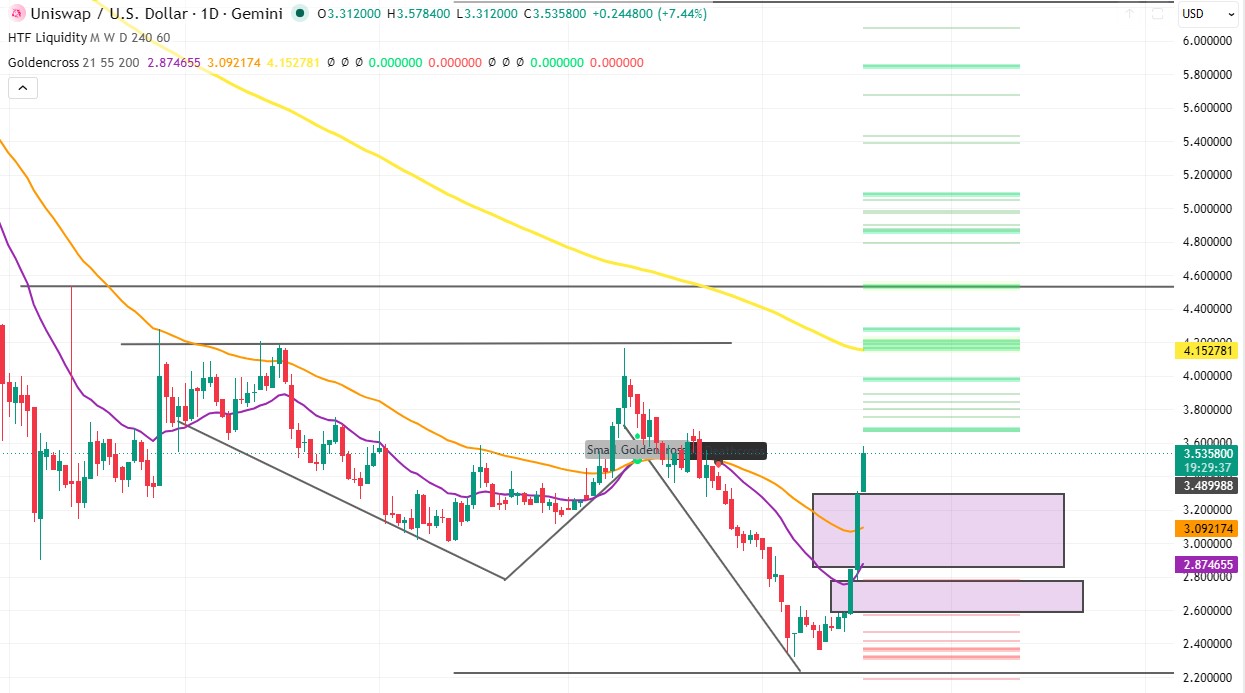
Key Support Levels
- $3.00
- $2.80
- $2.60
- $2.20
Key Resistance Levels
- $3.60
- $4.20
- $4.60
- $5.00
Short Term:
UNI is showing strong bullish momentum after a breakout from the demand zone. If buyers maintain control above $3.20, the price could target $3.80–$4.20 in the near term.
Long Term:
A sustained move above the major resistance zone could open the path toward $4.60–$5.00, while holding above $2.80 keeps the broader recovery structure intact.
Indicator Readings
• RSI (Daily): Bullish per Coinpedia — 50-day MA rising above price. Short-term momentum is supportive. Today's 8.54% gain adds to the trend.
• 50-Day MA (Daily): Rising and currently above price — could act as resistance on the way up. A sustained close above the 50-day MA (around $3.20) would be a meaningful technical event.
• 200-Day MA: Falling since May 7, 2026 — long-term trend still weak. This is the key indicator that needs to flatten and turn upward before institutional capital treats UNI as a structural hold.
• Weekly Chart: Bearish — 50-day MA above price and falling; 200-day MA falling since November 2025. Long-term trend confirmation remains negative.
• Ascending Triangle (4H): Ali_charts identified an ascending triangle pattern with breakout confirmation needed above $4.10. This structure has been forming since early Q2 2026 and remains intact.
• Genesis Demand Zone: At $1.80 to $4.50, UNI is trading inside what Coinpedia calls the 'genesis demand zone' — the price range from which the 2021 bull run launched. The re-entry into this zone after completing a full market cycle is a structural accumulation signal used by long-term cycle investors.
Price Predictions — All Timeframes
Short-Term (June – July 2026)
|
Scenario |
Price Range |
Probability |
Key Driver |
|
Bull Case |
$4.12– $5.00 |
25% |
$4.10 ascending triangle breaks; Standard Chartered creates FOMO; altcoin season |
|
Base Case |
$2.30 – $3.20 |
50% |
Range consolidation; Standard Chartered note digested slowly; burn pace steady |
|
Bear Case |
$1.80 – $2.20 |
25% |
200-day MA resistance; BTC pullback; fee switch fails to generate burn velocity |
Q3 2026
|
Scenario |
Price Range |
Probability |
Key Driver |
|
Bull Case |
$5.00 – $6.50 |
20% |
SC $6.50 target; altcoin season; tokenized RWA volume lifts Uniswap fees |
|
Base Case |
$3.00 – $4.50 |
55% |
Ascending triangle resolves; UNI governance aligns on fee structure |
|
Bear Case |
$1.50 – $2.50 |
25% |
Macro reversal; competitor DEX eats market share; 200-day MA caps recovery |
End of Year 2026
|
Scenario |
Price Range |
Probability |
Key Driver |
|
Bull Case |
$6.50 – $10.00 |
20% |
SC year-end target; Coinpedia $10 bull; full altcoin season rotation |
|
Base Case |
$3.22 – $5.00 |
50% |
Changelly max $4.53 Dec; Coinpedia mid; steady protocol revenue growth |
|
Bear Case |
$1.50 – $2.50 |
30% |
ETH L2 cannibalises Uniswap volume; fee burns insufficient; DeFi remains niche |
Long-Term 2027–2030
|
Scenario |
Price Range |
Probability |
Key Driver |
|
Ultra-Bull |
$50 – $100 |
10% |
SC $100 target; Uniswap = global tokenized asset DEX; fee burn flywheel peaks |
|
Bull Case |
$15 – $40 |
20% |
Coinpedia long-term bull; DeFi TVL expansion; RWA tokenization mainstream |
|
Base Case |
$5 – $12 |
40% |
Changelly $11.61 by 2030; consistent protocol growth; fee burns steady |
|
Bear Case |
$1 – $3 |
30% |
Competition from Hyperliquid, DEX aggregators; fee switch underperforms |
The Risks: What Can Go Wrong
Near-Term Risks
• 200-Day MA Resistance: The daily 200-day MA has been falling since May 7, 2026, and sits above the current price. Without a reversal in this indicator, institutional momentum investors will treat UNI as a short-term trade rather than a structural hold.
• Fee Switch Complexity: The mechanics of how protocol fees flow to burns vs. LPs vs. treasury are not simple. If the community continues to debate governance parameters around the fee switch, execution uncertainty keeps institutional buyers cautious.
• Foundation Runway: The Uniswap Foundation treasury has an $85.8 million runway through January 2027. If governance does not approve fresh treasury allocations, development velocity could slow at a critical period.
Medium-Term Risks
• Hyperliquid Competition: Hyperliquid broke into the DeFi top 10 by market cap on June 6, 2026 — becoming only the second DeFi-native token to do so. As a perpetual DEX, Hyperliquid competes for the leveraged trading volume that generates Uniswap's highest fee density. If this competition intensifies, Uniswap's fee burn rate could plateau.
• ETH L2 Volume Fragmentation: Uniswap is deployed on 12+ chains, but fee burns require ETH mainnet gas consumption. As activity continues migrating to Arbitrum, Base, Optimism, and other L2s, the mainnet fee burn mechanism captures a smaller fraction of total protocol activity.
• Regulatory Uncertainty: Despite the Defend Developers PAC, the regulatory framework for DEX operators remains unresolved in the U.S. and EU. A hostile regulatory move against Uniswap Labs — not the protocol, but the company — could temporarily depress UNI even if the on-chain protocol continues operating.
Conclusion: The $2.58 vs $100 Debate Is a Timing Question, Not a Fundamental One
Standard Chartered does not publish $100 targets carelessly. The research infrastructure behind their June note reviewed $4 trillion in protocol volume, 119 million swappers, $2.6 billion in TVL, and a fee burn mechanism just beginning to show its power. Their conclusion — that Uniswap will be the dominant trading venue for the global tokenized asset market by 2030 — is not a moonshot fantasy. It is a thesis grounded in the protocol's track record and the direction of institutional finance.
The honest near-term picture is less exciting. UNI is in a descending weekly trend. The 200-day moving average is falling. The token is 94% below its all-time high. The genesis demand zone has provided support, but turning that support into a meaningful recovery requires either a catalyst that forces price discovery upward (like today's 8.54% gain) or the slow accumulation of fee burns that mechanically reduces supply over time.
The 2026 year-end target of $6.50 from Standard Chartered requires approximately a 2.5x return from today's price in six months. That is achievable but not guaranteed — it requires sustained altcoin season capital rotation, continued protocol revenue growth, and the ascending triangle pattern resolving bullishly above $4.10. None of those things is certain.
What is certain is that Uniswap in June 2026 has more genuine institutional credibility, more real protocol revenue, more unique users, and more defensive tokenomic mechanics than it has had at any point in its history. The market is not pricing that correctly. Whether it corrects that pricing in six months or three years is the only real question — and that depends on timing, not fundamentals.
Disclaimer: This report is for informational and educational purposes only. It does not constitute financial, investment, or legal advice. All price predictions are speculative estimates sourced from publicly available analyst data. Cryptocurrency markets are highly volatile. Always conduct your own independent research (DYOR) before making any financial decisions. Standard Chartered's $100 UNI target is a 2030 long-term forecast. The 2026 target of $6.50 is not guaranteed.


You May Also Like

Blue Sage Solutions Expands Embedded AI Capabilities Across the Mortgage Lifecycle
Defying Trump’s Hopes of a Rate Cut, Warsh Holds Rates Steady at 3.75%

How Much Ripple (XRP) Do You Need to Become a Millionaire? A Top Analyst Perspective



