-
Bitcoin surged as improving risk sentiment following the US-Iran peace deal boosted investor confidence and renewed capital flows
-
A massive concentration of short liquidations above current levels could accelerate BTC's rally toward $71,200 and potentially $83,400
Bitcoin extended its recovery to $65,596 with a rise of 1.5% after reclaiming the $64,400 local resistance, following the announcement of a US-Iran peace deal. The easing of geopolitical tensions triggered fresh liquidity across risk assets, allowing the Bitcoin price to climb above $65,500 and shifting the short-term market structure back in favor of the bulls.
More importantly, the breakout has placed Bitcoin in a region where a large concentration of leveraged short positions remains stacked above the current price. If buyers maintain momentum, forced liquidations of these shorts could accelerate the rally, creating a classic short-squeeze scenario. The focus for traders now is no longer whether BTC can hold above the breakout level, but whether the resulting liquidity cascade can propel the price beyond the $70,000 mark.
Bitcoin Liquidation Map Points to a Potential Short Squeeze
Bitcoin’s breakout above $64,400 has changed the market structure, but the liquidation map suggests the rally may not be over yet. With BTC trading around $65,500, a large cluster of leveraged short positions remains concentrated above the current price, particularly between $66,000 and $70,000.
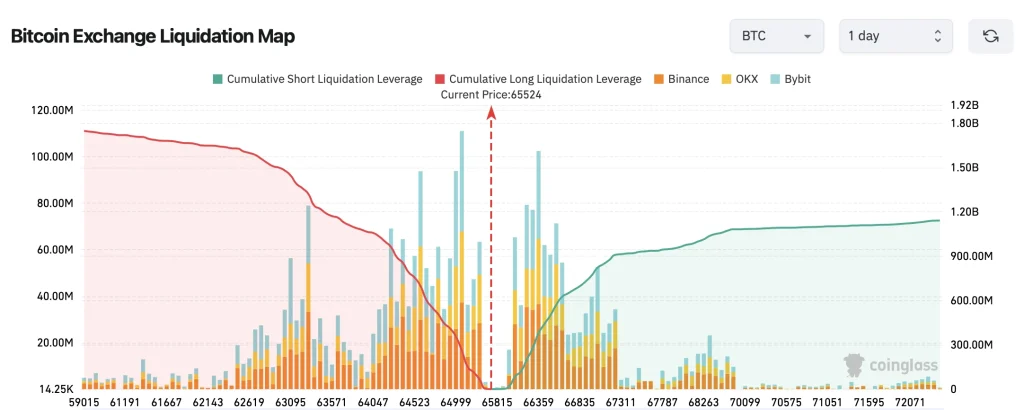
In simple terms, many traders are still betting that the Bitcoin price will reverse lower. If the price continues to climb, those bearish positions could be forced to close, creating additional buying pressure as short sellers rush to cover their trades. This chain reaction, commonly known as a short squeeze, often accelerates price moves far beyond what spot buying alone can achieve.
Another encouraging sign is that much of the downside liquidity has already been absorbed during the recent correction, while the bigger liquidity pools now sit overhead. As a result, a sustained move above $66,000 could quickly open the door to the $68,000-$70,000 zone, with the next major liquidity cluster emerging near $72,000. Whether Bitcoin reaches those levels will depend on whether bulls can maintain momentum over the coming sessions.
Bitcoin Bulls Defend a Critical Support Zone
The Bitcoin price appears to have completed a successful defense of the $59,500-$60,500 demand zone, an area that has repeatedly attracted buyers after the sharp selloff earlier this month. Instead of extending lower, BTC produced a strong rebound from this support and has now reclaimed the $65,500 level, signaling that bearish momentum is fading.
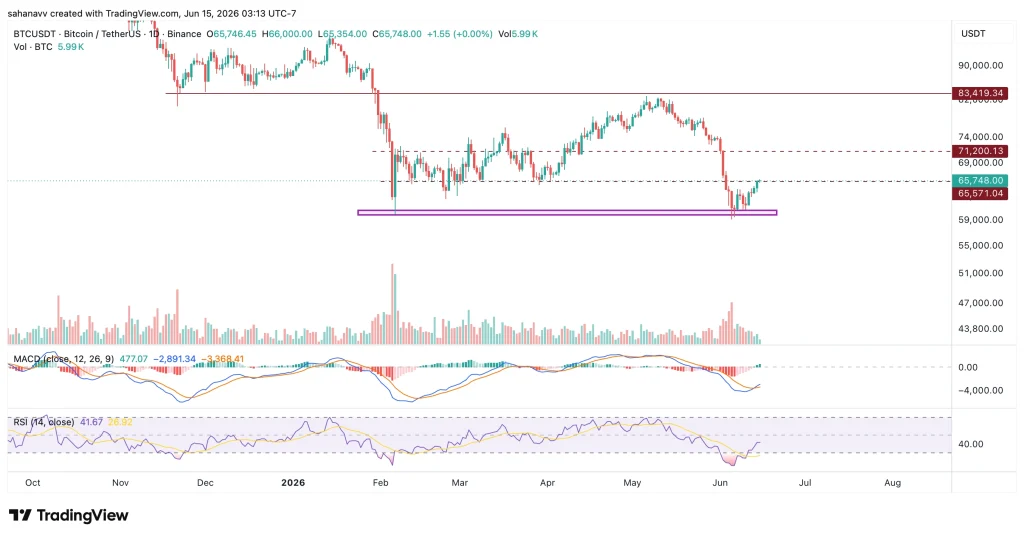
The MACD histogram has turned positive, indicating that downside momentum is weakening and buyers are gradually regaining control. Meanwhile, the RSI has rebounded from oversold territory, suggesting that fresh buying interest has entered the market after the recent correction rather than the recovery being driven solely by short-term speculation.
The next challenge for Bitcoin lies near $71,200, which represents the immediate resistance on the chart. A decisive break above this level would confirm the recovery and increase the probability of a rally toward the $83,400 resistance zone. However, if BTC fails to sustain above the recently reclaimed $65,500 level, traders could see another retest of the $60,000 support region before the next directional move develops.
Can Bulls Trigger a Short Squeeze Toward $83,400?
Bitcoin price has regained short-term bullish momentum after reclaiming the $64,400-$65,500 resistance zone, while the liquidation map suggests a large pool of short liquidity remains above the current price. This combination increases the probability of an accelerated upside move if bulls maintain control.
For traders, $71,200 is the immediate level to watch. A decisive breakout above this resistance could trigger a rally toward $83,400, aided by a potential short squeeze. On the downside, failure to hold above $65,500 could see the BTC price revisit the $60,000 support zone before attempting its next directional move.