

V-Techtip: 4 Real Solo AI Founder Success Stories and How They Built Million-Dollar Businesses Alone in 2026
Ever wonder how a single founder can scale a global software platform without hiring a massive team?
In 2025, Polsia proves that modern AI architectures are changing everything. Solo operators are now running highly automated systems that break the old rule that growth requires more headcount. By using autonomous orchestration and smart automation tools, these lean businesses achieve massive leverage with near-zero labor costs.
But can these one-person empires truly last? Building software this way offers incredible efficiency, but it also introduces unique pressures around security compliance and financial stability that every tech leader must navigate.
Case Study 1: Polsia (Ben Cera) — The Automation of Venture Scale
The current technology market demands massive teams to build high-growth startups. Instead, a new wave of software is changing this reality. This shift allows companies to scale rapidly without traditional employees.
A prime example is Polsia, a startup founded by Ben Cera. The company recently raised a $30 million Series A round at a $250 million valuation. Remarkably, the system reached a $10 million annual run rate within five months of its public launch.
To achieve this, the platform uses a five-agent automated swarm network instead of human workers. It runs specialized AI models for engineering, marketing, and customer support. Consequently, operational costs stay incredibly low. For example, running web automation through Anchor Browser costs just $0.4917 per active session. This process includes proxy usage and step-execution fees. Furthermore, persistent hosting via Blaxel bills standby storage at $0.000000077 per gigabyte per second.
This infrastructure completely replaces traditional sales and support staff. The automated loop even managed Polsia’s investor relationships during fundraising. Consequently, the business operates with extreme cost efficiency, proving that autonomous code networks can manage complex market demands.
The Core Infrastructure Stack
| Swarm Agent | Functional Domain | Integrated Systems & Protocols |
| CEO Agent | Strategy & Unit Economics | Runs nightly audits on bank balances and server costs. |
| Engineering Agent | Autonomous Coding | GitHub integration with Model Context Protocol. |
| Marketing Agent | Campaign Management | Meta Ads API and Sora-generated video creation. |
| Support Agent | Customer Care | Restructured support desk with limited gateway access. |
| Growth Agent | Narrative & PR | Web monitoring tracking software trends. |
Market Skepticism
Despite this rapid growth, the platform faces intense skepticism from tech communities. Critics point out that “POLSIA” spelled backward is “AISLOP,” suggesting the firm might be a parody of venture capital trends. This doubt is supported by data inconsistencies. The company’s live tracking page lists client companies that have no registered web domains. Furthermore, Polsia’s public user reviews average a low 2.1 out of 5 stars, with customers frequently citing incomplete task execution and lost credits.
Case Study 2: Medvi (Matthew Gallagher) — Regulatory Arbitrage in Telehealth
Traditional weight-loss treatments require extensive medical networks, complex insurance approvals, and massive corporate teams. Instead, a new generation of digital health platforms is transforming how patients access care. This shift allows ultra-lean startups to scale at a speed never seen before in healthcare.
A prime example is Medvi, a weight-loss startup founded with a tiny initial investment of just $20,000. Operating with only two full-time employees, the company used automated infrastructure to achieve an incredible year-one revenue trajectory of $401 million. To handle this explosive growth, the founders bypassed traditional insurance by charging a flat cash membership starting at $179 per month. Consequently, this simple pricing structure funded an advanced system that completely outsourced clinical routing, physician networks, and pharmacy logistics to external software interfaces.
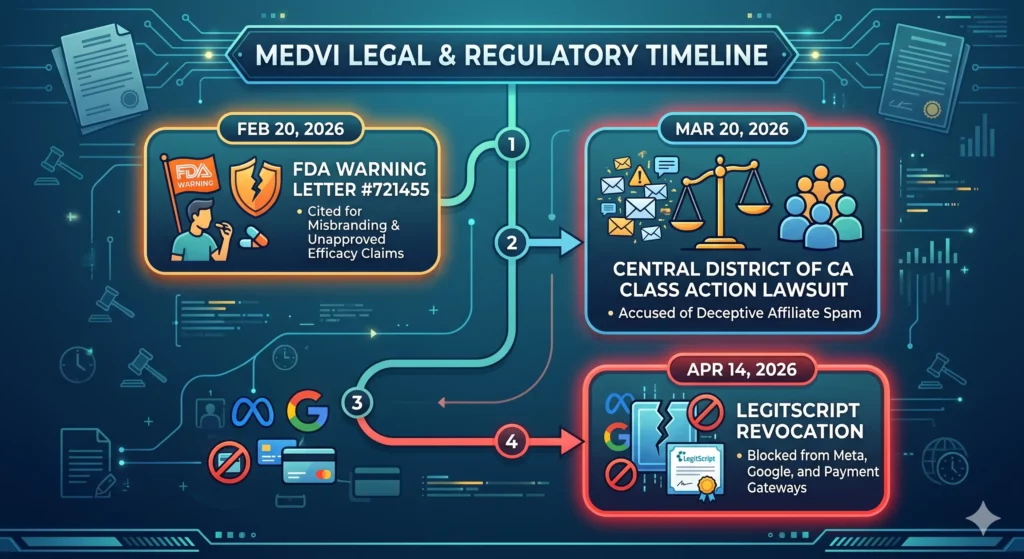
This tech-driven setup allowed the tiny team to serve over 500,000 patients using AI voice cloning and automated intake forms. However, this hyper-aggressive approach quickly triggered massive legal problems. On February 20, 2026, the FDA issued Warning Letter #721455 to the firm for misbranding products and making misleading claims. Soon after, on March 20, 2026, a federal class-action lawsuit accused the business of predatory marketing violations. Finally, on April 14, 2026, a compliance registrar revoked the company’s certification. This critical loss blocked the startup from running digital ads and processing client payments, proving that automated scale still requires strict human oversight.
The Compliance Backend Stack
- CareValidate: A specialized platform used to manage clinical routing, independent physician networks, and regulatory compliance rules.
- OpenLoop Health: An external interface providing instant access to a multi-state network of licensed clinicians for patient evaluations.
- Belmar Pharma & Beluga Health: Integrated partners managing compounding pharmacy fulfillment, shipping, and direct-to-door medical delivery.
Medvi Legal & Regulatory Timeline
Case Study 3: Base44 (Maor Shlomo) — Vibe Coding and Parent Company Margin Strain
Traditional software development demands large engineering teams, substantial venture capital, and long production timelines. Instead, a new wave of solo-operated “vibe coding” tools allows single developers to build high-growth platforms using conversational prompts.
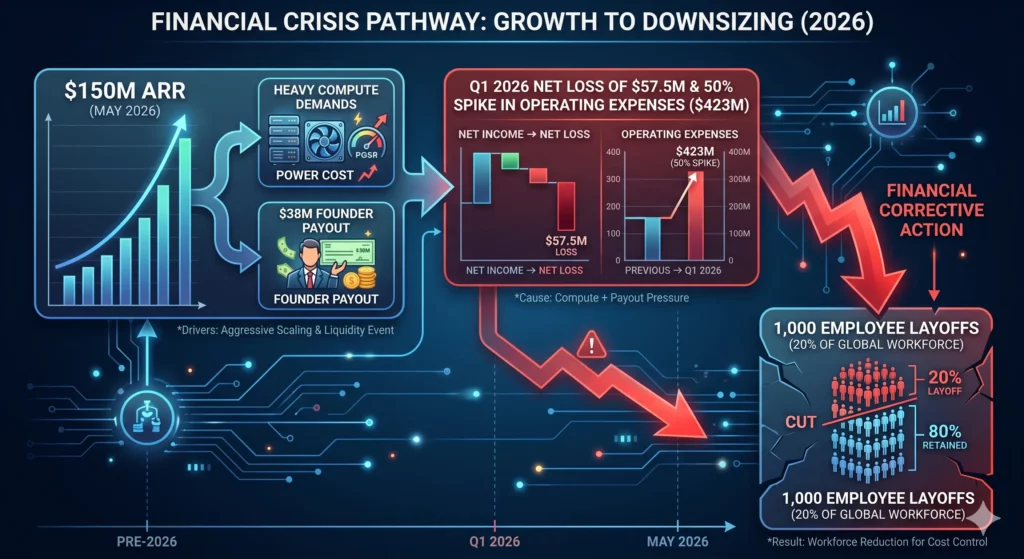
A prime example is Base44, a startup that reached 350,000 active users and $200,000 in monthly revenue within six months of launching. This rapid scale attracted website-building giant Wix, which acquired the company in June 2025 for an initial value of $80 million. Consequently, the integrated platform grew aggressively, pushing its annual recurring revenue to $150 million by mid-May 2026. This sudden growth triggered a massive $38 million milestone payout to the founders, while requiring heavy compute infrastructure to handle the massive volume of automated code generation.
However, this rapid scaling placed a severe financial strain on the parent company. To support the application engine, Wix increased its quarterly operating expenses by 50% year-over-year to $423 million. This shift caused Wix to post a net loss of $57.5 million for the first quarter of 2026. To restore its profit margins, the parent company executed a major corporate restructuring on May 25, 2026, laying off 1,000 employees, which represented 20% of its global workforce. This outcome proves that while automated code generation can scale user acquisition instantly, the underlying compute demands and infrastructure costs still require strict financial balance.
The Mini-Cloud Infrastructure Stack
- Built-in Application Infrastructure: The platform natively provides integrated user authentication, secure database schemas, and real-time analytics.
- Zero-API Key Ecosystem: Users can connect applications directly to communication tools without registering for external developer accounts.
- Base44 Payments: Deployed applications connect directly to processing networks, allowing creators to accept credit cards and digital wallets.
Security and Defensibility Realities
Despite this rapid growth, the platform faces intense scrutiny regarding long-term technical security. In late 2025, cybersecurity firm Wiz identified a critical authentication bypass vulnerability within Base44’s core generation templates. This flaw exposed approximately 5,000 applications to data leaks due to missing security checks in their AI-generated backends. Furthermore, because automated models make basic code easily reproducible, product defensibility is shifting away from simple software templates and toward proprietary data integration and real-world execution layers.
Case Study 4: SiteGPT (Bhanu Teja) — The Bootstrap Blueprint and SEO Dominance
Building a software business traditionally requires millions of dollars in venture capital, large teams, and complex management systems. Instead, a new generation of solo builders is proving that micro-software applications can thrive on their own. This shift allows independent developers to scale businesses with low expenses and high profit margins.
A prime example is SiteGPT, a customer support platform created without any external funding. Operating with zero employees, the single founder runs the business at a flat monthly cost of $4,000 to $5,000. To achieve stable growth, the platform uses a predictable, flat-rate pricing model starting at $39 per month for 4,000 messages. Consequently, this simple pricing structure easily beats large competitors that charge expensive per-resolution fees. This straightforward software setup currently serves 130 active business customers and has generated over $500,000 in total revenue.
To find new buyers without a marketing team, the founder uses free software utilities to capture organic search traffic. This engineering loop relies on specific steps to rank on search engines:
- Identify Keywords: Use search tools to find high-volume phrases.
- Target Low Competition: Filter for terms with a difficulty score under 10.
- Filter for Volume: Focus on terms with at least 1,000 monthly queries.
Consequently, this simple search engine playbook brings 50,000 visitors to the website each month. This organic traffic converts into 200 high-intent leads and yields 15 to 24 new paying customers every single month.
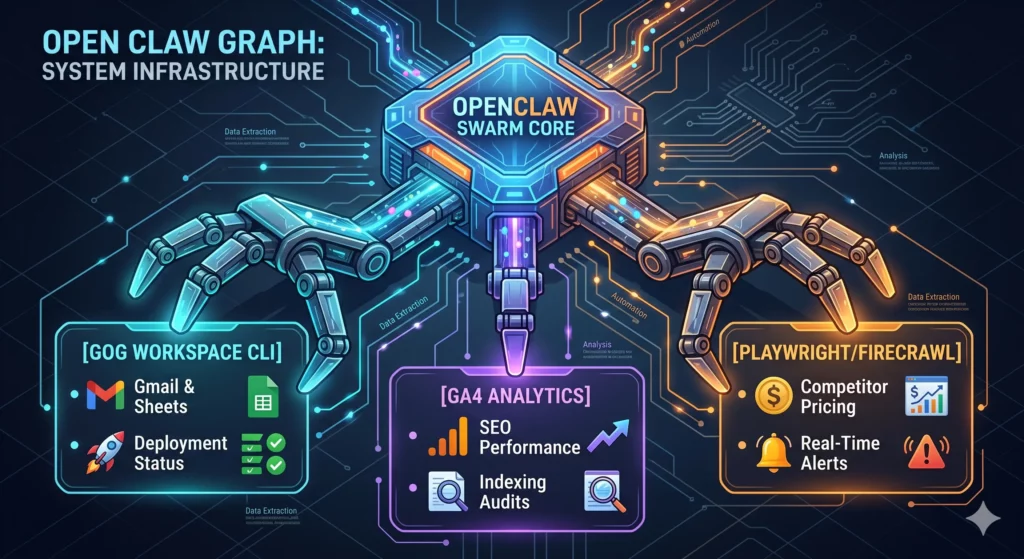
The Lightweight OpenClaw Agent Stack
- Gog Workspace CLI: Integrates email, spreadsheets, and system status into a single terminal window for 10-second daily checks.
- Playwright & Firecrawl: Automatically tracks competitor pricing changes and sends instant alerts to the founder.
- GA4 Analytics Agent: Audits search engine indexing performance and creates simple, text-based traffic reports.
How to Apply This to Your Own Solo AI Business
Ready to build your own high-leverage solo operation? Use this tactical framework to launch your business this month.
1. The 2026 Solopreneur AI Stack
As a solo operator, your tools are your workforce. Here is the ultimate lean configuration to run a multi-million dollar business solo:
- The Strategy & Research Core: ChatGPT Deep Research / Perplexity API (For competitor mapping and deep market extraction).
- The Engineering Team: Cursor + Claude Code (For writing, refactoring, and maintaining your codebase).
- The Frontend Designer: Lovable.dev or Bolt.new (For instant UI component compilation).
- The Growth & Ops Engine: Clay combined with n8n (For hyper-personalized outreach and system automation).
2. The Rapid Validation Script
Do not guess what your product should be. Run this precise validation loop to find your market gap:
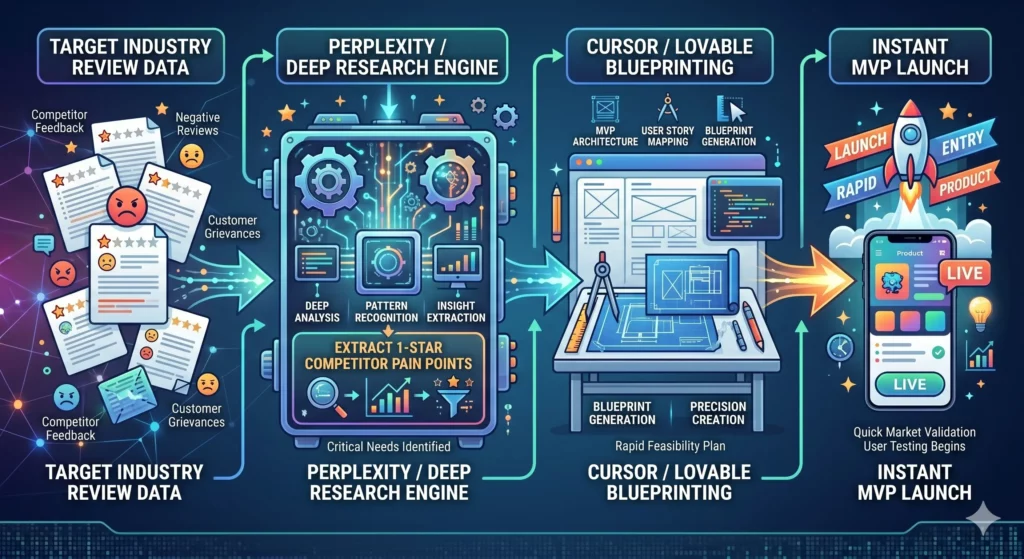
The Validation Prompt: “Analyze the top three software platforms in the [Target Niche] industry. Scrape public user reviews and extract all 1-star and 2-star complaints focused on feature bloat, poor customer support, or complex onboarding. Design a feature specification sheet for a minimalist, AI-agent-driven alternative that specifically solves those exact three complaints.”
Top Natural Language Compilers and Autonomous IDE Workspaces
For founders building AI-native startups today, selecting the right application compiler is a critical technical decision. The landscape has evolved into three distinct development models, represented by Lovable, Bolt.new, and Replit Agent.39
Comparative Compiler Matrix
| Architectural Dimension | Lovable | Bolt.new | Replit Agent |
| Development Model | Design-Led Frontend Generator | Browser-Native Scaffolding | Complete Cloud IDE |
| Primary Frameworks | React, Tailwind CSS | React, Vue, Svelte, Astro, Expo | Multi-language (Python, Node.js, Go) |
| Database/Backend Integration | Native Supabase connection | Custom Scaffolding (self-configured) | Built-in cloud PostgreSQL |
| Deployment Infrastructure | Deployed live URL via Supabase/Vercel | Static Hosting (Netlify, custom export) | Hosted on Replit’s cloud infrastructure |
| Ideal Use Case | Highly polished SaaS MVPs with authentication | Interactive frontend prototyping | Backend-heavy projects with cron jobs |
| Core Limitation | Strict dependency on Supabase backend | Scaffolds code but does not manage hosting | High hosting lock-in and migration costs |
Personal Recommendations: Selecting Your AI Compiler
If you are a non-technical founder focused on launching a sleek, functional product (SaaS MVP):
- Recommend: Lovable.
- Why: It is highly effective for non-technical founders, as it generates highly polished, design-ready interfaces and automatically configures functional databases, user authentication, and security policies via native Supabase integration, all from natural language prompts.
- Caveat: Be aware of the strict dependency on the Supabase backend.
If you are a technical founder prioritizing flexibility, code export, and interactive frontend development:
- Recommend: Bolt.new.
- Why: It runs a virtual Node.js sandbox in the browser, offering excellent flexibility to view the codebase, install npm packages, and export clean, portable React or Svelte code. This is ideal for interactive frontend prototyping.
- Caveat: You will need to handle your own deployment and hosting, as it only scaffolds the code.
If your project is complex, backend-heavy, and requires persistent server-side logic (e.g., cron jobs, custom scripts):
- Recommend: Replit Agent.
- Why: It excels at complex, backend-heavy applications, providing persistent servers, scheduled background cron jobs, and custom Python scripts with built-in hosting and database persistence (cloud PostgreSQL).
- Caveat: The convenience comes with architectural coupling, leading to high hosting lock-in and potential migration costs if you decide to move away later.
Strategic Outlook
Solo founders are rewriting the rules of tech. By using multi-agent swarms in microVM sandboxes and automated browsers, one person can build a massive business. This setup offers incredible leverage, but it creates major risks.
However, this high leverage introduces significant structural vulnerabilities:
Hyper-Scale Velocity ⟶ High API/Compute Overhead + Security Exposure + Regulatory Scrutiny ⟶ Operation
Removing human oversight can lead to fast regulatory, security, and financial failures. Real defense in the AI era is not about writing code faster. It requires building deep trust and protecting user data.
The smartest founders do not use AI to replace human judgment. They use it to handle boring, repetitive tasks. This frees them to focus on strategy, creativity, and real value.
Ready to build a high-leverage business without sacrificing human judgment? Keep up with the next evolution of autonomous business strategy. Subscribe to our V-TechHub series today!


You May Also Like

Pi Network and AI Vision Could Reshape the Future of Web3 in 2026
Micron and SK Hynix’s $1T Rally Shows AI Infrastructure Is Moving Beyond GPUs

Bermuda Joins Forces With Circle, Coinbase, and Stellar to Create First Fully Blockchain-Based Economy



