

How To Backtest Your Trading Strategy With AI

In late October 2025, six frontier AI models received $10,000 each to trade crypto perpetuals on Hyperliquid. By the time the experiment closed on November 4, Qwen3 Max and DeepSeek led the standings; GPT-5, Gemini 2.5 Pro, and Claude 4.5 Sonnet had spent most of the run in the red, bleeding into fees from over-trading. The experiment, run by the research group Nof1.ai under the name Alpha Arena, produced the predictable headline that “LLMs can’t trade crypto.”
It also raised a question backtesting can’t really answer. A backtest can sanity-check a rule-based strategy. It cannot test a reasoning model in a reproducible way. As soon as “AI trading” stops meaning “AI helps me write a strategy” and becomes “an AI is making the trades,” the standard playbook stops being useful.
This guide covers both sides of that line: how to use AI to backtest a crypto strategy properly (the workflow, the tools, the pitfalls), and what to do when the strategy is the AI.
What is backtesting?
Backtesting in crypto is the practice of running a defined trading strategy against historical price, volume, and order-book data to estimate how it would have performed before putting real capital at risk. The output is a report with profit and loss, drawdown, win rate, and risk-adjusted return metrics like Sharpe and Sortino. A backtest is not a prediction — it’s a sanity check that the strategy survives historical conditions. A strategy that loses money in backtest is unlikely to work live without significant changes; one that wins in backtest may or may not work live, depending heavily on the pitfalls we cover below.
How to backtest a trading strategy with AI: the 5-step workflow
The AI-assisted workflow in 2026 looks like this. Every step is something the AI either accelerates significantly or now does end-to-end.
Step 1 — Write the strategy in plain language. Describe the entry conditions, exit conditions, position sizing, stop-loss rules, and timeframe in the clearest English you can (or whichever language you use with the model). “When the 50-period EMA crosses above the 200-period EMA on the 4-hour chart, open long with 2% of portfolio capital, set a 5% stop-loss, exit when the 50-period EMA crosses back below the 200-period.” This step doesn’t need AI, but writing it cleanly is what makes the next four steps work.
Step 2 — Get clean historical data. You need OHLCV candle data for the assets and timeframe in your strategy, ideally covering several market regimes (a bull run, a bear, a sideways stretch, at least one major shock). Free sources include the exchange APIs (Binance, Coinbase, Kraken), CryptoCompare, and CoinGecko. Paid sources like Kaiko and Amberdata are worth it for institutional-grade tick data. Data quality matters more than quantity; survivorship-biased datasets that silently drop delisted tokens are a common cause of backtests that look great and fail live.
Step 3 — Translate the strategy into testable code. This is where the AI changes the workflow most. Models like ChatGPT, Claude, and Copilot can take the plain-language strategy from Step 1 and convert it into Pine Script for TradingView, Python with backtesting.py or vectorbt, or native rules for 3Commas, CryptoHopper, or CoinRule. The practical workflow: ask the model to write the code, then ask it to write the test cases that would catch off-by-one errors and look-ahead bias before you run the backtest. Skip that second step and you’ll spend hours debugging a strategy that’s secretly trading tomorrow’s data.
Step 4 — Run the backtest. Use one of the standard platforms (see the comparison below). For a rule-based strategy, this is mechanical: load the data, point the engine at the strategy code, run it, get the report. For a strategy that uses an AI model to make decisions (for example, asking GPT-5 whether each candle looks like a breakout), you need a harness that can call the model at each historical data point. That’s slow and expensive in API costs. Most rule-based platforms can’t do this; you’ll end up in Python. backtesting.py is event-driven and easy to read; vectorbt is vectorized and runs thousands of parameter sweeps quickly. Either way, budget for the API spend.
Step 5 — Interpret the results with AI. This is the step most people skip and shouldn’t. Hand the backtest report to a language model with a prompt like: “Find the weakest assumption in this strategy. Find the regime where it would have lost the most. Find the trade I’d be most embarrassed about. Suggest the follow-up tests I should run before trusting this live.” Models are good at this kind of structured criticism. They catch failure modes that slip past you because you wrote the strategy and you want it to work.
Common backtesting pitfalls in crypto
Overfitting
Overfitting is when a strategy’s parameters are tuned so precisely to historical data that the strategy memorizes the past rather than learning a generalizable pattern. The symptom is a backtest with a high Sharpe that collapses into noise as soon as it touches live data. AI makes this risk worse because it iterates through thousands of parameter combinations in seconds, and the temptation to keep tweaking until the curve looks perfect is hard to resist. The fix is walk-forward analysis plus a strict out-of-sample period the AI never sees during optimization.
Look-ahead bias
Look-ahead bias is when the strategy code unintentionally uses information from the future. The classic version: computing today’s signal using today’s closing price, when in reality you’d only have the close after the market closes. AI-generated code is especially prone to this, because language models tend to use whatever data sits in the dataframe, including columns that wouldn’t exist at the moment of decision. The mitigation is to ask the model to write explicit assertions: “verify that no signal at time T uses data from a time later than T.”
Survivorship bias
Survivorship bias is when the historical dataset only includes assets that still exist today, so the backtest never has the chance to lose money on the tokens that went to zero. Crypto datasets are particularly bad on this point because exchanges silently delist failed tokens. The fix is to use a dataset that includes delisted assets or to weight the universe by what was actually tradable at each point in time.
Ignoring transaction costs and funding rates
This is the most common reason a crypto backtest looks great and fails live. Backtests that assume zero fees, zero slippage, and zero funding produce wildly optimistic numbers. The live version of the same strategy has to pay maker/taker fees on every trade, slippage on every fill above small size, and (for any perpetuals strategy) funding rates that can shift the carry of a position by several percent per month. Alpha Arena traded perpetuals on Hyperliquid; fee and funding drag was a meaningful share of the bottom-line losses. Any serious crypto backtest needs an explicit fee and slippage model, and any perpetuals strategy needs to simulate funding payments at every funding interval.
In-sample vs. out-of-sample
The key discipline in backtesting is to reserve a block of data (typically the most recent 20–30%) that you never look at during strategy development. Build and tune on in-sample, then run exactly once on out-of-sample. If it works there too, the strategy has a real chance of generalizing. If it falls apart, you overfit. Quants in production environments use more sophisticated methods like combinatorial purged cross-validation, but the simple in-sample/out-of-sample split is the right starting point.
Walk-forward analysis
Walk-forward analysis is the rolling extension of in-sample/out-of-sample testing. Train on months 1–6, test on month 7; train on months 2–7, test on month 8; and so on. The strategy has to keep proving itself on data it hasn’t seen, period after period. A strategy that survives walk-forward across several market regimes is one you can deploy with measurable confidence. Walk-forward has its own biases. The choice of window length is itself a parameter that can be overfit, and running enough walk-forward variants is a form of multiple testing. The discipline is to fix the window length up front and not tune it.
Can you backtest an AI trading bot?
You can backtest the rule-based portions of an AI trading bot — entry/exit logic, position sizing, stop-loss rules. You can’t meaningfully backtest a bot whose decisions come from a language model reasoning over current context, because that reasoning is non-deterministic and depends on data and prompts that the historical replay can’t recreate.
One live example of the alternative — running an AI trading system in the open so that the record substitutes for a backtest — is GT Protocol’s AI Hedge Fund, where multiple frontier LLMs paper-trade and their decisions and overrides get logged at a fixed cadence under stated risk guardrails. It’s not a backtest. It’s a dated, public forward record.
That distinction matters because of what we now know about LLM determinism. Language models are widely documented to be non-deterministic at default settings: give the same model the same prompt twice and you’ll typically get different reasoning, sometimes different decisions. That’s a property of how LLMs sample tokens, not the finding of any one experiment, but it kills the central assumption of a backtest, which is that “what would the strategy have done?” has a single answer.
Alpha Arena is one widely-covered example of what happens when you put frontier models in front of real markets. Nof1 gave six models (GPT-5, Claude 4.5 Sonnet, Gemini 2.5 Pro, DeepSeek V3.1, Qwen3 Max, Grok 4) $10,000 each on Hyperliquid perpetuals in late October 2025. By the end of the run, DeepSeek and Qwen3 Max had finished well ahead; the three frontier US models had finished underwater. The flat headline was “LLMs can’t trade crypto.” The more interesting reading was that different model families have visibly different reasoning patterns under real risk, and none of those patterns was available in any backtest.
Forward testing vs. backtesting for AI strategies
Forward testing means running the strategy on live or live-paper data, forward in time. When the trader is an AI, it’s the substitute for a backtest. Backtesting asks “what would this strategy have done?” Forward testing asks “what is this strategy doing right now, in conditions it hasn’t seen?” For rule-based strategies, backtest first and then forward-test before deploying capital. For AI-reasoning strategies, skip the backtest. You’ll need months of forward data (including the losing trades) before the system has a record worth evaluating.
Best crypto backtesting platforms in 2026
The leading crypto backtesting platforms in 2026 are TradingView (Pine Script with AI-assisted code generation), QuantConnect (Python/C# at institutional grade), CryptoHopper and 3Commas (rule-based platforms with TradingView integration), CoinRule (template-based rules for non-coders, paper trading via TradingView), and the Python libraries backtesting.py (event-driven, easy to learn) and vectorbt (vectorized, built for parameter sweeps). For AI-reasoning strategies — where traditional backtesting breaks down — GT Protocol is the available commercial option, replacing backtest with a published forward record. Pick by use case. Chart-guided strategies belong on TradingView. Institutional-grade or multi-asset work belongs on QuantConnect. Non-coders are best served by CoinRule or 3Commas. Serious quants live in Python. For AI agents making the actual trade decisions, you’re outside the backtesting paradigm entirely and looking at forward-record platforms like GT Protocol.
| Platform | Best for | Backtest type | AI-assisted? | Pricing model |
| TradingView | Chart-guided strategies | Historical replay on candle data | Pine Script generation via Pine AI | Free tier + monthly paid plans |
| 3Commas | Rule-based bots, multi-exchange | Built-in via TradingView integration | Indirect (via TradingView) | Free tier + paid subscription |
| CryptoHopper | Rule-based strategies + signal marketplace | Built-in backtester | Optional “Trading A.I.” at the top tier | Free tier + paid subscription |
| GT Protocol | AI-reasoning strategies (no traditional backtest) | Forward record via public AI Hedge Fund | Multi-LLM consensus (5 frontier LLMs) | Free + $GTAI staking |
| CoinRule | Beginners building rules without code | Paper trading on demo + TradingView (no native historical backtest) | Plain-language rule input | Free tier + paid subscription |
| QuantConnect | Institutional/quant-grade backtesting | Tick-level, multi-asset, Python/C# | LLM code generation supported | Free for backtesting; paid for live |
| backtesting.py (Python) | Event-driven programmatic backtesting | Library-level, fully customizable | Full LLM code-gen workflow | Open source |
| vectorbt (Python) | Vectorized backtesting, thousands of sweeps | Library-level, fully customizable | Full LLM code-gen workflow | Open source (paid Pro tier available) |
How to read a backtest report: questions to ask before trusting it
Whatever tool produced the report, work through these before committing capital. The AI is great at running this checklist for you if you paste the report into a model and ask.
- What’s the time period, and which regimes does it cover? A backtest that only covers 2020–2021 (a near-vertical bull run) means nothing for a bot you plan to run in 2026.
- What’s the in-sample vs. out-of-sample performance? If the report doesn’t separate them, ask for a re-run that does.
- What’s the maximum drawdown, and what regime caused it? If you can’t take that drawdown psychologically, the strategy isn’t for you, regardless of the Sharpe.
- What’s the trade count? Strategies with very few round-trip trades are statistically indistinguishable from luck. A few dozen trades is the rough threshold for having any confidence.
- What does it assume about slippage and fees? Crypto backtests that assume zero fees or zero slippage are common and produce dramatically optimistic results. For perpetuals strategies, the funding-rate model matters just as much.
- What survives walk-forward? If the strategy works on one window and falls apart on the next, it isn’t a strategy. It’s noise.
Conclusion
AI has made backtesting faster and more accessible. It has also surfaced failure modes that used to require expert eyes. For rule-based crypto strategies, that’s clearly a win. But when the strategy is itself an AI making real-time decisions, the backtest stops applying as a concept. What replaces it is a forward record: months of dated, public decisions on live or paper data. The two modes will coexist for years, and knowing which one your strategy needs is the call you have to make.
Frequently asked questions
What is backtesting in crypto?
Backtesting in crypto is the practice of running a defined trading strategy against historical price, volume, and order-book data to estimate how it would have performed before putting real capital at risk. The output is a backtest report with P&L, drawdown, win rate, and risk-adjusted return metrics. Backtesting catches strategies that fail historically; it does not guarantee future performance.
How do I backtest a strategy with AI?
The AI-assisted workflow has five steps: write the strategy in plain English, gather clean historical data, use the AI to translate the strategy into testable code (Pine Script for TradingView, Python with backtesting.py or vectorbt, or platform rules for 3Commas / CryptoHopper / CoinRule), run the backtest, and then hand the results back to the AI to find failure modes you might be missing. The biggest accelerator is using the AI to write test cases that catch look-ahead bias before you trust the report.
What is the difference between backtesting and forward testing?
Backtesting runs a strategy against historical data. Forward testing runs the same strategy against live or live-paper data, forward in time. Backtesting is fast and free but vulnerable to overfitting. Forward testing is slower but produces evidence you can’t have curve-fit. For rule-based strategies, backtest first and forward-test before deploying capital. For AI-reasoning strategies, forward testing is the reliable evidence, because backtests on reasoning models don’t reproduce.
Can you backtest an AI trading bot?
You can backtest the rule-based parts of an AI trading bot: entry/exit logic, position sizing, stop-loss rules. You can’t meaningfully backtest a bot whose decisions come from a language model reasoning over current context, because that reasoning is non-deterministic and depends on data the historical replay can’t recreate. The replacement is a published forward record. GT Protocol’s AI Hedge Fund is one current example: frontier LLMs paper-trading with decisions and overrides published at a fixed cadence.
What is overfitting in backtesting?
Overfitting is when a strategy’s parameters are tuned so precisely to historical data that the strategy memorizes the past rather than learning a generalizable pattern. The symptom is a backtest with a great Sharpe that fails as soon as it goes live. The fix is an out-of-sample period the strategy is never optimized against, plus walk-forward analysis across several market regimes.
What is walk-forward analysis?
Walk-forward analysis is a discipline where you train the strategy on a rolling window of historical data, test on the next window, and then slide the window forward and repeat. A strategy that survives walk-forward across several market regimes is one you can deploy with measurable confidence. Walk-forward has its own biases. Picking the window length is itself a parameter you can overfit, so fix that length up front instead of tuning it.
What are the best AI backtesting tools for crypto?
For rule-based crypto strategies in 2026, the practical defaults are TradingView (Pine Script with Pine AI), 3Commas or CryptoHopper (with TradingView integration), CoinRule (template-based rule input), and QuantConnect for institutional-grade Python/C# backtesting. For users comfortable in Python, backtesting.py (event-driven) and vectorbt (vectorized for parameter sweeps) offer the finest control with full LLM code-generation workflows. For AI-reasoning strategies that fall outside traditional backtesting, GT Protocol’s AI Hedge Fund is the available commercial platform — a published forward record substitutes for the backtest you can’t run.
How do I avoid overfitting in a backtest?
A few habits. Reserve a strict out-of-sample window the strategy is never optimized against. Use walk-forward analysis across several market regimes. Keep the number of optimized parameters small — each additional parameter increases the overfitting risk. Run the strategy on an asset universe different from the one you used to tune it. And be skeptical of any crypto backtest with an unusually high Sharpe: on long-only crypto strategies tested across 2020–2021, a great Sharpe usually means the strategy is fit to the bull run, not robust.
The post How To Backtest Your Trading Strategy With AI appeared first on Metaverse Post.


You May Also Like
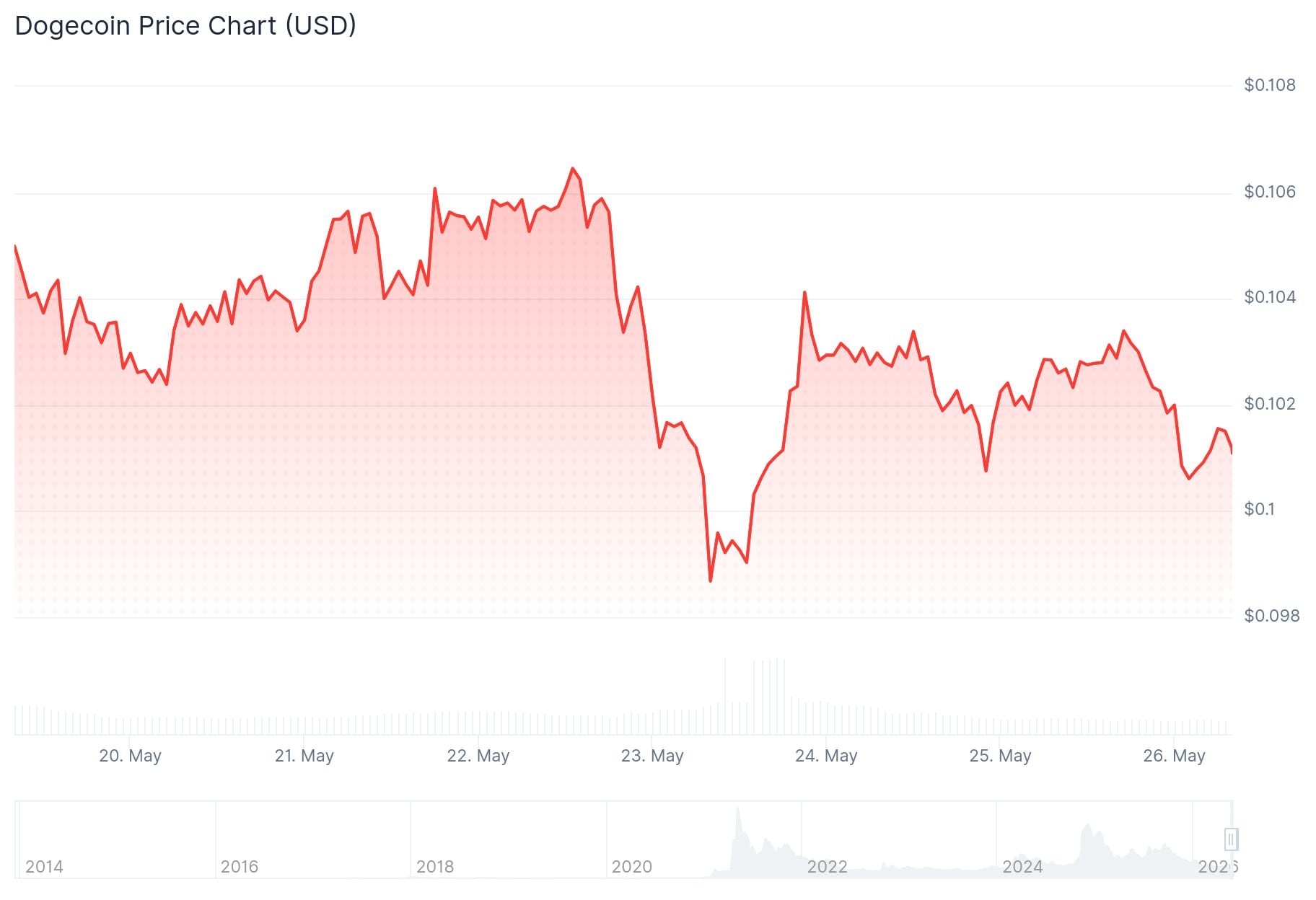
Dogecoin (DOGE) Price: ETF Inflows Hold Steady for Four Weeks as Price Tests Key Support

Chainlink Whale Activity Rises While Price Bleeds for 7 Straight Months
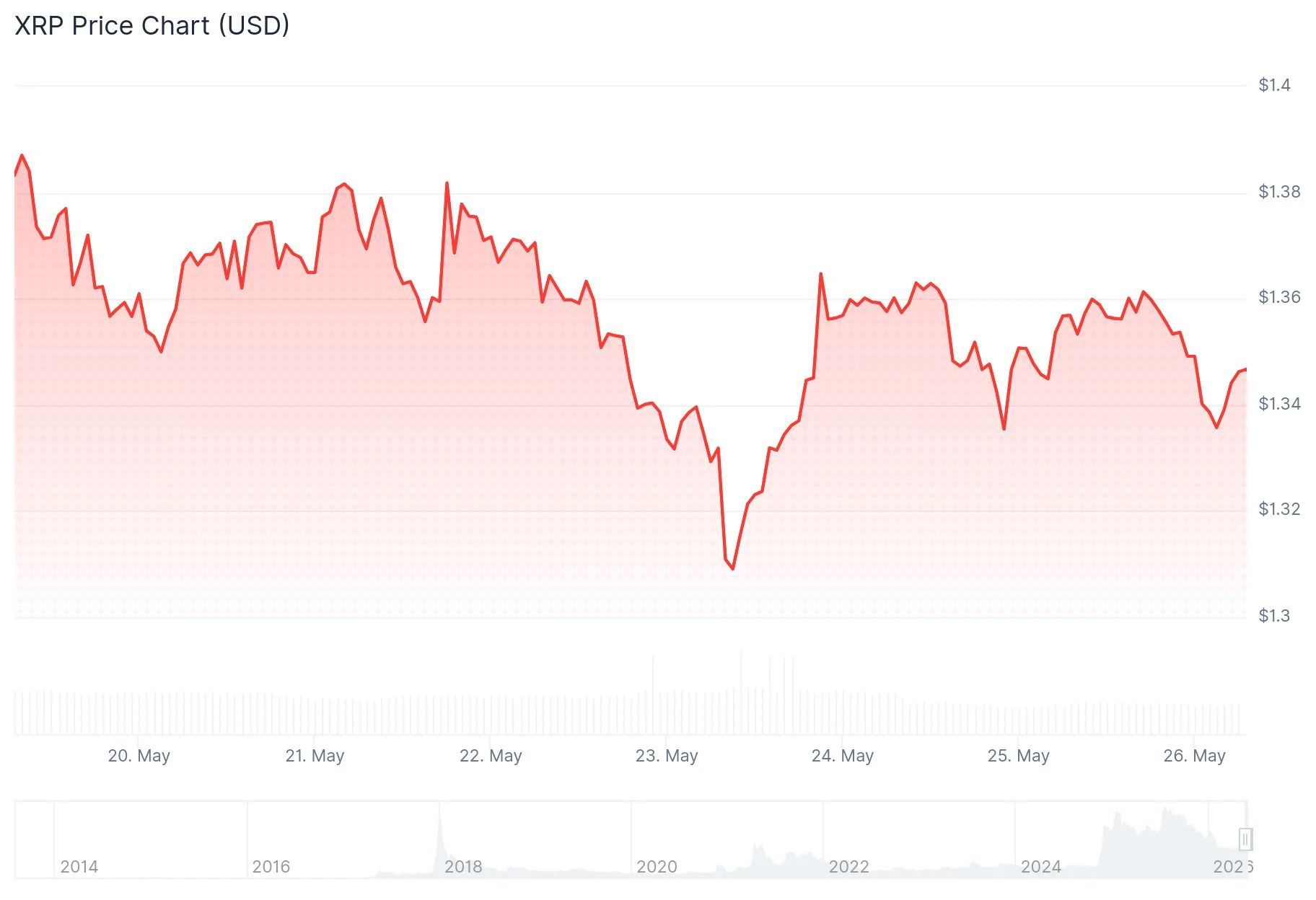
Chris Larsen’s $3.5B XRP Holdings See Fresh Blockchain Movement



