

TC2000 vs. StockCharts vs. Optuma vs. eSignal: Best Professional Charting Software for Serious Traders
Serious traders nowadays do not need more indicators. They need charting software that is fast, stable, analytically deep, and built around how professional technical analysis actually works. The best charting software professionals’ conversation is not about which platform looks the nicest; it is about which one handles real workloads without breaking down. TC2000 vs StockCharts separates scanning-first from breadth-first thinking. Optuma and eSignal push further into institutional territory. This comparison goes beyond surface-level features to look at where each platform genuinely earns its place in a serious trader’s workflow.
Comparison Table
TC2000
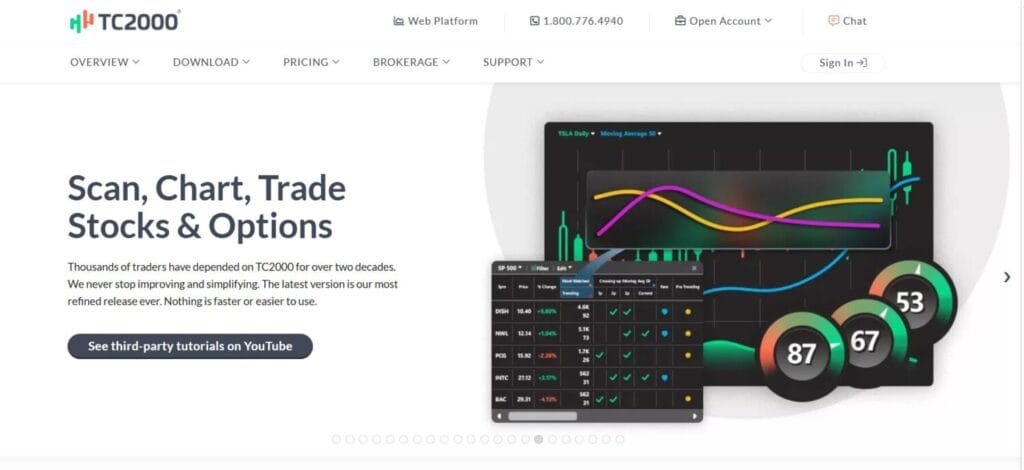
TC2000 has been a fixture of serious US retail trading for over 25 years, and its durability is not accidental. The platform is built around two things it does better than almost anything at its price point: real-time scanning speed and integrated trading from charts. EasyScan, its proprietary screening engine, scans thousands of US and Canadian stocks in under two seconds using combinations of 192 fundamental criteria and 108 technical indicators. That is not a marketing number — it is a functional advantage for traders who run complex condition-based scans multiple times per session.
In any comparison, TC2000 wins clearly on scanning speed, execution integration, and options workflow. StockCharts wins on market breadth data and educational depth. What sets TC2000 apart from every other platform in this comparison is the chart-to-trade pipeline: traders using TC2000 Brokerage can move from a scan result to a chart to an executed order without touching another application. The options integration is similarly tight, with 24 built-in options strategies, live options chains, and direct execution all live inside the charting interface.
Pricing runs from $24.99 to $99.99 per month, with real-time data costing extra. The honest limitation is the absence of automated pattern recognition and backtesting, two areas where TrendSpider and eSignal have a clear edge.
Key Features:
- EasyScan Real-Time Scanner — Scans thousands of US and Canadian stocks in under two seconds using combinations of 192 fundamental criteria and 108 technical indicators, including pre-market data support.
- Condition Wizard — Drag-and-drop scan condition builder that allows traders to create complex multi-criteria scans without writing formulas, lowering the barrier for professional-grade screening.
- Integrated Options Workflow — 24 built-in options strategies with live options chains, volatility analysis, and direct execution from the chart, making TC2000 one of the most complete options-integrated charting platforms available.
StockCharts
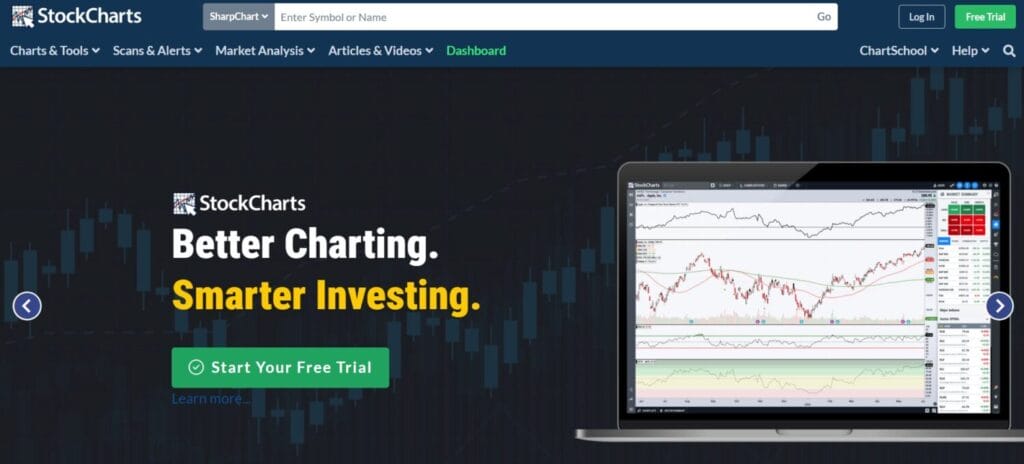
StockCharts has been around since 1999 and maintains a loyal following among technical purists, Chartered Market Technicians (CMTs), and serious swing traders for good reason. It is not the fastest platform in this comparison, and its charts are not the most interactive. What StockCharts offers instead is analytical depth that most modern platforms do not attempt to match: market breadth tools, sector rotation visualisation, and a 25-year legacy of serious technical analysis infrastructure that few web-based competitors can match.
The platform’s most distinctive contribution to the professional charting space is its market breadth suite. Advance-Decline lines, McClellan Oscillators, Bullish Per cent Indexes, and other internal market indicators are available in depth and quality that most platforms simply do not prioritise. Relative Rotation Graphs (RRGs), which StockCharts pioneered for retail use, allow traders to visualise sector and ETF rotation in a way that no standard chart type replicates. ChartSchool remains one of the most comprehensive free libraries of technical analysis and indicators education on the internet, regularly cited by CMT exam candidates.
Paid plans start at $19.95 per month, scaling to $49.95 for Extra and $99.95 for the Elite tier.
Key Features:
- Relative Rotation Graphs (RRG) — A proprietary sector and ETF rotation visualisation tool that plots relative strength against relative momentum, giving traders a unique view of which sectors and asset classes are leading or lagging the market.
- Market Breadth Suite — Comprehensive internal market analysis, including Advance-Decline lines, McClellan Oscillators, Bullish Percent Indexes, and dozens of breadth indicators that most charting platforms do not offer at this depth.
- StockChartsACP (Advanced Charting Platform) — An interactive, drag-and-drop charting engine with real-time streaming api, multiple layout options, and a modern interface designed to complement the legacy SharpCharts engine.
Optuma
Optuma is the most institutionally positioned platform in this comparison. It is built for portfolio managers, buy-side and sell-side analysts, RIAs, and professionally minded private traders who need a tool that goes beyond standard technical analysis into quantitative signal testing, Gann analysis, seasonality charts, and global multi-market workflows. The customer base includes Wall Street departments and fund managers who have been using it for 18+ years.
In any serious Optuma review, the scripting capability stands out immediately. The Optuma Script Language (OSL) is designed to feel as intuitive as Excel formulas while being powerful enough to build custom indicators, automated signals, and quantitative back-testing systems without coding knowledge. Signal testing with Monte Carlo simulation is available on the Enterprise tier — a level of statistical rigor typically found only in institutional-grade software. Multi-monitor support is best-in-class: the platform handles multi-timeframe analysis across different instruments on multiple screens with performance that serious workstation setups demand.
Pricing starts at $67.50 per month for the Trader tier with end-of-day data. The Professional tier runs around $112.50 per month with a data feed, and Enterprise adds 3D charts, full RRGs, and quantitative signal testing.
Key Features:
- Optuma Script Language (OSL) — A proprietary scripting system designed to be as accessible as Excel formulas while powerful enough to build custom indicators, automated signal detection, and strategy testing without traditional programming knowledge.
- Quantitative Signal Testing with Monte Carlo — Available on the Enterprise tier, allows traders and analysts to statistically validate strategy signals using Monte Carlo simulation, bringing institutional-grade back-testing methodology to the desktop.
- Advanced Gann & Seasonality Tools — Comprehensive Gann analysis, including Gann squares, angles, and planetary tools alongside seasonality charts, offering analytical methods rarely available in retail charting platforms.
eSignal
eSignal is the oldest and most institutional-data-focused platform in this comparison. Owned by Intercontinental Exchange (ICE) the same organisation that runs the New York Stock Exchange eSignal’s core value proposition is simple: the fastest, most reliable real-time data feed available to retail traders, connected directly to global exchange infrastructure. For serious day traders and futures professionals who cannot afford data delays or platform instability, that pedigree matters in a way that no subscription-based charting tool can replicate.
The platform connects to a number of brokers for direct-from-chart execution and covers stocks, options, futures, forex, and cryptocurrency markets globally. The eSignal Formula Script (EFS) language allows creation of fully custom indicators and automated strategies, and the Dow Jones Factiva streaming news feed covering over 600 sources is integrated directly into the charting workspace, which is a genuine differentiator for traders who need institutional-grade news alongside their charts. Advanced GET (Elliott Wave analysis) and Options Analytix are available as premium add-ons.
The honest tradeoff is cost and modernity: plans run from $67 per month for Classic to $466 per month for Elite, with additional exchange fees and add-on costs that can push serious setups above $600 per month.
Key Features:
- ICE-Backed Real-Time Data Infrastructure — Direct exchange-level data feeds covering stocks, futures, options, forex, and crypto globally, backed by Intercontinental Exchange, delivering millisecond-level updates with institutional reliability and uptime.
- 50+ Broker Integrations — Direct order routing from charts to over 50 connected brokers including futures commission merchants (FCMs), allowing trade entry, management, and exit without leaving the charting interface.
- Dow Jones Factiva News Integration — Streaming real-time news from over 600 global sources integrated directly into the platform workspace, giving traders institutional-grade breaking news coverage alongside live charts and market data.
Conclusion
The best charting software professionals 2026 will use depends on the kind of professional they are. TC2000 is the right choice for active US stock and options traders who need scanning speed and chart-to-trade execution without complexity. StockCharts is built for technical analysts and CMTs who want market breadth tools and sector rotation analysis that most platforms do not prioritize. Optuma sits in a category of its own for fund managers, portfolio analysts, and serious private traders who need multi-market institutional workflows and quantitative scripting. eSignal remains the strongest choice where data quality and reliability are non-negotiable — particularly for futures professionals and serious day traders for whom milliseconds and uptime matter more than cost.
Frequently Asked Questions (FAQs)
Is TC2000 better than StockCharts for active traders?
For active traders, yes. TC2000’s two-second EasyScan, integrated options execution, and chart-to-trade brokerage workflow make it significantly more practical for intraday and swing traders. StockCharts is better for technical analysts focused on market breadth and sector rotation over price-action trading.
Who is Optuma best suited for?
Optuma is built for professional technical analysts, portfolio managers, RIAs, and fund managers who need multi-market global charting, quantitative signal testing, Gann analysis, and scripting capability. It is explicitly not recommended for traders who only need basic indicators and moving averages.
Why is eSignal so expensive compared to alternatives?
eSignal’s pricing reflects its ICE-backed institutional data infrastructure, 50+ broker integrations, and global exchange coverage. Modern alternatives like TrendSpider offer more chart automation at lower prices, but no retail platform matches eSignal’s data feed pedigree and reliability for professional day trading environments.
Does StockCharts have real-time charting?
Yes, but only through its ACP (Advanced Charting Platform) engine on paid plans. The legacy SharpCharts engine produces static chart images that require manual refresh, which limits its usefulness for active traders monitoring fast-moving price action throughout the day.
Is there a professional charting platform that works on Mac natively?
StockCharts and GoCharting are the strongest browser-based options and work on any device. Optuma and eSignal are Windows-only desktop applications. TC2000 has a web version but performs best on Windows. Mac traders often use a VPS or virtualisation for desktop platforms.


You May Also Like
IREN Limited (IREN) Stock: Climbs as Mirantis Deal Strengthens AI Cloud Push

Monad Brings Tokenized Stocks and Credit On-Chain as Ecosystem Activity Surges in April




