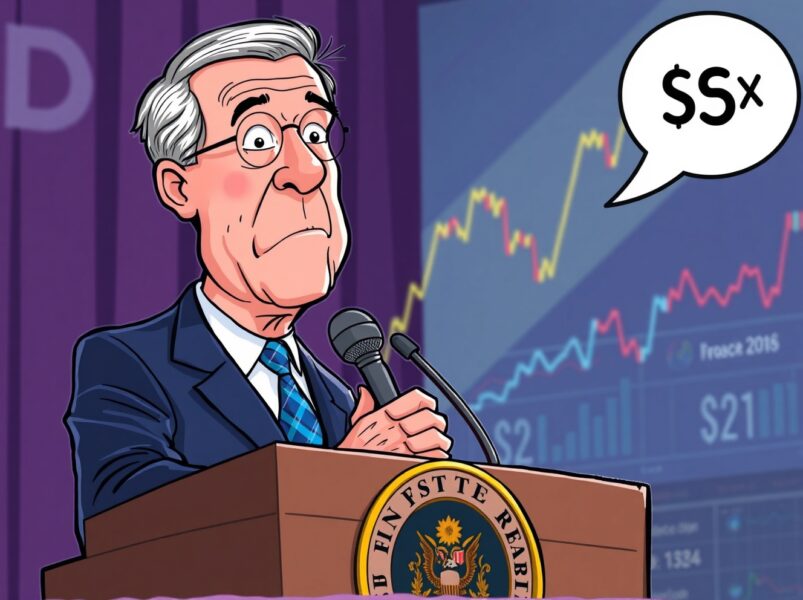
The post Arthur Hayes says Scott Bessent will force the Fed under Treasury control appeared on BitcoinEthereumNews.com. According to Arthur Hayes in his latest essay Four, Seven, Scott Bessent is ready to do what hasn’t been done since World War II; pull the Federal Reserve under the boot of the Treasury and reshape the U.S. economy by force. Arthur says that Scott wants to rip credit creation from the hands of the Fed and private equity and shove it into regional banks, then drown the financial system in new debt and money printing. Arthur says the goal is to stop America’s slide from a global empire to just another strong country. Back in 1942, the Treasury made the Fed cap short-term yields at 0.675% and long-term ones at 2.5%. Arthur points out that the wartime yield curve was steeper than today’s flat or inverted mess. That curve made it safe and profitable for small banks to lend. Scott wants that back. But instead of using war as a reason, he’s using populism and political control. He plans to manipulate yields again, this time with modern tools, and drag America back into industrial dominance using what Arthur called “QE 4 Poor People.” Trump pushes Fed toward yield curve control The Fed doesn’t get to make every decision on its own. Two boards run things: the Federal Reserve Board of Governors (FBOG) and the Federal Open Market Committee (FOMC). Arthur explains the FBOG sets the interest on reserves (IORB) and discount window (DW) lending. The FOMC controls SOMA, the actual mechanism for buying bonds with printed money. Right now, the Fed isn’t playing along. So Trump is stacking the FBOG with loyalists ready to serve Scott’s plan. With four of seven votes, Trump’s Fed governors can slash the interest on banking reserves (IORB), triggering an arbitrage flood where banks borrow at the discount window and lend at higher SOFR… The post Arthur Hayes says Scott Bessent will force the Fed under Treasury control appeared on BitcoinEthereumNews.com. According to Arthur Hayes in his latest essay Four, Seven, Scott Bessent is ready to do what hasn’t been done since World War II; pull the Federal Reserve under the boot of the Treasury and reshape the U.S. economy by force. Arthur says that Scott wants to rip credit creation from the hands of the Fed and private equity and shove it into regional banks, then drown the financial system in new debt and money printing. Arthur says the goal is to stop America’s slide from a global empire to just another strong country. Back in 1942, the Treasury made the Fed cap short-term yields at 0.675% and long-term ones at 2.5%. Arthur points out that the wartime yield curve was steeper than today’s flat or inverted mess. That curve made it safe and profitable for small banks to lend. Scott wants that back. But instead of using war as a reason, he’s using populism and political control. He plans to manipulate yields again, this time with modern tools, and drag America back into industrial dominance using what Arthur called “QE 4 Poor People.” Trump pushes Fed toward yield curve control The Fed doesn’t get to make every decision on its own. Two boards run things: the Federal Reserve Board of Governors (FBOG) and the Federal Open Market Committee (FOMC). Arthur explains the FBOG sets the interest on reserves (IORB) and discount window (DW) lending. The FOMC controls SOMA, the actual mechanism for buying bonds with printed money. Right now, the Fed isn’t playing along. So Trump is stacking the FBOG with loyalists ready to serve Scott’s plan. With four of seven votes, Trump’s Fed governors can slash the interest on banking reserves (IORB), triggering an arbitrage flood where banks borrow at the discount window and lend at higher SOFR…

Arthur Hayes says Scott Bessent will force the Fed under Treasury control

According to Arthur Hayes in his latest essay Four, Seven, Scott Bessent is ready to do what hasn’t been done since World War II; pull the Federal Reserve under the boot of the Treasury and reshape the U.S. economy by force.

Arthur says that Scott wants to rip credit creation from the hands of the Fed and private equity and shove it into regional banks, then drown the financial system in new debt and money printing. Arthur says the goal is to stop America’s slide from a global empire to just another strong country.

Back in 1942, the Treasury made the Fed cap short-term yields at 0.675% and long-term ones at 2.5%. Arthur points out that the wartime yield curve was steeper than today’s flat or inverted mess. That curve made it safe and profitable for small banks to lend. Scott wants that back.

But instead of using war as a reason, he’s using populism and political control. He plans to manipulate yields again, this time with modern tools, and drag America back into industrial dominance using what Arthur called “QE 4 Poor People.”

Trump pushes Fed toward yield curve control

The Fed doesn’t get to make every decision on its own. Two boards run things: the Federal Reserve Board of Governors (FBOG) and the Federal Open Market Committee (FOMC). Arthur explains the FBOG sets the interest on reserves (IORB) and discount window (DW) lending.

The FOMC controls SOMA, the actual mechanism for buying bonds with printed money. Right now, the Fed isn’t playing along. So Trump is stacking the FBOG with loyalists ready to serve Scott’s plan.

With four of seven votes, Trump’s Fed governors can slash the interest on banking reserves (IORB), triggering an arbitrage flood where banks borrow at the discount window and lend at higher SOFR rates. This bleeds the Fed until the FOMC caves and lowers the fed funds rate.

And once the Board controls who gets nominated as district bank presidents, they can approve only doves who’ll toe the line. Five district bank presidents vote on the FOMC each year, and Arthur notes 2026 is a reset year.

The FOMC’s rotating voting districts for 2026 are New York, Cleveland, Minneapolis, Dallas, and Philadelphia. Arthur points out that their boards are stacked with wealthy industrialists who would benefit from loose money.

If they want a seat at the table, they’ll send candidates the Board will approve; those aligned with Scott’s push for more printing and easier policy. With just three of four of those picks, plus New York and the four Trump-aligned FBOG votes, the FOMC is under control.

Treasury uses the Fed to flood the system with cheap debt

With both boards under his thumb, Scott can flip the switch. The FOMC uses SOMA to buy treasuries, capping long-term yields. The Fed prints, buys, repeats. That lets the Treasury issue as much debt as it wants without driving up interest costs. Arthur says this kills the federal deficit and slashes interest expenses, but trashes the dollar.

Cheaper dollars mean American manufacturers can export more, competing with China, Germany, and Japan in the Global South. Regional banks, now free from overregulation, lend to real factories, not to apps or stock buybacks.

With Trump’s Team Red facing midterms in 2026, control must be locked in fast. If Democrats retake the Senate, they’ll block new appointments. Arthur says this is the last window to get full Fed control. That’s why the plan is moving now, not later.

Arthur then does the math. Between now and 2028, the Treasury will need to issue $15.32 trillion in debt; $2 trillion in yearly deficits plus rollovers. During COVID, the Fed bought 40% of new debt. Arthur expects 50% now. He says foreign central banks won’t touch this junk, knowing Trump plans to print nonstop.

Commercial banks will pump out another $7.569 trillion in loans, based on the COVID period’s $2.523 trillion over three years. That puts total new credit at $15.229 trillion. Arthur calculates that for every trillion of credit, Bitcoin rose 19% during COVID. Apply the same ratio, and Bitcoin hits $3.4 million by 2028.

“Do I think Bitcoin will rise to $3.4 million by 2028? No,” Arthur says. “But I believe the number will be markedly higher than the ~$115,000 that it trades at today. My goal is to get the direction of travel correct and be confident that I’m betting on the fastest horse, assuming that Trump is serious about printing trillions of dollars to achieve his policy goals. This model does just that.”

KEY Difference Wire: the secret tool crypto projects use to get guaranteed media coverage

Source: https://www.cryptopolitan.com/arthur-hayes-scott-bessent-fed-treasury/
Market Opportunity
LETSTOP Logo
LETSTOP Price(STOP)
$0.0195
$0.0195$0.0195
-17.02%
USD
LETSTOP (STOP) Live Price Chart
Disclaimer: The articles reposted on this site are sourced from public platforms and are provided for informational purposes only. They do not necessarily reflect the views of MEXC. All rights remain with the original authors. If you believe any content infringes on third-party rights, please contact service@support.mexc.com for removal. MEXC makes no guarantees regarding the accuracy, completeness, or timeliness of the content and is not responsible for any actions taken based on the information provided. The content does not constitute financial, legal, or other professional advice, nor should it be considered a recommendation or endorsement by MEXC.

You May Also Like

Jerome Powell’s Press Conference: Crucial Insights Unveiled for the Market’s Future

Jerome Powell’s Press Conference: Crucial Insights Unveiled for the Market’s Future

BitcoinWorld Jerome Powell’s Press Conference: Crucial Insights Unveiled for the Market’s Future The financial world, including the dynamic cryptocurrency market, often hangs on every word from the Federal Reserve. Recently, Jerome Powell’s press conference following the Federal Open Market Committee (FOMC) meeting concluded, leaving investors and analysts dissecting his remarks for clues about the future economic direction. This event is always a pivotal moment, shaping expectations for inflation, interest rates, and the overall stability of global markets. What Were the Key Takeaways from Jerome Powell’s Press Conference? During Jerome Powell’s press conference, the Fed Chair provided an update on the central bank’s monetary policy decisions and its economic outlook. His statements often reiterate the Fed’s dual mandate: achieving maximum employment and stable prices. This time was no different, with a strong emphasis on managing persistent inflation. Key points from the recent discussion included: Inflation Control: Powell emphasized the Fed’s unwavering commitment to bringing inflation back down to its 2% target. He reiterated that the fight against rising prices remains the top priority, even if it entails some economic slowdown. Interest Rate Policy: While the Fed’s stance on future interest rate adjustments was discussed, the path remains data-dependent. Powell indicated that decisions would continue to be made meeting-by-meeting, based on incoming economic data. Economic Projections: The updated Summary of Economic Projections (SEP) offered insights into the Fed’s forecasts for GDP growth, unemployment, and inflation. These projections help market participants gauge the central bank’s expectations for the economy’s trajectory. Quantitative Tightening (QT): The ongoing process of reducing the Fed’s balance sheet, known as quantitative tightening, was also a topic. This reduction in liquidity in the financial system has broad implications for asset prices. How Did Jerome Powell’s Remarks Impact Cryptocurrency Markets? The conclusion of Jerome Powell’s press conference often sends ripples through traditional financial markets, and cryptocurrencies are increasingly sensitive to these macroeconomic shifts. Digital assets, once thought to be uncorrelated, now frequently react to the Fed’s monetary policy signals. Higher interest rates, for instance, tend to make riskier assets like cryptocurrencies less attractive. This is because investors might prefer safer, interest-bearing investments. Consequently, we often see increased volatility in Bitcoin (BTC) and Ethereum (ETH) prices immediately following such announcements. The tightening of financial conditions, driven by the Fed, reduces overall liquidity in the system, which can put downward pressure on asset valuations across the board. However, some argue that this growing correlation signifies crypto’s increasing integration into the broader financial ecosystem. It suggests that institutional investors and mainstream finance are now paying closer attention to digital assets, treating them more like other risk-on investments. Navigating the Economic Landscape After Jerome Powell’s Press Conference For cryptocurrency investors, understanding the implications of Jerome Powell’s press conference is crucial for making informed decisions. The Fed’s policy trajectory directly influences the availability of capital and investor sentiment, which are key drivers for crypto valuations. Here are some actionable insights for navigating this environment: Stay Informed: Regularly monitor Fed announcements and economic data releases. Understanding the macroeconomic backdrop is as important as analyzing individual crypto projects. Assess Risk Tolerance: In periods of economic uncertainty and tighter monetary policy, a reassessment of personal risk tolerance is wise. Diversification within your crypto portfolio and across different asset classes can mitigate potential downsides. Focus on Fundamentals: While market sentiment can be swayed by macro news, projects with strong fundamentals, clear use cases, and robust development teams tend to perform better in the long run. Long-Term Perspective: Cryptocurrency markets are known for their volatility. Adopting a long-term investment horizon can help weather short-term fluctuations driven by macro events like Fed meetings. The challenges include potential continued volatility and reduced liquidity. However, opportunities may arise from market corrections, allowing strategic investors to accumulate assets at lower prices. In summary, Jerome Powell’s press conference provides essential guidance on the Fed’s economic strategy. Its conclusions have a profound impact on financial markets, including the dynamic world of cryptocurrencies. Staying informed, understanding the nuances of monetary policy, and maintaining a strategic investment approach are paramount for navigating the evolving economic landscape. The Fed’s actions underscore the interconnectedness of traditional finance and the burgeoning digital asset space. Frequently Asked Questions (FAQs) Q1: What is the Federal Open Market Committee (FOMC)? A1: The FOMC is the monetary policy-making body of the Federal Reserve System. It sets the federal funds rate target and directs open market operations, influencing the availability of money and credit in the U.S. economy. Q2: How do the Fed’s interest rate decisions typically affect cryptocurrency markets? A2: Generally, when the Fed raises interest rates, it makes borrowing more expensive and reduces liquidity in the financial system. This often leads investors to shy away from riskier assets like cryptocurrencies, potentially causing prices to decline. Conversely, lower rates can stimulate investment in riskier assets. Q3: What does “data-dependent” mean in the context of Fed policy? A3: “Data-dependent” means that the Federal Reserve’s future monetary policy decisions, such as interest rate adjustments, will primarily be based on the latest economic data. This includes inflation reports, employment figures, and GDP growth, rather than a predetermined schedule. Q4: Should I change my cryptocurrency investment strategy based on Jerome Powell’s press conference? A4: While it’s crucial to be aware of the macroeconomic environment shaped by Jerome Powell’s press conference, drastic changes to a well-researched investment strategy may not always be necessary. It’s recommended to review your portfolio, assess your risk tolerance, and consider if your strategy aligns with the current economic outlook, focusing on long-term fundamentals. If you found this analysis helpful, please consider sharing it with your network! Your insights and shares help us reach more readers interested in the intersection of traditional finance and the exciting world of cryptocurrencies. Spread the word! To learn more about the latest crypto market trends, explore our article on key developments shaping Bitcoin price action. This post Jerome Powell’s Press Conference: Crucial Insights Unveiled for the Market’s Future first appeared on BitcoinWorld.
Share
Coinstats2025/09/18 16:25
Shiba Inu Price Forecast for Feb 9: Here’s Key Overhead Resistance for Any Move Upwards

Shiba Inu Price Forecast for Feb 9: Here’s Key Overhead Resistance for Any Move Upwards

Shiba Inu remains under pressure as resistance cap rebounds, while falling open interest and weak momentum continue to limit upside potential. The Shiba Inu (SHIB
Share
Coinstats2026/02/09 18:10
Australian regulators ease regulations on stablecoin intermediaries

Australian regulators ease regulations on stablecoin intermediaries

PANews reported on September 18th that, according to Decrypt, the Australian Securities and Investments Commission (ASIC) has granted a regulatory exemption to stablecoin intermediaries, allowing them to distribute cryptocurrencies issued by licensed Australian institutions without having to hold a separate financial services license. The exemption, published Thursday, states that intermediaries distributing stablecoins issued by Australian Financial Services (AFS) licensed issuers no longer need to apply for separate AFS, market, or clearing facility licenses. This measure, effective upon registration of federal legislation, is a significant step forward in addressing Australia's regulatory challenges in the stablecoin market. Blockchain APAC CEO Steve Vallas stated that this move is a temporary transition before broader reforms and is consistent with financial services law. The exemption does not change the determination of whether stablecoins are financial products, but simply "suspends the secondary licensing requirement for distributors of licensed issuers," allowing distribution through licensed channels while maintaining issuer liability and requiring intermediaries to provide product disclosure statements to ensure transparency.
Share
PANews2025/09/18 13:25
