Singapore Stablecoin Regulation: What Could MAS Change?
Overview
Singapore is moving to refine its stablecoin framework as the Monetary Authority of Singapore opens a new consultation on proposed amendments linked to the Payment Services Act 2019. The consultation focuses on how stablecoins should be regulated as the market becomes more international, particularly when issuers operate across multiple jurisdictions or when offshore-issued stablecoins seek recognition in Singapore.
The proposed Singapore stablecoin regulation changes are important because stablecoins are no longer used only for crypto trading. They are increasingly involved in payments, cross-border settlement, tokenized securities and institutional liquidity. That creates new questions around reserve location, redemption rights, issuer supervision and which regulator is responsible when a stablecoin serves users across several countries.
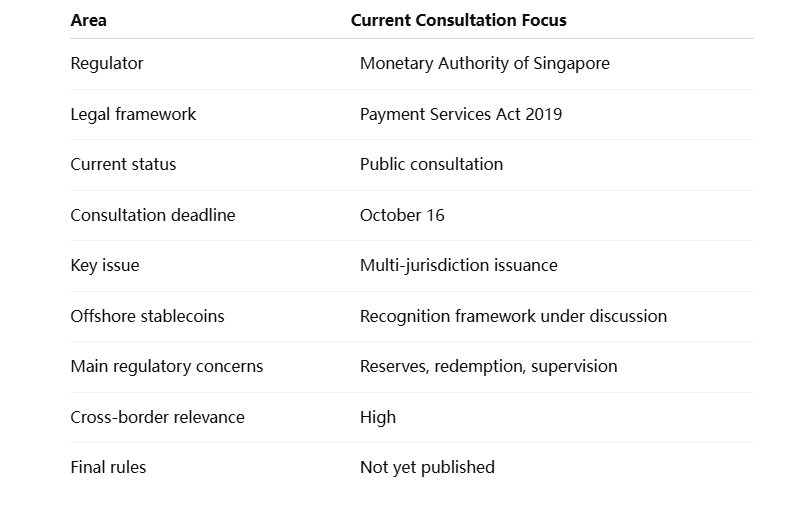
The consultation remains a proposal, not a final rule. Market participants have until October 16 to submit feedback, and the final framework could differ from the draft. The central issue is therefore not whether Singapore is becoming more supportive or restrictive toward stablecoins. It is how MAS plans to apply an existing high-standard regulatory model to products that may be issued, backed and distributed across multiple jurisdictions.
Key Takeaways
- MAS has opened a consultation on proposed changes to Singapore’s stablecoin framework.
- The consultation addresses offshore-issued and multi-jurisdiction stablecoins.
- The feedback period runs until October 16.
- The proposals remain under consultation and are not yet final rules.
- Cross-border recognition, reserve supervision and redemption standards are likely to be key issues.
What Is MAS Proposing for Singapore Stablecoin Regulation?
Why Is MAS Revisiting the Framework?
Singapore already has a detailed regulatory approach to digital payment tokens and stablecoins, but the market has evolved rapidly since the earlier framework was developed.
Stablecoins are now used across exchanges, payment systems, tokenized-asset platforms and cross-border financial infrastructure. A single token may be issued by one entity, backed by reserves held in another jurisdiction and used by customers in several countries.
That creates a regulatory problem. If an issuer operates across multiple legal entities and countries, authorities need to determine which entity is responsible for reserves, redemptions, consumer disclosures and compliance.
The new consultation is designed to address those increasingly complex structures.
When Does the Consultation End?
The consultation closes on October 16.
Until MAS publishes final rules, the proposals should be treated as draft policy rather than binding regulation.
This distinction is important for exchanges, issuers and investors. A consultation can indicate regulatory direction, but final legal requirements may change after public feedback.
Market participants should therefore monitor both the consultation text and the eventual final amendments rather than assuming every proposed provision will be implemented unchanged.
How Could Offshore Stablecoins Be Recognized?
Why Do Multi-Jurisdiction Stablecoins Create Regulatory Problems?
A stablecoin can appear simple to users because one token is designed to equal one dollar. Behind that token, however, the operational structure may be spread across several countries.
For example, the issuer could be incorporated in one jurisdiction, reserves could be held by banks in another, and the token could circulate globally through exchanges and wallets.
If a redemption problem occurs, users need clarity on which entity is legally responsible. Regulators also need to know which authority supervises reserve quality, audit standards and consumer protection.
Multi-jurisdiction issuance therefore introduces coordination risk even when the token itself maintains a stable market price.
Could Foreign Stablecoins Receive Recognition in Singapore?
Potentially, depending on the final framework.
The consultation is exploring how offshore-issued stablecoins could be recognized and under what conditions they could operate within Singapore's regulated payment environment.
A recognition framework could allow MAS to distinguish between foreign stablecoins that meet sufficiently high reserve and redemption standards and those that do not.
This would be important for global stablecoin issuers because Singapore is a major financial and payments hub. A clear recognition pathway could provide greater regulatory certainty for products already issued outside the country.
However, recognition would likely depend on supervision, reserve transparency, redemption arrangements and cooperation between regulators.
Why Does Cross-Border Stablecoin Regulation Matter?
Stablecoins Have Moved Beyond Crypto Trading
Stablecoins originally became popular as trading assets that allowed crypto investors to move between volatile tokens and dollar-linked value.
That use case remains important, but the market is now broader. Stablecoins increasingly support merchant payments, remittances, institutional settlement and the cash side of tokenized-asset transactions.
As stablecoins move into these roles, regulators need to evaluate them more like payment and settlement infrastructure.
A failure at a major issuer could affect more than speculative traders. Businesses, payment providers and tokenized financial markets could also face disruption.
This is why Singapore stablecoin regulation is becoming increasingly focused on operational and cross-border resilience.
Why Is Singapore Especially Relevant?
Singapore is a major international financial center with deep links to banking, payments, asset management and regional cross-border flows.
That makes it a natural market for stablecoin and tokenized-finance experimentation, but it also increases the importance of regulatory clarity.
A stablecoin that operates across Singapore, Hong Kong, Europe and the United States may need to satisfy several different regulatory frameworks at the same time.
Singapore's approach could therefore influence how international issuers design legal entities, reserve structures and redemption processes.
Singapore Stablecoin Regulation Snapshot
How Could the Rules Affect Stablecoin Issuers?
Reserve Management Could Become More Complex
Stablecoin issuers need high-quality liquid reserves that can support redemptions during both normal and stressed market conditions.
Cross-border structures make this more complicated because reserves may sit with banks in different jurisdictions and be subject to different insolvency, custody and regulatory rules.
MAS may therefore focus on whether Singapore users have clear and enforceable claims regardless of where reserves are physically or legally held.
Reserve transparency will also remain important. Users and regulators need reliable information about what backs the token and how quickly those assets can be liquidated.
Redemption Rights Are Central
A stablecoin is only as useful as its ability to be redeemed at or near its stated value.
If users cannot reliably convert a token back into fiat, the market peg may become unstable during periods of stress.
Cross-border issuance can complicate redemption because users may interact with a local distributor while the actual issuer sits abroad.
A strong recognition framework would likely need clear rules on who owes the redemption obligation and how users can exercise that right.
What Could the Rules Mean for Exchanges and Users?
Could Stablecoin Listing Standards Become Clearer?
Potentially.
If MAS creates a defined recognition process for foreign stablecoins, exchanges and payment platforms could have clearer criteria for determining which products meet regulated standards in Singapore.
That could reduce uncertainty around reserve quality, issuer responsibility and redemption.
For users, the benefit would be greater clarity about which stablecoins are operating under recognized regulatory conditions.
However, the final impact will depend on how strict the recognition requirements are and whether major global stablecoin issuers choose to comply.
Could Some Stablecoins Face Higher Barriers?
Yes.
A tighter framework may make it more difficult for issuers with opaque reserve structures, weak redemption rights or limited regulatory supervision to operate in Singapore.
That does not necessarily mean those tokens would disappear globally. It could instead create a more segmented stablecoin market where different products are available in different jurisdictions.
Such fragmentation is already becoming one of the central challenges in global digital-asset regulation.
MEXC View: Stablecoin Regulation Is Moving Into Its Cross-Border Phase
The next stage of stablecoin regulation is increasingly about interoperability between legal systems rather than simply deciding whether stablecoins should exist.
Major jurisdictions are already creating reserve, redemption and licensing rules. The more difficult question is what happens when a stablecoin designed under one framework is used in another market.
For exchanges and users, this matters because the same token may receive different regulatory treatment depending on jurisdiction. Clear recognition standards could reduce uncertainty, but overly fragmented rules could also make global liquidity more complex.
The key development to watch is whether regulators begin accepting equivalent foreign regimes rather than requiring every stablecoin issuer to recreate the same legal structure country by country. If mutual recognition becomes practical, cross-border stablecoin markets could scale more efficiently while maintaining regulatory oversight.
What Are the Biggest Uncertainties?
Final Recognition Standards Are Not Yet Known
The consultation does not guarantee the exact shape of the final framework.
MAS could modify requirements after reviewing industry feedback, especially around foreign issuer recognition, reserve location and supervision.
Issuers therefore cannot treat the draft as a final compliance checklist.
The transition period will also matter. If new rules are introduced, existing stablecoin providers may need time to restructure operations or obtain additional approvals.
Cross-Border Enforcement Remains Difficult
Even with a recognition framework, regulators may face challenges when an issuer fails outside Singapore.
Enforcing claims across jurisdictions can be slower and more complex than supervising a domestic entity directly.
This is why international regulatory cooperation will likely become increasingly important as stablecoins expand.
The strongest stablecoin frameworks may ultimately depend not only on national rules but also on agreements between regulators.
MAS Is Moving From Stablecoin Principles to Cross-Border Detail
The latest Singapore stablecoin regulation consultation reflects how quickly the market has evolved. Stablecoin oversight is no longer limited to questions about whether reserves exist or whether tokens can maintain a one-dollar peg.
The next generation of policy must address where issuers are located, which regulator supervises them and how users are protected when a token crosses national borders.
For Singapore, this is particularly important because the country sits at the center of regional payments and international finance. Offshore-issued stablecoins are likely to remain relevant, but MAS needs a framework that determines when foreign supervision is sufficiently robust for recognition.
The consultation should therefore be viewed as part of a broader shift toward regulatory interoperability. A successful framework could allow global stablecoins to operate across markets without lowering reserve and redemption standards.
At the same time, the details remain unsettled. The consultation closes on October 16, and the final rules may differ materially from the proposals.
The most important question is not whether Singapore is becoming more friendly or hostile toward stablecoins. It is whether MAS can create a cross-border recognition model that preserves trust while allowing digital-dollar liquidity to operate efficiently across jurisdictions.
Sources
https://www.mas.gov.sg/regulation/acts/payment-services-act
https://www.mas.gov.sg/regulation/explainers/regulatory-approach-for-stablecoin-related-activities
Risk Disclaimer: This article is for reference only and does not constitute investment advice. The cryptocurrency market is highly volatile. Please make decisions cautiously based on your individual circumstances.


Можеби ќе ви се допадне и ова
Gold Price Falls Toward $4,300 as Rate-Hike Expectations Return
Robinhood Memecoin: What It Means and Why the Sector Is Growing

Felix Pago Raises $200M: Are Stablecoins Fixing Remittances?