Everyone is talking about the Citrini Research report that sent the market into a tailspin yesterday. Buried in its 7,000 words of wisdom is a huge buy signal forEveryone is talking about the Citrini Research report that sent the market into a tailspin yesterday. Buried in its 7,000 words of wisdom is a huge buy signal for

Solana, Ethereum L2s (and XRP?) Just Got a Huge Buy Signal From Citrini Research

2026/02/25 00:26
5분 읽기

Everyone is talking about the Citrini Research report that sent the market into a tailspin yesterday. Buried in its 7,000 words of wisdom is a huge buy signal for Solana and Ethereum Layer 2s.

The report, entitled The 2028 Global Intelligence Crisis, is a work of fiction that explores a future scenario in which AI disruption leads to what it describes as a “negative feedback loop with no natural brake”.

In short, AI is going to displace white collar workers at an unprecedented rate. It should have been obvious, but we waited until 2028 for the penny to drop…

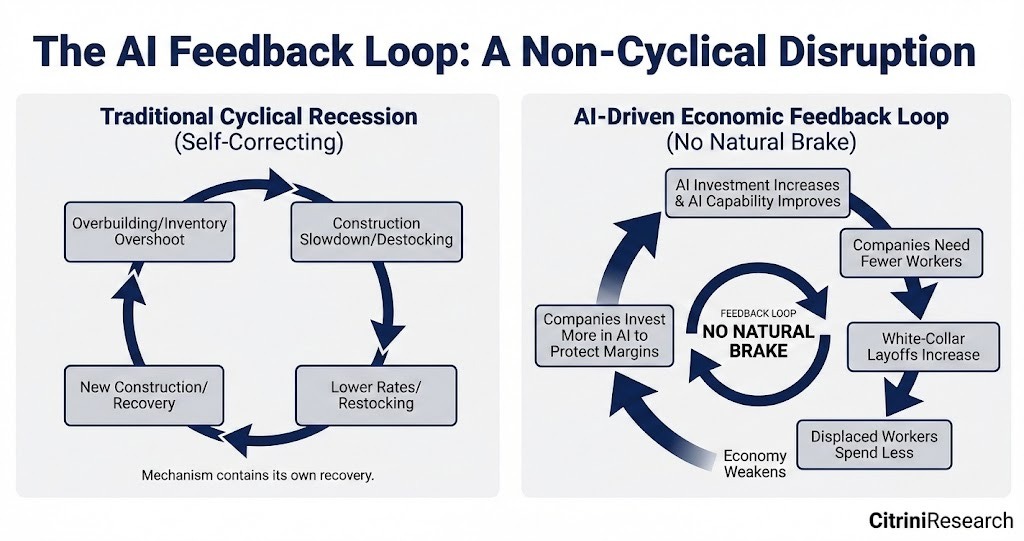
Here’s what that looks like schematically:
Entering an age of abundant intelligence

There is no self-correction as we would expect to see in a typical cyclical recession.

It goes something like this: construction (or other economic activity) slows, rates adjust downwards, allowing businesses to return to expanding output, until overproduction kicks in again, and so on.

In the AI doom loop, AI improves, fewer workers are needed, fewer workers mean less spending, the economy weakens, companies invest in more AI to protect margins, AI gets even better, and the cycle repeats – there is no natural break.

We thought it was a sectoral story. I’m not in Software-as-a-Service (SaaS), so there’s no need to worry. But it is more than software. Much more. It was a comforting notion that AI would usher in an era of creative destruction, as seen in past technological assaults on the old ways of doing things.

Yes, AI will destroy jobs, but, as in the past, new jobs and hitherto unimagined industries would emerge to replace them.

Trouble is, according to Citrini’s scenario, AI is a story of human intelligence displacement. The entire white collar workforce is imperilled. It is the consequence of abundant intelligence.

The authors of the Cetrini report remind us that advanced economies like the US are service-based. The report breaks that down so everyone can understand:

Unfortunately for all of us – white collar, blue collar, whatever – machines don’t buy stuff.

AI agents destroy intermediation – bye bye credit cards, hello stablecoins

The report makes a robust case for how consumer agents will end the age of intermediation.

AI agents operate autonomously on behalf of their human owners, which means they can find the best flight or hotel on the market with ease because they never get tired, don’t find anything monotonous or dull, and never sleep.

The days of companies relying on our laziness or inertia are numbered. Add ‘vibe coding’ to the mix, and a new wave of startups can spin up delivery services apps in a few weeks to compete with DoorDash et al, or automate workflow in a bespoke way that fits your corporate needs more performantly than say Monday. Everywhere, fees are being compressed to near zero.

And then we come to our friends, the banks. Why pay fees to Mastercard and Amex when you can use a stablecoin running on a low-fee blockchain like Solana, or an Ethereum Layer 2 like Base, Arbitrum, Optimism, or Polygon?

And what agentic AI will do for stablecoins could also be applied to cross-border payment protocols like Ripple’s XRP Ledger, although it doesn’t get a mention in this report.

Coinbase has already begun experimenting with a protocol that allows AI agents to make payments on-chain.

The tokenization, disintermediation, agentic AI narrative to beat the bear market blues

Crypto has been looking for a “new” narrative to lift the fog of the bear market. Well, it’s been hiding in plain sight: tokenization, disintermediation, and Agentic AI.

Will that solve the problem of an economy without enough workers getting paid wages and salaries to drive the consumption that companies depend on?

Probably not, but as the report contends, we’ve got time to figure out a solution for that. Taxing the hyperscaler ‘robber barons’ is suggested, but that’s unlikely to go down well with the Lords of the data centers.

In payments, as elsewhere, disruption is coming and everyone – investors, companies, and consumers – needs to start thinking about what it all means.

Consumer behavior is already shifting. Chargebacks911, a global leader in dispute resolution and chargeback prevention, is warning merchants and payments firms that agentic commerce will reshape disputes, as AI systems move from recommending purchases to executing them. Chargebacks are payment reversals initiated by a cardholder’s bank.

For years, most chargebacks fell into three categories: fraud, merchant error, or buyer’s remorse. Agent-initiated transactions create a fourth scenario. The purchase is technically authorised, but the result does not match the customer’s expectations.

“The payments industry has always treated the click as the signal of intent,” says Monica Eaton, founder and CEO of Chargebacks911.

“Agentic commerce removes the click. So now we need a new way to prove intent when a human was not directly involved.”

Keep an eye on your bank account, and welcome to the future.

Report co-author Alap Shah, explains more about the ideas in the report, such as AI-induced ‘ghost GDP’, where value accrues on the balance sheets of the hyperscalers but does not show up in the “human-centric consumer economy”:

시장 기회
리플 로고
리플 가격(XRP)
$1.3042
$1.3042$1.3042
-3.91%
USD
리플 (XRP) 실시간 가격 차트
면책 조항: 본 사이트에 재게시된 글들은 공개 플랫폼에서 가져온 것으로 정보 제공 목적으로만 제공됩니다. 이는 반드시 MEXC의 견해를 반영하는 것은 아닙니다. 모든 권리는 원저자에게 있습니다. 제3자의 권리를 침해하는 콘텐츠가 있다고 판단될 경우, crypto.news@mexc.com으로 연락하여 삭제 요청을 해주시기 바랍니다. MEXC는 콘텐츠의 정확성, 완전성 또는 시의적절성에 대해 어떠한 보증도 하지 않으며, 제공된 정보에 기반하여 취해진 어떠한 조치에 대해서도 책임을 지지 않습니다. 본 콘텐츠는 금융, 법률 또는 기타 전문적인 조언을 구성하지 않으며, MEXC의 추천이나 보증으로 간주되어서는 안 됩니다.

추천 콘텐츠

Morgan Stanley Files For Bank Charter To Offer Crypto Custody And Staking Services — Report

Morgan Stanley Files For Bank Charter To Offer Crypto Custody And Staking Services — Report

The post Morgan Stanley Files For Bank Charter To Offer Crypto Custody And Staking Services — Report appeared on BitcoinEthereumNews.com. Morgan Stanley
공유하기
BitcoinEthereumNews2026/02/28 19:18
Trump Announces Major U.S. Combat Operations in Iran to Counter “Imminent Threats”

Trump Announces Major U.S. Combat Operations in Iran to Counter “Imminent Threats”

Trump Announces Major U.S. Combat Operations in Iran, Citing Imminent Threats President Donald Trump announced that the United States has begun what he descri
공유하기
Hokanews2026/02/28 19:06
Michigan Bitcoin Bill: A Pivotal Step Towards State Crypto Reserves

Michigan Bitcoin Bill: A Pivotal Step Towards State Crypto Reserves

BitcoinWorld Michigan Bitcoin Bill: A Pivotal Step Towards State Crypto Reserves A truly transformative development is unfolding in the heart of the Midwest, capturing the keen attention of cryptocurrency enthusiasts, financial strategists, and policymakers alike. The proposed Michigan Bitcoin bill, officially designated as House Bill 4087 (HB 4087), has successfully cleared its second reading in the Michigan House of Representatives. This pivotal legislative move, if enacted, would grant the state government the unprecedented authority to allocate a significant portion of its budget—specifically up to 10%—into digital assets such as Bitcoin. This advancement marks a potential paradigm shift in how states approach treasury management and investment strategies, positioning Michigan at the forefront of innovative financial policy within the United States. Understanding the Scope of the Michigan Bitcoin Bill (HB 4087) The journey of HB 4087 through the Michigan legislative process has garnered considerable interest. Following its successful second reading, the bill has now been referred to the influential Government Operations Committee for comprehensive review and detailed deliberation. This committee holds a critical responsibility in scrutinizing the practical implications, potential economic impacts, and any inherent challenges associated with such a groundbreaking financial proposal. At its core, this Michigan Bitcoin bill aims to empower the state with the flexibility to strategically diversify its investment portfolio, moving beyond traditional bonds and equities. The proposed 10% allocation limit for cryptocurrency investments suggests a balanced yet progressive approach. It acknowledges both the substantial potential rewards and the inherent volatility characteristic of the digital asset market. Cointelegraph, a respected cryptocurrency news outlet, was among the first to report on this significant progression, underscoring the accelerating mainstream interest in digital currencies among various state governments. Key Provision: Permits investment of up to 10% of the state’s budget in eligible cryptocurrencies. Legislative Status: Passed its second reading; currently under review by the Government Operations Committee. Core Objective: To strategically diversify state treasury investments. What Compels Michigan to Consider a Bitcoin Reserve? Michigan’s proactive exploration of a Bitcoin reserve bill is not an isolated event; rather, it reflects a growing, broader trend of institutional interest in digital assets. There are several compelling economic and strategic reasons why a state might consider such a forward-thinking move, ranging from enhancing economic diversification to strategically positioning itself in the rapidly evolving digital economy. One primary motivation is the potential for substantial returns on investment. Historically, Bitcoin has demonstrated periods of explosive growth, offering a powerful hedge against inflationary pressures and a viable pathway to potentially grow state reserves more rapidly than traditional, lower-yield investments. Furthermore, by openly embracing cryptocurrency, Michigan could significantly signal its commitment to technological innovation. This could, in turn, attract leading blockchain companies, tech startups, and highly skilled talent to the state, fostering a vibrant ecosystem for future economic development. States like Texas and cities like Miami have already begun exploring similar initiatives, recognizing the long-term benefits. Many financial experts suggest that including digital assets in a state’s comprehensive investment strategy could offer: Enhanced Portfolio Diversification: Reducing over-reliance on conventional asset classes. Inflationary Hedge: Bitcoin’s limited supply makes it an attractive asset during periods of economic uncertainty. Technological Leadership: Solidifying Michigan’s reputation as an innovation-friendly state. Stimulated Economic Growth: Attracting crypto and blockchain-related businesses. Navigating the Inherent Challenges of the Michigan Bitcoin Bill While the potential benefits of the Michigan Bitcoin bill are indeed compelling, the path to its successful implementation is undeniably fraught with inherent hurdles. Investing in the cryptocurrency market, particularly in assets like Bitcoin, comes with a unique set of risks that demand meticulous consideration, robust regulatory frameworks, and sophisticated risk management strategies. The most prominent challenge remains market volatility. Cryptocurrency prices are notoriously susceptible to dramatic fluctuations, which could lead to significant gains or, conversely, substantial losses for state funds within relatively short periods. Moreover, the global regulatory landscape for digital assets is still in its nascent stages and continues to evolve, creating an environment of uncertainty that needs careful navigation. The Government Operations Committee will undoubtedly be tasked with thoroughly examining these concerns, working to establish clear, comprehensive guidelines and stringent safeguards to protect the state’s financial interests. Additionally, ensuring the secure management and storage of digital assets is paramount, requiring specialized expertise, cutting-edge infrastructure, and continuous vigilance to prevent cyberattacks or potential loss. Therefore, the successful and responsible implementation of this pioneering legislation will critically depend on: Comprehensive Risk Management: Developing strategies to mitigate market volatility. Clear Regulatory Frameworks: Establishing unambiguous legal and operational guidelines for crypto investments. Advanced Security Measures: Implementing state-of-the-art protocols to protect digital assets. Public Transparency and Education: Ensuring clear communication and understanding among citizens. What’s the Next Step for Michigan’s Pioneering Crypto Legislation? The referral of the Michigan Bitcoin bill to the Government Operations Committee signifies a critical and deliberative phase in its legislative journey. It is expected that the committee will conduct extensive, in-depth hearings, gather expert testimonies from financial professionals and blockchain specialists, and meticulously consider potential amendments to further refine and strengthen the legislation. This rigorous process is absolutely essential to ensure the bill is comprehensive, addresses all conceivable concerns, and ultimately serves the best long-term financial interests of the state and its citizens. Should the bill successfully navigate the committee stage, it would then proceed to a full vote within the Michigan House of Representatives. If approved there, it would then advance to the Senate for their independent review and vote. Finally, if it garners approval from both chambers, the bill would be sent to the Governor for signature, officially becoming law. This multi-stage democratic process underscores the robust checks and balances in place, ensuring thorough scrutiny before any major policy shift. The ongoing discussions and decisions surrounding this landmark bill could indeed set a powerful precedent for other states across the nation that are considering similar innovative investment strategies. In conclusion, the significant advancement of the Michigan Bitcoin bill represents a truly momentous occasion in the evolving and dynamic relationship between state governments and digital currencies. By actively exploring the possibility of investing in Bitcoin, Michigan is not merely seeking new avenues for potential financial growth but is also boldly embracing the future of finance itself. While challenges and complexities undoubtedly exist, the proactive and forward-thinking steps taken by the Michigan House of Representatives unequivocally highlight a commendable willingness to innovate and adapt in an increasingly digital and interconnected world. This legislative journey will be closely watched by financial institutions and governments globally, potentially paving the way for other states to follow suit in exploring the vast and transformative potential of cryptocurrency reserves. Frequently Asked Questions (FAQs) Q1: What is HB 4087? A: HB 4087, or House Bill 4087, is a proposed Michigan Bitcoin bill that would permit the state government to invest a portion of its budget, specifically up to 10%, into cryptocurrencies like Bitcoin. Q2: What does the Michigan Bitcoin bill propose? A: The bill proposes to allow the state of Michigan to diversify its treasury investments by including digital assets, with a cap of 10% of the state’s total budget allocated for such investments. Q3: What are the potential benefits of this bill for Michigan? A: Potential benefits include portfolio diversification, a hedge against inflation, attracting tech innovation and businesses to Michigan, and the possibility of higher returns on state investments. Q4: What are the main challenges associated with state investment in Bitcoin? A: Key challenges involve managing market volatility, navigating an evolving regulatory landscape, ensuring robust security measures for digital assets, and maintaining public transparency and understanding. Q5: What are the next steps for the Michigan Bitcoin bill? A: After passing its second reading, the bill has been sent to the Government Operations Committee for further review. If approved there, it will proceed to a full House vote, then the Senate, and finally to the Governor for signature to become law. Share This Insight Did you find this update on Michigan’s pioneering crypto legislation insightful? Share this article with your network on social media to spread awareness about the evolving landscape of state government and cryptocurrency. Your engagement helps us foster informed discussions about the future of finance! To learn more about the latest crypto market trends, explore our article on key developments shaping Bitcoin institutional adoption. This post Michigan Bitcoin Bill: A Pivotal Step Towards State Crypto Reserves first appeared on BitcoinWorld.
공유하기
Coinstats2025/09/20 00:40