

70 Economists Urge EU to Launch Public Digital Euro Over Private Stablecoins
Seventy European economists have called on EU lawmakers to prioritize public interest over private-sector lobbying in shaping the digital euro, warning that poor design choices could leave Europe dependent on foreign payment systems and dollar-backed stablecoins.
The open letter, published Sunday by Utrecht University’s Sustainable Finance Lab, comes as the European Parliament prepares to finalize legislation that will determine whether the digital currency becomes a meaningful alternative to private money or a “symbolic compromise.”
The academics argue that Europe’s payment infrastructure has become dangerously concentrated in non-European hands, with thirteen euro area countries now relying entirely on international card schemes for basic retail transactions.
“This dependence on foreign (US) payment providers exposes European citizens, businesses, and governments to geopolitical leverage, foreign commercial interests, and systemic risks beyond Europe’s control,” the letter states, adding that U.S.-backed private digital currencies are gaining ground while Europe deliberates.
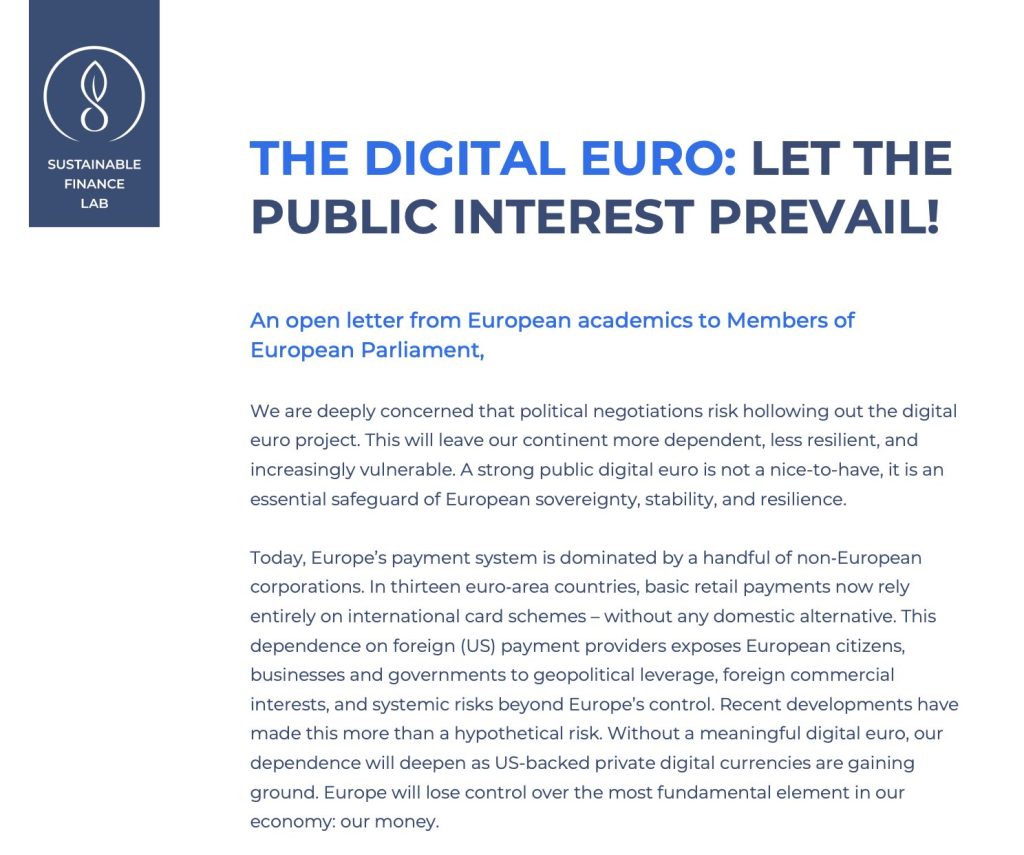 Open Letter to MEP. | Source: Sustainable Finance Lab
Strong Design Features Essential for Digital Euro Success
The signatories, including former central bank governors and prominent economists such as Thomas Piketty and Paul De Grauwe, demand three core features.
The digital euro must function as “the backbone of a sovereign, resilient European payment infrastructure based on domestic providers adopting the highest privacy standards,” serve as “public digital money accessible to all Europeans, supporting financial inclusion,” and offer “a credible store of value through a generous and gradually rising holding limit.“
Without these elements, the economists warn that the project will fail.
“If a large part of European companies is excluded or allowed to refuse it, or if holding limits remain so low that citizens cannot use it as a serious store of value, then the digital euro will fail to realise its potential,” they write.
The letter describes the stakes in stark terms, asking whether Europeans will “assert control over their money in the digital age, or do we allow others to control it for us?“
ECB Officials Position Digital Euro Alongside Safe Asset Expansion
ECB Executive Board member Philip Lane reinforced the strategic case in a January 9 speech to the Danish Economic Society, framing the digital euro within broader efforts to strengthen Europe’s financial architecture.
Lane argued that structural changes, including geopolitical shifts, digitalization, and climate change, represent common shocks best handled through monetary union, with the digital euro providing “retail central bank money in digital form” as transaction systems evolve.

ECB Philip Lane. Source: CEPR
Lane also addressed Europe’s shortage of safe assets, noting that the German Bund alone cannot meet global demand for euro-denominated securities.
He outlined potential solutions, including expanded common bonds for European public goods and the “blue bond/red bond” reform, where member states would ring-fence tax revenues to back jointly issued securities.
“The shared pay-off would be the reduction in debt servicing costs generated by the safe asset services provided by an expanded stock of common debt,” Lane said.
Timeline Advances as Political Negotiations Continue
Technical preparations are nearing completion following the ECB’s October decision to move into the readiness phase.
ECB President Christine Lagarde confirmed last month that “we have done our work, we have carried the water,” placing responsibility on EU institutions to finalize legislation.
Board member Piero Cipollone previously indicated that pilot transactions could begin mid-2027, with the first issuance possible in 2029 if lawmakers approve the framework next year.
Last month, the EU Council also agreed on its negotiating position, establishing a framework that includes both online and offline payment options.
The offline version would allow device-to-device transactions without internet access, offering privacy comparable to cash for low-value payments while maintaining anti-money laundering compliance for wallet funding.
Lagarde emphasized that the digital euro would complement physical currency under Europe’s Markets in Crypto-Assets Regulation, describing MiCA-compliant stablecoins as “an alternative form of payment” that can be “regarded as safe.”
Public acceptance remains uncertain, with recent ECB surveys showing many Europeans see limited need for the new payment option despite official assurances.
추천 콘텐츠

Trouble for US Crypto Reform?

WIF Price Prediction: Targets $0.45 by February Amid Mixed Technical Signals
