Bitcoin ($BTC) sits at the top of the crypto food chain with a market cap larger than some nations’ GDPs.Bitcoin ($BTC) sits at the top of the crypto food chain with a market cap larger than some nations’ GDPs.

Bitcoin Hyper Explained: Fastest Bitcoin Layer-2 Nears $19M Presale

2025/09/29 20:49
Bitcoin Hyper Explained: Fastest Bitcoin Layer-2 Nears $19M Presale

Yet for all its dominance, the network still struggles with a basic problem: speed. Bitcoin processes around seven transactions per second (TPS), making it slow, expensive, and unsuitable for today’s demands like dApps, DeFi, or even meme coins. During peak periods, fees can spike above $100, pricing out everyday users who simply want to move their $BTC.

That gap is where Bitcoin Hyper ($HYPER) steps in. It plans to introduce a Bitcoin Layer-2, integrating Solana’s Virtual Machine (SVM) to deliver sub-second transactions, near-zero fees, and cross-chain access from day one.

The concept has clearly struck a nerve. Its presale has already pulled in close to $19M. If you want to understand why investors are piling in, now’s the time to pay attention.

The Problem Bitcoin Still Hasn’t Solved

Bitcoin ($BTC) remains surprisingly clunky in 2025. The network averages around nine TPS in real-time, while Solana ($SOL) clears more than 770 TPS – around 85x faster.

At peak, Bitcoin might touch 13 TPS, but Solana’s max throughput has hit 4.7K TPS in recent blocks, with a theoretical ceiling above 65K TPS. That gap shows just how far behind Bitcoin lags in terms of raw scalability.
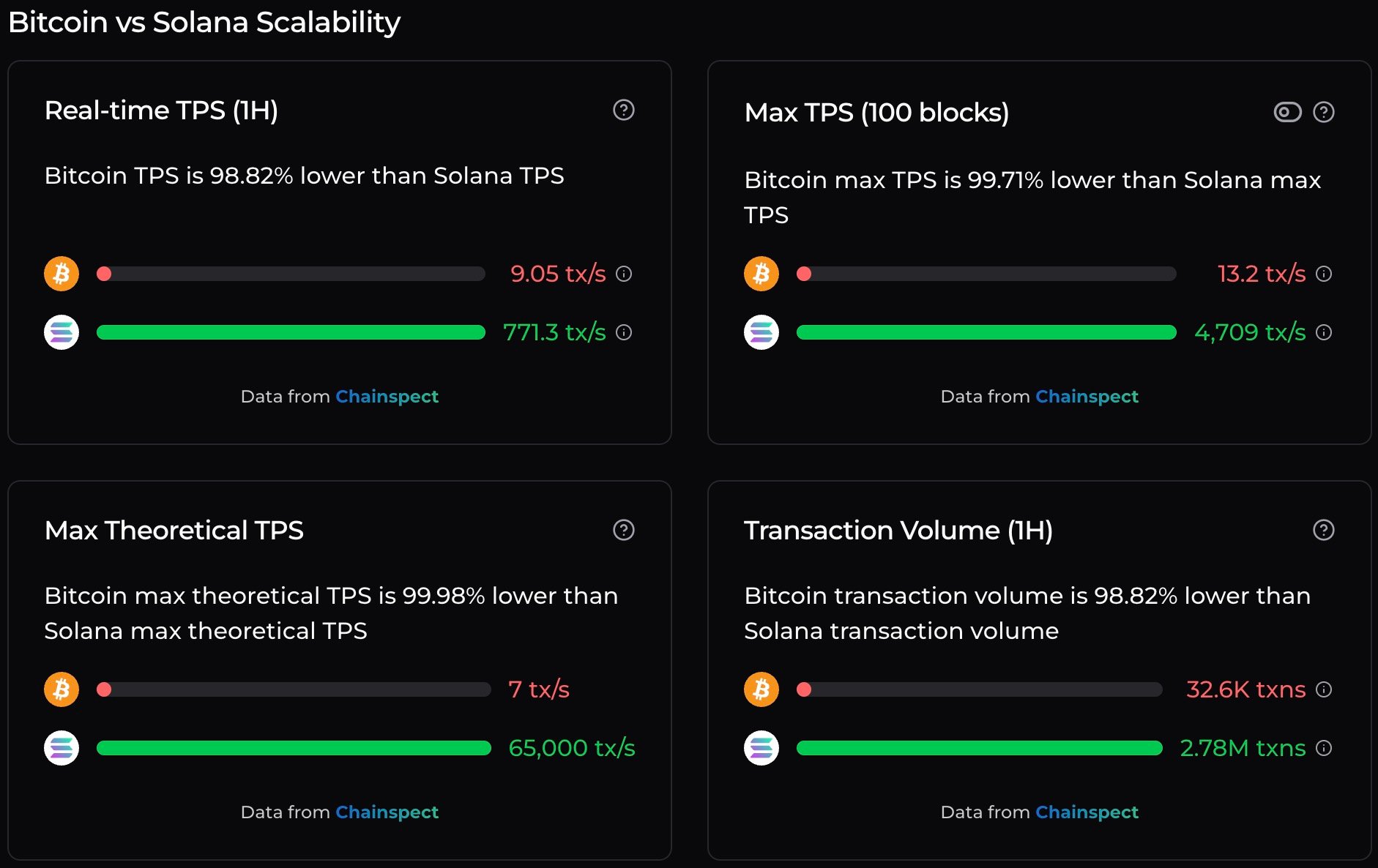
Bitcoin vs Solana scalability comparison.

Source: Chainspect

And block times don’t help. With 10 minutes between confirmations, using Bitcoin for everyday payments feels outdated in a world where people expect instant settlement.

Fees are another sticking point. In April 2024, during the launch of the Runes protocol, average Bitcoin fees spiked above $120 as a result of high congestion, making small payments not only impractical but downright absurd. Imagine trying to buy a $4 coffee and having to pay $120 just to settle it.

The surge in ordinals and BRC-20 meme coin activity in 2023–2024 filled blockspace, driving fees higher and leaving regular $BTC transactions stuck in the queue.

At the same time, ETFs have made Bitcoin easier to hold, but not easier to use. Bitcoin remains unmatched as a store of value. But as an execution layer, it’s still missing critical components. And that’s exactly where Bitcoin Hyper ($HYPER) aims to change the game.

The Bitcoin Hyper Solution

Bitcoin Hyper ($HYPER) brings a unique Layer-2 proposal – built directly on Bitcoin – to the table, using the SVM as its engine. The pitch? Bitcoin remains the monetary base layer, while Hyper acts as its execution layer.

Here’s how it works:

You bridge Bitcoin into the system, and the protocol will mint an equivalent amount on Hyper’s Layer-2. From there, you’ll be able to send, stake, or trade it instantly with near-zero fees. Transactions will be bundled and proven valid using zero-knowledge proofs, and then settled back onto Bitcoin’s Layer-1. That will keep security intact while unlocking speed and scale.
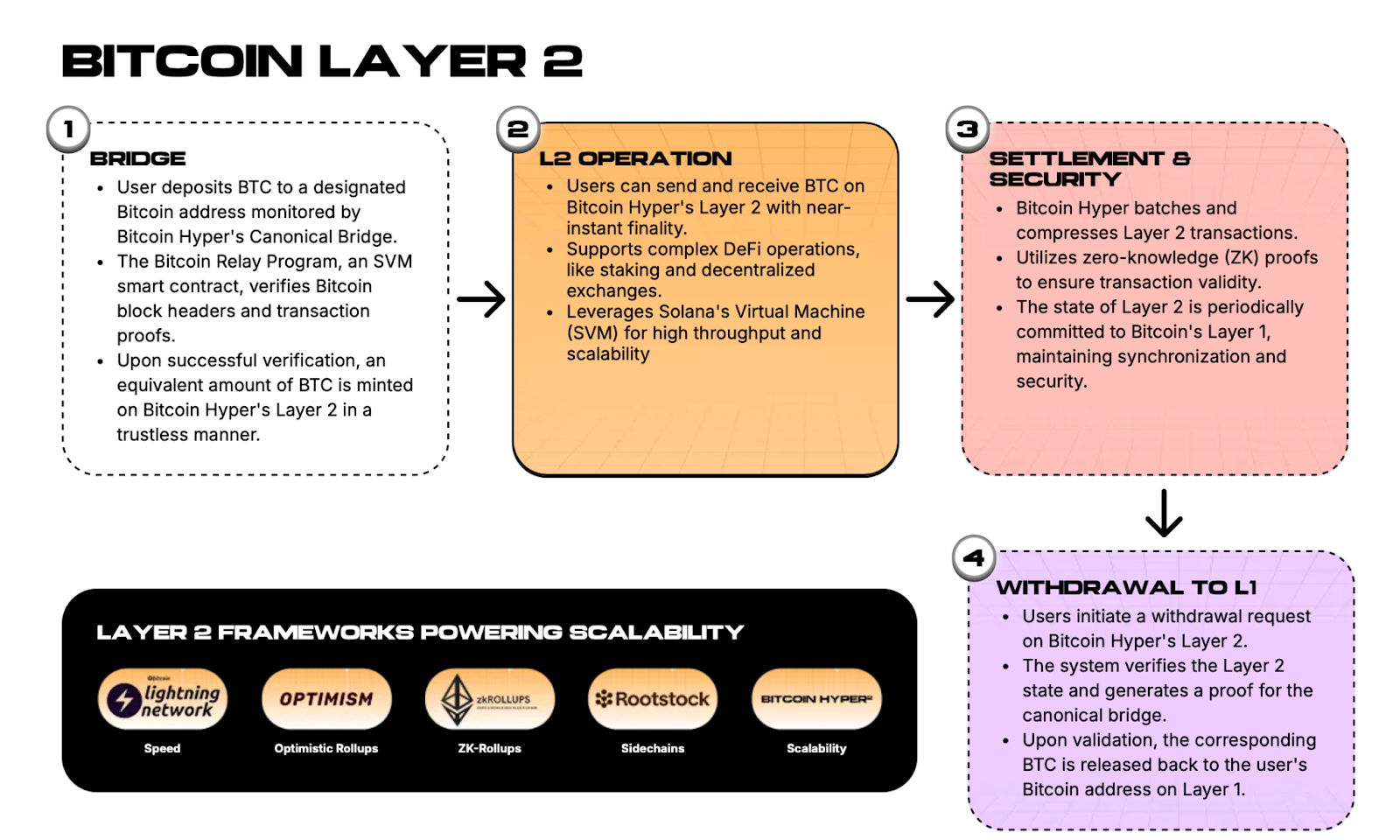
Bitcoin Hyper’s Layer-2 architecture.

SVM integration is crucial to Hyper’s solution. Solana has proven it can push real throughput into the hundreds of thousands of TPS. By using the same framework, Bitcoin Hyper will inherit this raw performance while adding seamless compatibility with Solana’s existing ecosystem of apps and tools.

This opens doors that Bitcoin alone has never managed to push through. DeFi protocols, lending markets, meme coins, DAOs, and even micro-payments will suddenly become viable on Bitcoin. Cross-chain support from day one will also mean assets can move freely between $BTC, $ETH, and $SOL without friction.

The best way to think about it: Bitcoin is the vault, Hyper is the mall built around it. The vault holds the value; the mall is where all the activity happens.

Discover more about this Layer-2 ecosystem in our complete Bitcoin Hyper review.

The Financial Side – Presale & Tokenomics

Momentum around Bitcoin Hyper’s presale has been building quickly. The project has already raised more than $18.8M, with the $HYPER token currently priced at $0.012995. That’s a low entry point for what the dev team positions as the execution layer for Bitcoin. In fact, our Bitcoin Hyper prediction sees the possibility of $HYPER reaching $1.20 by 2030.

Presale buyers aren’t just speculating on price. They can already stake their tokens at a 63% APY, effectively putting their coins to work before exchanges even list $HYPER. If you’re thinking of investing in Bitcoin Hyper, take a look at our step-by-step guide to buying $HYPER.
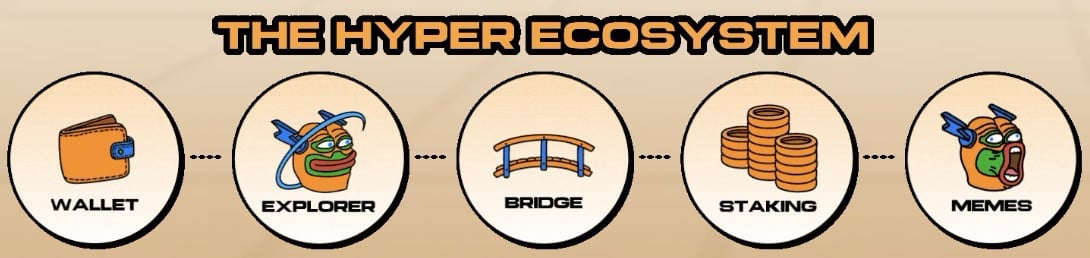
The Bitcoin Hyper ($HYPER) ecosystem.

$HYPER itself plays a central role in the ecosystem. It fuels gas fees, powers staking, underpins governance, and provides access to upcoming token launches on the network. If Bitcoin Hyper develops into the primary playground for Bitcoin-native apps and memes, $HYPER becomes the ticket to entry.

Large buyers appear to agree with that thesis. Whale buys of $161.3K, $100.6K, $74.9K, and more are flowing into the presale – a sign that deeper pockets see value in the early price.

The presale offers $HYPER at its cheapest, with listing prices expected to climb once exchanges open trading. For investors who believe in Bitcoin’s next phase, the incentive is clear: early entry secures first-mover advantage.

Could $HYPER Push Bitcoin Even Higher?

Bitcoin already controls more than 50% of the entire crypto market cap, sitting at around $112K with a market cap of $2.23T – a dominance that has held for years despite waves of competition.
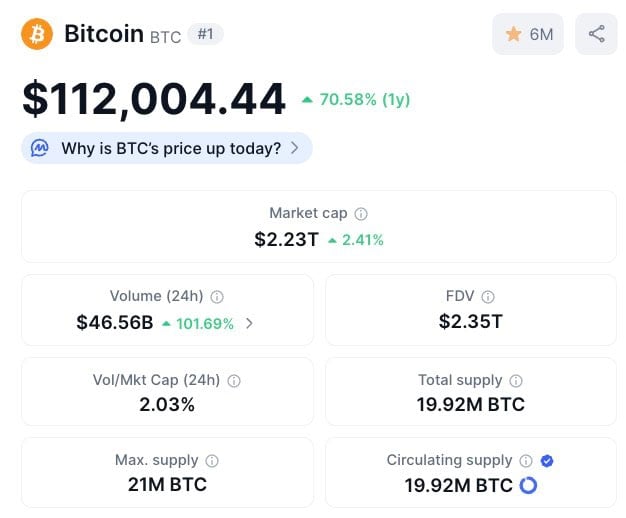
Bitcoin ($BTC) price, market cap, volume, and more.

Source: CoinMarketCap

Yet Bitcoin has been largely seen as a vault… The place you store value; not the place you build. Scaling through Bitcoin Hyper changes that equation. Instead of waiting 10 minutes for a transaction, you could send $BTC instantly with negligible fees.

Suddenly, Bitcoin isn’t just a passive asset; it’s the foundation of a culture of builders and retail activity. Memes, DAOs, dApps, and even micro-payments could all run directly on Bitcoin’s rails.

And if Ethereum’s 2017 pivot into dApps turned it from a payments network into a global platform, Bitcoin Hyper could mark a similar inflection point – one that takes Bitcoin beyond ‘digital gold.’

Considering Bitcoin Hyper’s potential as a game-changer for $BTC, it’s no wonder the presale is nearing the $19M milestone, with no signs of losing momentum. And it’s a play that sets up $HYPER as one of the best presales of the 2025.
Ready to jump in? Visit the official Bitcoin Hyper ($HYPER) presale today.
시장 기회
Hyperlane 로고
Hyperlane 가격(HYPER)
$0.14003
$0.14003$0.14003
+1.39%
USD
Hyperlane (HYPER) 실시간 가격 차트
면책 조항: 본 사이트에 재게시된 글들은 공개 플랫폼에서 가져온 것으로 정보 제공 목적으로만 제공됩니다. 이는 반드시 MEXC의 견해를 반영하는 것은 아닙니다. 모든 권리는 원저자에게 있습니다. 제3자의 권리를 침해하는 콘텐츠가 있다고 판단될 경우, service@support.mexc.com으로 연락하여 삭제 요청을 해주시기 바랍니다. MEXC는 콘텐츠의 정확성, 완전성 또는 시의적절성에 대해 어떠한 보증도 하지 않으며, 제공된 정보에 기반하여 취해진 어떠한 조치에 대해서도 책임을 지지 않습니다. 본 콘텐츠는 금융, 법률 또는 기타 전문적인 조언을 구성하지 않으며, MEXC의 추천이나 보증으로 간주되어서는 안 됩니다.

추천 콘텐츠

Fed rate decision September 2025

Fed rate decision September 2025

The post Fed rate decision September 2025 appeared on BitcoinEthereumNews.com. WASHINGTON – The Federal Reserve on Wednesday approved a widely anticipated rate cut and signaled that two more are on the way before the end of the year as concerns intensified over the U.S. labor market. In an 11-to-1 vote signaling less dissent than Wall Street had anticipated, the Federal Open Market Committee lowered its benchmark overnight lending rate by a quarter percentage point. The decision puts the overnight funds rate in a range between 4.00%-4.25%. Newly-installed Governor Stephen Miran was the only policymaker voting against the quarter-point move, instead advocating for a half-point cut. Governors Michelle Bowman and Christopher Waller, looked at for possible additional dissents, both voted for the 25-basis point reduction. All were appointed by President Donald Trump, who has badgered the Fed all summer to cut not merely in its traditional quarter-point moves but to lower the fed funds rate quickly and aggressively. In the post-meeting statement, the committee again characterized economic activity as having “moderated” but added language saying that “job gains have slowed” and noted that inflation “has moved up and remains somewhat elevated.” Lower job growth and higher inflation are in conflict with the Fed’s twin goals of stable prices and full employment.  “Uncertainty about the economic outlook remains elevated” the Fed statement said. “The Committee is attentive to the risks to both sides of its dual mandate and judges that downside risks to employment have risen.” Markets showed mixed reaction to the developments, with the Dow Jones Industrial Average up more than 300 points but the S&P 500 and Nasdaq Composite posting losses. Treasury yields were modestly lower. At his post-meeting news conference, Fed Chair Jerome Powell echoed the concerns about the labor market. “The marked slowing in both the supply of and demand for workers is unusual in this less dynamic…
공유하기
BitcoinEthereumNews2025/09/18 02:44
3 Paradoxes of Altcoin Season in September

3 Paradoxes of Altcoin Season in September

The post 3 Paradoxes of Altcoin Season in September appeared on BitcoinEthereumNews.com. Analyses and data indicate that the crypto market is experiencing its most active altcoin season since early 2025, with many altcoins outperforming Bitcoin. However, behind this excitement lies a paradox. Most retail investors remain uneasy as their portfolios show little to no profit. This article outlines the main reasons behind this situation. Altcoin Market Cap Rises but Dominance Shrinks Sponsored TradingView data shows that the TOTAL3 market cap (excluding BTC and ETH) reached a new high of over $1.1 trillion in September. Yet the share of OTHERS (excluding the top 10) has declined since 2022, now standing at just 8%. OTHERS Dominance And TOTAL3 Capitalization. Source: TradingView. In past cycles, such as 2017 and 2021, TOTAL3 and OTHERS.D rose together. That trend reflected capital flowing not only into large-cap altcoins but also into mid-cap and low-cap ones. The current divergence shows that capital is concentrated in stablecoins and a handful of top-10 altcoins such as SOL, XRP, BNB, DOG, HYPE, and LINK. Smaller altcoins receive far less liquidity, making it hard for their prices to return to levels where investors previously bought. This creates a situation where only a few win while most face losses. Retail investors also tend to diversify across many coins instead of adding size to top altcoins. That explains why many portfolios remain stagnant despite a broader market rally. Sponsored “Position sizing is everything. Many people hold 25–30 tokens at once. A 100x on a token that makes up only 1% of your portfolio won’t meaningfully change your life. It’s better to make a few high-conviction bets than to overdiversify,” analyst The DeFi Investor said. Altcoin Index Surges but Investor Sentiment Remains Cautious The Altcoin Season Index from Blockchain Center now stands at 80 points. This indicates that over 80% of the top 50 altcoins outperformed…
공유하기
BitcoinEthereumNews2025/09/18 01:43
Bitcoin devs cheer block reconstruction stats, ignore security budget concerns

Bitcoin devs cheer block reconstruction stats, ignore security budget concerns

The post Bitcoin devs cheer block reconstruction stats, ignore security budget concerns appeared on BitcoinEthereumNews.com. This morning, Bitcoin Core developers celebrated improved block reconstruction statistics for node operators while conveniently ignoring the reason for these statistics — the downward trend in fees for Bitcoin’s security budget. Reacting with heart emojis and thumbs up to a green chart showing over 80% “successful compact block reconstructions without any requested transactions,” they conveniently omitted red trend lines of the fees that Bitcoin users pay for mining security which powered those green statistics. Block reconstructions occur when a node requests additional information about transactions within a compact block. Although compact blocks allow nodes to quickly relay valid bundles of transactions across the internet, the more frequently that nodes can reconstruct without extra, cumbersome transaction requests from their peers is a positive trend. Because so many nodes switched over in August to relay transactions bidding 0.1 sat/vB across their mempools, nodes now have to request less transaction data to reconstruct blocks containing sub-1 sat/vB transactions. After nodes switched over in August to accept and relay pending transactions bidding less than 1 sat/vB, disparate mempools became harmonized as most nodes had a better view of which transactions would likely join upcoming blocks. As a result, block reconstruction times improved, as nodes needed less information about these sub-1 sat/vB transactions. In July, several miners admitted that user demand for Bitcoin blockspace had persisted at such a low that they were willing to accept transaction fees of just 0.1 satoshi per virtual byte — 90% lower than their prior 1 sat/vB minimum. With so many blocks partially empty, they succumbed to the temptation to accept at least something — even 1 billionth of one bitcoin (BTC) — rather than $0 to fill up some of the excess blockspace. Read more: Bitcoin’s transaction fees have fallen to a multi-year low Green stats for block reconstruction after transaction fees crash After…
공유하기
BitcoinEthereumNews2025/09/18 04:07