The FTX Recovery Trust has filed a $1.15 billion lawsuit against the Bitcoin mining firm Genesis Digital Assets, alleging fraudulent transfers. The complaint, filed on Monday in U.S. Bankruptcy Court for the District of Delaware, alleges that Sam Bankman-Fried used misappropriated FTX customer funds to purchase Genesis Digital shares at “outrageously inflated prices” through his hedge fund, Alameda Research, between August 2021 and April 2022. Genesis Digital co-founders Rashit Makhat and Marco Krohn received $470 million and $80.9 million, respectively, for their shares in February 2022, according to court documents. The trust contends that only Alameda, and by extension Bankman-Fried, as its 90% owner, benefited from the investments, while FTX customers and creditors suffered losses from the diverted exchange funds.Court Document (Source: Bloomberg Law) Genesis Investment Timeline Reveals Systematic Fund Diversion Court documents reveal that discussions between Bankman-Fried and Genesis Digital began in July 2021, when the Kazakhstan-based mining company was seeking capital to expand its operations into the United States. Bankman-Fried joined Genesis Digital’s board in October 2021, according to Bloomberg, positioning himself to oversee what would become one of Alameda’s largest venture investments. The complaint describes how the FTX founder caused Alameda to purchase multiple tranches of Genesis shares over an eight-month period, with the lawsuit characterizing Genesis as “one of Bankman-Fried’s most reckless investments with commingled and misappropriated funds.“ Between August 2021 and April 2022, Alameda invested $1.15 billion across four distinct funding rounds: $100 million in August 2021, $550 million in January 2022, $250 million in February, and $250 million in April 2022. The trust alleges that FTX insiders regularly caused Alameda to “borrow” billions from the FTX.com exchange to fund “profligate lifestyles and vanity investments” while hiding the source of these funds from investors and creditors. Bankman-Fried resigned from Genesis Digital’s board one day before FTX filed for bankruptcy in November 2022, according to the court filing. Mining Sector Faces Renewed Scrutiny Amid FTX Fallout The Genesis Digital lawsuit is the latest effort by FTX’s bankruptcy estate to recover assets for creditors, with the trust having already distributed $6.2 billion across two previous rounds of payments. The trust completed a $1.2 billion distribution in February, followed by a larger $5 billion payout in May, with an additional $1.6 billion distribution scheduled for September 30, bringing total recoveries to nearly half of the $16.5 billion earmarked for victims. These recovery efforts come as Genesis Digital, which operates over 500 megawatts of mining capacity across 20 data centers on four continents, saw its valuation reach $5.5 billion during an April 2022 fundraising round shortly before cryptocurrency prices collapsed later that year. The mining company was exploring an initial public offering in the United States as recently as July 2024, working with advisors to evaluate a potential listing and planning a pre-IPO funding round amid the crypto industry’s recovery from the 2022 market downturn. However, the FTX lawsuit adds another layer of complexity to Genesis Digital’s corporate structure, which includes an extensive network of U.S. subsidiaries with names like Dog House TX-1, Mother Whale LLC, and White Deer LLC. The complaint alleges that these U.S. subsidiaries operate as “alter egos” of the parent company, potentially exposing the entire corporate structure to clawback claims under both federal bankruptcy law and Delaware state fraudulent transfer statutes. Meanwhile, Bankman-Fried continues to serve his 25-year prison sentence following his conviction on seven felony charges, with oral arguments for his appeal scheduled for November 4, 2025. The lawsuit adds to the complex web of litigation following the $175 million settlement earlier this year with Genesis Global, a subsidiary of Digital Currency Group, as creditors and bankruptcy trustees pursue recovery efforts across multiple jurisdictions and corporate entities tied to the failed exchangeThe FTX Recovery Trust has filed a $1.15 billion lawsuit against the Bitcoin mining firm Genesis Digital Assets, alleging fraudulent transfers. The complaint, filed on Monday in U.S. Bankruptcy Court for the District of Delaware, alleges that Sam Bankman-Fried used misappropriated FTX customer funds to purchase Genesis Digital shares at “outrageously inflated prices” through his hedge fund, Alameda Research, between August 2021 and April 2022. Genesis Digital co-founders Rashit Makhat and Marco Krohn received $470 million and $80.9 million, respectively, for their shares in February 2022, according to court documents. The trust contends that only Alameda, and by extension Bankman-Fried, as its 90% owner, benefited from the investments, while FTX customers and creditors suffered losses from the diverted exchange funds.Court Document (Source: Bloomberg Law) Genesis Investment Timeline Reveals Systematic Fund Diversion Court documents reveal that discussions between Bankman-Fried and Genesis Digital began in July 2021, when the Kazakhstan-based mining company was seeking capital to expand its operations into the United States. Bankman-Fried joined Genesis Digital’s board in October 2021, according to Bloomberg, positioning himself to oversee what would become one of Alameda’s largest venture investments. The complaint describes how the FTX founder caused Alameda to purchase multiple tranches of Genesis shares over an eight-month period, with the lawsuit characterizing Genesis as “one of Bankman-Fried’s most reckless investments with commingled and misappropriated funds.“ Between August 2021 and April 2022, Alameda invested $1.15 billion across four distinct funding rounds: $100 million in August 2021, $550 million in January 2022, $250 million in February, and $250 million in April 2022. The trust alleges that FTX insiders regularly caused Alameda to “borrow” billions from the FTX.com exchange to fund “profligate lifestyles and vanity investments” while hiding the source of these funds from investors and creditors. Bankman-Fried resigned from Genesis Digital’s board one day before FTX filed for bankruptcy in November 2022, according to the court filing. Mining Sector Faces Renewed Scrutiny Amid FTX Fallout The Genesis Digital lawsuit is the latest effort by FTX’s bankruptcy estate to recover assets for creditors, with the trust having already distributed $6.2 billion across two previous rounds of payments. The trust completed a $1.2 billion distribution in February, followed by a larger $5 billion payout in May, with an additional $1.6 billion distribution scheduled for September 30, bringing total recoveries to nearly half of the $16.5 billion earmarked for victims. These recovery efforts come as Genesis Digital, which operates over 500 megawatts of mining capacity across 20 data centers on four continents, saw its valuation reach $5.5 billion during an April 2022 fundraising round shortly before cryptocurrency prices collapsed later that year. The mining company was exploring an initial public offering in the United States as recently as July 2024, working with advisors to evaluate a potential listing and planning a pre-IPO funding round amid the crypto industry’s recovery from the 2022 market downturn. However, the FTX lawsuit adds another layer of complexity to Genesis Digital’s corporate structure, which includes an extensive network of U.S. subsidiaries with names like Dog House TX-1, Mother Whale LLC, and White Deer LLC. The complaint alleges that these U.S. subsidiaries operate as “alter egos” of the parent company, potentially exposing the entire corporate structure to clawback claims under both federal bankruptcy law and Delaware state fraudulent transfer statutes. Meanwhile, Bankman-Fried continues to serve his 25-year prison sentence following his conviction on seven felony charges, with oral arguments for his appeal scheduled for November 4, 2025. The lawsuit adds to the complex web of litigation following the $175 million settlement earlier this year with Genesis Global, a subsidiary of Digital Currency Group, as creditors and bankruptcy trustees pursue recovery efforts across multiple jurisdictions and corporate entities tied to the failed exchange

FTX Trust Sues Genesis Digital for $1.15B Clawback Over Alleged Fraudulent Transfers

2025/09/24 03:14

The FTX Recovery Trust has filed a $1.15 billion lawsuit against the Bitcoin mining firm Genesis Digital Assets, alleging fraudulent transfers.

The complaint, filed on Monday in U.S. Bankruptcy Court for the District of Delaware, alleges that Sam Bankman-Fried used misappropriated FTX customer funds to purchase Genesis Digital shares at “outrageously inflated prices” through his hedge fund, Alameda Research, between August 2021 and April 2022.

Genesis Digital co-founders Rashit Makhat and Marco Krohn received $470 million and $80.9 million, respectively, for their shares in February 2022, according to court documents.

The trust contends that only Alameda, and by extension Bankman-Fried, as its 90% owner, benefited from the investments, while FTX customers and creditors suffered losses from the diverted exchange funds.
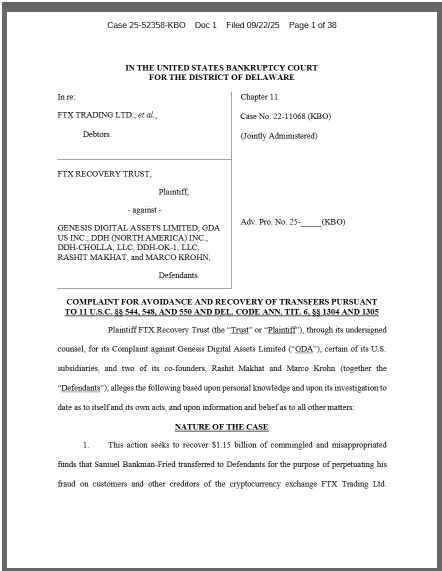
FTX Trust Sues Genesis Digital for $1.15B Clawback Over Alleged Fraudulent TransfersCourt Document (Source: Bloomberg Law)

Genesis Investment Timeline Reveals Systematic Fund Diversion

Court documents reveal that discussions between Bankman-Fried and Genesis Digital began in July 2021, when the Kazakhstan-based mining company was seeking capital to expand its operations into the United States.

Bankman-Fried joined Genesis Digital’s board in October 2021, according to Bloomberg, positioning himself to oversee what would become one of Alameda’s largest venture investments.

The complaint describes how the FTX founder caused Alameda to purchase multiple tranches of Genesis shares over an eight-month period, with the lawsuit characterizing Genesis as “one of Bankman-Fried’s most reckless investments with commingled and misappropriated funds.

Between August 2021 and April 2022, Alameda invested $1.15 billion across four distinct funding rounds: $100 million in August 2021, $550 million in January 2022, $250 million in February, and $250 million in April 2022.

The trust alleges that FTX insiders regularly caused Alameda to “borrow” billions from the FTX.com exchange to fund “profligate lifestyles and vanity investments” while hiding the source of these funds from investors and creditors.

Bankman-Fried resigned from Genesis Digital’s board one day before FTX filed for bankruptcy in November 2022, according to the court filing.

Mining Sector Faces Renewed Scrutiny Amid FTX Fallout

The Genesis Digital lawsuit is the latest effort by FTX’s bankruptcy estate to recover assets for creditors, with the trust having already distributed $6.2 billion across two previous rounds of payments.

The trust completed a $1.2 billion distribution in February, followed by a larger $5 billion payout in May, with an additional $1.6 billion distribution scheduled for September 30, bringing total recoveries to nearly half of the $16.5 billion earmarked for victims.

These recovery efforts come as Genesis Digital, which operates over 500 megawatts of mining capacity across 20 data centers on four continents, saw its valuation reach $5.5 billion during an April 2022 fundraising round shortly before cryptocurrency prices collapsed later that year.

The mining company was exploring an initial public offering in the United States as recently as July 2024, working with advisors to evaluate a potential listing and planning a pre-IPO funding round amid the crypto industry’s recovery from the 2022 market downturn.

However, the FTX lawsuit adds another layer of complexity to Genesis Digital’s corporate structure, which includes an extensive network of U.S. subsidiaries with names like Dog House TX-1, Mother Whale LLC, and White Deer LLC.

The complaint alleges that these U.S. subsidiaries operate as “alter egos” of the parent company, potentially exposing the entire corporate structure to clawback claims under both federal bankruptcy law and Delaware state fraudulent transfer statutes.

Meanwhile, Bankman-Fried continues to serve his 25-year prison sentence following his conviction on seven felony charges, with oral arguments for his appeal scheduled for November 4, 2025.

The lawsuit adds to the complex web of litigation following the $175 million settlement earlier this year with Genesis Global, a subsidiary of Digital Currency Group, as creditors and bankruptcy trustees pursue recovery efforts across multiple jurisdictions and corporate entities tied to the failed exchange.

면책 조항: 본 사이트에 재게시된 글들은 공개 플랫폼에서 가져온 것으로 정보 제공 목적으로만 제공됩니다. 이는 반드시 MEXC의 견해를 반영하는 것은 아닙니다. 모든 권리는 원저자에게 있습니다. 제3자의 권리를 침해하는 콘텐츠가 있다고 판단될 경우, service@support.mexc.com으로 연락하여 삭제 요청을 해주시기 바랍니다. MEXC는 콘텐츠의 정확성, 완전성 또는 시의적절성에 대해 어떠한 보증도 하지 않으며, 제공된 정보에 기반하여 취해진 어떠한 조치에 대해서도 책임을 지지 않습니다. 본 콘텐츠는 금융, 법률 또는 기타 전문적인 조언을 구성하지 않으며, MEXC의 추천이나 보증으로 간주되어서는 안 됩니다.
