

TalkSign: Edidiong Ekong just wanted to talk to friends; now he is using AI to bridge the silence

On most afternoons, it looked like any other childhood. Children gathered outside, turning sand into makeshift houses, laughter carrying easily between them. But for one boy, something did not quite fit. He could see and play with his friends, yet when it came to speaking, there was a quiet wall he could not cross.
Three of his closest friends were deaf.
At nine, he did not yet have the language to describe exclusion or accessibility. What he felt instead was simpler and sharper: he could not fully connect with the people he cared about. So he made a decision that would quietly shape the rest of his life.
“I told my parents I wanted to learn sign language because I wanted to be able to speak with them,” Edidiong Ekong tells me during the interview.
His parents agreed. What began as a child’s attempt to belong soon became something deeper. By twelve, he was fluent, signing at events and even teaching others. Over time, he moved comfortably between two worlds, one spoken, the other signed, while staying closely connected to the deaf community.
That proximity would later define everything he chose to build.
TalkSign: From belonging to building
Founded in November 2025 by Edidiong Ekong and Kazi Mahathir Rahman, TalkSign, an AI startup building tools for real-time communication between deaf and hearing individuals, converting American Sign Language into speech and text in under 100 milliseconds.
The company sits at the intersection of artificial intelligence and accessibility, combining research and product development to tackle a problem that has long been overlooked.
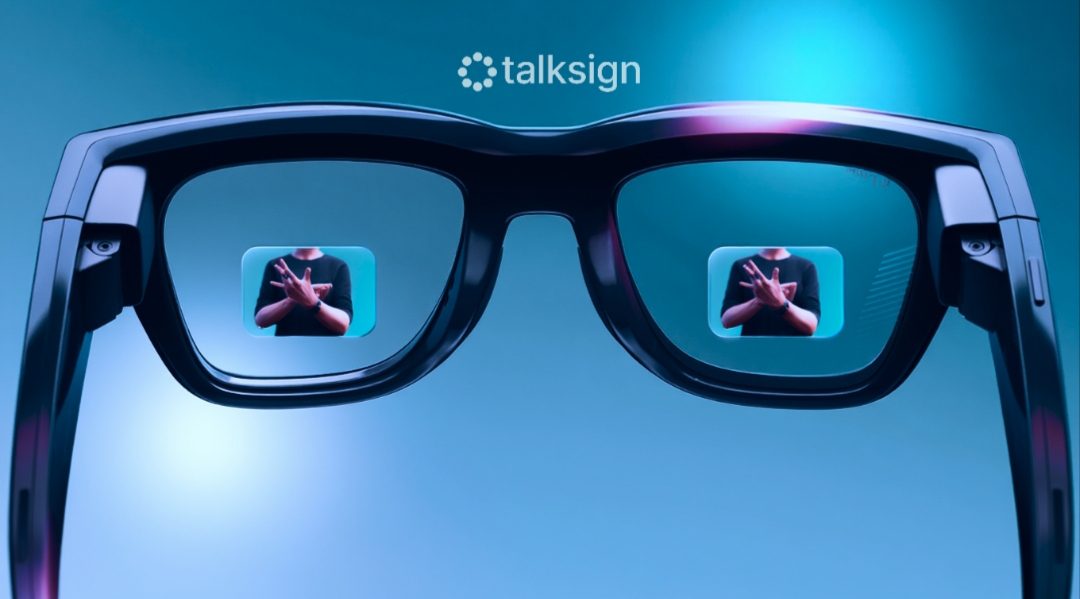 TalkSign Smart glasses
Before TalkSign, Ekong spent years working across startups and growth-focused companies, helping scale products and drive revenue across different markets. But TalkSign marks a shift in direction, from building for growth to building for impact. At its core, the company is trying to answer a question he has been circling since childhood: What would it take to make communication truly accessible?
For many people, communication is invisible because it simply works. You enter a hospital, articulate your symptoms, and anticipate comprehension. You hear an announcement at the airport and adjust. You speak in meetings and assume others will follow.
For the over 430 million people worldwide are deaf or hard of hearing and 70 million people those same moments are anything but simple. A deaf patient in a hospital may struggle to explain pain clearly.
An interpreter might not be immediately available, and even when one is, critical details can be lost in translation. “A lot of information is lost,” Ekong explains, especially in high-stakes environments like healthcare.
The same friction appears in quieter, everyday situations. A flight announcement changes without warning.
A workplace conversation moves too quickly to follow. A qualified candidate is overlooked because communication feels like too much effort. These are not isolated incidents; they are patterns that shape access to opportunity, often in ways that remain invisible to everyone else.
Redesigning the environment
Years later, that early awareness returned in a more concrete form. During a meeting, Ekong watched a deaf participant rely entirely on captions to follow the conversation. It worked, technically, but something about it felt incomplete.
That moment stayed with him. He began to frame the problem differently, asking not just how individuals could adapt but how the environment itself could change.
“How do we modify the environment to support accessible communication? And how do we empower individuals with the tools that make communication easy?” he says.
Those questions became the foundation for TalkSign.
Fundamentally, TalkSign is designed to enable real-time communication between deaf and hearing individuals. The idea is straightforward: translate speech into sign language and sign language back into speech as naturally as possible.
The execution, however, is far more complex. The system combines mobile processing, a set of AI models, and smart glasses that project translations directly onto the lens. One model converts speech into sign language, while another translates sign back into spoken words.
Together, they aim to remove the need for intermediaries and allow direct interaction.
 TalkSign co-founders
“The goal is to allow people who cannot hear or talk to communicate in real time without barriers,” Ekong explains.
In practice, this could reshape a wide range of situations. A doctor and a deaf patient could communicate without waiting for an interpreter. A workplace meeting could include everyone seamlessly. Even something as routine as watching a film could become more immersive, with sign language appearing alongside the content.
Building with the Community
Building this is not as simple as applying existing AI models. Sign language is not universal; it varies across regions, cultures, and communities. Datasets are limited and often fragmented, which makes accuracy difficult to achieve at scale. Even now, the system is still evolving.
“We don’t think we’ve got to 100% accuracy. It’s nowhere near,” he admits, noting that improvement will depend heavily on continuous data collection and collaboration with deaf communities.
That collaboration is central to the approach. Rather than building in isolation, the team works directly with deaf users to validate and refine the system. Their feedback shapes how the models are trained and how the product evolves.
At the same time, the technology must function in imperfect conditions. In regions with unreliable internet, TalkSign is designed to process data on-device, allowing it to work offline when needed. This becomes especially important in markets like Nigeria, where connectivity cannot always be assumed.
Bridging the perception gap
Beyond the technical challenges, there is a more subtle barrier: perception. People tend to underestimate problems they have never experienced. Without firsthand exposure, the communication gap between deaf and hearing individuals can seem abstract or even negligible.
“Most people still don’t understand,” Ekong says, “because they haven’t experienced it firsthand.”
 TalkSign
That gap in understanding affects everything from hiring decisions to product adoption. Employers hesitate to bring in deaf talent, not because of ability, but because communication feels uncertain.
Systems remain unchanged because the urgency is not widely felt. And yet, when people do encounter it up close, the perspective shifts quickly.


추천 콘텐츠

CME Group to launch Solana and XRP futures options in October

Q2 Market Insights: Bitcoin regains dominance in risk-averse environment, ETFs remain critical to market structure
